Robots Are Actually Working Now
100 megawatts. That's the size of the solar farm that Maximo – a robotics company incubated within energy giant AES Corporation – just completed using an autonomous robot fleet. Not a demo. Not a prototype. A commercial-scale solar installation that powers roughly 20,000 homes, built by robots.
NVIDIA used National Robotics Week (first week of April) to showcase where Physical AI stands today. The short version: it's no longer a lab exercise. Robots are pulling weeds on real farms and building real power plants.
What "Physical AI" Actually Means
When most people think AI, they think ChatGPT or image generation – software that lives inside screens. Physical AI extends that into the real world. It combines a robot's eyes (cameras), brain (AI models), and hands (manipulators) to perceive, reason, and act in physical environments.
The hard part: the real world is vastly more complex than the digital one. If ChatGPT gives a bad answer, you ask again. If a robot installs a solar panel wrong, that's millions of dollars in damage. That gap between digital and physical is what makes Physical AI so challenging.
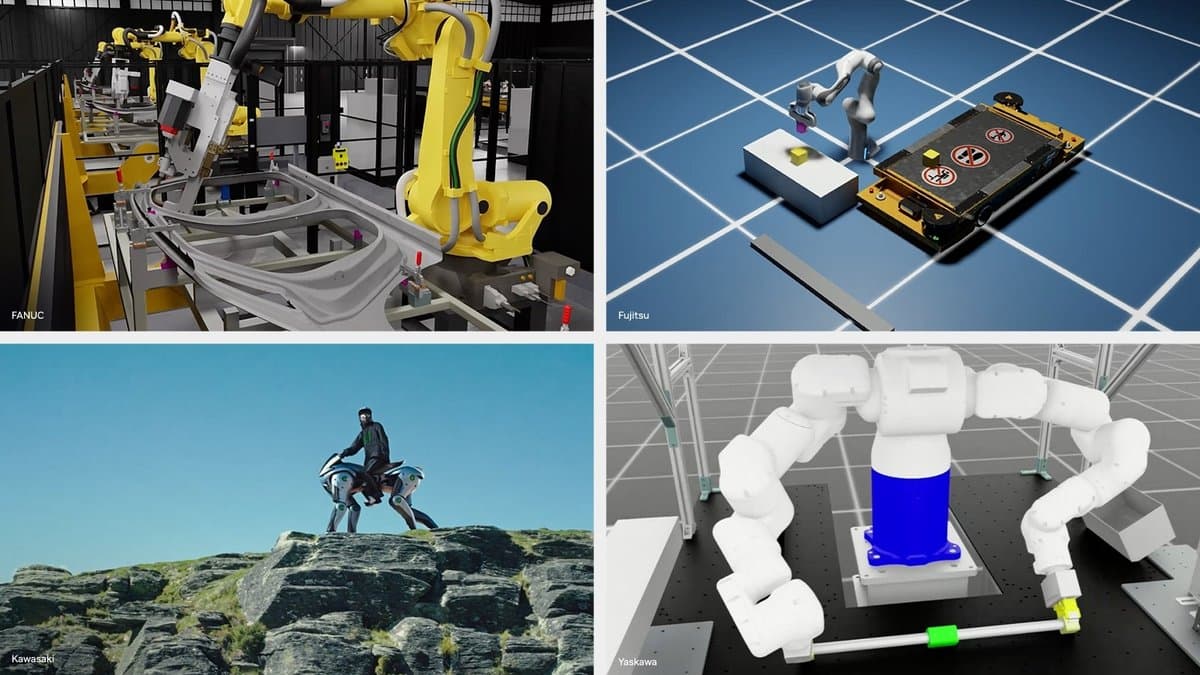
NVIDIA's approach is "simulation first." Instead of deploying robots directly into the real world, they train in Omniverse – a physics-accurate virtual environment – for hundreds of thousands of iterations before ever touching real hardware.
| NVIDIA Physical AI Stack | Role |
|---|---|
| Omniverse | Physics simulation environment |
| Isaac Sim | Robot training simulator |
| Isaac ROS | Robot OS framework |
| Foundation Models | Robot behavior base models |
| GPU Accelerated Computing | Training + inference hardware |
The Robots in the Field
Aigen: Solar-Powered Weed Killers
Aigen builds autonomous agricultural robots powered by solar panels. What they do sounds simple but is genuinely revolutionary: they roam fields, use vision AI to identify weeds, and physically remove them with precision.
Why this matters: weed control in agriculture relies overwhelmingly on chemical herbicides. The US alone spends billions annually on herbicides, causing soil contamination and ecosystem damage. Aigen's robots remove weeds mechanically – no chemicals needed. They're on the front line of agriculture's push to go chemical-free.
Maximo: The Robot Fleet That Built a Power Plant
Maximo recently completed a 100-megawatt solar installation using its autonomous robot fleet. In industry terms, that's "utility scale" – real infrastructure connected to real power grids, not a demonstration project.
The robots were developed using NVIDIA accelerated computing, Omniverse libraries, and the Isaac Sim framework. They trained in virtual environments hundreds of thousands of times before being deployed to the field.
The solar installation industry faces chronic labor shortages. Maximo's achievement proves that robots can be a practical solution, not just a theoretical one.
Why Robots Are Surging Now
Three forces are converging in 2026.
First, AI model performance has reached "good enough for the real world." Vision AI now works reliably in outdoor, unstructured environments. Planning AI can handle complex sequential actions.
Second, simulation technology has dramatically narrowed the gap between virtual training and real-world performance. The maturation of "sim-to-real transfer" – training in simulation, deploying in reality – has removed the biggest bottleneck for commercial robotics.
Third, labor shortages. Agriculture, construction, and energy face persistent worker shortfalls. Robots aren't just about cost reduction anymore – they're the answer when you literally can't find enough people.
What This Means for You
For most consumers, robot-built solar farms and autonomous weed pullers are invisible. But for industry, the implications are immediate.
For farmers, chemical-free weed control is becoming a real option. For the energy sector, autonomous installation addresses the labor bottleneck that's slowing the renewable energy buildout. For robotics developers, NVIDIA's Omniverse-Isaac Sim stack is solidifying as the de facto industry standard.
When Jensen Huang declared the "era of Physical AI" at GTC 2026, it sounded like marketing. National Robotics Week showed receipts: robots are actually in fields pulling weeds and on sites building power plants. The era isn't coming – it's here.