Three State AI Bills Landed in a Single Week
The federal government is quiet. State legislatures are not.
Between April 10 and 13, 2026, three states each advanced or passed distinct AI regulations. Nebraska passed LB 525, which includes the Conversational AI Safety Act for minors. Maryland advanced HB 895, restricting algorithmic personalized pricing by food retailers. Maine approved LD 2082, banning unlicensed AI-based therapy. Law firm Troutman Pepper Locke's April 13 update tracked 42 separate AI-related state bills moving nationally in that single week.
This isn't gradual policy drift. Absent a federal AI framework, every state is writing its own interpretation simultaneously. The same chatbot now carries specific disclosure obligations in Nebraska, can't make therapy claims in Maine, and in Maryland can't use consumer-surveillance data to set prices. For companies, three bills in a week means your compliance team is now branching by state.
Compare this to the EU AI Act, which took effect in August 2024 and imposed one harmonized baseline across 27 member states. The US is sprinting in the opposite direction — toward 50 different regulatory regimes.
What Changed — Before vs. After
Here's the concrete change each law introduces, mapped from the actual statutory text.
| Area | Before (through 2025) | After (April 2026+) | Source Law |
|---|---|---|---|
| Chatbots + minors | No legal obligation to disclose AI identity | Must display persistent "chatting with AI" disclosure or re-notify at session start and every 3 hours. Engagement rewards for minors banned. Suicide/self-harm prompts must trigger a crisis-service response protocol. | NE LB 525 (Conversational AI Safety Act) |
| AI price discrimination | Food retailers free to run dynamic pricing algorithms | Dynamic pricing using consumer surveillance data is prohibited (food retail) | MD HB 895 |
| AI therapy | Unlicensed AI-based mental health services allowed | Prohibits any person from providing, advertising, or offering AI-based therapy without a licensed professional. Clinical AI use banned; administrative use only. | ME LD 2082 |
These three matter because they mark a shift from generic "transparency and fairness" principles to specific industry + specific capability prohibitions. The era of "AI regulation in the abstract" is over; the era of "chatbot + minor + crisis response" is here.
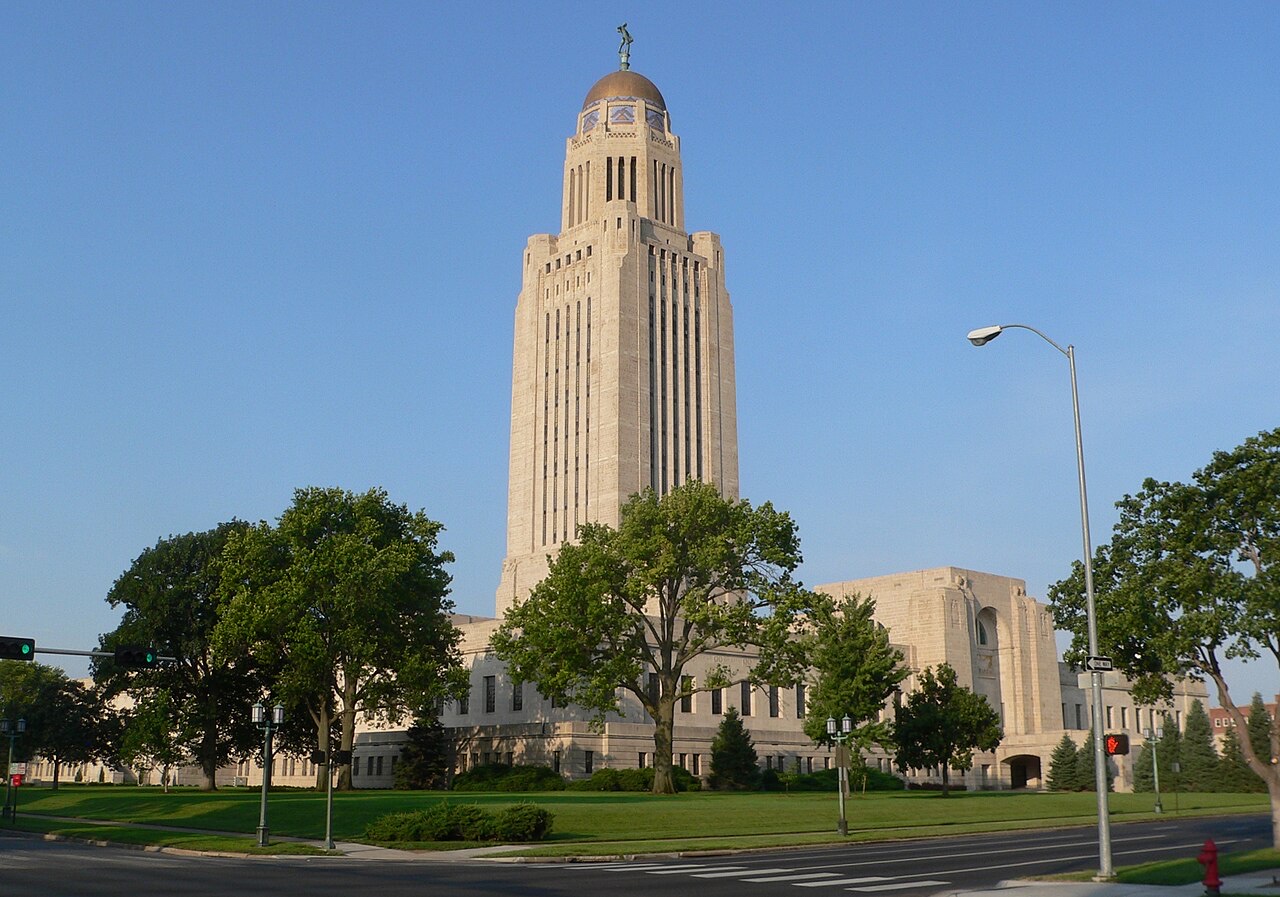
Nebraska's law is particularly detailed. Beyond disclosure, it prohibits chatbots from representing themselves as designed to provide professional mental or behavioral health care. This language reaches directly into companion chatbot products like Character.AI and Replika. Violations are enforced by the state attorney general.
 Source: commons.wikimedia.org · CC BY-SA
Background — Why Everything Landed at Once
Three triggers collided.
First, the federal AI framework gap is still wide open. Congress filed multiple AI bills through 2025 — SAFE AI Act among them — but none passed. The post-Biden administration rolled back major portions of the existing AI executive order in early 2026, weakening federal oversight further. States filling a federal vacuum is classic American federalism — the same pattern that produced CCPA in California and then spread state-by-state through privacy law.
Second, 2025 produced visible consumer harm. Multiple US and UK cases reported teenagers completing suicide after long chatbot interactions. MIT and Harvard research published in late 2025 showed supermarket AI pricing algorithms quoted higher prices to residents of lower-income zip codes. These stories gave state legislators direct, narratable motivation to act.
Third, politics. With midterm elections in November 2026, state lawmakers want visible wins. State legislatures, which move faster than Congress, are the perfect stage for turning a specific AI harm story into legislation. "A chatbot hurt a constituent's child" is a bipartisan message.
Impact on Each Stakeholder
Companies
Large companies and startups face opposite realities.
Big tech absorbs it organizationally. Google, Meta, OpenAI, and Anthropic already run per-state and per-country compliance engineering teams. Adding Nebraska's chatbot disclosure requirement is a JSON config change. Maryland's pricing rule only applies to food retail. Maine's therapy ban only affects a handful of products. For the scaled platforms, the marginal cost is real but absorbable.
For startups it's existential. Stanford HAI's 2025 report pegged average compliance spend at 4–8% of operating costs for US AI startups, with projections of 7–15% by late 2026. Outside legal counsel alone can run $150K–$500K per state. For seed-stage companies this is lethal. The practical statement is blunt: "If your AI companion startup serves five states, you need lawyers."
The middle tier (Series B–C) is in the worst position. Not enough budget for a proper legal org, too much scale to just stop shipping. This is why 2026 is expected to see a wave of mid-market M&A — companies that can't absorb compliance costs getting rolled up into platforms that can.
Users and Developers
User experience is now bifurcating at state lines.
A teenager in Nebraska using Character.AI will see a persistent "You're chatting with an AI" banner with renotifications every three hours. A Maine resident wanting AI-based features from a therapy platform will only get them under the supervision of a licensed clinician. A Marylander using a food delivery app won't see prices raised based on their zip-code income profile.
Developers need to prepare for two shifts. First, geographic feature gating (geofencing). Infrastructure to toggle capabilities per state is no longer optional. Second, audit logs and transparency documentation. Nebraska's law obligates chatbot operators to maintain records proving their crisis-response protocols exist and work. "Add trust features later" doesn't fly — this has to be in the foundational architecture.
 Source: commons.wikimedia.org · CC BY-SA 3.0
Compliance Costs — Concrete Estimates
Per-state direct and indirect costs roughly break down as follows. The figures below are industry estimates drawn from published AI-compliance benchmarks by Troutman Pepper Locke, DLA Piper, and Akin Gump in late 2025.
| Item | Startup (10–50) | Mid (100–500) | Enterprise (1,000+) |
|---|---|---|---|
| Initial legal review (per state) | $15K–50K | $50K–150K | $150K–500K |
| Product engineering (per state) | $20K–100K | $100K–300K | $300K–1M |
| Ongoing monitoring (annual) | $100K–300K | $500K–1.5M | $2M–5M |
| Violation penalty range (per state) | $500–10K/violation | $10K–100K/violation | Cumulative $1M+ |
| Compliance headcount (FTE) | 0.2–0.5 | 2–5 | 10–30 |
The US Chamber of Commerce estimated that AI compliance fragmentation will impose $12–20 billion in total incremental costs on the US AI industry during 2026. More than half of that is "adapter cost" — the engineering to reconcile conflicting state requirements.
The biggest trap isn't the penalty; it's the launch delay. Waiting on per-state legal review before shipping an AI feature can burn 3–6 months. "Ship fast and capture the market" does not hold up under state-level regulation.
Other Jurisdictions Compared — EU / US / China / UK
The same AI chatbot service, deployed across four jurisdictions, operates under dramatically different regimes.
| Jurisdiction | Framework | Approach | Enforcement | Max Penalty |
|---|---|---|---|---|
| EU | EU AI Act (in force 2024) | Risk-based, unified regulation | EU AI Office + member states | 7% of global turnover or €35M, whichever higher |
| US (federal) | No omnibus framework, sectoral patchwork | None | FTC, SEC, CFPB each separately | Varies by agency |
| US (states) | 50 state legislatures independently | Fragmented | State attorneys general | Varies (e.g., NE up to $500K/violation) |
| China | Generative AI Services Rules (Aug 2023) | Pre-approval + content review | Cyberspace Administration of China | Service suspension, license revocation |
| UK | AI White Paper (2023) | Sector regulator delegation | ICO, CMA, FCA independently | £17.5M or 4% turnover |
The starkest contrast is between the EU and the US. EU AI Act classifies every AI system by risk tier and layers obligations (conformity assessment, data governance, cybersecurity) onto high-risk systems. The US layers partial state regulations on top of each other with no harmonized assessment framework.
A US AI company serving the EU follows one law. A US AI company serving all 50 US states chases 50 laws with state-by-state engineering branches. Paradoxically, US-domestic operation is becoming more complex than EU market entry.
Industry Response + Litigation
The industry split two ways.
The first thread: unified federal law. Anthropic's Dario Amodei, OpenAI's Sam Altman, and Meta's Mark Zuckerberg have repeatedly called for a single federal AI framework in Congressional testimony and interviews over the past six months. The stated motivation is safety and innovation; the practical driver is 50-state compliance cost. Ironically, these same executives strongly opposed the EU AI Act — but in the US they want regulation harmonized, not killed.
The second thread: constitutional challenges. NetChoice (big tech coalition) is already suing California's AI transparency law (SB 942) and Texas's AI liability law on First Amendment grounds. Nebraska's LB 525 is a likely next target. The core legal question: does mandating a chatbot's crisis-response obligation constitute compelled speech?
A third thread, less expected: some startups are actively welcoming regulation. Safety-focused players (Anthropic, Inflection-lineage teams) see clear rules as competitive advantage. Early investment in safety and compliance becomes a moat once regulation arrives.
What This Means for You
For consumers, AI service experience is now splitting at state lines. "California version" and "Texas version" of the same AI app will become common. Sensitive capabilities (mental health, children, pricing) in particular. Even users in other countries VPN-ing into US services may hit state-gated experiences without realizing it.
For AI startup founders, three decisions matter. First, which states to launch in. "The US" is no longer the unit of launch — "California only" or "these 15 states" now is. Second, how early to invest in compliance architecture. Feature flags + geofencing are foundational stack, not optional. Third, when to budget legal. Securing $200K–$500K in outside counsel before Series A is what separates companies that can scale fast from those that can't.
A unified federal law is plausible in 2–3 years. But by then, companies will have sunk significant capital into state-by-state compliance, and any federal law will likely land at the common-denominator level of the strictest state laws. The work you do today isn't wasted — but regulatory fragmentation will remain a design constant for AI products through at least 2030.
References
- Troutman Pepper Locke: Proposed State AI Law Update — April 13, 2026
- Transparency Coalition: Guide to Nebraska AI Chatbot Safety Bills LB 939 and LB 1185
- Nebraska Unicameral Update: Ag privacy bill amended to include AI protections (LB 525)
- Nebraska Unicameral Update: AI protections for minors approved
- Maryland Daily Record: Care must be taken to prevent discrimination by AI
- Transparency Coalition: AI Legislative Update — April 10, 2026
- EU AI Act — Official Portal