4,000 → 0. The half-life of Google internal protest, Maven edition
Back in 2018, roughly 4,000 Google employees signed a letter demanding the company walk away from Project Maven, a Pentagon drone-footage analysis contract. That petition pushed Sundar Pichai to pull out of Maven and publish the "Google AI Principles," pledging not to build AI for weapons or mass surveillance. Eight years later, April 16, 2026, The Information broke a different kind of story.
Alphabet is negotiating a contract with the US Department of Defense to deploy Gemini AI inside classified environments.
No petitions this time. No reversals. Google has been shipping Gemini for Government into the Pentagon's unclassified GenAI.mil platform since December 2025, and it's now pushing into the air-gapped classified networks. Project Maven was an anomaly. This deal is the new baseline.
Who the parties are: Alphabet and the US Department of Defense
Alphabet, Google's parent, is a $350B-revenue holding company with 180,000 employees in 2025. Ads still drive most revenue, but Google Cloud crossed a $50B annual run rate in 2025 and has become the growth engine. Gemini, now in its 3.0 generation, is one of the "big four" frontier AI systems alongside GPT-5, Claude Sonnet 4.5, and xAI's Grok 4.
The company's AI ethics posture has shifted steadily since 2018. In early 2025, Google quietly softened the "no weapons, no mass surveillance" language in its AI Principles into more abstract governance commitments. In 2024, Google fired around 50 employees who protested Project Nimbus (a cloud deal with the Israeli government). The message to staff: the cost of ethics-based protest has gone up, and the internal machinery that blocked Maven in 2018 has been systematically weakened.
The US Department of Defense spends roughly $850B a year and is one of the largest single IT buyers on the planet. AI procurement is coordinated by the Chief Digital and AI Office (CDAO). In December 2025, the DoD launched GenAI.mil, an enterprise AI platform. Undersecretary Emil Michael framed the moment this way: "for the first time ever, three million employees, warfighters, contractors, are going to have AI on their desktop." The Pentagon's sourcing question has shifted from "which vendor do we pick?" to "how do we design a common contract template that every frontier vendor can sign?"
The Google-DoD relationship has gone through a collaborate-rupture-reconverge cycle. Maven in 2017, Google exits in 2018. Google re-enters with JWCC (Joint Warfighting Cloud Capability) in 2021 as one of four cloud vendors on a $9B ceiling deal. This classified Gemini agreement is the deepest point in that reconvergence.
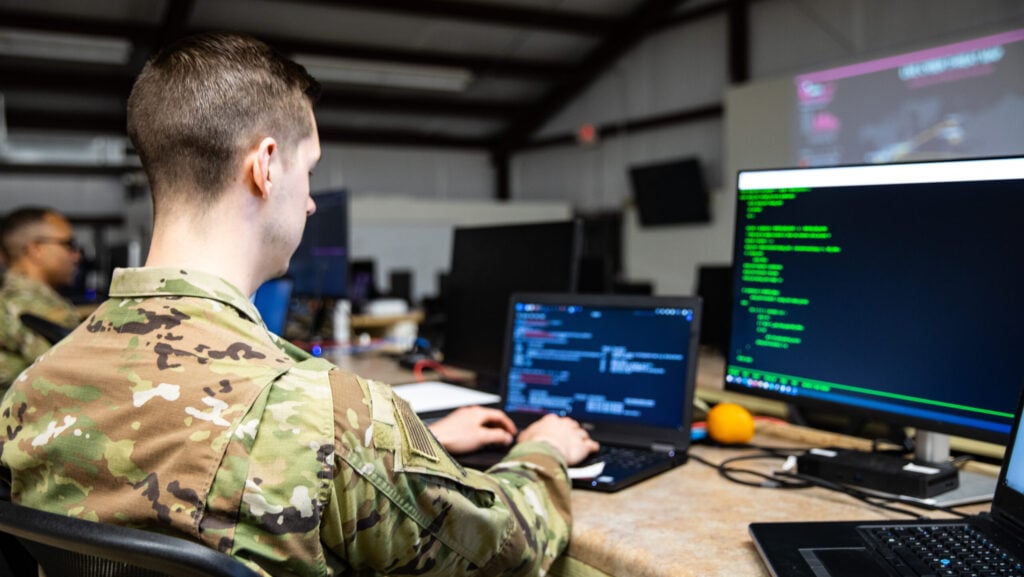 Source: breakingdefense.com · US DoD DVIDS public domain
Deal structure – terms, price, duration, exclusivity
The unusual thing about this deal is that neither the price nor the duration has been publicly disclosed. What's reported is the shape of the terms. Google is proposing Gemini for "all lawful uses" by the DoD, with two carve-outs explicitly written into the contract.
| Item | Disclosed terms |
|---|---|
| Negotiation disclosed | April 16, 2026 (via The Information) |
| Scope | Full Gemini model family, including classified environments |
| Carve-out 1 | Autonomous weapons — prohibited without "appropriate human control" |
| Carve-out 2 | Domestic mass surveillance — prohibited |
| Exclusivity | Non-exclusive — Pentagon has parallel deals with OpenAI, Anthropic, xAI |
| Infrastructure | Expected to run on Google Cloud's IL-6 (Top Secret) accredited regions |
| Reference deal | OpenAI accepted the same terms in its early 2026 Pentagon contract |
The "non-exclusive" line is the interesting part. The Pentagon already has multi-hundred-million-dollar ceiling contracts with OpenAI (a $200M Chief Digital and AI Office deal in late 2024), Anthropic (via the Palantir-AWS stack for classified Claude), and xAI. If Google signs, all four frontier vendors are inside Pentagon infrastructure under essentially the same commercial rules.
The probable deal size, based on the OpenAI $200M ceiling as reference and Google Cloud's existing JWCC allocation, is multi-year and in the low-to-mid nine figures. That's not huge by Alphabet revenue standards. But the symbolic weight is outsized: providing the model itself inside classified environments is a level of delegation way beyond infrastructure hosting.
What each side gets
For Alphabet, three clear levers. First, classified market entry. This is a market with brutally high barriers that, once entered, lock you in for decades – the AWS-CIA-GovCloud pattern from 2013 is the template. Second, production-grade defense validation for Gemini. A model certified for IL-6 environments carries directly into allied-government and intelligence-agency sales pipelines globally. Third, Google Cloud valuation defense. Wall Street has been pricing in slower Cloud growth vs. AWS and Azure; large-ticket government deals rebuild that thesis.
For the Pentagon, the headline benefit is vendor diversification plus negotiating leverage. Internally, DoD leaders have flagged concern that OpenAI's footprint inside the department was growing unbalanced. Bringing Google, Anthropic, and xAI in under matching terms spreads vendor risk and creates real procurement competition on price and feature. Even better, model specialization becomes usable – Claude for long-context analysis, GPT for general reasoning, Gemini for multimodal and Google-Search-integrated tasks, Grok for real-time X-feed signals – so workflows can be model-matched.
Both sides share a lesser-discussed joint benefit: they get to set the AI governance template. The moment a DoD contract ships with "no autonomous weapons without human control" and "no domestic mass surveillance" as signed commitments, those same clauses can be waved at enterprise deals, allied-government contracts, and EU AI Act negotiations. Federal procurement ends up writing the de facto civilian AI ethics standard – a strange inversion of how these things usually propagate.
 Source: commons.wikimedia.org · CC BY-SA 2.0
Past partnerships that worked – and one that didn't
Big Tech deals with the Pentagon have sorted into three piles.
Success 1 — AWS-CIA (2013, $600M). The contract that opened government cloud. It made AWS GovCloud the default for national-security workloads and laid the rails for JEDI and JWCC. Lesson: classified entry is slow but, once achieved, reshapes the market for a generation.
Success 2 — Palantir-US Army Vantage (2020). A data integration platform that began as a pilot and grew into hundreds of millions in annual revenue. The deep embed into Army operations – not the initial price tag – is what created enduring value. Lesson: what matters five years in isn't the headline number, it's how deep the vendor gets into actual workflows.
Failure — Google Project Maven (2017–2018). Google won a drone-footage analysis contract, then pulled out a year later under pressure from the ~4,000-signature protest. The DoD took a real hit – there weren't ready substitutes – and Google published the AI Principles to formalize its retreat. Lesson: if a vendor's internal culture isn't prepared to hold a defense contract, the contract itself collapses. The 2026 Gemini deal is Google explicitly redesigning its culture to not reproduce 2018.
One borderline case is worth flagging: Microsoft-US Army IVAS ($22B, HoloLens-based). Signed in 2021, but hardware issues and user complaints forced a 2024 restructure. Lesson: a massive contract is not self-validating. If frontline utility doesn't show up, any dollar figure can come undone. Gemini/Pentagon will face the same stress test once actual usage metrics start leaking.
Competitor counter-plays
OpenAI plays the incumbency card. Sam Altman publicly asked the DoD to "offer every frontier AI company the same terms" – a move that looks generous but effectively opened the door for Google. It was probably deliberate: single-vendor dominance is politically unsustainable, so OpenAI would rather set the standard it already meets and then win on performance and price. Expect OpenAI to pour its energy into infrastructure scale (the Stargate-tier data center push) rather than bespoke defense features.
Anthropic's reaction is the most delicate. Newsweek specifically framed Gemini's move as happening "after the Anthropic fallout." Anthropic has been publicly commercial-first and cautious about deep defense integration, partly because that posture is tied to its safety-oriented brand. Watching Google accept the same terms will intensify an internal debate: hold the defensive line or match the terms? Where Dario Amodei draws the line in the next two quarters is the thing to watch.
xAI is organizationally the most naturally aligned to Pentagon work – Musk's overlapping ties to SpaceX, Starlink, and Palantir make defense integration a natural extension. Grok 4's real-time information processing is an obvious fit for battlefield intelligence, and industry chatter around such use cases is already active. Given Musk's political position, xAI's play is less a counter-move than a move. The open question for H2 2026 is what differentiated value xAI brings to the four-way split.
Chinese counterparts – DeepSeek, Qwen, Kimi – can't counter here directly. But the PLA's domestic AI program is building the mirrored "other standard," and over the next two to three years the global AI governance question becomes: will non-US, non-China governments adopt the Pentagon template or the Beijing template?
What changes for whom
For Gemini commercial customers, very little changes directly. Classified deployments run on fully isolated air-gapped IL-6 infrastructure, separate from the commercial API pipeline and with a different weight-management path. Indirectly, Google gains a "defense-grade validated model" marketing angle that will show up in enterprise sales alongside SOC2 and HIPAA – real buying influence, even if the substance is upstream.
For AI policy people, the moment is big: federal procurement is now the lead drafter of AI ethics standards. The DoD template's two carve-outs (autonomous weapons, mass surveillance) overlap substantially with EU AI Act high-risk categories, which means US and EU regulation is starting to converge at the contract level. The same template will likely propagate to Korean, Japanese, and Australian government deals over the next 18 months. That's a real inflection point for global AI governance.
For Google engineers and researchers, it's a career fork. In 2018, the assumption was "sign the letter, the company pulls out." In 2026, the company has been restructured in advance to prevent that. Expect ethics-oriented talent to keep migrating to Anthropic or smaller labs through 2026–2027, with the counter-flow being ex-DoD and ex-IC professionals joining Google. The center of gravity of who's inside Google shifts.