
warpdotdev/warp — Rust Modern Terminal Goes Open Source, 51K Stars in Days
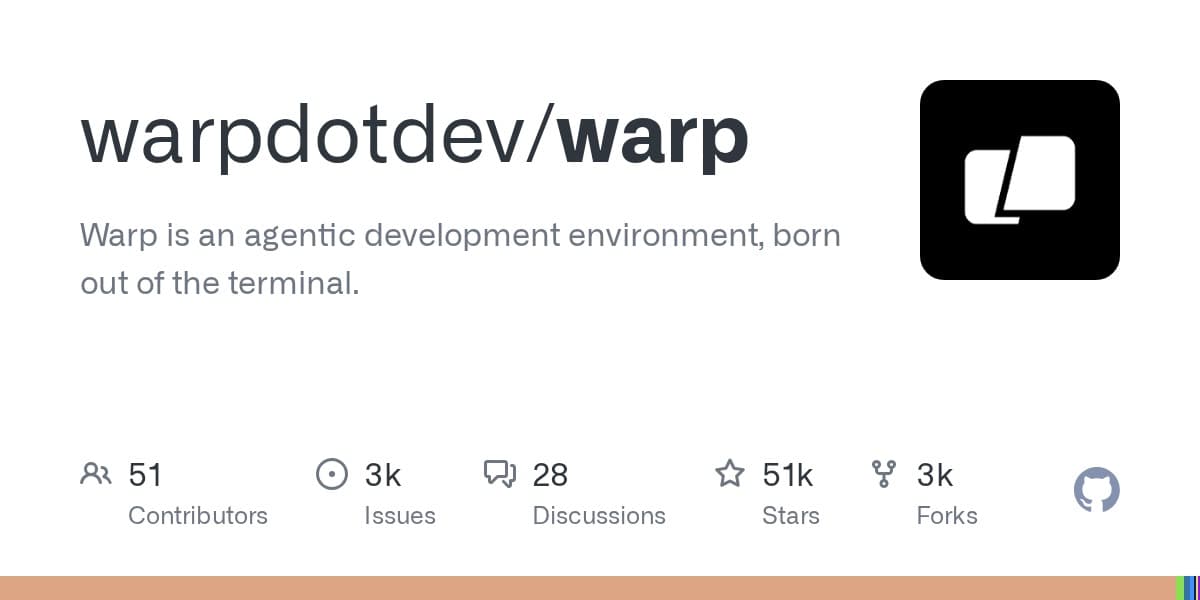
Warp opened up its Rust terminal client April 28. 35K stars in 24 hours, 51K+ by May 2. The story is the business pivot — OSS client, premium cloud layer 'Oz' — and the bet that the terminal is the native environment for agentic dev.
35K Stars in Day One
On April 28, Warp flipped to OSS. Apache-2.0 client on GitHub, premium cloud product 'Oz' announced as the future revenue line. 35K stars in the first 24 hours, ~4,500/day pace, ~24,000 in the first week, sitting at 51K+ by May 2.
The pivot is the headline. Warp ran as closed-source SaaS since 2020 with ~$73M raised (Sequoia, GV). One Tuesday they released the entire client and re-positioned the business on a Cal.com-style "OSS client + cloud premium" model.
Background — Zach Lloyd's "Terminal in the 5G Era"
Warp CEO Zach Lloyd is ex-Google Sheets engineering lead and ex-Time Inc CTO. The 2020 thesis: terminals stalled in the 1980s; GPU rendering, block UI, and AI should reset them. The April 28 announcement quotes him directly: "Warp is no longer just a terminal — it's the agentic development environment born out of the terminal."
Two reasons drove the OSS move. One: with Cursor, Claude Code, Codex all heating up, a standalone terminal couldn't keep up as a separate business. Users finishing everything inside the IDE drained the standalone terminal value. Two: opening the client invites community throughput while letting Warp move the business one layer up onto Oz. The terminal becomes commodity OSS; the cloud layer pays the bills.
Core — Block UI + Embedded AI Agent
The signature feature is the block-based command UI. Classic terminals stream commands and output as text; Warp groups each command into a block — searchable, shareable, replayable, GUI-quality. It's the biggest shift to terminal UX in decades.
AI agent integration generates shell commands from natural language, suggests fixes on failed commands, and chains long sequences. With GPT-5.5's OSWorld 56% landing the same week, the picture clicks: the terminal is the native environment for the agent. Warp open-sourced that environment.
GPU-accelerated rendering puts Warp in Alacritty's category by primitives, but Alacritty is minimalist OSS while Warp is full-feature IDE-grade. Remote SSH speed is striking — client-side rendering plus input prediction.
git clone https://github.com/warpdotdev/warp.git
cd warp && cargo build --release
./target/release/warp
Stack + Architecture
Rust + Tauri-like shell + GPU rendering + block UI. Rust because terminal latency over 50ms is felt instantly; Tauri-like shell because Electron's 200-400MB resident memory is a non-starter for a terminal (Warp sits at 50-80MB). The agent runs through client-side inference hooks, with BYOK across Anthropic, OpenAI, and local Ollama.
Compete Set
| Project | Language | UX | AI integration | Business model |
|---|---|---|---|---|
| warpdotdev/warp | Rust | Block UI + IDE-grade | Built-in + BYOK | Oz cloud premium |
| wezterm/wezterm | Rust | Classic + GPU | External | OSS only |
| alacritty/alacritty | Rust | Minimalist GPU | None | OSS only |
| anthropic/claude-code | TS | CLI + agent | Native | Anthropic sub |
Warp's wedge is the three-way: agent integration + IDE-grade UX + OSS. WezTerm is closest by category but punts AI to external tools. Alacritty is minimalist on purpose. Claude Code is on a CLI track.
Why Now
Three currents merged in one week. One, GPT-5.5's OSWorld 56% put "AI directly using a computer" past a threshold, and the terminal is that environment's native habitat. Two, Cursor reportedly negotiating a $50B round confirmed how hot IDE-adjacent categories are; Warp's OSS pivot bets on a different cut of the same market — integrated env vs. IDE-only. Three, six months of Claude Code reset the "CLI agent" pattern, and Warp's block UI lifts that pattern to GUI-grade.
The most-quoted HN comment: "I can't tell if this is an IDE or a terminal, and that's the point."
Getting Started + Pitfalls
Build: cargo build --release. First build pulls Rust deps, takes 5-10 minutes; output is 80-120MB. Two pitfalls: AI features need API key env vars (OPENAI_API_KEY, ANTHROPIC_API_KEY, WARP_AI_PROVIDER), and zsh/fish plugin compatibility is still rough on edge cases.
Limits and Outlook
Linux packaging is Ubuntu/Fedora-first; Arch and Alpine need manual builds. The roadmap issue #9233 covers a plug-in system and broader distro coverage in May-June. Long-term, Warp is a referendum on the "OSS client + cloud premium" model for dev tools — if Oz lands well, the pattern follows everywhere else.
Tomorrow Morning
Developers: build it and try one full workday on Warp instead of iTerm2 — within hours you know whether block UI changes how you work. AI users: plug in Anthropic via BYOK and try find files modified in last 7 days containing TODO as a single sentence — that's the OSWorld-56% threshold made tangible. Investors/founders: Oz launch (expected H2 2026) is the inflection. Track OSS client adoption quarterly until then.
References
- Repo: https://github.com/warpdotdev/warp
- Warp OSS announcement: https://www.warp.dev/blog/warp-is-now-open-source
- Roadmap issue: https://github.com/warpdotdev/warp/issues/9233
- WezTerm: https://github.com/wez/wezterm
- Alacritty: https://github.com/alacritty/alacritty
출처
관련 기사
Former GitHub CEO's Entire Redefines Git for the Agent Era
Git tracks what changed, but not why decisions were made. Entire introduces a checkpoint system that captures AI agent decision-making context alongside code changes.
Warp Open-Sources Its Terminal — The Real Product Is Oz, Its Cloud Agent Orchestrator
Warp open-sourced its terminal client on GitHub on April 28. UI crates under MIT, the rest under AGPL-3.0. The repo hit ~26k stars within hours. The real product is Oz, W
AI 트렌드를 앞서가세요
매일 아침, 엄선된 AI 뉴스를 받아보세요. 스팸 없음. 언제든 구독 취소.