microsoft/agent-framework — Semantic Kernel and AutoGen Finally Merged
Microsoft shipped 1.0 GA of agent-framework, the unified successor to Semantic Kernel and AutoGen. Python and .NET get identical APIs, graph-based multi-agent workflows, and direct Azure AI Foundry integration.
Semantic Kernel and AutoGen, finally one SDK
Microsoft's two agent frameworks — Semantic Kernel (C#/.NET first) and AutoGen (Python multi-agent research) — finally merged. Released as 1.0 GA on April 3, 2026, microsoft/agent-framework provides identical APIs in Python and .NET and standardizes graph-based multi-agent workflows. It crossed 10K stars by early May, with a steady 250 stars/day growth pattern.
Project background — why the two frameworks merged
Microsoft's LLM tooling started right after ChatGPT in late 2022. Sam Schillace's team built Semantic Kernel for Office 365 Copilot, .NET-first, around the Plugin + Planner + Memory triad. Microsoft Research's Chi Wang built AutoGen as a Python research framework around Conversable Agent + GroupChat for multi-agent collaboration studies.
The two frameworks were constantly compared inside Microsoft. Production teams used Semantic Kernel; research teams used AutoGen. Mark Russinovich (Azure CTO) acknowledged at Build 2025 that "merging the two was the most-requested change." A year later, the merger shipped as 1.0 GA.
Maintainer Eduardo Pinheiro and Stephen Toub (Distinguished Engineer, .NET) led the unified design. The pivotal decision was API parity — every pattern available in Python had to be available in .NET with the same name and signature. That's an alignment Microsoft had never attempted in any prior SDK pair.
Simon Willison's analysis frames the design choice as "Plugin + Planner subsumed into graph workflows, Conversable Agent simplified into ChatAgent." The merger took the best of both and built a new abstraction layer on top.
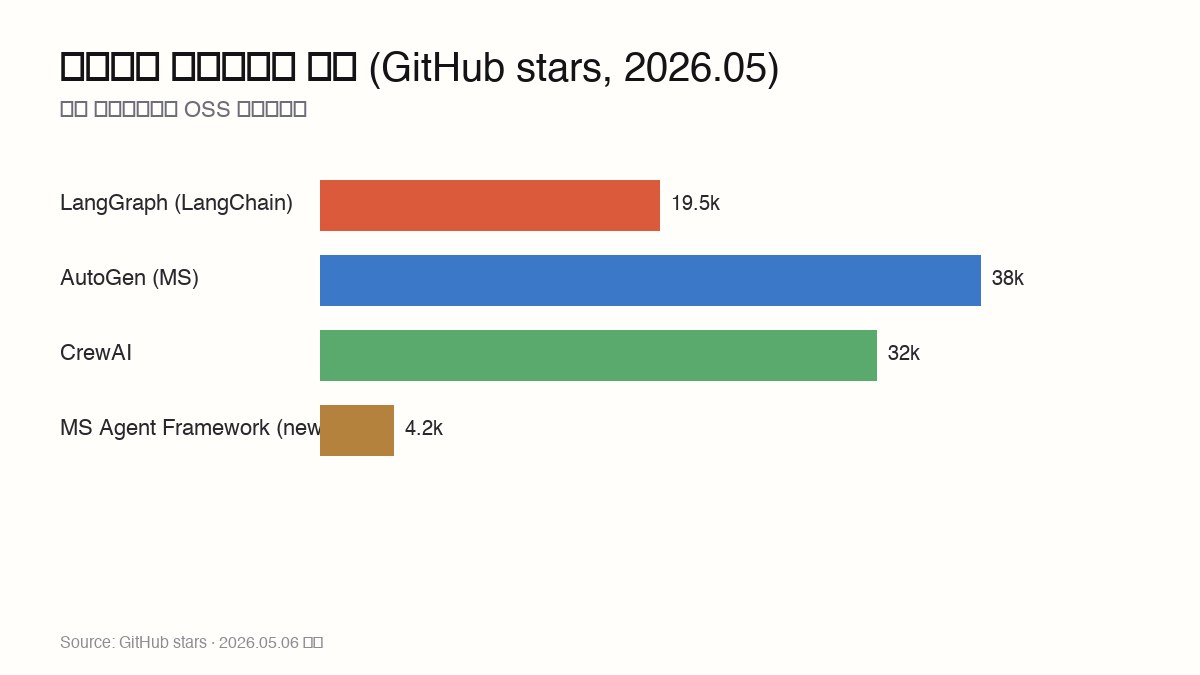 Source: spoonai chart · GitHub stars (May 6, 2026)
Core capabilities — graph workflows and four multi-agent patterns
The four built-in multi-agent patterns:
1. Sequential — agents pass work down a chain. A produces output, B picks it up, transforms it for C.
2. Concurrent — multiple agents process the same input in parallel from different perspectives, then merge.
3. Handoff — explicit control transfer. A "customer" agent handing off to a "billing" agent when the topic changes.
4. Group Collaboration — agents debate and converge on shared decisions. Direct AutoGen GroupChat heritage.
All four patterns compile to the same graph representation. Agents are nodes, message flow is edges, branching/looping/conditionals are graph operators. The execution shape resembles LangGraph but the same code runs identically in Python and .NET.
from agent_framework import ChatAgent, Workflow

writer = ChatAgent(name="Writer", instructions="Draft the article.")
editor = ChatAgent(name="Editor", instructions="Fact-check and edit.")

workflow = Workflow.sequential(writer, editor)
result = workflow.run("Anthropic-Blackstone JV — 1500-word brief")
Tech stack and architecture
First-class support for Python (3.10+) and C#/.NET (8.0+). Built-in adapters for OpenAI, Azure AI, Anthropic, Mistral, and local providers (Ollama). Plugin system inherits from Semantic Kernel 1.x and now exposes plugins as graph nodes.
Memory module supports five backends: in-memory, Azure Blob, Cosmos DB, Redis, SQLite. Execution is async-first, integrated directly with Python asyncio and .NET ValueTask, capable of 10K+ concurrent inference calls without thread-pool exhaustion.
Eval and telemetry follow OpenTelemetry. Per-call tokens, latency, and errors export directly to Azure Monitor, Datadog, or Honeycomb. This module unifies what existed in Semantic Kernel but was missing from AutoGen.
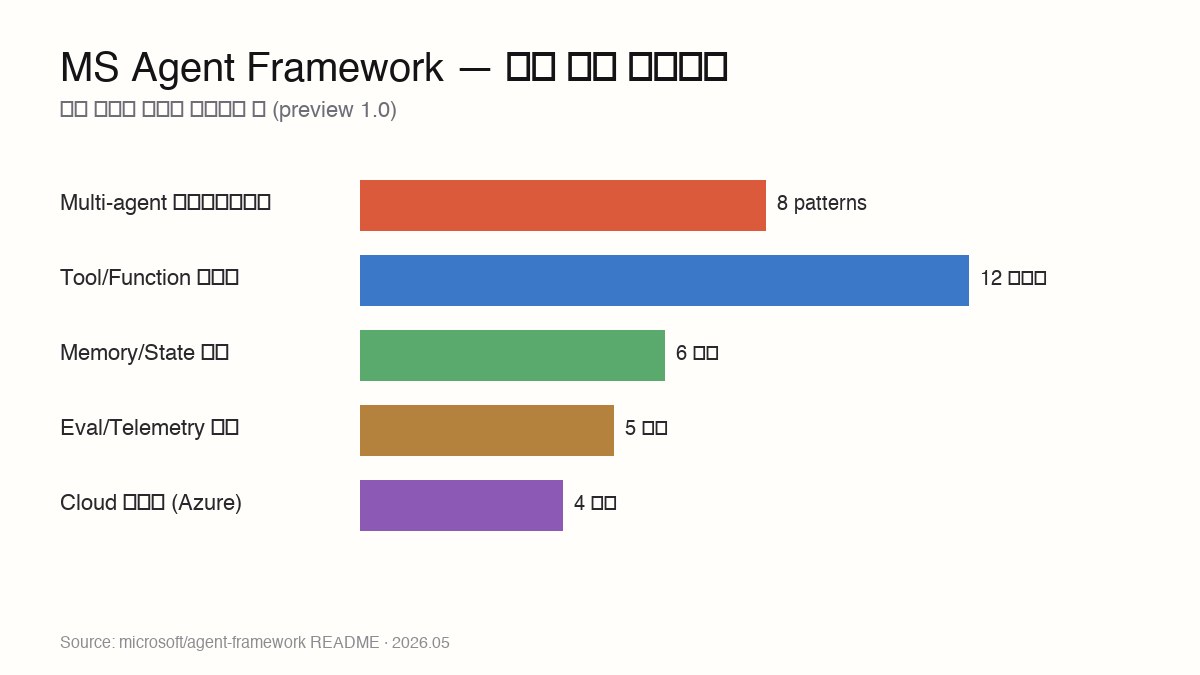 Source: spoonai chart · README analysis (May 2026)
Competitive comparison — LangGraph, AutoGen (kept separate), CrewAI, OpenAI Agents
| Project | Stars | Daily | Lang | Note |
|---|---|---|---|---|
| LangChain LangGraph | 19.5k | 35 | Python | Most mature graph framework |
| AutoGen (kept separate) | 38k | 30 | Python | Continued for research |
| CrewAI | 32k | 80 | Python | Simplicity and speed |
| MS Agent Framework | 4.2k | 250 | Py/.NET | 1.0 GA, unified, enterprise |
| OpenAI Agents (Python) | 11.2k | 100 | Python | Lightweight multi-agent SDK |
Two differentiators stand out. First, .NET first-class support — every other framework is Python-first or Python-only. Second, direct Azure AI Foundry integration — model hosting, memory backends, and eval ship as a single managed environment.
LangGraph is more mature with a larger community, but Agent Framework looks positioned to dominate enterprise .NET environments over the next 12-18 months by combining Microsoft infrastructure with the unified abstraction.
Ecosystem context — why now
Three currents are aligned. One: the multi-agent vs single-agent debate is tipping to multi-agent. Anthropic's 10-finance-agent launch (May 4, 2026) and OpenAI's Agents SDK (Nov 2025) both implicitly conclude that single agents struggle with complex domains.
Two: enterprise can't drop .NET. About 70% of the Fortune 500 maintains substantial .NET codebases, and Python-first frameworks don't penetrate those environments cleanly. First-class .NET support is the structural feature that opens that gate.
Three: AI Foundry as integrated runtime. Azure's 2025 push to consolidate model hosting, vector storage, and eval into one console gave Agent Framework an integrated platform to ship into.
Hacker News (April 3, 2026) ran a 1,200+ comment thread. Two reactions stood out:
"Keeping both frameworks alive separately would have been more confusing than the merger." — HN user jaredklewis
"AutoGen for research, Agent Framework for production — clean split." — HN user simonpure
Quickstart
Fastest path:
# Python
pip install agent-framework

# .NET
dotnet add package Microsoft.Agents.AI
from agent_framework import ChatAgent
from agent_framework.providers import OpenAIProvider

agent = ChatAgent(
    name="Researcher",
    instructions="Analyze company funding rounds.",
    llm=OpenAIProvider(model="gpt-5"),
)
result = agent.run("What's the key signal in Sierra's $950M round?")
Two common pitfalls. One: installing both Python and .NET adapters in the same process creates dependency conflicts; install in separate environments. Two: keeping the in-memory backend for production crashes around 1M state writes — switch to Cosmos DB or Redis before scaling.
Limitations and roadmap
What's not there yet: multi-region deployment automation, on-device model adapters (Apple MLX, Qualcomm Snapdragon), reasoning-chain debugger UI. Those land in 1.x point releases.
Roadmap by quarter. 1.1 (Q3 2026) — multi-region orchestration. 1.2 (Q4 2026) — edge agent runtime for mobile and IoT. 2.0 (Q1 2027) — agent-to-agent protocol compatible with Cloudflare and Stripe's AP2.
The future hinges on Azure AI Foundry adoption. If Microsoft can push .NET share to 50%+ of new agent installs in 6-12 months, the market settles into a Python-LangGraph + .NET-Agent-Framework duopoly. If not, this risks the Semantic Kernel and AutoGen fade-out trajectory.
3-Line Summary
- Microsoft shipped 1.0 GA unifying Semantic Kernel and AutoGen.
- Identical Python/.NET APIs + Azure AI Foundry integration are the differentiators.
- Steady 250 daily stars; positioned for enterprise .NET dominance.
Further reading
출처
관련 기사

Microsoft's VibeVoice Handles 60-Minute Audio in One Shot — and It's Open Source
Microsoft VibeVoice rockets up GitHub with 27.8K stars. Its ASR model processes 60-min audio in a single pass across 50+ languages, while TTS runs at just 7.5Hz frame rate. All open source.
This AI Rewrites Its Own Code — MiniMax M2.7's Self-Evolution Experiment
MiniMax M2.7 autonomously improved itself over 100+ iterations, scoring 56.22% on SWE-Pro — near Claude Opus 4.6 levels — at 1/50th the price.

Google Built Its Own Agent Framework -- ADK Hits 8,200 Stars at 180/Day
Google's official Agent Development Kit ships native Vertex AI deployment, multi-agent orchestration, and eval harness. The big-tech agent SDK wars are on.
AI 트렌드를 앞서가세요
매일 아침, 엄선된 AI 뉴스를 받아보세요. 스팸 없음. 언제든 구독 취소.