After 14 years of running ChromeOS and Android in parallel, Google finally picked a side
On May 12, 1pm US Eastern (May 13, 2am Korea), Google ran 'The Android Show: I/O Edition 2026.' Held one week before Google I/O 2026, it pre-empted the main event with a barrage of announcements that effectively re-architects the entire Android, Chrome, and Gemini stack at once. The two biggest names: Googlebook and Aluminium OS.
Googlebook is a new laptop category. Android underneath, ChromeOS-style desktop experience on top, and Gemini wired in as a system-level layer (branded "Gemini Intelligence"). Runs Google Play's Android apps natively, syncs seamlessly with Android phones and tablets, and ships in fall 2026. Aluminium OS is the umbrella initiative — the long-term roadmap that fuses ChromeOS into Android as a single platform. Googlebook is the first product; Aluminium OS is the OS architecture that makes it possible.
Why this matters: Google just made a decision it had postponed for 14 years. ChromeOS (2011) and Android (2008) are both Google operating systems, but they've shipped as separate teams, frameworks, and app stores — effectively competing internally. While Apple welded macOS and iOS together with shared M-series silicon, Metal, and Foundation Models, Google kept two parallel OSes. Now Android absorbs ChromeOS's desktop capabilities, and Aluminium OS is the integration roadmap.
The cast — Google, Android team, ChromeOS team, Gemini, OEMs
Google. CEO Sundar Pichai didn't take the keynote stage himself. The big presentations went to Android SVP Sameer Samat and Gemini lead Sissie Hsiao. The integration decision became visible in April 2024 when Sameer Samat became the single executive owner of both Android and ChromeOS — that org change made today's announcement structurally inevitable.
Android team. The merge winner. ChromeOS desktop features, keyboard/trackpad optimization, and external display support get absorbed into the Android 17 core. The 2018-era reality of "Android Studio runs on a Chromebook" has flipped to "ChromeOS is now a mode of Android" by 2026. The Android brand expands into laptops as a first-class category.
ChromeOS team. Effectively absorbed. The keynote never said the word "sunset," but the Aluminium OS roadmap implies a gradual wind-down of standalone ChromeOS development. ChromeOS will likely persist for the next 2–3 years as a managed SKU within Aluminium OS for enterprise and education, where its stability and management features remain strong (≈60% US K-12 laptop share is hard to vaporize overnight).
Gemini. The actual main character. Branded "Gemini Intelligence," it gets wired into Android and Googlebook as a system-level AI layer — touching notifications, search, captions, voice, camera, multitasking. Every system component calls Gemini APIs by default. This is Google's direct response to "Apple Intelligence" (2024–2025), which used a similar system-level integration to differentiate iOS and macOS.
OEM partners. Lenovo, HP, ASUS, and Acer confirmed as launch partners. Lenovo with the ThinkPad Googlebook X1, HP with the EliteBook Googlebook 14, ASUS with the ZenBook Google Edition. Samsung is conspicuously absent — Samsung is keeping its Galaxy Book + One UI line and limiting collaboration to Android + Wear OS.
Qualcomm, MediaTek, Intel, AMD. Snapdragon X Elite Gen 2 is the lead SoC for Googlebook. MediaTek Dimensity 9500 ships in some SKUs. Intel and AMD show up in select premium variants, but ARM is becoming the default — same playbook Apple Silicon used to flip the Mac line.
What's inside — Googlebook, Aluminium OS, Gemini Intelligence, Android 17
Googlebook spec. 13/14-inch OLED standard. Pro SKU: 32GB unified memory + Snapdragon X Elite Gen 2 with a 40+ TOPS NPU. Entry SKU: 16GB + Dimensity 9500. A dedicated "Gemini Key" sits above the keyboard — single tap for voice, double tap for multimodal input. Pricing starts $1,299 (Pro) and $799 (entry).
What "Aluminium OS" means. The codename suggests the metal: light but strong. The architecture: (1) Android kernel + Linux containers to host the ChromeOS desktop environment, (2) a single app store (Google Play), (3) a single update channel — Android's Mainline module system extended to cover the ChromeOS surface. Net result: one OS update lands the same security and feature patches across phones and laptops.
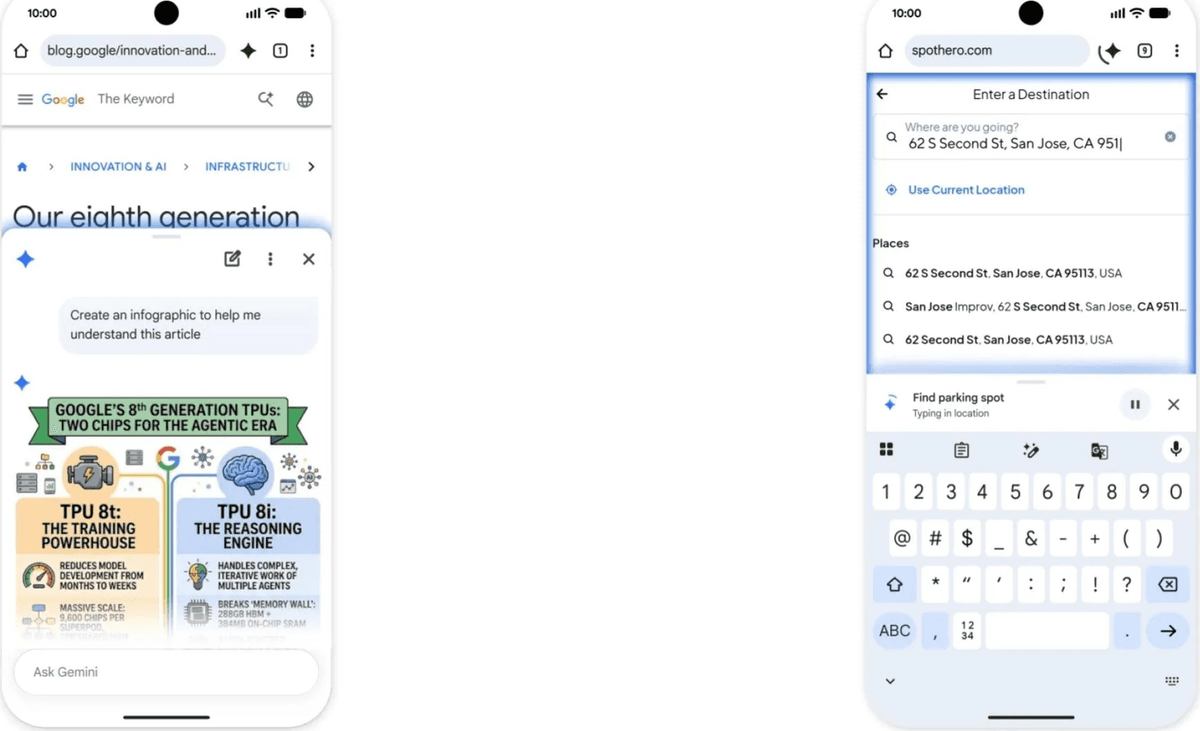
Gemini Intelligence. Six system-level entry points. (1) Hold to Ask — long-press anywhere on screen to make Gemini answer about what's visible. (2) Auto-Suggest — keyboard, mail, and messenger inputs surface Gemini-suggested next actions. (3) Multi-Window AI — Gemini reads multiple windows and unifies tasks across them. (4) Voice Companion — call Gemini even on a locked device. (5) Camera Intelligence — point-and-analyze for objects, documents, and code. (6) Gemini Live for Apps — a standard SDK so any Android app can drop in Gemini.
Android 17 preview. New multitasking surface ("Stack Spaces"), wallpaper-scoped automatic screen recording, system-level "Memory Mode" that retains important task context for Gemini to recall later. Stable Android 17 ships in August 2026, OEM rollout from September.
| Item | Detail |
|---|---|
| Announcement date | 2026-05-12 (US Eastern) |
| Googlebook ship | Fall 2026 |
| Lead OEMs | Lenovo, HP, ASUS, Acer |
| Lead SoC | Snapdragon X Elite Gen 2 |
| Gemini Intelligence entry points | 6 system-level integrations |
| Android 17 stable | Q3 2026 |
| Aluminium OS roadmap start | H2 2026 |
| Google I/O 2026 main event | 2026-05-19 |
Other announcements. AI glasses — first mass-market Android XR headset since Project Astra, partnered with Samsung and Magic Leap. Android Auto upgrade — Gemini-driven in-car voice. Wear OS 5.5 — wrist-side offline Gemini Nano calls. Single message: Gemini lives inside every device.
Who wins, who loses
Google. Big winner. First, R&D consolidation — merging ChromeOS and Android codebases saves billions over 2–3 years. Second, laptop market entry — Chromebook share (~8% global) can plausibly grow into "Android laptop" share, taking on Apple (~12%) and Windows (~70%). Third, Gemini reach — system-level integration puts Gemini on 3B+ Android devices by default. That's the install base that lets Google overtake OpenAI ChatGPT (~800M MAU) on raw AI usage volume.
Android org. Sameer Samat now owns Google's consumer computing line end-to-end. Big internal win.
Gemini business. API-call-by-API-call, the gap with OpenAI narrows fast. System-level integration means Gemini gets called without the user opening an app — daily call counts explode. By end of 2026 Gemini API calls plausibly cross OpenAI's.
OEMs. Mixed. New category to monetize, but cannibalization pressure on their Windows lines. Lenovo and HP juggle ThinkPad and EliteBook Windows + Android variants, splitting marketing spend.
Microsoft. Direct loss. Some Windows laptop share migrates to Android laptops. Hardest hit: education and entry-level enterprise — exactly where Chromebook already pressures Surface. No comment from Microsoft as of May 13.
Apple. Mixed. The "Apple Intelligence" differentiation gets diluted because Android now offers a comparable system-level AI experience. But Apple Silicon's absolute performance edge and the deeper macOS/iOS/iPadOS/visionOS bundle remain. Expect strong counter-positioning at WWDC 2026 on June 9.
OpenAI. Consumer-AI usage gap with Gemini compresses. OpenAI's response, visible on May 11 with the Deployment Company launch, is to lean into enterprise revenue and reduce dependence on consumer growth — but it can't match per-device AI distribution against Android.
Past patterns — what worked, what didn't
Worked: Apple's macOS / iOS / iPadOS convergence (2018–2024). Catalyst, SwiftUI, Apple Silicon — phased integration. Outcome: Mac share +3pp over four years, App Store revenue +25%. Aluminium OS borrows the playbook. Difference: Apple controls OS, hardware, and silicon all in-house; Google needs OEM and SoC partners.
Worked: Microsoft Windows on ARM (2017–2024). Surface Pro X (2019) → Snapdragon X Elite (2024) — laptop and tablet on the same ARM SoC base. Aluminium OS mirroring the ARM standardization arc.
Failed: Google Android Things (2016–2022). IoT-flavored Android variant; OEMs never adopted; sunset in 2022. Building a variant ≠ getting OEMs to adopt it. To avoid that trap, Aluminium OS needs OEM incentives (license cost cuts, marketing co-funding) sorted fast.
Failed: Microsoft Windows Phone (2010–2017). OS unification without consumer pull. The lesson: integration alone doesn't create value — the app and service ecosystem on top is what matters. Aluminium OS starts on Android's 5.5M-app base, which is its biggest advantage.
Counter-plays from the rest
Apple. WWDC 2026 (June 9): macOS Sequoia successor "macOS 16" with Apple Intelligence Pro tier; iPad Pro finally getting a macOS mode; Vision Pro 2nd gen with price cuts and a tighter ARM bundle. Apple Intelligence Pro likely adds multi-model routing including GPT-5 and Claude.
Microsoft. Push Windows 12 (codename "Hudson Valley"); expand Copilot Plus PCs lineup. Microsoft Build 2026 (May 19–21) — same week as Google I/O — likely previews Windows 12. Surface Laptop Studio and Surface Pro adopt Snapdragon X Elite Gen 2 to ride the ARM standardization wave.
Samsung. Stays on Galaxy Book + Tizen-successor strategy. Strengthens Android and Wear OS collaboration. Galaxy Z Fold and Flip get Gemini Intelligence inside Samsung One UI. Cedes the Android-laptop opening to Lenovo and HP; keeps Galaxy Book on Windows.
Huawei (China). Push HarmonyOS Next further, target zero domestic dependence on Android and ChromeOS. Aluminium OS has near-zero China relevance under sanctions.
OpenAI / Anthropic. Lack of system-level OS integration is the chronic weakness. OpenAI relies on the Apple Intelligence partnership for ChatGPT inside iOS. Anthropic has no consumer device strategy at all. Both pivot to enterprise revenue (see OpenAI Deployment Company launch on May 11) instead of fighting the consumer distribution battle.
So what changes — by persona
Consumers. Android 17 will arrive with Gemini wired into the system. Expect to learn gesture-based AI calls like "Hold to Ask." When Googlebook ships, the Pro at $1,299 prices ~10% under MacBook Air; Snapdragon X Elite Gen 2 performance is roughly M3 class. Expect price drops in the first six months.
Developers. End of split Android / ChromeOS development. A single Android app spans phones, tablets, laptops, XR headsets, and cars. Adaptive UI work for screen sizes is now mandatory. Learn the Gemini Live for Apps SDK to ship AI features quickly.
Enterprise IT. K-12, higher ed, and call centers running Chromebooks need Aluminium OS migration plans. Good news: Google Workspace and Chrome Enterprise management tools are compatible. Migration window is 2–3 years.
OEM and retail. Restructure shelves for Googlebook lines. Best Buy and Costco will likely carve dedicated sections. Expect pre-orders on Korean platforms (Coupang, 11st) at fall launch.
Investors. Alphabet's consumer-AI engagement KPIs become a 4–8 quarter growth driver beyond ad revenue. New "AI device active users" metric likely lands in quarterly disclosures. Qualcomm, ARM, and the Snapdragon ecosystem accelerate consumer SoC revenue beyond the data-center lane. Apple short-term impact is modest, but consumer-AI differentiation pressure on the multiple is real.
Regulators. Google bundling Android, Search, Gemini, and Chrome at the OS level invites a new round of EU DMA "gatekeeper" scrutiny. The US DOJ may add "AI bundling" as a follow-on antitrust angle on top of the existing Search ruling.