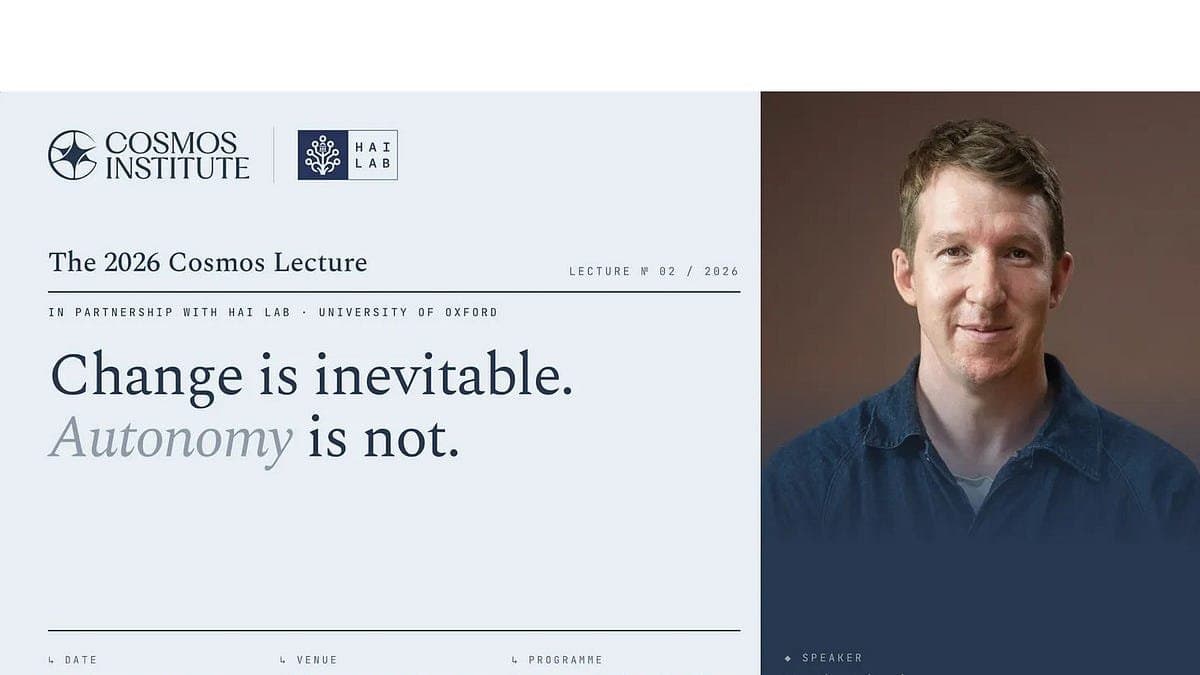
'Change is inevitable. Autonomy is not.' — an ambivalent title for an ambivalent talk
On May 20, Anthropic co-founder Jack Clark gave the 2026 Cosmos Lecture at Oxford, titled "Change is inevitable. Autonomy is not." The title compresses the whole tone — AI's capability gains can't be stopped, but how far we let that AI act autonomously is a choice we make.
And Clark nailed the future to specific numbers. (1) AI will help make a Nobel-level discovery within 12 months; (2) bipedal robots will assist tradespeople within two years; (3) within 18 months, a fully AI-run company will generate millions in revenue; and (4) by end-2028, there's a 60%+ chance that an AI fully trains its own successor — recursive self-improvement, an "intelligence explosion."
His direct quote: "My prediction is by the end of 2028, it's more likely than not that we have an AI system where you would be able to say to it: 'Make a better version of yourself.'" That's effectively Anthropic's internal timeline, said out loud. With the company nearing a ~$900B valuation, an IPO, and its first profit, the central tension of this talk is that "marketing" and "sincere warning" come out of the same mouth.
Clark also stared at the dark. He said the "non-zero chance" AI could kill everyone "hasn't gone away," and — invoking the failure to prepare for COVID-19 — urged "pandemic-level institutional readiness." Time summarized the talk as "selling Claude's promise while warning about AI's dangers." That duality is, in fact, Anthropic's identity.
The players — Jack Clark, Anthropic, and the Cosmos Institute
Jack Clark. Anthropic co-founder, currently Head of Public Benefit / the Anthropic Institute. A former tech journalist, he's one of the most influential voices in AI policy and governance. Famous for his weekly "Import AI" newsletter, he's built trust by taking both AI's capabilities and its risks seriously, with a balanced touch.
Anthropic. Maker of Claude, with "Responsible Scaling" as its core brand. The company sits at the peak of a huge capital cycle — a ~$900B valuation, IPO preparations, and a first-profit outlook. A co-founder saying "60% recursive self-improvement" and "extinction risk" at this moment carries weight that's hard to dismiss as pure marketing.
Cosmos Institute & Oxford HAI Lab. The Cosmos Lecture is an Oxford-based annual talk themed on "human flourishing in the age of AI," bridging philosophy, technology and policy. That Clark chose this stage signals his message borrows the platform of intellectual and policy discourse, not a corporate keynote. The lecture ran 3:00–4:30 p.m. on May 20 at the Schwarzman Centre.
What he said — unpacking the four predictions
Prediction 1: Nobel-level discovery within 12 months. AI will help produce a Nobel-worthy scientific discovery within a year. It rhymes eerily with OpenAI autonomously disproving the Erdős unit distance conjecture the same week. Clark put a quantified prediction on the "AI for Science moves from slogan to results" mood.
Prediction 2: bipedal robots assisting tradespeople within 2 years. A timeline for software intelligence crossing into the physical world. He pegged the stage where humanoid robots assist (not replace) skilled tradespeople — plumbers, electricians — at two years. It connects to the title: capability arrives, but full autonomy is a choice.
Prediction 3: AI-run company revenue within 18 months. A "fully AI-run company" will make real revenue. It echoes the vision of companies like Recursive Superintelligence and reads as a signal that the agentic economy is entering its revenue phase, not just experiments.
Prediction 4: 60%+ recursive self-improvement by 2028. The heaviest one. An AI fully training its successor without human intervention is the core mechanism of the "intelligence explosion" that AI-safety folks fear most. Clark calling it "more likely than not" means Anthropic treats this scenario as a near-term operational risk, not an abstract possibility.
| Prediction | Horizon | Implication |
|---|---|---|
| Nobel-level discovery | 12 months | AI for Science made real |
| Bipedal robots assist trades | 2 years | Intelligence enters the physical world |
| AI-run company revenue | 18 months | Agentic economy monetizes |
| Recursive self-improvement | End-2028, 60%+ | Intelligence-explosion risk |
Who gains what
Anthropic. It wins on both faces. Capability predictions (Nobel discovery, self-improvement) are "Claude is frontier tech" marketing; risk warnings (extinction odds, pandemic prep) are "we're the responsible lab" differentiation. For a company near IPO, it's selling growth and trust at once.
Jack Clark personally. He cements his status as a thought leader in AI-policy discourse. Via "Import AI" and the Cosmos Lecture, he occupies both "executive" and "public intellectual" seats. That dual status amplifies Anthropic's clout in regulatory debate.
The AI-safety camp. A frontier-lab co-founder publicly saying "60% recursive self-improvement" and "extinction risk" lends authority to safety arguments long dismissed as hype. Coming the same week Trump scrapped his AI security EO, it's a strong citation for the safety side trying to fill the regulatory vacuum.
The skeptics' rebuttal. The criticism is fierce too. Some see "labs inflating risk to build a regulatory moat," others "selling hype before an IPO." Clark's prediction is an unfalsifiable probability (60%), so "overclaiming" pushback is natural. That very debate has the benefit of maturing the discourse.
Precedents — wins and failures
A successful warning: Dario Amodei's 'Machines of Loving Grace' (2024). Anthropic CEO Dario Amodei's essay drew big resonance by mapping AI's upside (curing disease, reducing poverty) onto concrete timelines. Clark's lecture adds "warning" to that "optimism." Anthropic's signature register — presenting capability and risk together — runs consistently through both.
Predictions that proved overblown. AI history is full of "AGI is imminent" forecasts that missed. The 2010s "self-driving in 2 years" promise is the classic. Clark's concrete timelines (12 months, 18 months, 2028) carry the same risk. The difference: he speaks in probabilities (60%), framing bets rather than certainties.
An institutional-prep failure: COVID-19. Clark's own analogy. Pandemic risk was warned about for decades, yet institutional readiness lagged, and the cost was steep. His logic: don't repeat the mistake with AI. Even a low-probability risk warrants preparation if the outcome is catastrophic.
How rivals counter
OpenAI. Sam Altman also pairs "AGI imminent" with "safety," but OpenAI leans more toward "capability and speed." Against Clark's "60% recursive self-improvement," OpenAI can emphasize its own Preparedness framework, or counter with "we do it faster and safer."
Google DeepMind. Demis Hassabis is the AI-for-Science originator (AlphaFold's Nobel). To Clark's "Nobel discovery in 12 months," DeepMind can answer with results — "we already did it (AlphaFold)." On safety, its Frontier Safety Framework is the counter card.
Regulators and policy. Clark's "pandemic-level readiness" call gives ammunition to the EU and national AISIs trying to fill the void left by Trump's scrapped EO. But the "labs design regulation to their taste" check also runs, so it's unclear whether his message converts directly into policy.
The e/acc camp. Accelerationists who say "don't block innovation with inflated risk" rebut Clark directly. The Marc Andreessen–style "AI is unambiguously good" narrative and Clark's "careful ambivalence" are two worldviews in head-on collision.
So what actually changes — by persona
AI researchers and engineers. "Recursive self-improvement" dropped from abstraction to a concrete bet ("60% by 2028"). Self-improvement loops, automated training pipelines, and capability evals grow in importance. Time to check where your work sits on this timeline.
Companies and executives. The "AI-run company revenue in 18 months" prediction is a signal to evaluate agentic automation as a revenue model, not just an experiment. But Clark's predictions are bets, not guarantees — treat the timeline as a scenario, not a line item in your business plan.
Policy and regulators. A frontier-lab co-founder publicly warning of extinction risk and self-improvement is a powerful policy citation. Also note the "regulatory moat" critique, and judge by separating the labs' self-interest from the public interest.
AI safety / governance researchers. The overlap of a regulatory vacuum (Trump's EO cancellation) and a lab's voluntary warning is an opening. Demand grows for non-governmental safety infrastructure — evals, red teams, third-party audits — and statements from lab figures like Clark back its legitimacy.
General readers. No direct impact, but a useful case for sharpening how you read AI news. Lab statements always mix "capability bragging" and "risk warnings," and both can serve the company's interest (growth + trust). Knowing that makes it easier to separate hype from sincerity.