Big money poured again into the market where 'AI does enterprise research for you'
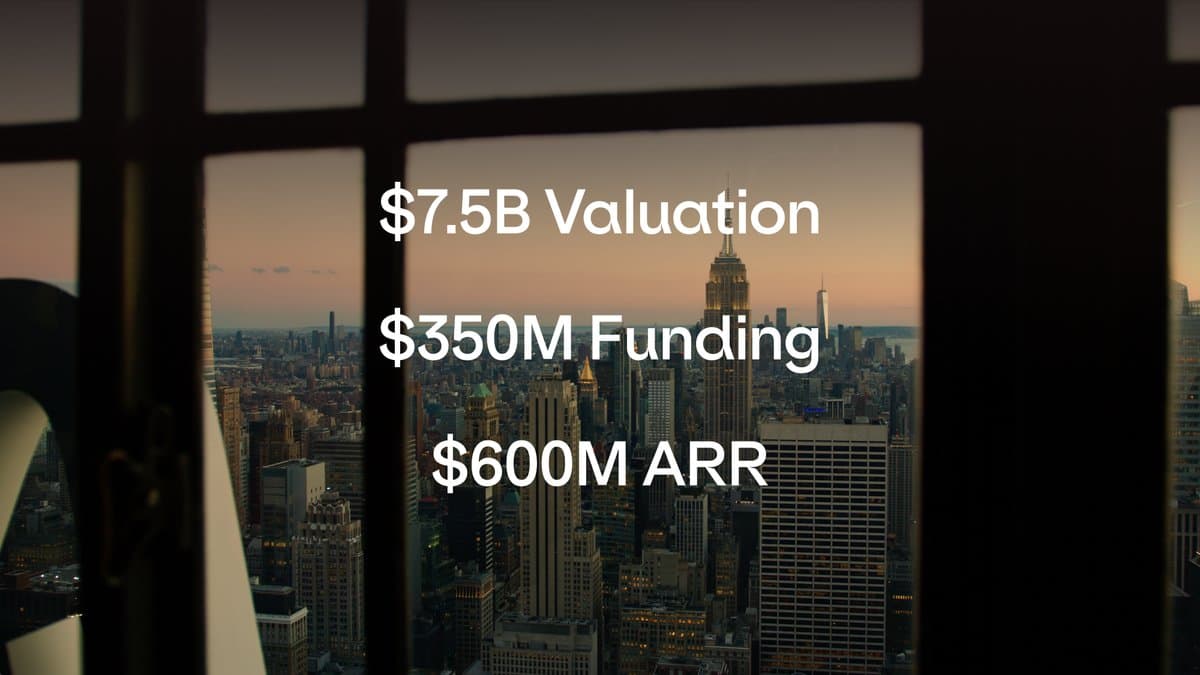
The market where AI takes over the work analysts used to spend all day on — digging through reports, earnings, and news — is growing fast. Its flagship, AlphaSense, raised another $350M on June 3 at a $7.5B valuation — nearly double its prior round's $4B in under a year. Total funding now well exceeds $1 billion.
The numbers impress because of the quality of the growth. AlphaSense's annual recurring revenue (ARR) crossed $600M, up from $500M in October 2025. This isn't a company torching cash to inflate its size — it's a flagship case of an "AI enterprise" where real revenue is compounding fast, which is why the market assigned a high price. Here's the company and why it's valued this way.
Who's in — the investor list is a trust signal
First, what AlphaSense does. In a phrase: an "AI-powered market-intelligence platform." It uses AI to search and analyze vast business documents — earnings calls, analyst reports, news, expert interviews — so investors and corporate strategy teams can extract decision-ready insight quickly. Its document trove exceeds 500 million. The core value: AI synthesizes in seconds what would take a person days to read.
This round's investor list is itself the proof of trust. Vitruvian Partners, Accenture Ventures, and J.P. Morgan Asset Management led, with new investors D. E. Shaw Ventures and Pinegrove Opportunity Partners joining. Existing backers CapitalG (Alphabet's growth fund), Goldman Sachs Alternatives, and Viking Global returned. Top-tier finance and consulting players lining up means the "user industry" that knows the product best is betting on it directly.
The customer list is formidable too. More than 7,000 enterprises worldwide use AlphaSense, including Adobe, Amazon, American Express, Cisco, J.P. Morgan, Microsoft, Nestlé, Nvidia, Pfizer, and Salesforce. Investors are customers and customers are investors — a rare, sturdy structure of trust.
The core of it — AlphaSense by the numbers
Put the announcement in numbers and you see at a glance why it's classed as a "hot AI enterprise."
| Item | Detail |
|---|---|
| New raise | $350M |
| Valuation | $7.5B (from $4B prior — ~2x) |
| Total funding | $1B+ |
| ARR | $600M+ (up from $500M in Oct 2025) |
| Customers | 7,000+ enterprises worldwide |
| Documents | 500M+ business documents |
The line to watch most is $600M ARR. Startup valuations are often priced on "the size of the dream," but AlphaSense is different — a "money-making AI company" with $600M of recurring revenue. Divide the $7.5B valuation by $600M ARR and you get roughly 12x, a multiple that's defensible for a high-growth SaaS/AI company. In an AI market full of bubble talk, that's why it's cited as a case of "growth backed by results."
Also, the use of proceeds is clear: the new capital accelerates the AI platform and the proprietary content library (500M+ documents). AlphaSense's real moat isn't only "AI tech" but "proprietary data built up over years." Anyone can use an AI model, but a high-quality business-document archive can't be copied overnight. The plan is to dig that moat deeper.
Who gains — why this bet is rational
AlphaSense's gain is clear: with a big war chest, it can invest more aggressively in AI R&D and data acquisition, and a higher valuation is a strong card for talent and M&A. Above all, a "high valuation backed by results" boosts negotiating power for a future IPO or further rounds.
Investors' gain is "riding proven growth." Amid an AI-funding explosion, plenty of companies sell vision without revenue. Against that, AlphaSense actually posting $600M ARR is a relatively safe bet. That financial firms like J.P. Morgan and Goldman Sachs are both investors and customers signals internal validation that "this product actually changes our work."
Customer enterprises' gain is "a leap in research productivity." When AI compresses a multi-day analyst research task into minutes, the speed of decision-making itself rises. In domains where "information is competitiveness" — finance, consulting, strategy — such a tool converts straight into competitive advantage, not just efficiency.
Past parallels — successes and failures
A good analogy for the path ahead is the Bloomberg Terminal. By gathering financial information in one place and becoming a "can't-work-without-it" essential, it built powerful lock-in where customers can't leave despite high subscription fees. AlphaSense is after that seat as the "research infrastructure of the AI era." Once embedded deep in workflows, the key strategy is a structure where even a cheaper rival can't pry customers away.
Another success pillar is the "data moat." AI search-and-summarize tech commoditizes fast, but proprietary, curated datasets don't. Just as whoever had "a good index" won the search-engine era, whoever has "a good document archive" has the edge in the AI-research era. AlphaSense pouring capital into its content library follows exactly that lesson.
But there's a failure shadow. As AI tech levels off, general-purpose AI (like ChatGPT-style tools) or Big Tech could bundle similar features more cheaply and squeeze specialized platforms. The very value proposition — "AI does research for you" — sits within Big Tech's range, a structural risk. How deeply AlphaSense digs its data moat and industry-specific trust will be the wall against general-AI encroachment.
The competitor counter-play
The most direct competition is general-purpose generative AI. As enterprise search and document analysis strengthen in ChatGPT or Gemini, the "reason to buy a separate market-intelligence platform" can shrink. AlphaSense's counter is "proprietary data + industry trust + compliance that general AI can't have." In finance, sourcing, accuracy, and compliance are life-or-death, so they want "AI that answers from verified data," not "just a smart AI."
Incumbent financial-data giants are a variable too. If Bloomberg, S&P, and FactSet quickly graft AI onto their platforms, AlphaSense's "AI-native" edge can dilute. The contest becomes a speed race: "how fast incumbents pivot to AI" vs. "how fast the AI-native upstart accumulates data and trust."
AlphaSense's smartest counter-play is likely "expansion via M&A." With a higher valuation and a full war chest, it can buy data companies specialized by industry or region, or small rivals, to widen the moat. As the AI-research market enters a consolidation phase, the well-capitalized leader growing the pie and cementing share is the likely scenario.
So what changes
For investors and market watchers, this deal reads as evidence for the "results" side of the "AI bubble vs. results" debate. It's a benchmark for how AI enterprises with genuinely compounding ARR get valued. A useful case for sharpening the eye that separates "vision without revenue" from "growth with results."
For corporate research and strategy leads, the rise of such tools signals a shift in how work is done. If competitors are accelerating research with AI while you still dig through documents by hand, the information gap widens into a competitive gap. It's time to ask "how do we fold AI into our team's research workflow?"
For AI startups and founders, AlphaSense's success formula is a hint: "build a moat by layering proprietary data and industry-specific trust on top of general-purpose AI." Rather than competing on the model itself, arming yourself with the "domain data and trust" that AI lacks is the way to survive within Big Tech's range.
🥄 Three Things You're Probably Wondering
— Isn't this just more AI bubble? It's closer to the counter-example. The growth is backed by real revenue — $600M ARR — so it's a different breed from "vision without revenue" bubbles. Doubling the valuation in a year is aggressive, sure, but as long as results follow, it's arguably in a reasonable range.
— Can't I just ask ChatGPT? Partly. But financial and strategic decisions live on "clearly sourced, verified data." AlphaSense's value sits in 500M+ proprietary business documents and the trust around them more than in AI tech — an area general AI can't easily replace.
— What does this mean for me? Nothing direct. But it's a sign that "AI doing professionals' research" is becoming a real, money-making market — so read it as an indicator of how knowledge work is changing.
Sources
- AlphaSense — Raises $350M at $7.5B Valuation, Surpasses $600M in ARR
- GlobeNewswire — AlphaSense Raises $350M at $7.5B Valuation (June 3, 2026)
- FinTech Futures — AlphaSense bags $350m funding round at $7.5bn valuation
- Nasdaq — AlphaSense Raises $350M at $7.5B Valuation
- citybiz — AlphaSense Raises $350 Million at $7.5 Billion Valuation
Numbers and criteria are as of announcement and may change. Investment calls are yours to make!