Past "AI that writes code" to "AI that runs toward a goal for days"
Here's the deal: OpenAI made Codex's 'Goal Mode' generally available (GA). Define the objective you want to reach and the success criteria, and Codex works autonomously for hours — even days — until it gets there. It's no longer experimental; it's available in the Codex app, IDE extension, and CLI. And, by coincidence, at almost the same time, Samsung Electronics deployed ChatGPT Enterprise and Codex to its entire Korea workforce and to its DX (Device eXperience) division worldwide — one of OpenAI's largest enterprise rollouts to date.
Why is this a big deal? Because the two events point to one trend. Goal Mode shifts the center of gravity of "AI coding." Until now, a coding AI was a "tool" that spat out code when you said "write this function." Goal Mode is an "executor" that, when you say "achieve this objective," splits the work into steps itself and grinds for days. You don't receive code — you receive a result. That leap from tool to executor is the first axis.
The second axis is Samsung's about-face. In March 2023, Samsung banned generative AI company-wide after an engineer accidentally uploaded internal source code and meeting records to public ChatGPT. Three years later it did the exact opposite — putting that very ChatGPT on every employee's desk. A company that "blocked it for security" swung 180 degrees to "deploying it for productivity." That's more than one company's policy change; it's a symbol of where the corporate world's attitude toward AI is heading.
So today's story is this: how Goal Mode differs from old Codex, why Samsung flipped from ban to full deployment, and what the two together signal about "enterprise AI adoption." Nail down three players and the picture clicks.
The players — OpenAI Codex, Goal Mode, and Samsung Electronics
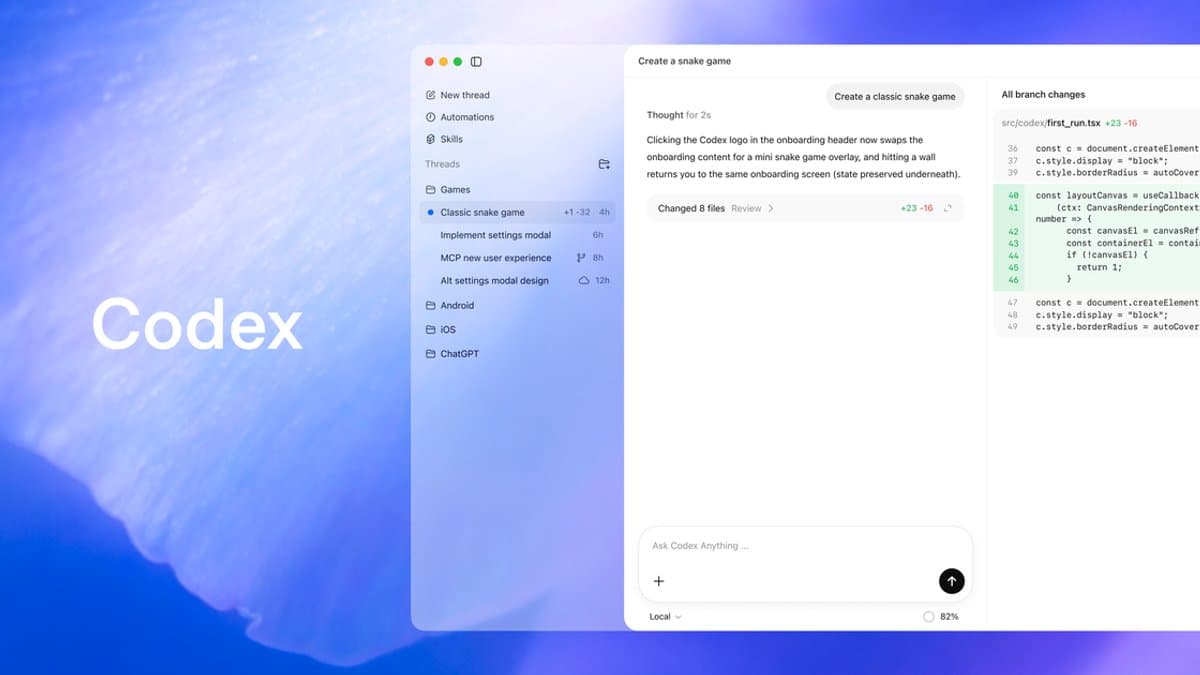
First, OpenAI Codex. OpenAI's coding agent. Beyond mere autocomplete, its goal is to write, review, and debug code autonomously. It's a head-to-head rival to Anthropic's Claude Code, and OpenAI has rapidly expanded Codex to run "anywhere — IDE, CLI, app, cloud." Goal Mode is the result of pushing that autonomy up one more notch.
Next, the star of the show, Goal Mode. In a phrase: specify the result, and the AI fills in the process. Normally a human has to chop work into pieces and assign them one by one; with Goal Mode, you give a big objective and "what counts as success," and Codex plans on its own and drives toward that goal for hours or days. OpenAI explained that "with Goal mode, you can have Codex drive toward a specific objective for hours or even days." The key is "long-duration autonomy."
Third, Samsung Electronics. One of the world's largest memory and smartphone makers. The interesting part is Samsung's history: it banned generative AI company-wide after the 2023 internal-ChatGPT leak. Now that same Samsung deployed ChatGPT Enterprise and Codex to all employees in Korea, and Codex to its DX division worldwide. The aim: ChatGPT for information search, document drafting, ideation, and data interpretation; Codex for code work and even business automation in non-developer teams.
Tie the three together in one line: at the very moment a more autonomous coding agent (Goal Mode) arrived, a giant manufacturer that once banned AI (Samsung) put it on every desk — together showing the move of enterprise AI 'from tool to executor, from some employees to all.' That's the skeleton.
The substance — what was announced
Words scatter, so let's put the confirmed facts in a table.
| Item | Detail |
|---|---|
| Codex Goal Mode | Experimental → GA. Available in Codex app, IDE extension, CLI |
| Goal Mode core | Set objective + success criteria → Codex works autonomously for hours/days |
| Appshots | macOS app feature. Hotkey attaches an app window to a Codex thread, sharing screen context |
| Samsung rollout date | June 21 |
| Samsung ChatGPT scope | All employees in Korea |
| Samsung Codex scope | All Korea employees + DX division worldwide |
| ChatGPT uses | Search/analysis, document drafting, ideation, data interpretation |
| Codex uses | Code writing/review/debugging + automation for non-dev teams |
| Past context | Samsung banned internal ChatGPT in March 2023 after a source-code leak |
Row by row. First, Goal Mode's promotion to GA is the key. An experimental feature going GA means "OpenAI judged this autonomy fit for production." An AI that runs for days on just an objective can dramatically lift dev productivity if it works — but it also brings a new risk: "what if it runs in the wrong direction for days?" The length of autonomy is also the length of both reward and risk.
Second, Appshots matters practically. On macOS, one hotkey attaches the app window you're looking at directly to a Codex thread. "Work with me while looking at this screen" becomes possible. If autonomy (Goal Mode) is "AI working alone for a long time," Appshots is "collaborating with AI while sharing a screen." It reads as OpenAI strengthening both axes — autonomy and collaboration — at once.
Third, Samsung's rollout scope is decisive. ChatGPT to all Korea employees and Codex worldwide to the DX division means widening AI from "a developers-only tool" to "a tool for all employees." That's what TechTimes meant by "Codex reached non-developers." Even employees who don't know how to code can use Codex to build internal tools and automation workflows. The barrier to AI coding drops sharply from "developers only."
Who gains what
Start with OpenAI's wins. First, it landed a mega reference in Samsung. The fact that a conservative giant that once banned AI went all-in is a powerful adoption argument for others — "even Samsung did it." Second, it widens Codex's use cases to non-dev teams, growing the coding-AI market from "developers" to "all knowledge workers." Third, against Anthropic's Claude Code, it holds both "Goal Mode autonomy" and "Samsung as a real-world case" at once.
Samsung (and enterprise customers) gain too. The biggest is productivity and talent competitiveness. When employees handle search, documents, and analysis with AI, low-value time shrinks, and even non-coding teams can build internal automation with Codex — lowering the barrier to turning "an idea into working software." Positioning as a company that went all-in on AI early helps recruiting too. And it resolved the 2023 trauma through a "controlled enterprise tool" — that matters.
And the unexpected variable is the shadow of the 2023 ban. Samsung blocked AI because of a source-code leak. That risk hasn't vanished — the deployment rests on the premise of an enterprise version where data isn't used for training and admins keep control. So this rollout's success rides not on "convenience" but on "whether that control actually works." The more all employees use AI, the more company-wide the blast radius if data governance is breached even once.
Net it out: short-term, it's a plus for OpenAI (reference, market expansion) and Samsung (productivity, talent). But whether Goal Mode's long autonomy is truly trustworthy, and whether all-employee AI's data controls actually hold, only reveals itself in use — and catching both autonomy and security at once is always hard.
Precedents — successes and failures
Deploying AI to all employees is, in fact, accelerating. On this site alone, "AI coworker" launches have come one after another — Zoom's ZoomMate, Databricks' Genie One. The common thread in successes was "whether AI melts naturally into the real workflow." Tools you had to open separately got ignored; tools that seeped into the seat where you already work survived. Samsung bolting ChatGPT and Codex onto everyday work — search, documents, code — follows that lesson by the book.
But fairness means staring at the failures too. Plenty of "company-wide AI rollouts" launched with fanfare only to see actual usage scrape the floor. The tool got installed, but employees didn't know "what to ask or how," so they didn't use it. And as Samsung's 2023 incident showed, releasing it without control invites the opposite accident — a data leak. The more autonomous Goal Mode is, the more it matters who reviews "the output an AI produced after running in the wrong direction for days."
Another balanced view is the gap between announced scale and real effect. "Deployed to all employees" is an impressive headline, but it doesn't guarantee "all employees use it well daily." Real results come not from deployment counts but from "how much faster work actually got" and "how trustworthy Codex's automation is." Demos are clean; reality is always messy — a year's worth of real usage data is the true scorecard.
So the balanced conclusion: the directions of "more autonomous coding AI" and "AI for all employees" are clearly the trend, but success hinges on the reliability of long autonomy, the data control of company-wide use, and actual usage rates. Enterprise-AI history teaches one thing: adoption is the announcement, but value is proven in real use a year later.
Competitors' counter-play
Will rivals sit still? The first counter is Anthropic's Claude Code. The same week, Anthropic shipped Claude Tag for Slack, pushing "an asynchronous coding coworker that lives in channels." OpenAI emphasizing "long autonomy via Goal Mode" and Anthropic emphasizing "a shared teammate in Slack channels" is a head-on collision over coding-agent autonomy. Both promise "AI that works on its own for days," so the contest will be decided on trust and real usage.
The second is Microsoft and Google's integration play. Microsoft can bundle GitHub Copilot and Azure, Google can bundle Gemini and its cloud, arguing "inside our ecosystem you go from coding to deployment." OpenAI took a big customer in Samsung, but Big Tech counters with the home-field advantage of "the dev environment already installed." The convenience of AI embedded in tools you already use, with no separate adoption, is a card not to dismiss.
The third is customers' "multi-vendor" strategy. Samsung choosing OpenAI doesn't mean it won't use other AIs. Many giants run several AIs at once for security, cost, and performance. So this Samsung deal is less "OpenAI monopoly" and more "OpenAI established as a leading option among several." Competition doesn't end with one adoption — it's a long game re-fought at every renewal.
And don't forget the variable: trust in autonomy. Whoever wins, "how far humans trust the result of AI working autonomously for days" is the shared homework. The longer the autonomy, the heavier the review burden. So the real next round won't be about "how long it works autonomously" but "how much you can trust and delegate the result." This launch is one scene in that long game.
So what actually changes — by role
If you're a developer. Watch how Goal Mode changes the way you work. From chopping work into pieces and assigning them one by one, you move to defining a big objective and success criteria. Your role shifts from "writing all the code yourself" to "defining the right objective for the AI and verifying the result days later." Writing clear specs and reviewing output becomes an increasingly core skill.
If you're a decision-maker. The lesson: adoption got easy, but control design matters more. As Samsung's 2023 ban showed, releasing it without control invites the opposite accident — a data leak. Before deploying AI to all employees, nail down "which data may go into the AI" and "who reviews the automation the AI builds." Samsung laying down a "controlled enterprise version" premise is the key point.
If you're a regular employee. The meaning: AI coding is no longer just for developers. With Codex, you can build internal tools and automation without knowing how to code. The key is learning "what to ask the AI, and how." As the tool gets stronger, the value of the person who can imagine what to build with it and verify the result goes up. "Problem definition" matters more than a coding language.
The one line across all three: AI is evolving from "a tool that writes code" into "an executor that runs toward a goal for days," and that executor is reaching beyond developers into every employee's hands. The real value will show up in the reliability of long autonomy and the control design of company-wide use.
🥄 Three Things You're Probably Wondering
— Goal Mode — does it really finish work on its own for days? Give it an objective and success criteria and it plans and runs for a long stretch — clearly different from the old way. But "days of autonomy" is a double-edged sword. Right direction, productivity explodes; off course, you review and discard days of output. So "delegate but check in periodically" is the safe way to use it, not "fire and forget."
— Why did Samsung flip from ban to full deployment? The 2023 ban was about a source-code leak, and now there's a premise to manage that risk via a "controlled enterprise version." With an enterprise build where data isn't used for training and admins keep control, the reasons to use it outweigh the reasons to block it. The key is that this isn't abandoning security — it's adoption premised on security.
— Can non-dev teams really use Codex? That's exactly what Samsung is targeting. Without coding knowledge, you can build internal tools, websites, and automation workflows with Codex. But "can build" and "can build reliably" are different, so who reviews the AI's output rides along. The barrier dropped, but the need for verification, if anything, rose.
References
- Samsung Electronics brings ChatGPT and Codex to employees — OpenAI
- Changelog – Codex — OpenAI Developers
- Samsung ChatGPT Enterprise: Codex Reaches Non-Developers in OpenAI's Biggest Korea Rollout — TechTimes
- Samsung Electronics rolls out ChatGPT in major AI deployment — UPI
- Samsung rolls out ChatGPT and Codex to employees worldwide — People Matters
Numbers and criteria are as of announcement and may change.