In the middle of bubble talk, $230M moved in one day
Here's the deal: on June 24, two AI startups each closed a Series C over $100M on the same day. Healthcare voice AI company Assort Health raised $120M led by Menlo Ventures and Lightspeed; financial-decisioning AI company Taktile raised $110M led by Goldman Sachs Alternatives. That's $230M in a single day.
The timing is striking. That same week, big tech shed $2.7 trillion and OpenAI delayed its IPO as "AI bubble" talk gripped the market. The stock market is trembling that "AI is overpriced," yet in private venture markets, nine-figure checks are still landing on specific AI startups. That contrast is the heart of the story — the bubble isn't deflating; the money is relocating.
What the two companies share tells you the direction. Assort automates hospital patient interactions (scheduling, intake, referrals); Taktile automates bank decisions (loan underwriting, fraud detection, onboarding). Neither is flashy "general AI" — both aim at the boring-but-expensive work of regulated industries where mistakes are costly. Where investors are betting shows up right here.
So here's what we'll unpack: what each company does, why these two got bundled on the same day, why such rounds are possible amid bubble talk, and what it says about the flow of AI startup funding.
The players — Assort Health, Taktile, and 'boring automation'
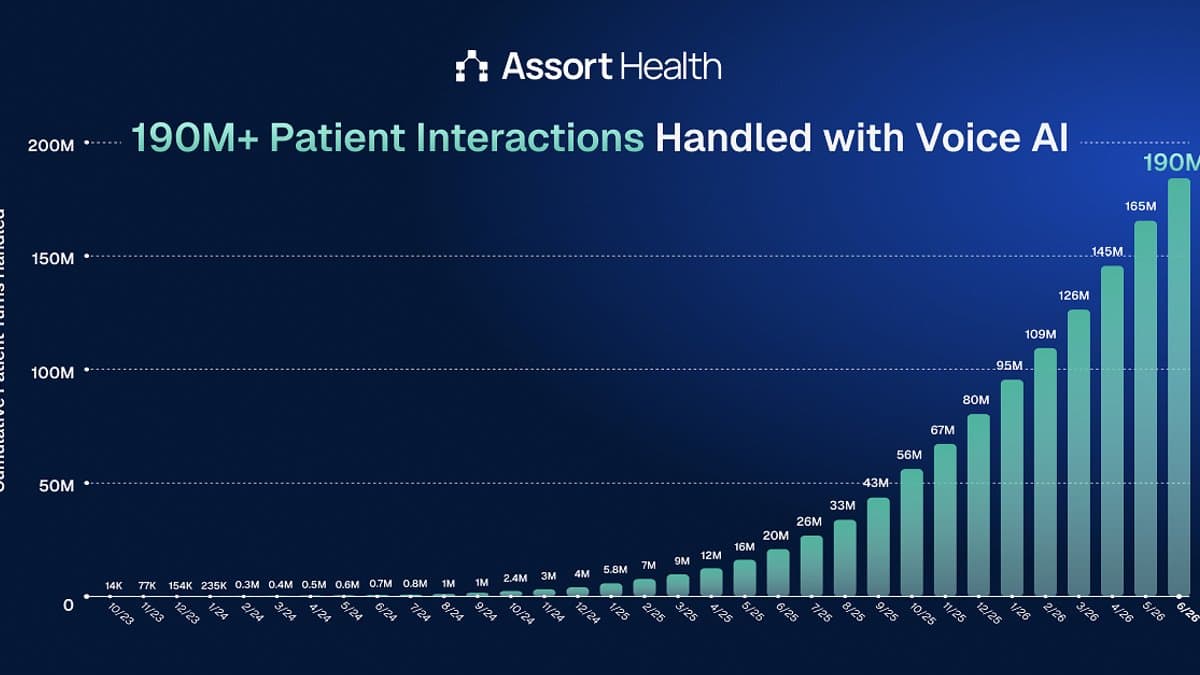
First, Assort Health. A healthcare voice AI company founded by Jon Wang and Jeffery Liu. Its core is "patient journey" automation — when a patient calls a hospital to book, check in, get referred to another department, and process paperwork, an AI agent handles all of it. It integrates with major electronic health record (EHR) systems, so the voice AI takes over what admin staff used to do on the phone. This round made it a unicorn at a $1.2 billion valuation and $222 million raised to date.
Next, Taktile. An "AI decisioning" company for financial institutions. It automates the moment banks and insurers decide whether to grant a loan, pay a claim, flag fraud, or onboard a new customer. The core is solving "the hardest problem of using AI in regulated industries" — financial decisions create legal and credit risk when they're wrong. Taktile combines AI agents, rules, context, and human oversight to automate underwriting, claims, fraud, onboarding, and anti-money-laundering (AML) workflows. Goldman Sachs leading is symbolic — the financial establishment bet directly.
The third lead isn't a company but a theme: "boring automation." Neither is a flashy general chatbot like ChatGPT. They target the hospital call center and the bank's underwriting desk — places nobody calls cool, but where huge labor costs leak daily. What investors look at isn't "how smart" but "how reliably does it save money." The condition for AI surviving the bubble era is exactly this "boring certainty."
One sentence to tie it together: two companies automating the boring work of heavily regulated industries (healthcare, finance) each landed a nine-figure check on the same day — signaling that "AI funding isn't dead; it just buys selectively now." That's the backbone.
What's confirmed
Words scatter, so here are the facts in a table.
| Item | Assort Health | Taktile |
|---|---|---|
| Field | Healthcare voice AI | Financial decisioning AI |
| Round | Series C $120M | Series C $110M |
| Close date | June 24, 2026 | June 24, 2026 |
| Lead investor | Menlo Ventures, Lightspeed | Goldman Sachs Alternatives |
| Valuation | $1.2 billion | Undisclosed |
| Raised to date | $222 million | $184 million |
| Core function | Scheduling, intake, referrals, docs | Underwriting, claims, fraud, AML |
| Integration | Major EHR systems | Bank/insurer decision systems |
| Founders/note | Jon Wang, Jeffery Liu / unicorn | Regulated finance focus |
Line by line. First, Assort's $1.2 billion valuation stands out. Hitting unicorn status (>$1B) off $222M raised means investors see the "hospital admin automation" market as that big. U.S. healthcare admin costs are notoriously high and inefficient, and the promise to cut them with voice AI bought $1.2 billion of belief. Notably, investors include the fund of Joe Montana (the legendary NFL quarterback).
Second, Goldman Sachs leading Taktile is telling. Goldman itself bet on financial-decisioning AI. That signals "the financial sector sees AI automation as internal infrastructure, not an outside spectacle." In finance, the most heavily regulated industry, handing the "decisioning" layer — where mistakes trigger legal liability — to AI means Taktile's "human-oversight-combined" approach earned real trust.
Third, the "same day, same size, same structure (Series C)" non-coincidence is key. Two companies in different industries (healthcare and fintech) closing similar rounds the same day is less coincidence than evidence that "AI-automation mega-rounds are concentrating in specific sectors." General-model competition became big tech's capital war, and a startup's path narrows to "deep work in a specific industry."
What each side gets
Start with Assort Health. First, land-grab capital: $120M is ammo to expand "the largest deployment of patient-journey AI agents" faster. Healthcare is sticky once embedded (via EHR integration), so whoever goes deep first wins long. Second, the trust effect of the unicorn title: a $1.2B valuation is a powerful calling card for hospital customers, recruiting, and follow-on funding.
Taktile's gains are clear too. First, the Goldman anchor: a bet from the financial establishment is more than money — it's a "ticket into finance." Goldman's network and trust translate directly into winning bank and insurer customers. Second, a regulated-industry moat: financial decisioning has high regulatory and compliance barriers, so once you're properly established, new entrants struggle to follow. Taktile got the capital to seize that hard-won seat.
The unexpected winner is the entire AI startup ecosystem. That mega-rounds closed amid peak bubble talk is evidence that "money isn't dry, it's pickier." Startups showing clear revenue, a regulatory moat, and concrete ROI still draw big checks. That's a coordinate for AI startups that only shouted "growth," telling them "what you need to show to attract money."
Precedents — successes and failures
Vertical-industry AI successes are piling up. The standout is legal AI Harvey, which focused on the narrow, heavily regulated domain of lawyer work and rocketed to an $11 billion valuation. "Leave general models to big tech; we sell the deep workflow of one industry" is the proven strategy. Assort (healthcare) and Taktile (finance) are clearly walking that path.
Another is the rise of call-center / customer-service automation AI. Voice AI replacing human agents is one of the clearest-ROI areas — labor savings show up directly in numbers. Assort's healthcare voice agents are the medical-specialized version of this trend. But healthcare's high cost of error is a double-edged sword. A bad instruction or wrong booking isn't mere inconvenience — it can become a safety or legal issue.
On the flip side, the failure scenario is clear. The trap of vertical AI is "the market is narrower, or adoption slower, than expected." The more regulated the industry, the more conservative the decisions and the longer the adoption cycle. Hospitals and banks adopt new tech slowly and carefully. Raising $120M means expectations rose accordingly, and if revenue doesn't follow fast enough, the next round can turn cold. A big check is also big pressure.
Competitors' counter-plays
Incumbent healthcare IT / EHR giants (like Epic) will respond to upstart voice AI like Assort two ways. One is embedding their own AI into the EHR to claim "we do AI too" and squeeze out external startups. The other is acquisition — buying a fast-growing voice AI and absorbing it. The deeper Assort integrates with EHRs, the more attractive an acquisition it becomes, putting it at a fork between independent growth and being acquired.
Financial SaaS and risk-solution vendors will counter Taktile's rise with "AI decisioning" feature competition. Incumbents already selling credit-scoring and fraud-detection solutions can bolt on an AI layer and claim "you don't need Taktile." But Taktile's strength is a regulation-friendly "human-oversight-combined" design, and for compliance-fearful finance firms that safety mechanism is the differentiator. The crux of the counter is who delivers more "compliance trust."
Big tech's general AI is paradoxically both friend and foe to these vertical startups. OpenAI's and Google's powerful models are the engine Assort and Taktile ride on, but if big tech ships "healthcare" or "finance" solutions directly, they become competitors overnight. A vertical startup's survival depends on how well it works a niche "too narrow and deep for big tech to enter directly." Too big and big tech eats it; too small and it doesn't pay.
So what actually changes
If you're on the front lines (hospitals, banks), the change is closest. AI agents will move faster into repetitive work like patient-intake calls and loan screening. For staff, expect a role shift: "AI handles simple repetition, humans handle judgment and exceptions." But since healthcare and finance are costly-error places, adoption likely goes cautiously as "partial automation under human oversight," not "full replacement."
If you're an AI founder, this is a clear coordinate. Even in a bubble-talk market, the AI that attracts money isn't "general smarts" but "reliably solving a specific industry's boring work." Show revenue, a regulatory moat, and concrete ROI, and nine-figure checks still come — that's what June 24 proved. You should be able to say in one sentence: "which industry's expensive task, cut by how much, how reliably."
If you watch investing and markets, the key is reading "the coexistence of bubble talk and mega-rounds." Stock-market fear and venture-market selective betting happening the same week signals not "all of AI collapses" but "the wheat separates from the chaff within AI." Money isn't dry, just pickier. Just note that private valuations tend to adjust later than public markets, so whether these rounds are "still strong" or "late-stage froth" needs more watching.
One step further — the rules of "AI Funding 2.0"
To read these two rounds right, see that AI funding's phase is shifting. The first AI boom of 2023–2025 was a time when "build a model, or put anything on top of a model" attracted money. Big checks flowed on growth potential and vision alone. But 2026's mood is different. As big tech settles the general-model race with capital, a startup can't win as "another chatbot." Survivors work deep niches "too industry-specific for big tech to do directly." Assort's and Taktile's simultaneous rounds are a textbook case of those "AI Funding 2.0" rules.
Another easily missed angle is "why healthcare and finance." What these two industries share: ① enormous admin and decision workloads, ② labor that's expensive and slow because of regulation, and ③ high cost of error. Paradoxically, that very "cost of error" becomes the startup's moat. Once you break through regulation and build "safe automation with human oversight," new entrants struggle to match that trust and compliance infrastructure. The harder an industry is to enter, the firmer the first mover's seat.
But there are cold variables. First, adoption speed. Hospitals and banks are inherently conservative, so whether $120M's expected growth curve actually materializes is uncertain. Second, the cost of "human oversight." Using AI safely in regulated industries ultimately needs a human-review step, which can eat into automation's cost savings. If it stays "semi-automated" rather than fully automated, ROI lands lower than hoped. Third, the bubble's shadow. If the broader AI market cools further, private valuations adjust late, and this $1.2B could get marked down in the next round.
In the end, the message of June 24's two rounds is clear: AI funding isn't dead — it grew up. Past the era of shouting vision and growth, it's now a time when you must prove "which industry's expensive problem, solved how reliably," to attract money. The bubble isn't deflating; money is moving to smarter places. That the smart place happens to be the hospital call center and the bank underwriting desk — unglamorous as it is — is this era's true face of AI.
🥄 Three Things You're Probably Wondering
— It's an AI bubble, right? So why is money pouring in? Stock-market fear and venture betting are different stories. Bubble talk asks "is general AI overpriced," while these two sell "a specific industry's reliable ROI." Money isn't dry — it moved to pickier places.
— So are chatbot startups done? "Another general chatbot" is tough against big tech. But vertical AI digging deep into a specific industry or task still has big upside. The key is finding a niche "too narrow and deep for big tech to do directly."
— Why was Taktile's valuation not disclosed? It wasn't released. Assort stated $1.2B, but Taktile disclosed only the amount ($110M), not the valuation. Goldman leading lends trust, but the exact price is too early to call.
References
- Assort Health Raises $120M at a $1.2B Valuation to Scale Patient Access AI Agents — HIT Consultant
- Assort Health Raises $120 Million Series C — PR Newswire
- Assort Health scores $120M Series C to scale voice AI agent platform for healthcare — Fierce Healthcare
- Venture Capital & Startup Funding Roundup, June 24, 2026 — Tech Startups
- Wilson Sonsini Advises Assort Health on $120 Million Series C — Wilson Sonsini
Numbers and criteria are as of announcement and may change. Investment calls are yours to make!