To Build a Better Agent, They Taught It the World — Not the Agent
Here's the deal: Alibaba's Qwen team released Qwen-AgentWorld on June 24. The name says agent, but the model wasn't trained as one. Instead it brings a new idea — a "language world model." Meaning: where a typical agent model learns "which action to take in this situation," Qwen-AgentWorld learns "if I take this action, how will the environment respond." The objective is environment prediction, not action selection.
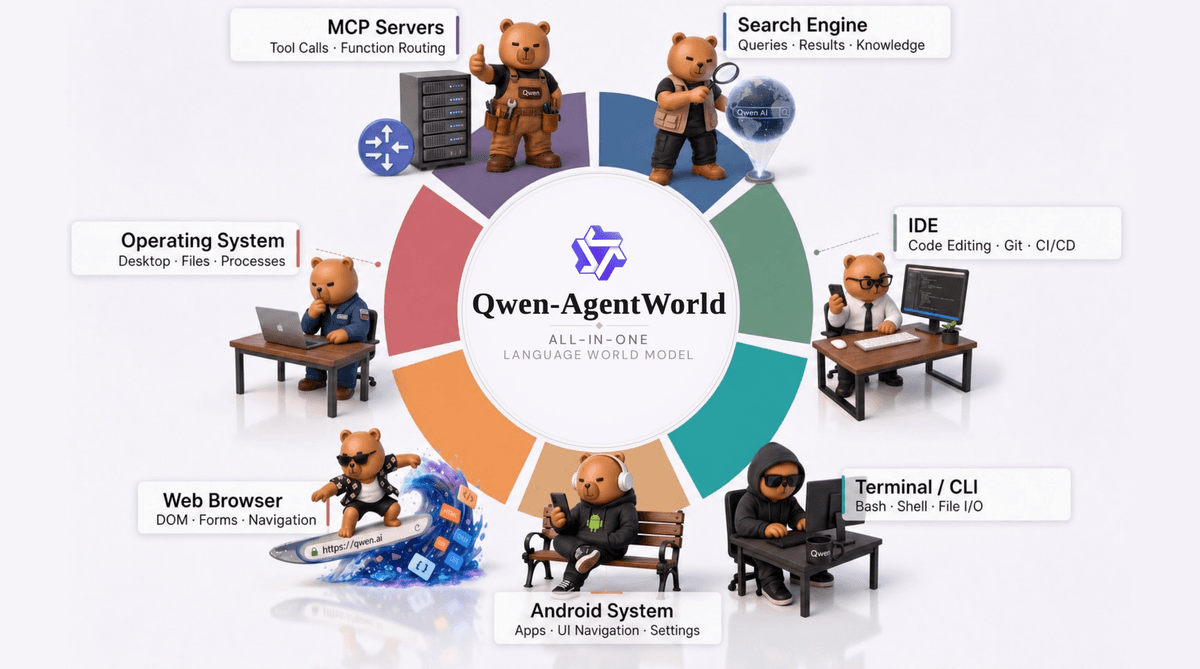
And it simulates 7 environments in one model — MCP, Search, Terminal, SWE (software engineering), Web, OS, and Android. Not trained separately; it learned all seven under one objective: "how environments respond to actions." For a human, it's less like memorizing each game's playbook and more like understanding the laws of physics themselves.
The results are striking. On its AgentWorldBench, the 397B-A17B model scored 58.71, beating GPT-5.4 (58.25), Claude Opus 4.8 (56.59), and Gemini 3.1 Pro (54.57) at environment simulation. And the smaller 35B-A3B model scored 56.39, edging out Claude Opus 4.8 too. All of it released open source under Apache 2.0 — anyone can download and use it.
Here's what we'll unpack: what makes a "world model" different, why it boosts agent performance, and what changes for developers, researchers, and the industry. Three players: the Qwen team, the U.S. frontier models that got out-scored, and the global developers who'll use this open source.
The Players — Qwen, the Out-Scored Frontier, and the Open-Source Ecosystem
First, Alibaba's Qwen team — China's flagship LLM research group, bundled with DeepSeek and Zhipu (GLM) as the "Chinese open-weight big three." Qwen has steadily released strong open models, building trust among global developers. AgentWorld isn't just "another good model"; it carries more weight because it changes the methodology of training agents.
Next, the out-scored frontier models — GPT-5.4, Claude Opus 4.8, Gemini 3.1 Pro, each company's top tier. On the specific task of "environment simulation," they trailed the open-source Qwen-AgentWorld. But don't misread it: this is one benchmark (AgentWorldBench), and a narrow capability — "predicting how the environment will respond." It says nothing about overall coding or reasoning superiority.
Third, global developers. The meaning of an Apache 2.0 release is big here. Anyone can grab the weights, self-host, fine-tune, and use commercially. For agent builders, "a model that understands environments" is a powerful starting point — and since even the 35B model performs well, you can run it without giant GPUs.
One line: Alibaba open-sourced a model that flips agent-training on its head, it beat U.S. frontier models on a specific task, and it handed developers a free starting point. That's the spine.
What's New — Why a "World Model" Differs
Let's make "world model" simple. A typical agent learns by trial and error — act, observe the result, reinforce the good, avoid the bad. The problem: it's expensive. Doing millions of trials in real environments (real terminals, real web) costs enormous time and money. But what if you had a model that accurately predicts "how the environment will respond"? You could run simulations in your head and pick an action — the way a chess player mentally pre-plays "if I move here, the opponent will go there."
| Model | AgentWorldBench | License | Note |
|---|---|---|---|
| Qwen-AgentWorld 397B-A17B | 58.71 | Apache 2.0 | #1 at environment sim |
| GPT-5.4 | 58.25 | Closed | Frontier |
| Qwen-AgentWorld 35B-A3B | 56.39 | Apache 2.0 | Small, beats Opus 4.8 |
| Claude Opus 4.8 | 56.59 | Closed | Frontier |
| Gemini 3.1 Pro | 54.57 | Closed | Frontier |
Two things stand out. First, an open-source model out-scored the closed frontier — the same pattern as GLM 5.2 beating Claude on a security bench days earlier, repeated in another area ("understanding agent environments"). Second, even the small 35B beat Opus 4.8. That's the scary part — you don't need a giant model; change the training method and you can catch the frontier on a specific task.
The training is unusual too. Qwen-AgentWorld made "environment modeling" the objective from start to finish (CPT→SFT→RL). It didn't bolt agent skills onto a general LLM; it learned "the environment itself" from over 10 million real environment-interaction trajectories. Hence VentureBeat's headline: "never trained as an agent, yet improved agent performance."
Who Wins
Alibaba's Qwen team wins biggest. It didn't just top a benchmark — it proposed a new paradigm for agent training, flexing research leadership. And by open-sourcing it, when global developers build on it, Qwen sits at the center of that ecosystem — growing trust and influence at once. A clever move.
Developers and researchers benefit too. They get "a model that understands environments" as a free starting point for building agents. Since even the 35B performs, individual researchers and small teams can experiment without big infrastructure. Releasing AgentWorldBench alongside improves research reproducibility.
The strained party is the closed frontier camp. "Our most expensive model lost to a free open model on a specific task" replays again. It's a narrow benchmark, but as such cases pile up, "why pay for the expensive closed model?" grows louder. Frontier labs feel pressure to differentiate on something other than raw performance.
Precedents — Wins and Misses
We've seen this before. RL world models like MuZero showed it in games — model the environment accurately and you can plan "in imagination" without real trial and error. Qwen ported that DeepMind-proven idea to language-based digital environments (terminal, web, OS). The "world model" is a validated, powerful idea.
The key to the win is simulation accuracy. The more accurate the environment prediction, the better the mental plan matches reality. The failure risk is just as clear — if the simulation is wrong, the model plans on a "fantasy that doesn't exist in reality." Call it "world-model hallucination"; a big gap from the real environment is poison. Qwen training on 10M real trajectories is precisely to shrink that gap.
There's an open-source lesson too. As DeepSeek, GLM, and Qwen showed, the Chinese-lab strategy of "build trust by releasing" worked. But open source is double-edged — rivals can absorb the research and follow. So Qwen must keep releasing "faster and further ahead" to hold leadership. It's not a one-release game.
Worth flagging: the benchmark itself is part of the strategy. By releasing AgentWorldBench alongside the model, Qwen doesn't just claim a win — it defines the yardstick the win is measured by. Whoever sets the benchmark shapes what "good" means in a field, and history shows the framework can outlast any single model that tops it. ImageNet mattered more than any one model that won it; the test became the arena. If AgentWorldBench becomes the standard way labs measure "environment understanding," Qwen will have planted a flag the whole field has to march toward — a subtler and more durable form of leadership than a leaderboard score that gets beaten next quarter.
Rival Counter-Plays
U.S. frontier labs (OpenAI, Anthropic, Google) counter by "absorbing the world-model idea and fusing it with their strengths." Since it's open-sourced, anyone can copy the methodology. Layer on their giant models, safety, and product integration, and they answer with "open models are parts, we're the finished product."
Other Chinese labs (DeepSeek, Zhipu) ride the wave with "open + new methodology." GLM 5.2's security win and Qwen-AgentWorld's agent win, days apart, are hardening the narrative that "the Chinese open-weight camp overtakes the frontier in specific areas." They also compete among themselves over who ships the more impactful open model.
Agent-framework and tool companies gain reason to integrate this model into their stacks. "An open model that understands environments" is attractive as an agent-product base. But the permissive Apache 2.0 license makes "how to differentiate" their real homework, more than integration itself.
So What Changes
If you build agents — Qwen-AgentWorld is worth evaluating as a starting point, especially for agents heavy on environment interaction (terminal, web, OS), where "a model that understands environments" can cut trial-and-error cost. The 35B performs, so infrastructure burden is small. Validating performance on your real domain is mandatory.
If you're a researcher — the very idea of "training agents on environment prediction, not action" is a hot topic. With AgentWorldBench and weights public, reproduction and extension experiments get easier. World model + language model fusion will be a hot field for a while.
If you watch the industry — read it as a signal that "the center of gravity in AI competition shifts from model size to training method." A 35B beating giant frontiers on a specific task is evidence that "clever" beats "just big." That trend opens opportunities for small teams and nations short on infrastructure.
🥄 Three Things You're Probably Wondering
— So is Qwen a better model than GPT-5.4? No, don't read it that way. This is one benchmark (AgentWorldBench), and a narrow capability — "predicting how the environment responds." It says nothing about overall coding, reasoning, or general chat. Treat it as one narrow track.
— Is the "world model" really that big a deal? The idea is powerful. Predict the environment accurately and you can plan without real trial and error. But if the simulation is wrong, you risk "fantasy-based planning." How well it matches reality is the crux — verify per domain.
— It's open source, so what does Alibaba get? Sitting at the center of the ecosystem. When global developers build on Qwen, trust and influence flow to Alibaba — and it ties into its cloud business. "Give it away to own the standard" is the heart of the open-source strategy.
Sources
- Qwen-AgentWorld: Language World Models for General Agents — Alibaba Cloud
- Alibaba's Qwen-AgentWorld improves agent performance across seven benchmarks — VentureBeat
- Qwen-AgentWorld: Language World Models for General Agents — arXiv
- Qwen-AgentWorld — QwenLM GitHub
- Qwen-AgentWorld: Language World Models — Qwen Blog
Numbers and criteria are as of announcement and may change.