The Biggest State Government in America Just Picked an AI Vendor
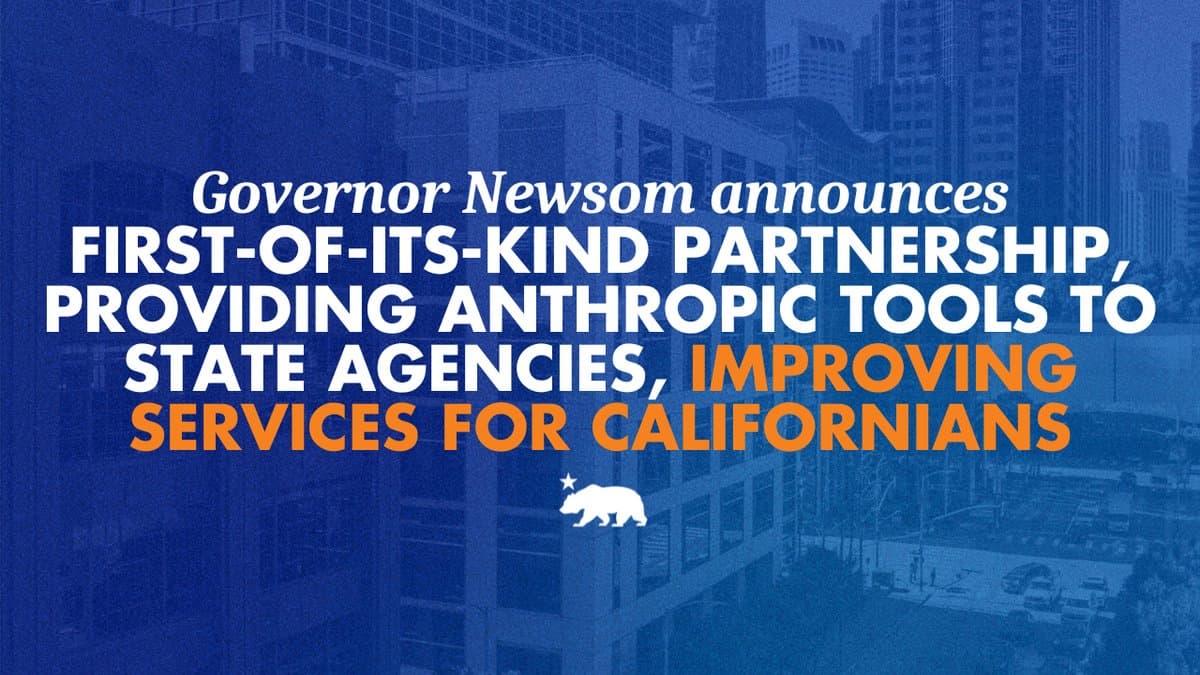
Here's the deal: California isn't just another U.S. state. Measured by GDP, it's one of the four largest economies on the planet, and the budget and headcount its government runs are on par with operating a whole country. So when a place like that stands up on June 29 and officially says "we're putting Claude across our entire government," that's not a footnote. Governor Gavin Newsom did exactly that, personally announcing a partnership with Anthropic and slapping the label "first-of-its-kind" on it.
There's really one number to remember: 50%. Every California state agency, plus the cities and counties that opt in, can now use Claude at half of standard pricing. This isn't a cautious "let's dabble in AI" pilot. It's a decision to fold the price tag in half and open a channel that the entire state apparatus can walk through. And it's not just software tossed over the wall, either. The deal bundles in free workforce training, expert-level generative AI support, and hands-on workflow consulting from Anthropic's own developers.
You can see the picture forming, right? The most populous, richest state in the country just effectively chose one safety-focused AI vendor as the default AI tool for its government. That forces every other state to look up and go, "wait, California did what?" It's a starting gun. Government markets tend to work that way — once one big player sets a standard, everyone else uses it as the benchmark and follows.
The timing is sharp, too. AI companies have been slugging it out in consumer and enterprise markets for years now, but everyone knows the real high-stakes prize is government. Government contracts are big, long, and sticky — once you're in, you rarely get swapped out. California just opened that door for Anthropic first. In this piece I'll break down exactly what changes, who wins, and where this is likely headed.
The Cast — California's Government, Anthropic, and the Workers Who'll Actually Use It
This story has three main characters. The first is obviously the State of California, and its face is Governor Gavin Newsom. Newsom set the tone very deliberately in the announcement. He drew a hard line: AI is "not about replacing human labor in government." Instead, he framed it as a tool that helps public workers move faster, solve problems better, and ultimately deliver better outcomes for Californians. That's a calculated message — it's designed to head off the fear that always trails public-sector AI talk: "so are you about to lay everyone off?"
The second character is Anthropic, the company behind Claude, led by CEO Dario Amodei. Anthropic grew up putting "AI safety" front and center, and that identity turns into a serious weapon in the government market. Governments, unlike private companies, are far more sensitive about data security, accountability, and predictability. A brand that says "we design for safety first" gives a procurement officer cover — it lowers perceived risk. And for Anthropic, the payoff is landing a giant reference customer named California.
The third character is actually the most important one: the government workers who'll actually use this. Think of the DMV employee dealing with the public, or the DHCS (California Department of Health Care Services) staffer wrestling with internal paperwork. The announcement confirmed the DMV is already using Claude to improve customer service, and DHCS is using it for internal workflows. So the sequence isn't "we plan to adopt this someday" — it's "it's already running, and now we're scaling it across every agency." The pilots have already done some of the validation.
And there's a quiet supporting player standing in the back: the California Department of Technology. It runs the SITeS (Statewide Information Technology Shared Services) portal that serves as the real conduit for this partnership. Picking the vendor, negotiating the price, laying the infrastructure so agencies can access it — that operational nerve center sits with this office. The splashy press release puts Newsom's and Amodei's names in big letters, but the gears that actually turn this contract belong to the Department of Technology. Keep that in mind and the whole thing gets a lot clearer.
So this is a four-layer structure: a politician sells the vision, a vendor supplies the tool, an operational office builds the pipe, and workers use it in the field. Each layer wants something slightly different, so when we dig into who benefits later, keep these characters in your head as you follow along.
What Actually Changed
Enough talk — let me just lay it out in a table. Here's the substance of the partnership.
| Item | Details |
|---|---|
| Who it covers | Every California state agency + participating cities and counties (local governments) |
| Discount | 50% off standard pricing (same discount applies to local governments) |
| What's included | Free workforce training, expert generative AI support, workflow consulting from Anthropic developers |
| Channel | The new SITeS portal from the California Department of Technology |
| Already in use | DMV (customer service improvements), DHCS (internal workflows) |
The line people most often skip in this table is "channel." Everyone remembers it as "California got Claude for half price," but the real design core is the SITeS portal. Its full name is Statewide Information Technology Shared Services. It's a portal the state's Department of Technology just built, and Claude became the very first AI productivity tool accessible to all state agencies through it. That word "first" matters — it implies more tools can be added to this portal later.
What does SITeS actually do? Think of it as a marketplace that gathers AI tools by core use case and offers them at transparent pricing. It organizes tools around the areas government actually wants to improve — operational efficiency, data security, employee experience. In the old world, each agency negotiated separately with vendors, prices were all over the place, and security reviews got duplicated, eating up months. This flips that into a centralized "pick what you need here" structure. Cutting the friction out of procurement is the real play.
You should also know this deal didn't fall out of the sky. Newsom issued Executive Order N-5-26 on March 30, 2026. That order established the procurement standards an AI supplier has to meet to sell tools into the government — a threshold that keeps just any AI from walking in. And Anthropic became the first vendor to clear that bar. So the sequence goes: write the rules first, partner with the first company that passes them, then push it out to every agency via the SITeS portal. It's a pretty orderly path.
Finally, I want to re-stress the "already in use" part. The DMV is applying Claude on the customer-facing side, like handling public inquiries, and DHCS is using it on the back-office side, like organizing internal documents and workflows. These two cases matter because they show this expansion isn't "recklessly deploying unproven tech everywhere" — it's "we ran it, confirmed it works, now we scale." The thing governments fear most when adopting new tech is a giant failure, and this is following the textbook order: pilot, then standardize, then expand.
Who's Smiling
Anthropic is grinning the widest. This isn't just one contract won. They've locked in the biggest state government in America as a reference. In government markets, "who validated it first" carries enormous weight. When another state is weighing AI adoption and can say "California runs Claude too — and it even cleared the procurement standards," half the sales job is already done. And bundling free training plus workflow consulting is also a strategy to get workers comfortable with Claude's way of doing things, quietly driving lock-in. Once something's in your muscle memory, you don't want to switch.
Newsom wins too. Politically, he grabbed a clean picture. He gets the "I'm the leader putting California at the front of the AI era" image, while pre-installing the defensive line that "this doesn't kill jobs, it helps public workers." Add the 50% discount and you've got perfect material to brag to taxpayers about "saving the budget." Innovation, job protection, and cost savings — he's trying to bag all three rabbits with one announcement. Of course, real results have to show up for it to be a true win, but the announcement itself is politically profitable.
Government workers can benefit too, if this runs well. When AI takes the repetitive, tedious stuff off your plate — summarizing documents, drafting, triaging inquiries — people can focus on work that actually needs judgment. And the free training attached helps dodge the common failure pattern of "here's a new tool, figure it out yourself." There's a condition, though: the benefit only materializes if the training isn't just box-checking and actually embeds into real field workflows. Otherwise it risks becoming yet another "tool I only open because I'm told to."
Californians — the intended ultimate beneficiaries — also win in theory. Shorter DMV waits, faster health service processing, better inquiry response: all good, right? Newsom's emphasis on "better outcomes for Californians" was aimed squarely at this point. But this is still in the realm of promises. Until it's proven with actual service-improvement metrics, we should honestly admit it's still at the "that'd be nice" stage.
On the flip side, not everyone's smiling. Competing AI vendors — especially OpenAI and Google — just lost the first door into a prime market to Anthropic. And there are civil-society groups and experts who worry about data privacy and government dependence on AI. Questions like "how deeply should a government entangle itself with a single private AI company?" and "how is resident data protected?" will keep trailing this deal. The announcement is flashy, but the scrutiny grows just as much.
Precedents — Wins and Wipeouts
The history of governments adopting IT at scale is honestly a fifty-fifty mix of successes and disasters. You need to know both to judge this deal coldly. Start with the wins. Over the past decade-plus, the U.S. federal government and many states moved to the cloud. AWS, Microsoft Azure, and Google Cloud cleared government-specific certifications (security standards like FedRAMP), and agencies migrated from running their own servers to the cloud. That worked because clear security standards came first, and multiple vendors passing those standards gave governments real choice. California's N-5-26 procurement standards follow exactly this pattern.
Now the catastrophic failures — there are plenty. The most famous in the U.S. is the 2013 HealthCare.gov meltdown. They launched the Obamacare enrollment site with great ambition, and from day one servers crashed, no one could log in, and it took an emergency rescue team to barely stabilize it. Why? Too many subcontractors were tangled together and nobody owned the whole thing, and they scaled before doing proper real-usage testing. It's still cited as the textbook case of government IT failure. This California deal's emphasis on running DMV and DHCS pilots before expanding can be read as a lesson learned from exactly this kind of disaster.
Here's something you absolutely have to flag: vendor lock-in. When a government leans deeply on one company's tool, switching later becomes brutally hard even if that company raises prices or changes terms. The data's already in their system, the workers are used to their tool, and the integrated workflows are all built to their spec. A 50% discount is sweet right now, but it can be the classic move of lowering the entry price to get in the door, then watching negotiating power shift to the vendor once the scale is large. California designing SITeS as a "marketplace that holds multiple tools" looks like a deliberate hedge against this lock-in risk, leaving room to add other vendors later.
One more worth referencing: the "bought the licenses, nobody uses them" failure pattern in big SaaS rollouts. Companies and governments alike drag in a grand tool, skimp on training, and check back a few months later to find usage in the basement. This is extremely common. The fact that this deal explicitly includes free training and workflow consulting is a safeguard against that "bought it, don't use it" trap. It's a design that understands the cost of putting people around a tool to make it stick is scarier than the tool's price.
Bottom line: this partnership grabbed a lot of the good ingredients from past successes — setting standards up front, validating with pilots, pairing in training. But the two old traps of vendor lock-in and real-usage adoption are still very much alive. We'll need to watch the actual usage metrics and renewal terms over the next year or two to know whether this ends up a success story or just another "loud announcement, quiet failure."
The Competitor Counter-Play
Anthropic opening California's first door doesn't mean the competitors sit still. The first to react is obviously OpenAI. OpenAI has already been pushing product lines aimed at government and public sector, and it's expanding into federal too. Having lost California, it'll likely go grab another large state first — Texas, New York, Florida — to fire back with "we've got our own giant state government reference." Or it could exploit the fact that the SITeS portal is built to hold multiple vendors and lobby to "put our tool on this portal too." Even if the first door is taken, an open portal leaves room to angle for the second slot.
Google is no pushover either. Google has run in the government cloud market for years with Google Cloud and has deep experience in security certifications and compliance. It can package Gemini for government and play the integration card: "we give you everything from cloud infrastructure to AI in one place." Managing multiple vendors is a headache for governments, so the logic that "getting infrastructure and AI bundled from one company is easier to manage" lands well with procurement officers. If Anthropic is a pure AI tool, Google can wield the whole stack as a weapon.
A price war is also likely to ignite. Anthropic threw down 50%, so competitors chasing other states may come out swinging with "we'll cut deeper." Government procurement is price-sensitive, and in the early entry stage vendors tend to grind their margins to secure references. The token-price war that raged in consumer markets could spill over into a government-contract discount war. Short term that favors governments (read: taxpayers), but there's a matching risk that once a winner solidifies, prices climb back up.
Finally, the weak spot competitors will poke at is "rebutting the safety brand." If Anthropic leads with safety, competitors will counter with "we're faster, cheaper, and perform better" or "we passed all the government security standards too." Ultimately, government-market wins come down to three things: clearing the procurement bar, the operational muscle to actually make adoption stick, and long-term cost. Anthropic currently leads on the first two, and how fast competitors close those two axes will decide the government AI landscape for years.
So What Actually Changes
Let me break it down by persona. Translating abstract news into "what changes for you" is the whole point.
If you're a California resident — nothing changes for you today. But the direction is clear. Your time waiting in line at the DMV, health-service processing delays, response speed on various inquiries — there's now room for all of that to improve. Since the DMV and DHCS are already using Claude, that's likely where you'll feel it first. That said, this is the "if it runs well" story, so don't set expectations sky-high before real improvement metrics land. And the worry "is my personal data flowing to an AI company?" is a legitimate question — worth watching what data-protection safeguards get disclosed.
If you're a government worker — this is the most direct for you. It means a tool that offloads repetitive work is coming in officially, and with free training attached. Hand off document drafts, summaries, and triage to the AI, and you get room to focus on work that needs judgment. The key is "don't be scared — actually take the training." Since Newsom nailed down that this isn't about job replacement, at this stage a worker who's good with AI is likely to become more valuable, not less. Learning the tool beats avoiding it right now.
If you're a procurement lead in another state or government — California just handed you a free template. The path — "set procurement standards by executive order, pick a vendor that passes them, expand across all agencies via a shared portal" — has already been demonstrated. Benchmark it directly and you can cut way down on trial and error. But if you're not California-sized, your negotiating power may be weaker, so joint procurement across multiple states is worth considering. And designing an open portal rather than nailing yourself to a single vendor is better for avoiding lock-in.
If you're an AI vendor — you need to accept the rules of the government market just changed. "A high-performing model" alone isn't enough anymore; you need "clearing the procurement bar + operational support + adoption services" as a set to get into government. The consumer-market strategy of "ship a good model and they'll use it" doesn't work in government. The company that invested in the "boring but essential" stuff — training, consulting, security certification — takes this game. Anthropic just showed that, and catching up means spending money and people here.
Bottom line: this announcement is bigger than a single contract — it's an event that sets the standard for "how government buys and uses AI." The world won't flip overnight, but for the next several years, government AI adoption across the U.S. is likely to reference this blueprint. That's why, even though it looks quiet relative to its scale, the actual ripple effect is a pretty big deal.
Three Things You're Probably Wondering
— So what does this actually change for me? Honestly, you may not feel much right away. But the DMV and Department of Health Care Services (DHCS) are already using Claude, so things like inquiry processing and wait times should trend faster. The real question is whether it's proven with actual metrics, and that'll take a few months to see.
— Why Anthropic, of all companies? It's sequence, not luck. Newsom set AI-vendor procurement standards first, back in March with Executive Order N-5-26, and Anthropic was the first to pass them. On top of that, its "safety first" brand mapped neatly onto government worries about security and accountability, and the DMV and DHCS pilots had already given it some validation. It grabbed both the credibility and the track record.
— Will other states go this route too? Likely. California demonstrated the whole path — "set standards, pick a vendor, expand via a shared portal" — so other states now have a justification to benchmark it. But there's no guarantee the vendor will be Anthropic. OpenAI or Google could come in cheaper and with a more integrated package in other states.
Sources
- Governor Newsom announces a first-of-its-kind partnership providing Anthropic tools to state agencies — Office of Governor Gavin Newsom
- Newsom's office touts Anthropic 'partnership,' 50% discount on Claude AI — Fox Business
- California signs deal to bring Claude AI tools to government workers — CBS Sacramento
- Newsom strikes Anthropic deal for half price Claude AI access — TechRadar
- Governor Newsom Executive Order N-5-26 (AI procurement standards) — Office of Governor Gavin Newsom
Numbers and criteria are as of announcement and may change.