After 15 Years as an "Investor," Chamath Is Back in the "Operator" Seat
Here's the deal: when you hear the name Chamath Palihapitiya, two images usually come to mind. One is the early Facebook executive who engineered the company's explosive growth. The other is the billionaire investor who dissects markets on the "All-In" podcast and once took startups public via SPACs. But in late June 2026, he sat down in a completely different chair for the first time in 15 years — he became the full-time CEO of 8090, the AI startup he founded. This is his first operating role since he left Facebook in 2011. The investor decided to get his hands dirty again.
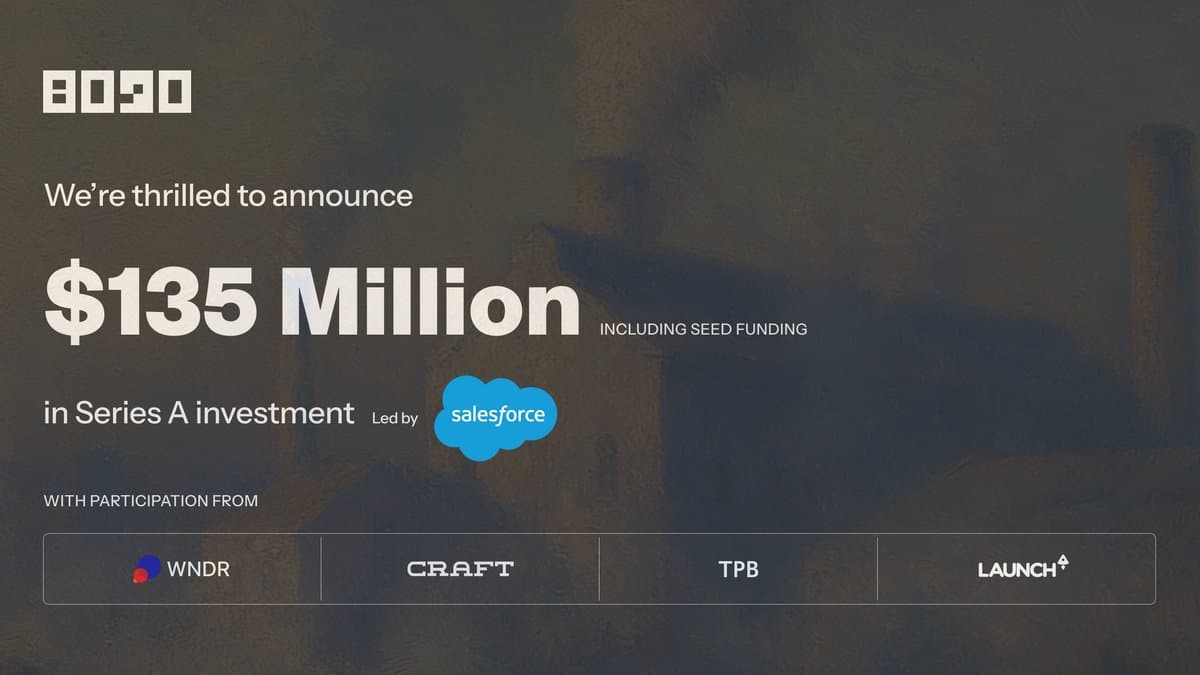
And alongside that decision, 8090 announced it had raised a $135 million Series A. The round was led by Salesforce Ventures, the venture arm of Salesforce. Joining in were Jeffrey Katzenberg's WndrCo, David Sacks' Craft Ventures, David Friedberg's The Production Board, and Jason Calacanis' LAUNCH. If that list looks familiar, it should — it's essentially the entire "All-In" podcast cast showing up in one cap table. Chamath set the table, and his longtime co-hosts backed him with capital.
The point here isn't just "a famous investor started a company." What makes this interesting is how specific the market 8090 is chasing actually is. It targets healthcare, insurance, life sciences, aerospace, energy, manufacturing, financial services, and the U.S. government — industries where regulation is brutal and legacy systems are piled up like mountains. These are places where a "vibe-coded" prototype thrown together in an afternoon absolutely does not fly. Everything needs audit trails, needs to be verifiable, and needs to not blow up when it hits real production. 8090 is going straight at that hard problem with AI.
By the end of this piece, it should get clearer why Chamath is trading his investor chair for an operator's one right now, and why Salesforce opened its checkbook for this company. To spoil it slightly: this isn't a run-of-the-mill bet riding the "AI coding" wave — it's a positioning move in a much bigger fight over who gets to rebuild enterprise software from the ground up.
The Players — Chamath, 8090, and the All-In Crew
Let's start with who Chamath Palihapitiya actually is. Born to Sri Lankan immigrants and raised in Canada, he joined Facebook in the late 2000s and led the user growth team that designed the company's explosive expansion. After leaving Facebook in 2011, he reinvented himself as an investor by founding the venture fund Social Capital, then rode the SPAC boom hard enough to earn the nickname "the SPAC king." In recent years, the "All-In" podcast pushed his public profile even higher. In other words, for 15 years he's been the guy who puts money into other people's companies and offers commentary from the sidelines. Him personally sitting in the CEO chair is a signal all on its own.
The company name 8090 is fun too. "80/90" can be read as 80% AI, the rest finished by humans — or simply as a statement of intent to automate the vast majority of software development. Chamath founded the company in January 2024, with Sina Sojoodi joining as cofounder and CTO. Sojoodi is a seasoned engineering leader from the enterprise software platform world, and he's the axis connecting Chamath's capital and vision to the technical muscle that actually runs the product. If Chamath is the face, Sojoodi is the engine.
Salesforce Ventures, which led this round, is not just a VC with deep pockets. Salesforce is one of the dominant forces in the global enterprise SaaS market, and Salesforce Ventures is known for strategically investing in companies that create synergy with its ecosystem. The fact that it led the 8090 round suggests it sees the company's "Software Factory" as meshing with the enterprise-AI picture Salesforce is drawing.
Look at the rest of the participant list and the nature of this deal comes into sharper focus. Jeffrey Katzenberg's WndrCo (Katzenberg cofounded DreamWorks), David Sacks' Craft Ventures, David Friedberg's The Production Board, and Jason Calacanis' LAUNCH — as noted, effectively the "All-In" lineup. On top of that, heavyweight angels joined too, including Palo Alto Networks CEO Nikesh Arora and Quora CEO and AI power broker Adam D'Angelo. In short, this is a round where Chamath's personal network poured into the company wholesale, in the form of capital and credibility.
What Actually Happened — What Even Is a "Software Factory"?
8090's core product is called Software Factory. By name alone it might sound like just another AI coding tool, but the actual architecture is different. This isn't a chatbot that autocompletes code — it bills itself as an "AI-native software development lifecycle (SDLC) control plane." In plain terms, it's a single integrated control tower where AI manages the whole process of planning, designing, building, and deploying software.
Concretely, Software Factory is built out of four modules: requirements definition, architecture design, project planning, and code execution. These four stages aren't siloed — they're integrated into one pipeline, designed to carry you from "here's the system we need" all the way to deployable, production-grade software. This is precisely the line 8090 draws between itself and prototypes hacked together via "vibe coding." The phrase Chamath and 8090 keep repeating is "production-quality software" — software an enterprise can actually trust and run.
Why does that matter so much? Because in regulated industries, you simply can't take "code an AI wrote" on faith. A bank, a hospital, an aerospace firm has to keep records of why code was written a certain way, who approved it, and what verification it passed. 8090's selling point is that Software Factory bakes these audit trails and control mechanisms in from the start. So it isn't selling "build it fast" — it's selling "build it fast while keeping it fully controlled."
Look at 8090's target customer list and the strategy gets even clearer: healthcare, insurance, life sciences, aerospace, energy, manufacturing, financial services, and the U.S. federal government. Every one of these has decades of legacy systems stacked up, industries where touching the wrong thing can be catastrophic. Here's a table laying out the core of the deal and the product.
| Item | Detail |
|---|---|
| Announcement date | June 29, 2026 |
| Round | Series A |
| Amount raised | $135 million |
| Lead investor | Salesforce Ventures |
| Key participants | WndrCo, Craft Ventures, The Production Board, LAUNCH |
| Notable angels | Nikesh Arora, Adam D'Angelo, and others |
| Founder/CEO | Chamath Palihapitiya (became full-time CEO June 2026) |
| Cofounder/CTO | Sina Sojoodi |
| Founded | January 2024 |
| Core product | Software Factory (4-module SDLC control plane) |
| Target industries | Healthcare, insurance, aerospace, finance, energy, manufacturing, U.S. gov |
That table alone makes it obvious that 8090 isn't chasing the "coding assistant for individual developers" market — it's after the "large-scale software modernization for enterprises and government" market. If Cursor or GitHub Copilot are tools that boost an individual developer's productivity, 8090 has the ambition to change how an entire organization produces software in the first place.
What Each Side Is Really After
Start with what this decision means for Chamath. He's a man who doesn't need to be a full-time CEO — he's already a billionaire and can keep plenty of influence through investing and podcasting alone. So returning to an operating role after 15 years signals that 8090 isn't just another portfolio company to him; it's a game he's convinced he has to win in this AI cycle. When someone who used to offer commentary from the sidelines steps in to personally shoulder the risk and execution, that's the strongest possible signal of how big he thinks the opportunity is.
Salesforce Ventures' calculus is also clear. Salesforce is pushing hard to embed AI agents across its entire product suite. But what enterprise customers actually want isn't a chatbot — it's real capability to safely overhaul their aging systems. 8090's Software Factory targets exactly that demand, so from Salesforce's perspective, leading this round means staking out an early position in a strategic asset that can create ecosystem synergy. Coming in as lead investor signals it expects more than a purely financial return.
The "All-In" crew's participation reveals another layer of intent. Craft Ventures' David Sacks, WndrCo's Katzenberg, The Production Board's Friedberg, and LAUNCH's Calacanis all have long relationships with Chamath. Their showing up in one round means they're betting on Chamath the person and his judgment as much as they're deploying capital. In startup investing, a founder's network and credibility are intangible assets in their own right — and 8090 secured the maximum of that from day one.
The angel participation from the likes of Nikesh Arora and Adam D'Angelo carries weight too. Arora runs cybersecurity giant Palo Alto Networks and knows the enterprise security and regulatory market better than almost anyone, and D'Angelo sits at the center of the AI industry's inner circle. People like this putting in personal money is evidence that 8090's "target regulated industries" strategy looked persuasive even to seasoned insiders. That said, angel backing is no guarantee of success, and that's worth keeping in mind.
Precedents — Wins and Failures
The history of "startups founded by famous people" splits sharply between wins and failures. On the win side, plenty of serial founders have leveraged their reputation and network to quickly raise large rounds and grab market share early. In these cases, the founder's name translated into real premiums for early customer acquisition, talent recruiting, and follow-on funding. Chamath is playing that card to the hilt. At a stage when an unknown founder would struggle to close a seed, he locked in over $100 million in a Series A along with a top-tier investor list in one shot.
But there are plenty of failures too. Capital drawn in on a famous name alone, absent real product and execution, has collapsed countless times. Notably, several companies taken public during the very SPAC boom Chamath championed later saddled investors with big losses through stock crashes and weak results. That's why some skeptics haven't dropped the "here goes Chamath manufacturing hype again" glance. What's different this time is that he's personally responsible for execution as CEO — but the execution risk hasn't vanished.
The enterprise software modernization market itself is a mixed bag of wins and failures. The IT world is littered with companies and consulting projects that set out to overhaul creaky legacy systems only to founder on budget overruns and schedule slips. The more regulated the industry, the more complex the requirements and the more verification steps involved — so a promise to "swap it out fast with AI" tends to slam into the wall of reality. The audit trails and controls 8090 emphasizes are precisely the differentiation aimed at that pain point, but whether safely rebuilding a hospital's or bank's core systems with AI is as easy as it sounds remains to be seen.
So 8090's real test won't be "funding" — it'll be "reference customers." If it successfully builds a production-grade system for one or two large customers in a regulated industry, and that turns into verifiable results, the company will earn trust fast. Conversely, if actual adoption lags far behind the flashy round, the shadow of past SPAC hype could get summoned right back.
Rivals' Counterplay
The "AI software development" market 8090 jumped into is already a crowded battlefield. The first names that come to mind are Anysphere (maker of Cursor), Cognition (Devin, positioning itself as an autonomous software engineer), and Microsoft with GitHub Copilot out front. But many of these are focused on boosting the productivity of individual developers or dev teams. 8090 steps back from that and drills into a different angle: the "software production pipeline for the entire organization" and "the control requirements of regulated industries." It's less a head-on collision and more a flanking maneuver.
That doesn't mean it can relax, though. Companies like Cursor and Cognition are rapidly expanding into the enterprise market and beefing up audit and governance features. If they layer enough of the controls regulated industries demand onto their products, 8090's differentiation could narrow in a hurry. Ultimately this fight is likely to become a speed race over who first finishes a product that regulated industries can genuinely trust and deploy.
Big Tech's response can't be ignored either. Microsoft, Google, and Amazon all stack enterprise AI development tools on their own clouds, and Microsoft in particular is already deeply embedded in countless large-enterprise dev orgs through GitHub and Azure. Armed with overwhelming distribution and existing contracts, they can lean on the logic of "you're already using ours — why bother switching to a young startup?" To clear that wall, 8090 has to prove with real cases that it does what existing tools simply can't.
The intriguing part is Salesforce coming in as lead investor. Salesforce itself competes with Microsoft and others in the enterprise AI agent market, so betting on 8090 could be a move to fold this capability into its own ecosystem. Which means 8090 is competing as a standalone startup while also potentially riding on the distribution muscle of a giant ally in Salesforce. If that materializes, the competitive picture could get reshaped meaningfully in 8090's favor.
So What Changes
For developers, this news cuts both ways. On one hand, Software Factory's vision of AI managing everything from requirements to architecture to deployment can stir the "so what about my job?" anxiety. But realistically, what 8090 is targeting is the decades-old legacy code in regulated industries that nobody wants to touch. If AI shoulders a big chunk of that tedious, risky maintenance and modernization work, developers get room to focus on the more creative, judgment-heavy areas. And as long as the "a human verifies and takes responsibility for AI-written code" structure holds, the role of skilled engineers isn't going to vanish overnight.
For investors, this deal is a benchmark in several ways. First, it shows just how strongly the signal of "a famous founder personally returning as operator" can move a Series A valuation. Second, a strategic investor like Salesforce leading as lead suggests that in the enterprise AI dev-tools market going forward, "ecosystem-linked strategic investment" may carry more weight than "purely financial investment." That said, whether a $135 million early-stage round gets backed up fast enough by real revenue and adoption is still an open question, so it's too early to call.
For everyday users and enterprise decision-makers, the ultimate effect of this trend is likely to show up as "how fast regulated industries digitally modernize." The reason your banking app feels slow and dated, the reason hospital systems still run on fax, is mostly that the legacy systems underneath are painfully hard and expensive to replace. If a company like 8090 can genuinely lower that cost and risk, over the long run that could flow through to better service quality that consumers actually feel. Of course, that all rests on the assumption that 8090 proves its promises with a real product.
To sum up: this 8090 round isn't just a "star founder's comeback show" — it's a serious bet in a much bigger fight over who gets to rebuild enterprise software. If the reason Chamath decided to get his hands dirty after 15 years is that he sees the opportunity as truly large, then the actual adoption cases 8090 produces over the next year or two will decide which way this game breaks.
🥄 Three Things You're Probably Wondering
— So what does this mean for me? Not much directly, at least for now. But if you use regulated-industry services like banking apps or hospital systems, the more companies like this succeed, the more those creaky systems might slowly get faster and better. If you're a developer, it's worth reading as a signal that "legacy modernization" has become AI's next battleground.
— Is Chamath becoming CEO really that big a deal? Symbolically, yes — it's a shift from investor to operator after 15 years, signaling he sees this opportunity as huge. But fame isn't the same as execution, so the real meaning only becomes clear once actual product and customer results show up. Too early to say.
— Is "Software Factory" the real thing, or just more hype? The direction is persuasive because it targets regulated industries' control and audit requirements head-on. But safely rebuilding a hospital's or bank's core systems with AI is extraordinarily hard, so it's right to hold judgment until a reference customer's real success story appears.
References
- 8090 — Announcing Our Series A (official blog)
- AI software development startup 8090 nabs $135M funding round — SiliconANGLE
- 8090 Raises $135M Series A to Accelerate Their Rollout of Software Factory — BusinessWire
- Chamath Palihapitiya raises $135M Series A for his AI coding startup, takes CEO role — TechCrunch
Numbers and criteria are as of announcement and may change. Investment calls are yours to make!