A human-shaped robot just became a stock
Here is the deal: a company whose two-legged robots haul totes around warehouses is actually going public. Oregon-based Agility Robotics is merging with a SPAC — Churchill Capital Corp XI, run by Wall Street dealmaker Michael Klein — and will list on Nasdaq under the ticker AGLT. The valuation lands around $2.5 billion, and the deal pulls in more than $620 million in fresh cash. Why is that a big deal? Because this is the first time a company whose entire business is humanoid robots — nothing else — is hitting a US public market.
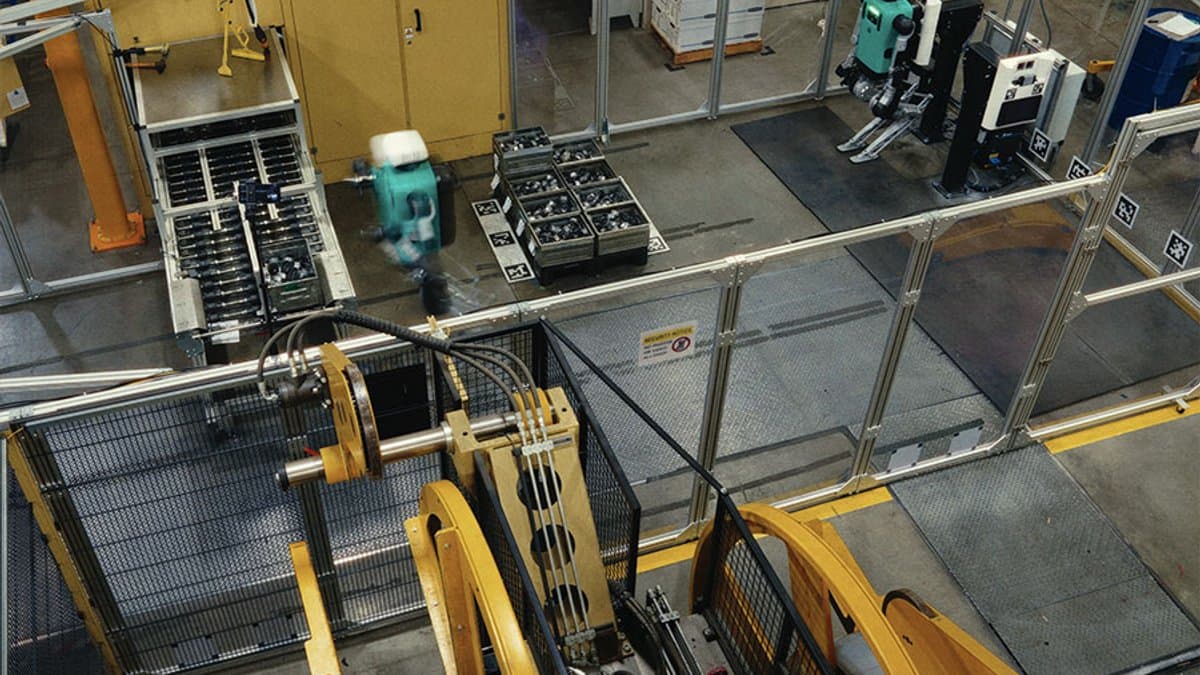
Until now, humanoid robots mostly lived in YouTube demo reels and funding-round headlines. Tesla's Optimus, Figure, Apptronik — they all keep repeating "it's coming soon." Agility is a bit different. It already sells Digit, a robot that's genuinely working inside Amazon warehouses and at German auto-parts giant Schaeffler's factories. So when a company like that crosses over into the public market, it becomes a symbolic moment: the industry moving from "demo stage" to "prove it with revenue" stage.
The announcement dropped on June 24, 2026, and for more than a week after, tech and finance outlets kept digging in and the story kept growing. Why does it keep getting talked about? Because the roster of investors on this deal is jaw-dropping. The PIPE (private investment made alongside the public listing) was led by Foxconn — yes, the company that assembles your iPhone — and existing backers NVIDIA, Amazon, and SoftBank Vision Fund 2 all decided to stay in. Instead of cashing out, they rolled their equity into the public company. What that signals, I'll unpack later.
The cast — a robot company, a SPAC heavyweight, and Foxconn
First, the protagonist: Agility Robotics. Headquartered in Salem, Oregon, its flagship is Digit — a robot that walks on two legs like a person. It stands roughly human height and does jobs like grabbing plastic totes and picking cases in warehouses. The CEO is Peggy Johnson, a veteran executive who was a business-development VP at Microsoft and then CEO of Magic Leap. The telling part: Agility put a commercialization-and-sales operator in the top seat, not a founder-engineer. In the announcement, Johnson put it bluntly: "Companies don't buy tech; they buy solutions. At Agility, we're doing just that."
Second is the man who brought the SPAC: Michael Klein. When people on Wall Street think "SPAC," they think of him. A former Citigroup banker, his signature deal was taking EV maker Lucid Motors public via SPAC, and small-reactor company Oklo also went through his hands. This time he's using the eleventh vehicle in his Churchill series — Churchill Capital Corp XI (ticker CCXI) — to bring Agility to market. Klein's involvement signals this isn't some penny-stock listing; it's an engineered debut with a thick layer of institutional money underneath.
Third, and maybe the most important, is Foxconn. The Taiwanese company is the world's largest electronics contract manufacturer — the one that assembles iPhones. Foxconn led the roughly $200 million PIPE at $10 per share. But Foxconn didn't just write a check; it was already an Agility investor. That makes this a strategic bet: "we're going to use these robots on our own factory lines, so we're going deep as a shareholder." Electronics assembly lines still lean heavily on human hands, so for Foxconn, humanoids are a cost-cutting weapon in waiting.
The supporting cast is glittering too. NVIDIA, Amazon, SoftBank Vision Fund 2, DCVC, Playground Global, and Schaeffler all show up as existing investors. NVIDIA sells the AI chips and simulation platforms that become the robot's brain; Amazon is both a customer and a backer. Just reading that list tells you Agility sits right in the middle of a semiconductor–cloud–logistics–manufacturing industrial belt.
The substance — where the $620M actually comes from
The core of this transaction is: how do you build up more than $620 million? A SPAC listing runs on two pools of money. One is the cash the SPAC parked in a trust account when it first listed; the other is the fresh PIPE money added at merger time. The Agility deal combines the two into over $620 million in gross proceeds, which the company is calling "the largest capital raise in humanoid robotics history to date."
Here is the money structure in a table.
| Item | Detail |
|---|---|
| Listing method | SPAC merger with Churchill Capital Corp XI (CCXI) |
| Market / ticker | Nasdaq · AGLT |
| Valuation (pre-money equity) | ~$2.5 billion |
| Trust account cash | ~$420 million (assuming no redemptions) |
| PIPE size | ~$200 million (at $10/share) |
| PIPE lead investor | Foxconn |
| Total gross proceeds | $620 million+ |
| Announcement date | June 24, 2026 |
| Expected close | Later in 2026 |
Pay attention to that "assuming no redemptions" caveat. In a SPAC, existing shareholders who dislike the merger have the right to pull their money out at around $10 per share (redemption). As the SPAC market cooled recently, plenty of deals saw redemption rates above 90%. That would shrink the trust's $420 million in reality. The saving grace here: existing investors like Foxconn, NVIDIA, Amazon, and SoftBank chose to roll their equity rather than cash out, so the $200 million of fresh PIPE money is relatively solid. That's exactly why this deal is being described as different from "just another SPAC."
Just as important as the money is the proof of business. Agility says Digit has logged more than 65,000 hours of operation across nine customer facilities. At logistics firm GXO alone, Digit moved over 100,000 totes last year, and ahead of the close, customers including Schaeffler, GXO, Toyota Motor Manufacturing Canada, and Latin American e-commerce player Mercado Libre have pre-ordered the next-gen "Digit v5" to the tune of $300 million-plus. If that holds, it's the decisive line separating Agility from other humanoid companies that have demos but no revenue.
Manufacturing capacity is another pillar. Agility owns a robot-dedicated factory in Salem, Oregon called RoboFab. The facility is designed to produce up to 10,000 Digit units per year, and the company says roughly 75% of Digit's parts are sourced domestically within the US. The "Made in USA" framing is a favorable card for government and large-enterprise procurement in the current US policy climate, which is why the company is leaning on it.
What each party gets — Agility, Klein, Foxconn, investors
What Agility gets is simple: time and ammunition. Humanoids are an insanely R&D-hungry business, where improving a single component can burn millions. Over $600 million of cash buys several years of runway for Digit v5 mass production, RoboFab expansion, and hiring software talent. On top of that, being a public company makes big enterprise customers more comfortable placing large orders, reassured this vendor "won't disappear." To win a contract for 200 robots in a warehouse, a startup has to pass the "will you still exist in three years?" test — and a Nasdaq ticker is itself an answer.
What Michael Klein gets is another landmark deal. The SPAC market shrank hard after the 2021 mania, and a pile of failed SPAC listings dented its reputation. In that environment, stamping the "first pure-play humanoid listing" title onto his own vehicle lets Klein rebuild the brand of a "heavyweight who only picks deals that work." And SPAC sponsors typically pick up founder shares cheaply, so the financial upside is substantial too.
Foxconn gets two things at once. First, potential financial return — as an early investor and PIPE lead, it profits if Agility's stock rises. Second, and more important, strategic access. Foxconn's core electronics-assembly business is still labor-intensive, and replacing part of the line with humanoids would let it attack rising labor costs and worker shortages head-on. As an Agility shareholder, it gets a stronger seat at the table for priority robot supply and joint development.
The existing investors (NVIDIA, Amazon, SoftBank) rolling their equity also has logic behind it. Private startup stakes are "locked money" that's hard to sell; going public gives them liquidity — at minimum a market price and the eventual ability to sell. SoftBank Vision Fund 2 in particular is betting big on robotics and AI right now, so holding Agility as a public trophy helps the fund's narrative. That said, the fact that they're not selling now is also a bet that it goes higher — which conversely means low early float and potentially high stock volatility.
Past parallels — the wins and the wrecks
SPAC listings have split into extremes. Take Michael Klein's own signature, Lucid Motors. When it went public via SPAC in 2021, it raised over $4 billion in cash and its market cap briefly soared toward $90 billion. But production ramped far slower than planned, losses kept piling up, and the stock fell sharply from its listing price. It's a case where "the tech and vision were real, but the wall of mass production was higher than the money the SPAC raised." Agility risks the same road if robot production doesn't go to plan.
On the flip side, some robot companies — like Intuitive Surgical (surgical robots) — have climbed for decades on steady post-listing revenue growth. Of course, that was a normal IPO, not a SPAC, and crucially it had a recurring-revenue model in "per-procedure consumables." Whether Agility can bolt recurring revenue — software subscriptions, maintenance, inventory-management services — onto selling a robot, rather than a one-and-done sale, will decide its long-term fate.
The most painful cautionary tale is the pile of "tech SPACs" that collapsed over the past few years. eVTOL aircraft, self-driving trucks, and space-launch startups all went public via SPAC with fanfare, only to see revenue come in below a tenth of projections, stocks fall 90%+, and many get delisted. Their common thread: at listing time, actual revenue was near zero and they were valued purely on projected future revenue. To avoid that trap, Agility has to show quarter after quarter that figures like 65,000 operating hours and $300 million in pre-orders actually convert into revenue.
Bottom line: Agility is clearly ahead of the "demo-only SPACs" — it has a product that sells and paying customers. But to become a "SPAC that held its listing price," it ultimately has to climb two mountains — production speed and recurring revenue — and that's something the next few quarters of results, not a press deck, will prove.
How rivals counter-play
Competitors won't sit still on Agility's listing news. The biggest rival is Tesla's Optimus. Tesla doesn't need to go public — it's already one of the most cash-rich companies on earth, and with Elon Musk publicly claiming "Optimus will make up most of Tesla's value," it effectively wields near-limitless capital plus its own factories, batteries, and AI-chip ecosystem. While Agility touts $620 million, Tesla can burn that much on quarterly R&D. Agility's counter is its real-world deployment record: "we're already getting paid to work in other people's factories."
The second rival is Figure AI. Backed by Microsoft, OpenAI, and NVIDIA money, it's stayed private at a multi-billion-dollar valuation and is famous for its BMW factory pilot. Figure chose to keep burning private capital instead of listing. If Agility locks in funding and credibility first via the public market, Figure may counter with "we raise at higher valuations in private," or it may actually time its own listing based on how Agility's stock trades. In effect, Agility's share price becomes the public valuation benchmark for the whole humanoid industry.
Third, don't sleep on Apptronik. It's pushing its "Apollo" robot in partnership with Google DeepMind and has run a Mercedes factory pilot. And the Chinese camp — companies like Unitree and UBTech — is flooding the market with far cheaper humanoids. If a Chinese robot costs half as much, Agility's "75% American-made" premium is a strength on procurement and security grounds but a burden in pure price competition.
The rivals' shared counter-play ultimately comes down to price and software. Hardware eventually converges and gets cheaper over time. The real moat is how fast a robot learns new tasks — that is, the AI software. That's exactly why NVIDIA invests in both Agility and Figure: whoever wins, NVIDIA sells the robot-brain chips. For Agility, how much of its listing ammunition it pours into software learning speed — not just hardware production — will be the next battleground.
So what actually changes
For investors, there's finally a pure-play stock to buy the "humanoid robot" theme directly. Until now, betting on this theme meant buying companies like NVIDIA or Tesla where robots are only part of the business, or watching from the sidelines because you couldn't get into private startups. Once AGLT lists, for better or worse there's a new benchmark: a "pure humanoid stock." But SPAC listings carry heavy early volatility and traps like redemption dynamics and lockup-expiry supply, so diving in the moment it lists is risky.
For logistics and manufacturing companies eyeing robots, the listing lowers "vendor risk." The scariest thing for a plant manager leasing 200 robots over three years was "who handles service if the supplier goes bust in two years?" As a public company with disclosed financials and a thicker capital base, that anxiety shrinks, making it easier to commit to big orders. The $300 million in pre-orders attached to this announcement reflects exactly that psychology.
For everyday workers, the feelings get more complicated. Agility CEO Peggy Johnson drew a line in interviews, saying a robot in your home is still a long way off. For now, this robot focuses on replacing repetitive labor in warehouses and factories. So no robot butler in your living room anytime soon — but the simple, repetitive jobs in fulfillment centers and assembly lines are starting to enter this trend's blast radius. Good or bad, the core point is that "the era of humanoids getting paid to work on real industrial floors" just got formalized in the shape of a stock listing.
For general readers watching tech and industry, this listing will act as a thermometer for the "humanoid hype cycle." If AGLT's stock holds up post-listing, capital pours into the sector and follow-on listings and funding for Figure, Apptronik, and others cascade; if the stock collapses, a wave of "told you it was too early" skepticism blankets the industry. So this deal isn't just Agility's story — it's the entire humanoid industry stepping onto the public market's judgment stand for the first time.
🥄 Three Things You are Probably Wondering
— So what does this mean for me? No direct impact right now. But if you're an investor into robotics or AI themes, this is the first pure-play humanoid stock, so it's worth watching as a benchmark. If you work in logistics or manufacturing, this trend could reshape floor-level jobs over the coming years.
— Why is this happening right now? Humanoid hardware hit the exact inflection point of moving from "demo" to "actual paid deployment," and Agility already has Amazon and Schaeffler track records, so the timing was right to sell a story to the market. The SPAC market cooled, sure, but a deal with real revenue is precisely what stands out as scarce right now.
— Is Agility ahead of Tesla or Figure? On sheer capital and AI muscle, Tesla and Figure are thicker. Agility's real edge is "already getting paid to work in other people's factories" plus the symbolism of being the first pure-play listing. It's too early to say it leads on technical advantage — production speed and software learning ability will settle that.
References
- Agility Robotics official announcement — Go Public Through Merger with Churchill Capital Corp XI
- The Robot Report — Humanoid maker Agility Robotics to go public through SPAC merger
- TechCrunch — This humanoid robotics company is going public
- StockTitan — Churchill Capital Corp XI (CCXI) Form 425 business combination filing
- Humanoids Daily — Agility to Go Public in $2.5 Billion SPAC Merger with Churchill Capital XI
Numbers and criteria are as of announcement and may change. Investment calls are yours to make!