In the same week Zuckerberg admitted agents "haven't accelerated," Meta shipped an image hit
Meta had a whiplash of a week. On July 2, Mark Zuckerberg stood in front of employees at an internal town hall and admitted that over the previous four months, AI agent development "hasn't really accelerated in the way that we expected." That's a heavy line coming from the CEO of a company that just laid off around 8,000 people and pledged $125 billion to $145 billion in 2026 capital spending. The stock slid 5-7% in extended trading, and the headlines wrote themselves: "Meta's AI is falling short."
Then, exactly five days later on July 7, Meta flipped the script entirely. It unveiled Muse Image, its first in-house image-generation model, and dropped it directly into the Meta AI chatbot, Instagram, and WhatsApp. The message underneath was clear: agents may be sputtering, but image generation can land in the hands of billions of users right now. Same company, same week, two contradictory truths side by side — "our AI isn't there yet" and "our AI is already everywhere."
That contrast is the real story here. Meta sits somewhere between "lagging challenger" and "distribution juggernaut." In the race to build smart, autonomous agents that actually get work done, it's widely seen as trailing OpenAI, Google, and Anthropic. But in the ability to put whatever it builds in front of more people faster than anyone alive, nobody comes close. Muse Image leans hard into that second strength, which is exactly why it matters.
In this piece I'll break down what Muse Image actually does, where it lives, and how this consumer hit tangles strangely with Zuckerberg's agent confession — with a fresh privacy fight thrown in for good measure.
The cast: Meta, Superintelligence Labs, Muse Image, and a distribution machine of billions
Start with Meta. This isn't the company's first rodeo in image generation. It ran an earlier image model called Emu and a consumer feature called "Imagine with Meta." But for years, Meta's image AI trailed the name recognition of OpenAI's DALL·E or Google's Imagen. It existed; it just never quite broke through culturally. Present but not talked-about — that was the slot Meta kept landing in.
Muse Image comes from Meta Superintelligence Labs — yes, the organization Zuckerberg stood up earlier this year by throwing eye-watering pay packages at top AI talent. Meta's newsroom explicitly calls Muse Image the lab's "first image generation model." In other words, this isn't a bolted-on third-party system; it's the first consumer-facing output of the expensive new org the whole company has been staking its future on. The symbolism is enormous.
Next comes the real protagonist: the distribution surface. Muse Image runs today inside the Meta AI chatbot, Instagram Stories, and WhatsApp. Instagram Stories gets more than 30 new AI-powered effects, and WhatsApp lets you generate images inside your private chats with Meta AI (limited countries first, expanding). Facebook, Messenger, and an advertiser-facing "Advantage+ creative" integration are coming soon. The point: you don't install a new app or sign up for a new service. Image generation just switches on inside the apps you already open every single day.
The final character is Zuckerberg himself, currently carrying two narratives at once. One is the grand "we're marching toward superintelligence" vision. The other is the sober admission that "our agents aren't showing up as fast as we hoped." Muse Image is the strongest card he can play between those two stories. Big autonomous agents aren't here yet — but a fun, tangible, use-it-today image generator absolutely is. It's visible proof, for investors and employees alike, that Meta's AI actually runs.
What Muse Image actually does: generate, edit, and that @-mention
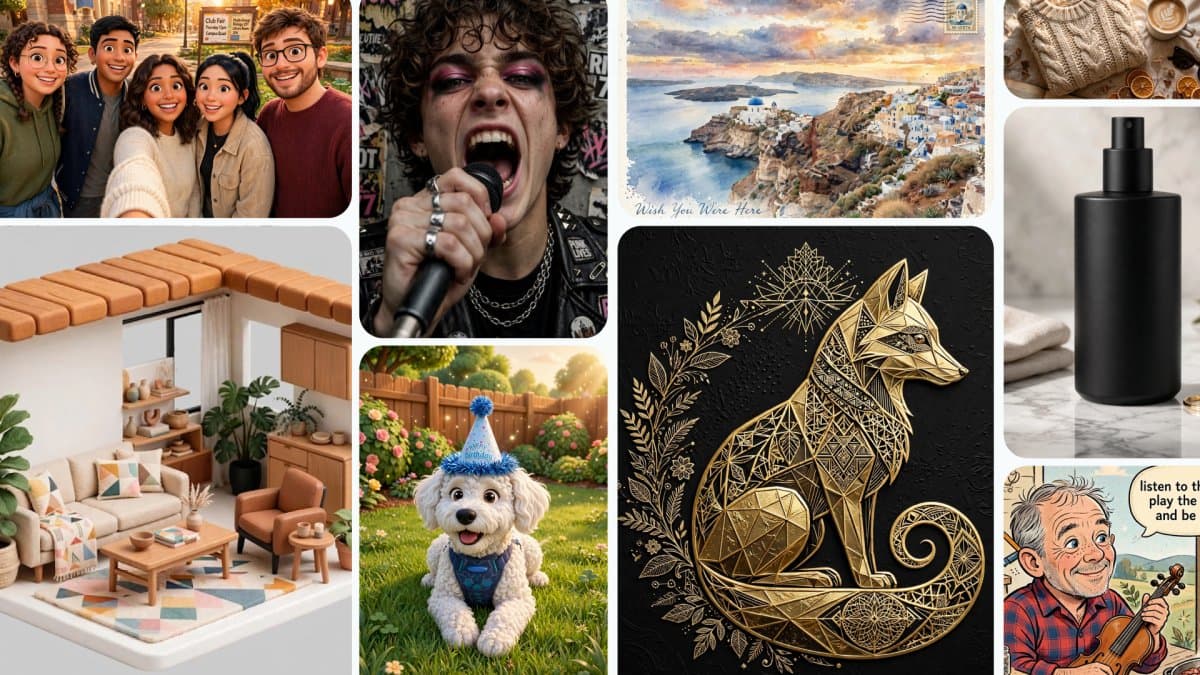
Muse Image splits into two lanes. One is generation from a blank slate; the other is editing photos you already have. On the generation side, you type a prompt and it produces things like "a shot of me in front of a historic landmark" or a clean, styled infographic. Meta stresses that the model parses complex prompts with advanced reasoning and seamlessly blends multiple photos into a single high-quality result.
The editing side is where it gets genuinely useful. You can sketch or mark up edits directly on top of an existing photo — "fix this here" — and it applies them. Erase a photobomber lurking in the background, or restore an old photo by removing scratches and fixing faded color. A few lines of prompt and your photo edit is done.
Meta also claims to have cracked two things that have been the Achilles' heel of image AI for years. First, rendering legible, cleanly styled text inside images. Second, producing QR codes that actually scan and work. Both are tasks that DALL·E, Imagen, and nearly every other model have mangled into garbled nonsense for years, so leading with them is a calculated selling point — these are exactly the elements marketers and advertisers use constantly.
The trouble is the third feature: the @-mention. On Instagram, tag another person's profile with the @ symbol, and Muse Image can pull their public photos and content into a brand-new AI image. Meta framed this as a playful way to "bring specific Instagram profiles right into your images." Users immediately pushed back — because you're dragging a real person into a generated image without their consent. Worse, it's opt-out by default, and Meta's policy states that "people may be able to create content with your Instagram content using AI features at Meta" and that "you will not be notified about content created using AI features at Meta." One X user quoted by TechCrunch put it bluntly: "Pulling real users into generated photos without explicit consent is a privacy landmine waiting to detonate."
Here's where you can use what, at a glance.
| Surface | Core capability | Status |
|---|---|---|
| Meta AI chatbot/app | Text→image generation, prompt editing, QR & text rendering | Live now (free by default) |
| Instagram Stories | 30+ new AI effects, @-mention to summon profiles | Live now |
| Image generation in private Meta AI chats | Rolling out, limited countries first | |
| Facebook & Messenger | Image generation/editing | Coming soon |
| Advantage+ creative (advertisers) | Auto-generated ad creative | Coming soon |
| Paid (subscription) | Higher volume, advanced features | Included in Meta subscription plans |
What each side gets: Meta, billions of users, and advertisers
Meta's win is obvious. First, validation that it can build a frontier-grade image model in-house. Superintelligence Labs landing its first consumer output cleanly is a defense against the charge that all that talent money vanished into thin air. Second, engagement. The fun of making and fixing images is powerful glue that keeps people inside the app. Add 30-plus new Stories effects and people post more Stories, which feeds right back into ad inventory.
For billions of Instagram and WhatsApp users, the barrier to entry is effectively zero. No separate Midjourney subscription, no Discord to learn, no new app to download. You just type into an app you already open daily — "erase the guy behind me in this photo" — like sending a message. Basic use is free; only people who want to create a lot get nudged toward a subscription. That "it's already right there" accessibility is Meta's real weapon, the one OpenAI and Midjourney can't easily copy no matter how good their models get.
Advertisers and creators get a gift too. Once the coming Advantage+ creative integration ships, a small-business owner can generate ad imagery from a prompt with no designer in the loop. Meta has already boosted ad performance with auto-generated creative, and welding its own image model onto that engine makes the ad-revenue machine stronger. The emphasis on QR codes and readable text is no accident either — both are staples of marketing and advertising assets.
But there's a bill on the flip side of all this "winning." The @-mention and opt-out default may juice engagement in the short term, but they chip away at privacy trust. Meta paid a $5 billion FTC fine over the 2019 Cambridge Analytica scandal and shut down Facebook's facial recognition in 2021. Critics see the same pattern repeating: broad use of your data unless you actively turn it off. The engagement comes now; the regulatory and trust invoice may arrive later.
Prior cases: image generation has always been a minefield
The history of image-gen AI is a roughly even split of dazzling wins and embarrassing faceplants. The most famous disaster was Google Gemini's image generation in 2024. Tuned so aggressively for diversity that it rendered historically white figures as other ethnicities, Google was forced to suspend image generation of people entirely. It showed that the thing that burns a company isn't the tech — it's how you design the guardrails.
On the other side sit the wins. OpenAI's DALL·E series essentially introduced text-to-image to the masses, and the later image generation baked into GPT went viral more than once (remember the Ghibli-style flood). It proved how powerful the UX of making images conversationally, inside a chatbot, really is. Meta planting Muse Image inside its chatbot and messengers rather than a standalone app follows that lesson to the letter.
Meta's own past belongs here too. Emu and "Imagine with Meta" ran quietly but never produced a cultural moment. The model existed; the buzz didn't — that's been the chronic ailment of Meta's image AI. Muse Image is an attempt to break the jinx: in-house build plus billions of distribution plus practical hooks like QR codes and text rendering, aiming this time to be the talked-about feature rather than the quiet model.
And then the dark shadow: deepfakes. Any feature that makes it trivial to composite and edit photos of real people has always drawn backlash over non-consensual deepfakes and likeness rights. Muse Image's @-mention getting hammered from launch day is that learned wariness kicking in. The lesson from every prior case is the same — in image generation, what topples a company is rarely model quality; it's how you designed consent, safety, and trust.
Rivals' counter-play: OpenAI, Google, Black Forest Labs, Midjourney, ByteDance
The image-generation arena is hand-to-hand combat right now. OpenAI set the standard for in-chatbot image UX with GPT's native generation and holds a strong brand plus a paid subscriber base. When Meta pitches "make images conversationally inside a chatbot," OpenAI is positioned to answer, "we invented that." The decisive difference is that OpenAI lacks a social distribution network of billions the way Meta has one.
Google, with Gemini's image features and its acclaimed editing model nicknamed "Nano Banana," has earned praise especially on photo-editing quality. Its own distribution — Android, Google Photos, Search — is nothing to sneeze at. Google will push the quality and integration of its editing model against Muse Image's edit-and-restore tricks, and having been burned by the 2024 Gemini image fiasco, it may even market its safety guardrails as a feature.
The specialist camp holds Black Forest Labs (Flux) and Midjourney. Flux is strong in the open ecosystem and developer/enterprise integrations; Midjourney still commands a devoted following on pure image quality and artistry. They fight on a different axis from Meta's "free for the masses" play. Even if Meta sweeps the mass market, the high-end and pro-creator tiers remain very much theirs to hold. The market isn't collapsing into one winner; it's splitting into layers.
Finally, ByteDance. With TikTok and CapCut, ByteDance controls a massive creator-distribution pipe and collides with Meta most directly, because both run the same play: embed image generation inside the social feed. Meta stacking 30-plus effects into Instagram Stories is a signal that it intends to fight ByteDance's creative tools head-on. Ultimately, the battleground is shifting from "who builds the better model" to "who puts it in more people's hands every day." And that's precisely the ring Meta feels most confident stepping into.
So what actually changes — persona by persona
For everyday users, image generation shifts from "something you go somewhere special to use" to "something that's just in the app." You make an AI image mid-Story like picking an effect, or type "erase the guy behind me in this photo" during a WhatsApp chat and you're done. Zero barrier means image generation drops from an early-adopter hobby to a daily habit for billions. In exchange, features like @-mention add a fresh anxiety: your public photos can become raw material for someone else's generated image. You can turn it off in settings, but the fact that it's on by default is the uncomfortable part.
For creators and marketers, it's another free productivity tool falling into their lap. Generate ad creative without a designer, spin up promo images with QR codes and baked-in text in seconds. Once the coming Advantage+ creative integration lands, the real cost of ad production for small businesses drops. The catch: when everyone reaches for the same tool and pulls the same style, "obviously-AI" imagery floods the feed and differentiation paradoxically gets harder.
Now the investor angle — today's headline. Overlay Zuckerberg's "agents haven't accelerated like we expected" confession with the Muse Image launch and the picture sharpens. Meta is visibly flailing in the race for smart, autonomous agents. It cut 8,000 jobs and is burning north of $125 billion, yet the CEO himself admitted the reorg wasn't "clean" and those bets "haven't come to fruition yet." The market answered with a 5-7% stock drop.
But Muse Image is the exact card that covers that weakness. Agents may still be a daydream, yet image generation can land in billions of hands today. Meta's true moat isn't "the smartest AI" — it's "the AI that ships to the most people the fastest." The question investors should sit with: is Meta a company falling behind on agents, or the company that distributes everyone's AI features at the largest scale? Muse Image pushes hard on the latter narrative — you don't have to win the frontier-model race if you win distribution, because that's where the money is. The catch that lingers, though, is that for this logic to hold long term, Meta eventually has to deliver on the genuinely hard AI — agents included — too.
🥄 Three Things You're Probably Wondering
— Can I stop my Instagram photos from being pulled into someone else's AI image via @-mention? Yes, there's a setting. The problem is that it's on by default (opt-out). Per Meta's policy, if someone makes an AI image from your content, you won't be notified. If you care about privacy, go into settings and turn it off yourself. If you do nothing, your public photos can become fuel for someone's generated image. Annoying as it is, it's worth checking that setting once.
— Is Muse Image completely free? Basic generation and editing are free. But push it and you hit usage limits, above which you cross into paid features bundled in Meta's subscription plans. If you dabble for fun, you'll never pay. If you're a creator cranking out images daily, you'll eventually meet the subscription.
— Zuckerberg said AI agents "haven't accelerated" — so has Meta AI failed? Agents and image generation are different stories. Autonomous agents that get work done are sputtering, but visible consumer features like image generation are actually shipping well. Remember that Meta's edge isn't "the smartest AI" but "the AI that ships widest fastest," and every future Meta headline reads differently.
Sources
- Introducing Muse Image — Meta Newsroom (Jul 7, 2026, primary source)
- Meta Debuts New AI Image-Generation Model Inside Chatbot, Instagram — Bloomberg
- Meta rolls out Muse, a new AI image generator — and users are already pushing back — TechCrunch
- Zuckerberg tells staff AI agents haven't progressed as quickly as he'd hoped — TechCrunch
- Meta AI image model lets users work off other people's Instagram media — Washington Times
- Zuckerberg Admitted AI Agents 'Hasn't Really Accelerated' as Meta Stock Dropped — Motley Fool
Numbers are as of announcement and may change.