When Samsung opens its wallet twice, that's not just a check
Honestly, the word that jumps out of this whole story is "Samsung." Rebellions raising money isn't news anymore — it happens constantly. The real signal is that Samsung Electronics, which was already a shareholder, put in more. When an existing investor doubles down in a later round, it's the market's way of saying "this one still looks good," and when that investor is Samsung, the message carries very different weight.
Rebellions is currently running a $150-200 million (roughly ₩204-288 billion) pre-IPO round. CFO Shin Sung-gyu confirmed directly to CNBC and Korean outlets that Samsung Electronics joined this round. Samsung didn't disclose exactly how much it wrote, but the point stands: an existing shareholder increased its stake right before the listing.
And the plan is that once this round closes, the company goes straight into IPO prep. CEO Park Sung-hyun has now publicly committed to a Kospi listing in the first half of 2027, and Rebellions has already lined up JPMorgan and Samsung Securities as underwriters. So this Samsung investment isn't a random cash infusion — it's the last magazine of ammo being loaded before the listing.
If any Korean AI-chip company is actually going to make it to a public offering, Rebellions is standing at the front of the line right now. That's why the "Korea's Nvidia" nickname keeps sticking to it — and today's story is really about Samsung betting on that nickname.
Who is Rebellions, and why are Samsung AND SK both in the cap table?
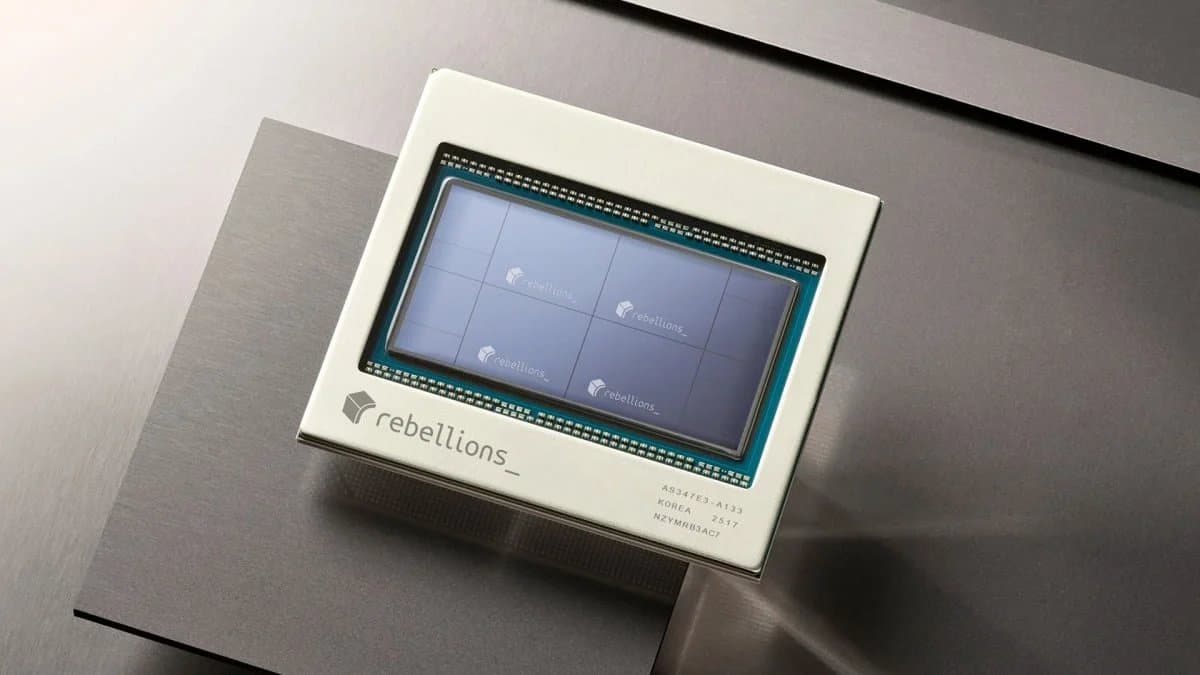
Rebellions is a fabless AI chip startup founded in 2020. Fabless means no factories — they design chips and let someone else manufacture them. Specifically, they build NPUs (neural processing units) tuned for AI inference — the stage where a trained model actually runs to produce answers, as opposed to the training that created it. A crew of engineers out of Samsung, Intel and similar backgrounds, led by CEO Park Sung-hyun, started the company.
The cap table is where it gets interesting. In December 2024, Rebellions merged with Sapeon Korea, and that's when things scaled up. Sapeon was an SK Telecom subsidiary, so the merger pulled SK Telecom and SK Hynix in as strategic shareholders. A company that had leaned Samsung suddenly had the entire SK camp on board too. That's how you end up with the odd picture of Korea's two semiconductor giants both draped over a single startup.
Run down the shareholder list and it's genuinely stacked: Samsung Electronics, SK Hynix, SK Telecom, KT, the Korea National Growth Fund, Saudi Aramco (via Wa'ed Ventures), Mirae Asset, IMM Investment. Two of Korea's three telcos, two chip giants, sovereign-fund-scale money, and a venture arm of Saudi Arabia's state oil company. KT came in early back in 2022 and topped up multiple times; the SK camp arrived via the Sapeon merger; Samsung has steadily grown its position.
Notably, in March 2026 Rebellions was picked as the first direct-investment target of the Korea National Growth Fund under the government's so-called "K-Nvidia" nurturing project, pulling in a ₩640 billion pre-IPO round. That round valued the company at ₩3.4 trillion, and cumulative funding has climbed to roughly ₩1.3 trillion. A government fund choosing a single startup as its "first" direct bet is basically a declaration that it intends to raise this one into a national champion.
Keep the underwriter lineup in mind too: JPMorgan (global), Samsung Securities, and Korea Investment & Securities. Bringing in JPMorgan as global coordinator signals they've had overseas investors and an overseas listing in their sights from the start — and indeed, Park has said that after the Kospi debut, a New York Stock Exchange or Nasdaq ADR listing is on the table.
So what exactly got decided here?
Let's strip it to the bones. First, Samsung Electronics joined the ongoing $150-200 million pre-IPO round as an additional investor. Second, Rebellions will pursue a first-half 2027 Kospi listing once this round wraps. Third, the underwriters are JPMorgan and Samsung Securities. Those three facts are the skeleton of the news.
One thing people keep conflating: the "₩640 billion at a ₩3.4 trillion valuation" round already closed in March 2026, and this new "$150-200 million" is an additional pre-IPO round stacked on top of it. Don't add them together — think of this new one as the final pre-listing top-up of cash and allies. Some foreign outlets like CNBC and Caproasia bundle the two into a tidy "$400M at a $2.3B valuation," but per the Korean primary sources, the accurate mental model is "₩3.4 trillion valuation, with this extra round layered on."
What Rebellions actually builds matters most of all. Its first-generation chip is ATOM. ATOM was the first domestic NPU commercialized on KT Cloud, and Rebellions silicon also powers live services like SK Telecom's "A." (A-dot) call-summarization feature. In other words, this isn't a chip in a slide deck — it's a chip paying customers are already running. That's the basis for Park's line that "substantive revenue is now being generated."
The second generation is REBEL. It's fabricated on Samsung Foundry's 4nm process and paired with HBM (high-bandwidth memory) to target large language model inference. Rebellions plans to ship "Rebel-Quad" — four chips bundled into one package — within the year. And here Samsung's self-interest becomes crystal clear: Samsung is both an investor and the foundry customer manufacturing these chips. It puts money in and takes wafer orders out.
Here's a table of the round and listing terms.
| Item | Detail |
|---|---|
| Round type | Pre-IPO (additional pre-listing round) |
| Round size | $150-200M (approx. ₩204-288 billion) |
| New participation this round | Samsung Electronics (existing shareholder, topping up) + other domestic/foreign investors |
| Prior round (Mar 2026) | ₩640 billion raised, ₩3.4 trillion valuation |
| Cumulative funding | Approx. ₩1.3 trillion |
| Listing target | Kospi, first half of 2027 |
| Underwriters | JPMorgan (global), Samsung Securities, Korea Investment & Securities |
| Overseas listing | NYSE / Nasdaq ADR under review post-Kospi |
| Key shareholders | Samsung, SK Hynix, SK Telecom, KT, National Growth Fund, Saudi Aramco (Wa'ed), Mirae Asset, IMM |
| Founded | 2020 (CEO Park Sung-hyun) |
| Sapeon merger | December 2024 (SKT subsidiary → SK camp joins) |
| Main products | ATOM (Gen 1, commercialized) / REBEL (Gen 2, Samsung 4nm) |
What each side actually gets — Rebellions, Samsung, and the nation
What Rebellions gets is obvious: friendly capital that props up the valuation right before the listing. The closer a listing gets, the more a returning existing shareholder signals confidence than a fresh face would. The story "Samsung, which knows this company best, put in more" becomes a card to play when persuading retail and institutional buyers at the Kospi offering. And a fat pre-listing war chest is what lets Rebellions push Rebel-Quad into volume production and fund its next chip.
What Samsung gets is two-layered. One is a foundry customer. If Rebel's 4nm volume and Rebel-Quad production run through Samsung Foundry, then for a Samsung locked in a fight with TSMC, that's a stable domestic AI-chip account. With whales like Nvidia and Apple concentrated at TSMC, absorbing domestic AI-chip demand into its own fabs is strategically meaningful. The other layer is investment upside. If this reaches a listing, the value of an early stake jumps sharply — a fine financial bet on its own.
The national-level picture can't be ignored either. Korea's government is pushing a sovereign-AI agenda — build AI infrastructure on homegrown chips — and Rebellions is the poster child. The National Growth Fund's "first" direct investment, the parade of telcos and financial groups signing on (KB Financial inked a domestic inference-infrastructure partnership too) — it's all this same thread. A successful Rebellions IPO becomes a symbol that "Korea grew an Nvidia-alternative chip company all the way to a listing"; a stumble puts a crack in the entire sovereign-AI narrative. So this isn't just one company's IPO — it's a stress test for a national agenda.
For the investors, strategic shareholders like SK Telecom, KT and Aramco see beyond financial return. They're using equity to lock in a domestic chip supply chain for their own AI services and data centers. A telco running its AI services on Nvidia GPUs alone faces cost and supply risk, so holding a Rebellions stake and securing priority supply is the calculation underneath. Aramco's presence makes sense too, when you connect it to Saudi Arabia's own AI-infrastructure ambitions (a Middle East data-center build-out).
We've seen bets like this before — and they've gone both ways
A conglomerate and a state piling money into an AI-chip startup isn't new, and overseas the outcomes range from triumph to disaster. Groq rode its LPU — an inference-specialized chip pitched on blazing-fast inference — to a multi-billion-dollar valuation in 2025, pulling in Middle Eastern money and riding high. Cerebras, with its monstrous approach of using an entire wafer as a single chip, pushed toward its own IPO. As the inference market swelled, these became the poster cases for money flooding into "chips that aren't Nvidia's."
The flip side is painful. Graphcore was once hailed as an "Nvidia challenger" and the pride of Britain, hitting a multi-billion-dollar valuation — then it fell behind on software ecosystem and real-world sales, and in 2024 sold to SoftBank on terms close to fire-sale. It's the case study proving that great silicon dies if it can't clear an ecosystem moat like CUDA. SambaNova likewise burned huge sums, and its market traction remains a question mark.
Korea's own history of "national-champion chip" bets is worth remembering too. The government pouring big nurturing programs into system semiconductors and foundry is nothing new — Samsung Foundry chased TSMC with state-scale backing, and the gap persists. In other words, we've already learned that "if the state pushes, it all works out" isn't true. What's different about Rebellions is that it chose inference chips — a market with relatively more room to wedge in — rather than training silicon, which is Nvidia's home turf.
Boil the lesson to one line: capital and national will are necessary conditions, not sufficient ones. Rebellions could soar like Groq and Cerebras, or fold like Graphcore. The fork in the road comes down to (1) software and developer ecosystem, (2) large customers producing real revenue, and (3) manufacturing yield at volume. The fact that Rebellions already has commercial references at KT Cloud and SK Telecom is a genuinely different starting point from Graphcore's.
The competitors aren't sitting still — not even close
First, the elephant in the room: Nvidia. It's the overwhelming ruler of the AI-chip market and a near-monopoly on training. Even the inference market Rebellions is chasing is defended by Nvidia's steady stream of cheap, efficient inference parts. And the CUDA software moat is so deep that customers won't switch just because a rival is a little faster. The real wall Rebellions has to scale isn't Samsung or SK — it's this ecosystem barrier.
Right next door is domestic rival FuriosaAI. Founded in 2017, led by ex-Samsung/AMD engineer June Paik, it's taking aim at LLM inference with its second-gen chip "RNGD" (pronounced "renegade"). In LG's testing, RNGD reportedly delivered 2.25x better performance-per-watt than legacy GPUs. Furiosa became famous for turning down Meta's $800 million acquisition offer in 2025. It then raised a $125 million Series C bridge (bringing the total to $246 million), is preparing a $300-500 million Series D, and is also eyeing a 2027 listing. So Korea's two AI-chip unicorns are set to collide in an IPO race.
Overseas challengers aren't trivial either. As noted, Groq carves its niche on inference speed and Cerebras on giant chips, while SambaNova targets enterprise inference. These often outrank Rebellions on capital and name recognition, so how much of the global inference-chip pie Rebellions can claim is an open question.
And the scariest competitor isn't a startup at all — it's the hyperscalers' in-house silicon. Google TPU, Amazon Trainium and Inferentia, Microsoft Maia, Meta MTIA — the cloud giants building their own inference chips for their own data centers is now an entrenched trend. They don't need to sell chips; they just use them, which makes it a fundamentally different game from a merchant vendor like Rebellions. Rebellions' path lies where those giants' in-house chips don't reach — Korean and Middle Eastern telcos, sovereign data centers, on-prem enterprises — wedging in with a domestic, low-dependency pitch.
So what does this actually change — by persona
If you're a Korea tech-industry watcher, treat this as the first real proof point that a Korean AI-chip company might actually make it to a listing. Until now, "K-semiconductors" meant memory (Samsung, SK Hynix) and foundry — there was no case of a fabless AI-chip player reaching unicorn status and a public offering. If Rebellions actually lists on the Kospi in 2027, it hands the next wave of fabless startups a map showing "this road really does open up." If it collapses or the valuation gets slashed, the cynicism that "Korea can't do fabless" hardens right back.
If you're an AI-infrastructure buyer, the point is that a domestic, non-Nvidia inference chip you can actually purchase has matured to the level of a listable company. ATOM running commercially on KT Cloud and living inside SK Telecom's A-dot means, at minimum, "a product with references." If you want to hedge GPU supply, cost and geopolitical risk (export controls and the like), you now have a reason to at least pilot a domestic inference chip. Just be sure to vet the software stack and model compatibility before you commit.
If you're an investor, look at it coldly. This is an additional round layered on a ₩3.4 trillion valuation, and whether the 2027 listing prices above or below that depends on the temperature of the AI-chip market at that moment and on actual revenue growth. The attractions: (1) an all-star roster of Samsung, SK, the government and Aramco; (2) commercial references; (3) sovereign-AI policy tailwinds. The risks: (1) the Nvidia/CUDA ecosystem wall; (2) hyperscaler in-house silicon; (3) revenue that's still at the "just beginning" stage; and (4) uncertainty over whether the pre-IPO valuation holds up post-listing. Watch this while remembering how Graphcore ended.
In one sentence: Rebellions is the closest thing Korea has to a listable AI-chip card, and Samsung's follow-on investment is a stamp reconfirming that card. But one stamp absolutely does not end the game.
🥄 Three Things You're Probably Wondering
— How much did Samsung actually put in this time? Not disclosed. The company only confirmed that Samsung Electronics "participated in this $150-200 million round" and didn't reveal Samsung's slice. The mere fact that an existing top-tier shareholder came back in is the signal — that's why they don't bother breaking out the number. The signal matters more than the amount: a top existing backer topping up right before the listing. When you evaluate the Kospi offering, that story will move sentiment quite a bit.
— Which is the "real" size — the ₩640 billion or this ~₩200 billion? Both are real; they're just different points in time. The ₩640 billion (at a ₩3.4 trillion valuation) closed in March 2026, and this $150-200 million (roughly ₩204-288 billion) is an additional pre-listing round stacked on top. Foreign outlets sometimes bundle it into "$400M," but per the Korean primary sources it's cleaner to treat them separately. Mix up the numbers and you'll miscompute the valuation. Remember it as "₩3.4 trillion valuation + an additional round," and comparing against the eventual listing price gets easy.
— Can Rebellions really be an Nvidia alternative? Replacing Nvidia in training is unrealistic for now. What Rebellions is chasing is the inference market — specifically telco, finance and sovereign data centers where "domestic and low-dependency" sells. How much revenue it can grow inside exactly that gap is the whole question; it's not an "Nvidia killer." Don't get drunk on the "Nvidia challenger" headline. What actually matters is inference-market share and real revenue from large customers. That's the true report card.
Sources
- Samsung- and SK Hynix-backed Rebellions targets 2027 IPO — Hankyung
- Rebellions raises from Samsung, targets up to ₩288B pre-IPO — Edaily MarketIn
- Samsung-backed AI chip firm Rebellions targets IPO in South Korea next year — CNBC
- Rebellions draws Samsung into $200M pre-IPO round — AI Times
- Fabless x conglomerate: Rebellions takes aim at 'non-Nvidia' — Sisa Journal-e
- Rebellions CEO Park Sung-hyun: 'Targeting Kospi listing in H1 next year' — Business Post
- Fabless chip unicorn FuriosaAI raises $120mn in new funding — KED Global
Numbers and criteria are as of announcement and may change. Investment calls are yours to make!