They ripped out the camera — and the money showed up anyway
Here's the deal: a three-year-old startup out of Shenzhen called Even Realities closed a $150 million pre-Series B round on July 6, pushing its valuation to $1 billion and officially minting it as a unicorn. The round was led by Meituan, China's dominant food-delivery and local-commerce super-platform, and included Tencent, an existing backer that came back for more. A hardware startup barely three years old vaulting into unicorn territory isn't something you see often these days.
But the size of the check isn't the interesting part. The interesting part is what this company actually sells. Even Realities' smart glasses have no camera. Meta's Ray-Bans — the product that basically defines this category right now — lead with a camera you can shoot photos and video with. Even Realities went the exact opposite direction. It turned "we removed the camera entirely" into the selling point. It's aimed squarely at the people who won't touch smart glasses because of the privacy baggage, and at the bystanders who feel uneasy standing in front of someone wearing a camera on their face.
There's one more thing that makes this juicier. The founding team includes an Apple veteran — someone who lived inside the iPhone and the Apple hardware machine, now betting against Meta with the opposite hand: a camera-free, minimalist wearable. That's exactly why CNBC framed the story as "an Apple veteran takes on Meta with a $1 billion smart glasses maker." The contrast is the whole story.
So here's what we're unpacking today: who Even Realities actually is, why two Chinese tech giants chose right now to write these checks, whether "remove the camera" is a real strategy or a marketing line, and whether this small startup can survive in a market swarming with Meta, Samsung, Google, Xiaomi, and a rumored Apple. Three players carry the story — Even Realities, which makes the glasses; Meituan and Tencent, which put up the money; and the giants fighting for the same real estate on your face.
So who is Even Realities
Even Realities is a smart-glasses startup founded around 2023, headquartered in Shenzhen, China. If you don't know Shenzhen, it's basically the beating heart of the world's consumer-electronics hardware — where prototyping and mass production for a huge slice of the planet's gadgets actually happen. DJI's drones came out of here; countless wearable OEMs did too. If you want to design and ship precision camera-free optical glasses fast, there's no better address.
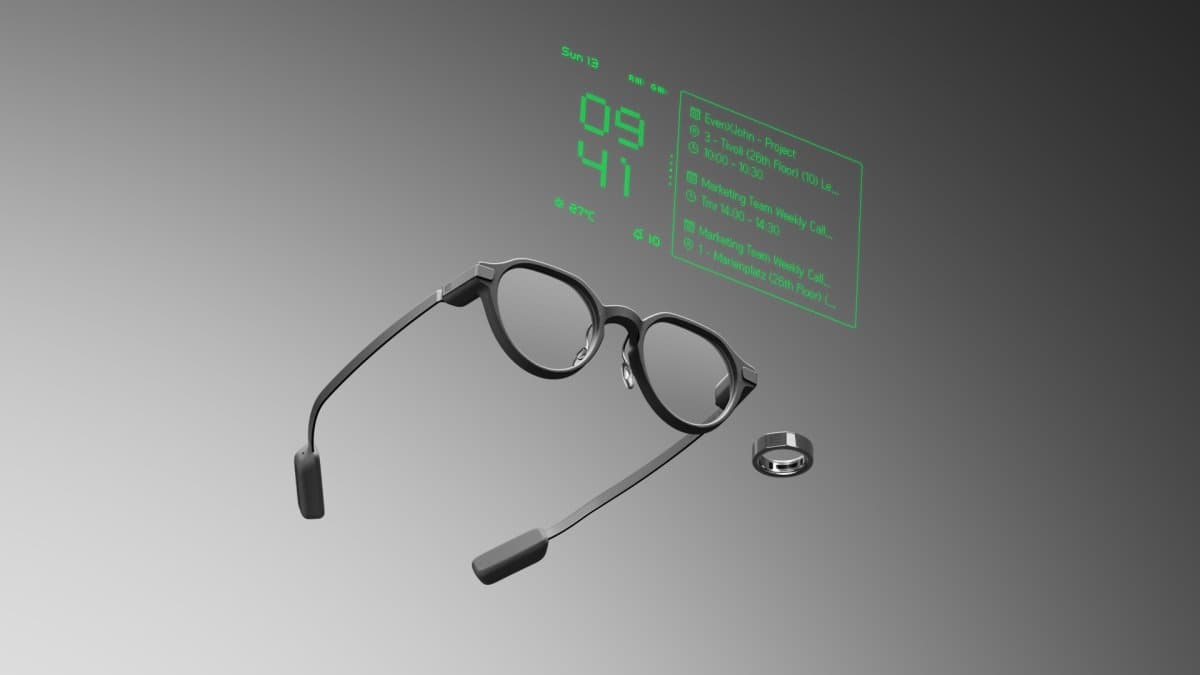
And this isn't vaporware — the product line already ships. The flagship is the G1 series, which from the outside looks like a plain, thin pair of acetate glasses. But there's a green monochrome micro-display embedded in the lens that floats text — notifications, navigation, translation, a teleprompter, to-do lists — into one corner of your field of view. It's not blasting flashy color AR at your eyeballs. It's the restrained approach: show me the words I need, nothing more. And they've clearly sweated to keep the weight in normal-glasses territory.
That tells you the whole thesis. What Even Realities sells isn't "a computer strapped to your face" — it's "a pair of glasses that happen to be smart, but is still, first and foremost, a pair of glasses." No camera means you can't covertly film anyone, the battery/heat/weight burden drops, and — most importantly — you're far less likely to catch social side-eye. Their entire bet is a diagnosis: the biggest obstacle to smart glasses going mainstream isn't the tech, it's the social allergy to standing in front of a person with a camera on their nose.
The Apple-veteran detail lands right in this context. Apple is famous for a product philosophy of hiding the technology instead of flaunting it. When the Apple Watch launched, it won not as "a computer on your wrist" but as "a watch that happens to be smart." Even Realities' "glasses first, features restrained" approach shares that DNA. That said, an Apple pedigree guarantees nothing — more on that later.
Put it together and Even Realities is this: a young challenger operating out of the ideal hardware city, already selling camera-free minimalist smart glasses, that pulled in Chinese big-tech money to reach unicorn status in three years. By scale it's nowhere near Meta or Samsung — but on direction, it's carrying the opposite flag.
What actually happened
Dig into the structure of this round and a few things stand out. First, it's labeled a pre-Series B. Raising $150 million and getting a $1 billion valuation before even reaching a formal Series B is a strong signal that the real Series B is being lined up at an even bigger scale. For a hardware startup, that's an aggressive capital-raising cadence.
The investor lineup is what's really telling. Lead investor Meituan is the super-app that effectively owns China's food delivery, local services, and instant commerce. Tencent holds WeChat — a messaging, payments, and mini-program ecosystem with well over a billion users. Why would these two put money into a glasses company? This reads less like a pure financial bet and more like both of them seeing "a display on your face" as a new interface their services could flow through. We'll get into that under stakes.
| Item | Detail |
|---|---|
| Round | Pre-Series B |
| Amount raised | $150 million |
| Valuation | $1 billion (unicorn) |
| Lead investor | Meituan |
| Participating investor | Tencent — returning existing backer |
| Announced | July 6, 2026 |
| Headquarters | Shenzhen, China |
| Founded | ~3 years ago (around 2023) |
| Core differentiator | Camera-free, privacy-first smart glasses |
| Flagship product | G1 series (monochrome micro-display) |
| Main rivals | Meta Ray-Ban, Samsung/Google Android XR, Xiaomi, Apple (rumored) |
On raw numbers, $150 million isn't huge in a world where AI startups torch billions. But for hardware — and a three-year-old consumer wearable company at that — it's a different story. Hardware doesn't clone itself with a line of code; it's a business where cash keeps draining into parts procurement, production lines, inventory, distribution, and after-sales support. That's why this money is oxygen — it funds optics improvements, display upgrades, and the ammunition to expand into Europe, the U.S., and beyond.
Don't miss the timing either. When Meta unveiled its display-equipped Ray-Bans in late 2025, the narrative that smart glasses are "finally the next big thing" swept the market. Investors started seeing this category as a candidate for the post-smartphone form factor. Even Realities hitting unicorn status is the signal flare that the heat has now spread to Chinese capital too.
What each player is really after
Start with Even Realities. This money is more than ammunition. Going head-to-head on specs with a rival that can burn near-infinite cash would starve it to death. So it staked out a narrow, sharp position — "no camera" — and holding that position while continuously raising product quality demands serious R&D funding. On top of that, the unicorn title is a real weapon for recruiting talent and negotiating with parts suppliers and distributors. It's a signal to the market: we're not a company that's about to fold.
Meituan's calculus is more strategic. Meituan lives on delivery riders and local services, and a hands-free display that shows a rider their route and order details without them touching a phone is a productivity tool on its own. Zoom out further and you get a local-commerce interface — you're walking down the street and "nearby restaurants, coupons, directions" float into your view. That could well be the picture Meituan is drawing: claiming "the space in front of your eyes" as a distribution channel for its services, going beyond the smartphone screen.
Tencent coming back as an existing investor is even more loaded. Tencent holds the massive WeChat ecosystem plus gaming, social, and payments. Every time a new hardware interface appears, Tencent is the company that first asks "how do our services run on this?" Putting money in again, at a higher valuation, into a company it already backed suggests the early bet has been at least partly validated. That said, Tencent's exact stake and terms weren't disclosed, so it's too early to weigh it precisely.
The shared big picture for both investors is this: get a seat early in case smart glasses become "the personal computing device after the smartphone." If that narrative comes true, whoever controls the apps, services, payments, and ads running on top owns the platform power of the next decade. For Chinese big tech, there's also a hedging angle — nurturing a homegrown alternative so they're not simply dragged along by a Western smart-glasses field led by Meta, Apple, and Google.
And for users: camera-free glasses genuinely lower the barrier for people who thought "I'd like to try smart glasses, but I don't want to look like I'm filming everyone." There's clearly demand for that compromise — the practical stuff like translation, navigation, and notifications, without the early-adopter stigma.
History has answers — the wins and losses of smart glasses
You can't talk about smart glasses without Google Glass. In 2013, Google boldly launched "a computer on your face," and the result was brutal. The core problem was — you guessed it — the camera. Walking around with a camera pointed forward triggered an explosion of social rejection ("is that person recording me right now?"), and it even birthed the slur "Glasshole" for wearers. It didn't die because the tech was weak; it died because society wouldn't accept it. The trauma of that failure is the root of Even Realities' decision to strip the camera out.
The recent success story on the other side is Meta's Ray-Bans. Meta partnered with eyewear giant EssilorLuxottica and quietly slipped a camera, speakers, and AI into "something that looks like an actual pair of sunglasses, tech not showing." And it sold. It was accepted as a fashion item first, with features following. The lesson is clear — for smart glasses, "am I embarrassed to walk outside in these?" matters far more than the spec sheet. Even Realities and Meta share that lesson but reached opposite conclusions on the camera.
Another failure worth remembering is Magic Leap. It once raised billions and was hailed as "the future of AR," then hit a wall in the consumer market with a headset that was heavy, expensive, and short on clear use cases. The lesson: "raising a lot of money" and "selling a lot of product" are completely different problems. Becoming a unicorn does not guarantee Even Realities anything — hardware is judged by units sold and return rates, not by valuation. This cautionary tale is worth tattooing on the wall.
So history's message boils down to three things. One: the camera is smart glasses' biggest weapon and biggest landmine at the same time. Two: "fashion first, features later" is the formula for going mainstream. Three: money raised and actual success are separate matters. Even Realities looks like it learned lessons one and two well — but it hasn't cleared gate three yet.
How the competitors counter
The most direct rival is obviously Meta. Meta has effectively bet the company's future on smart glasses, and beyond the Ray-Ban lineup it has shown off serious AR prototypes like Orion in its push to own this market. Meta's weapons are overwhelming capital and the EssilorLuxottica distribution-and-brand partnership. Even if Even Realities carves out a niche with "no camera," Meta could dilute that overnight by shipping a "camera-off mode" or a privacy-hardened version. The big incumbent copying the niche player's angle is a pattern that's repeated endlessly in tech history.
The Samsung-Google alliance is no pushover either. Together with Qualcomm, they're pushing a shared platform called Android XR. Just as Android did on phones, laying down a standard OS that hardware makers can just grab could put an independent-path startup like Even Realities at a disadvantage in the ecosystem fight — because app developers ultimately flock to the platform with the most users. Google is already growing the pie with killer-feature demos like live translation and Gemini integration.
On its home turf, Xiaomi is the genuinely scary one. Xiaomi has value-for-money DNA, a vast IoT ecosystem, and an offline retail network, meaning it can mass-produce a similar concept at a far lower price. Even if Even Realities positions itself as premium minimalism, a half-price Xiaomi "camera-free smart glasses" would collide head-on in China's domestic market. And since they draw from the same Shenzhen hardware ecosystem, Even Realities' manufacturing edge isn't large.
Then there's the elephant in the room: Apple. Apple already has the Vision Pro headset, and rumors of lighter smart glasses in development never stop. If Apple enters the glasses market with its signature polish, the whole board could be redrawn. The irony, of course, is that Even Realities' founding team includes an Apple alum — which could be a strategy to implement Apple's product philosophy first and grab the market, but could also make Apple the very first opponent it slams into if Cupertino shows up. Apple's timing and form are still just rumors, so it's too early to call.
The competitive picture in one line: Even Realities is smaller than the giants on every axis — capital, ecosystem, distribution. Its only weapons are a crisp identity ("we removed the camera") and the speed of having moved first. How fast and how firmly it can lock down that narrow gap will decide whether it lives or dies.
So what actually changes
For developers — this is a signal that the "display on your face" interface is genuinely scaling up. But the platform is fragmented right now (Meta, Android XR, independent paths). The question is whether a company like Even Realities opens an SDK and dev ecosystem or stays closed. Rather than jumping in immediately, it seems smart to watch where a standard settles (Android XR is the likeliest) while experimenting with lightweight UX like text notifications, translation, and navigation.
For investors — this round re-confirms that smart glasses are a leading candidate for "the device that carries AI on your body." Chinese big tech betting directly on hardware means they take this category seriously as the post-smartphone form factor. But a hardware startup's unicorn valuation is closer to a number on paper until it's validated by units sold. Don't forget the Magic Leap lesson.
For enterprises (especially logistics, retail, and field services) — look at why Meituan invested for the hint. Hands-free displays are likely to deliver real value first in B2B tasks: warehouse picking, delivery, field maintenance, in-store guidance. Industrial adoption could actually outpace consumer mainstreaming. And a camera-free model eases the workplace privacy-regulation burden too.
For everyday users — the most concrete change is more choice. For anyone who thought "I want smart glasses but the camera creeps me out," there's now one more camera-free alternative. A future where you quietly use translation, navigation, and notifications through a single pair of glasses just got a bit closer. That said, you still have to be cold-eyed about price, battery, and display quality — whether this is actually "worth buying" needs more real-world reviews before anyone can call it.
🥄 Three Things You're Probably Wondering
— So what does this mean for me? If you're not about to buy a pair, not much directly. But if smart glasses really do become "the next smartphone," the way you check notifications, navigate, and translate could get rebuilt a few years out. This company is the first real test of whether a "camera-free" option survives into that future.
— Is ditching the camera actually a winning strategy? For now, yes, it's a clever differentiator — it learned exactly why Google Glass died. But if Meta just pushes a solid "camera-off mode," that edge could blur. Whether it becomes a real moat or ends up as an early marketing line is too early to call.
— Why does it matter that Chinese big tech funded this? Because Meituan and Tencent don't read as chasing pure financial returns — this looks like a move to claim "the next interface" their services can flow through. The West has Meta, Apple, Google; China has this camp. Smart glasses are becoming a new battlefield in the U.S.-China platform contest.
Sources
- Smart glasses maker Even Realities hits $1B valuation with $150M funding led by Meituan, Tencent — TechCrunch
- Apple veteran takes on Meta with $1 billion smart glasses maker — CNBC
- Even Realities — Official site
- Introducing Ray-Ban Display glasses — Meta
- Android XR — Google official blog
Numbers and criteria are as of announcement and may change. Investment calls are yours to make!