In the summer lull, the AI money party didn't die — it went bigger
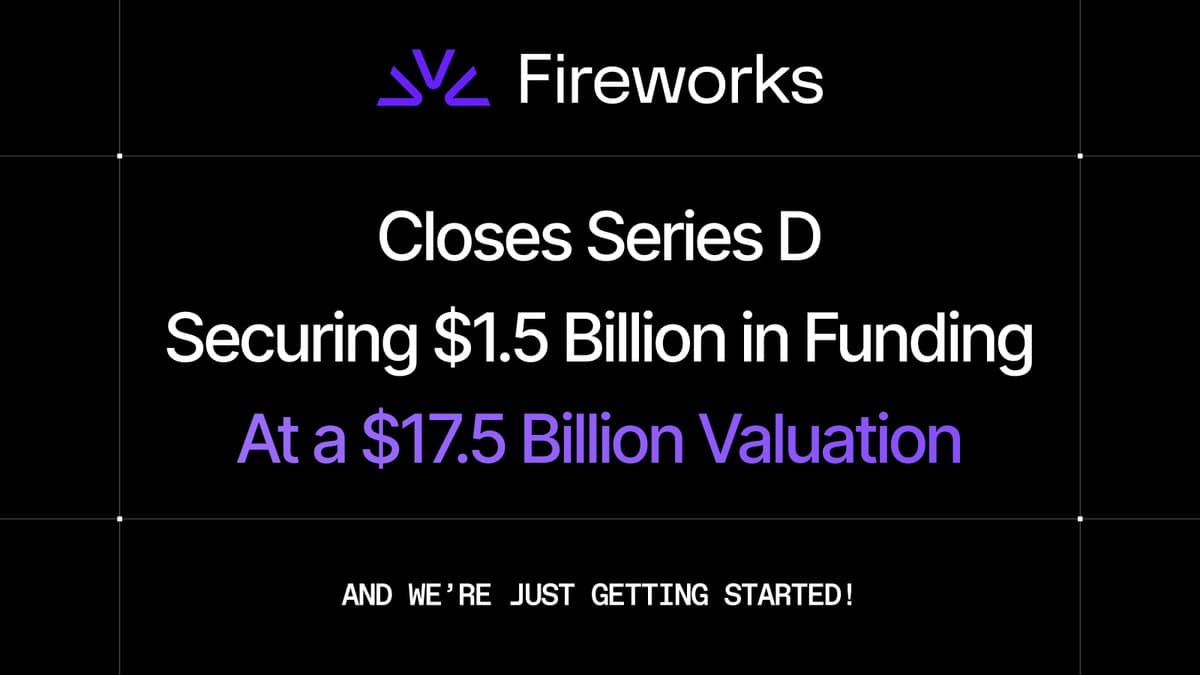
On July 16, a Silicon Valley startup called Fireworks AI announced a $1.5 billion Series D (technically $1.505 billion). The valuation? A cool $17.5 billion. Why is that surprising? Because venture money usually takes a nap in the summer. July and August are when investors go on vacation and deals freeze up. And yet, smack in the middle of that dead season, Fireworks scooped up $1.5 billion at a valuation more than ten times unicorn status.
Look at the number alone and you'd shrug — "another AI startup raised a pile of cash." But the real message here isn't the size, it's the direction. Fireworks doesn't sell chatbots, and it doesn't sell foundation models. What it sells is infrastructure: "take your company's data, build a model just for your company, and run it fast and cheap." It's a bet on a shift — away from an era where everyone just rents a giant general-purpose model from OpenAI or Anthropic, and toward one where companies own their own "specialized intelligence," tuned to their data.
And the people writing the checks aren't lightweights. Boston hedge-fund heavyweight Atreides Management, top-tier European VC Index Ventures, and growth specialist TCV co-led the round. Piling in behind them: Nvidia, Lightspeed, Bessemer, Menlo Ventures. Let me walk through why this is less "big funding headline" and more "inflection point in the inference-platform wars."
Who they are — the company built by the person who built PyTorch
Fireworks AI was founded in 2022 as an AI inference and fine-tuning infrastructure company. Look at the résumé of founder and CEO Lin Qiao and the company's identity clicks instantly. Qiao spent seven years at Meta (2015–2022) leading the PyTorch team. What's PyTorch? Only the de facto standard framework for AI research and development worldwide. A huge chunk of the models from OpenAI, Google, and Meta itself run on top of it. In other words, Qiao is the person who — with a team of 300-plus engineers — literally laid the floor the entire AI industry now stands on.
Her logic for leaving Meta to start Fireworks was crisp: "Big Tech shouldn't own AI. Companies should own their own intelligence." The co-founders are all ex-Meta and ex-Google infra and PyTorch core engineers — Benny Chen (former Meta ads infra lead), Chenyu Zhao (former Google Vertex AI lead), Dmytro Dzhulgakhov (former PyTorch core maintainer at Meta), and more. Put simply, this is a company built by the people who've built AI infrastructure from the ground up before.
Here's the dead-simple version of what Fireworks does. Anyone can grab an open-source model (think Llama, DeepSeek, Qwen), but actually running it in production — fast, cheap, and tuned to your company's data — is a completely different engineering game. Compressing the model, allocating GPUs efficiently, fine-tuning, serving it at ultra-low latency: Fireworks handles all that ugly, hard back-end plumbing for you. Its customers include Uber, Shopify, Doximity, Elastic, GitLab, MongoDB, plus coding AI Cursor and legal AI Harvey. The point is that real, name-brand companies are already using it in production.
Worth a beat on the three lead investors, too. Atreides Management is a Boston-based hedge fund known for big bets on tech and healthcare growth names. Index Ventures is a top-tier VC straddling Europe and the US. TCV is a growth-stage specialist that backed Netflix and Spotify early. When late-stage growth capital like this leads a round, that's the market saying Fireworks is no longer in the "experiment" phase — it's in the "scale up" phase.
The core — a $17.5 billion price tag backed by revenue
The proof this isn't just a vibes round is in the revenue. In the announcement, Fireworks said its annual recurring revenue (ARR) crossed $1 billion — and that's up 5x from its last round, in a single year. For an AI infrastructure startup to hit $1 billion in ARR means this isn't a fad; it's a real market where actual companies are paying real money.
The second number is even wilder. Fireworks processes more than 40 trillion tokens a day — nearly triple the 15 trillion from a year ago. Tokens are the basic units of text an AI processes, and 40 trillion a day means a genuinely hard-to-imagine volume of real usage running across this platform. And here's the kicker: more than 95% of those tokens come from "specialized models." Not general models being rented off the shelf — customer-specific models customized on their own data make up the overwhelming majority of traffic. Fireworks' "specialized intelligence" pitch isn't just marketing; it's showing up in actual usage patterns.
The fresh $1.5 billion goes to three places. First, expanding compute infrastructure — locking down more GPU and data-center capacity. Second, growing the engineering team. Third, deepening cloud partnerships with the likes of Microsoft and Nvidia. That Nvidia is an investor is telling: it's effectively planting a stake in the infrastructure layer that runs its GPUs most efficiently.
Trace Fireworks' growth curve round by round and you feel how fast this thing grew. The 2024 Series B was $52 million at a $552 million valuation. The 2025 Series C brought in $250 million and the valuation shot up. Now the Series D lands it at $17.5 billion. That's a 30x-plus jump in valuation in a little over two years. For context, Bloomberg reported just two months earlier, in May, that Fireworks was in talks at a $15 billion valuation — and the final deal closed even higher, at $17.5 billion.
| Item | Detail |
|---|---|
| Round | Series D |
| Size | $1.505 billion |
| Valuation | $17.5 billion (post-money) |
| Lead investors | Atreides Management · Index Ventures · TCV |
| Key participants | Nvidia · Lightspeed · Bessemer · Menlo Ventures · 20VC |
| ARR | Surpassed $1 billion (5x YoY) |
| Daily tokens served | 40 trillion+ (95% specialized models) |
| Total raised | ~$1.8 billion+ (Series B through D) |
| Positioning | Open-model fine-tuning + inference "specialized intelligence" platform |
Who wins from this deal
The investors smiled first. For Atreides, Index, and TCV, they've grabbed something rare in late-stage growth: $1 billion in ARR growing 5x. In the AI infrastructure market, the "companies that make models" (OpenAI, Anthropic) already have sky-high valuations and are near-impossible to buy into — but the "infrastructure that runs the models" hasn't crowned a clear winner yet. Backing the revenue leader at that bottleneck layer is the classic "picks and shovels" play. Instead of betting on the gold miners, they bet on the person selling the shovels.
Enterprise customers win too. The reason companies like Uber and Shopify use Fireworks is simple: rather than paying API fees forever to a closed giant model like OpenAI's, you can take an open-source model, specialize it on your own data, and run it far cheaper and faster. Plus your data never leaves, which helps on security and compliance. Fireworks scaling up its infrastructure with $1.5 billion means those customers get to run their own dedicated AI more reliably and affordably.
The whole inference ecosystem benefits as well. Fireworks hitting a $17.5 billion valuation is evidence that the approach of "own a specialized open model instead of getting locked into a general model API" actually works in the market. That's a tailwind for the entire open-source AI camp. The folks building open models like Llama, DeepSeek, and Qwen, and the infra startups deploying them in production, all see the pie grow together.
Nvidia is quietly grinning too. When Fireworks expands compute, that turns directly into demand for Nvidia GPUs. Nvidia investing isn't just about financial return — it's a strategy to tie the software layer that sells its hardware best into its own ecosystem. Up and down the AI infrastructure chain, everyone's pushing everyone else along.
Prior cases — inference platforms that soared and stumbled
"Open-model inference and fine-tuning platforms" like Fireworks are actually a crowded battlefield with several challengers already fighting. The most obvious is Together AI. Together also serves and fine-tunes open-source models fast, and it raised a big round in 2025 at a valuation north of $3.3 billion. It overlaps almost head-on with Fireworks. Interestingly, both companies sell the same story — "the open-source alternative to closed giant models." The fact that the market keeps pouring money into that story is itself proof of how big the demand is to escape OpenAI dependence.
But this space hasn't been all roses. Look at Anyscale, the company behind the distributed-computing framework Ray. It was once a leading candidate in AI infrastructure, but it struggled to nail down a business model while commercializing an open-source project, and ended up going through significant layoffs and a strategy reset. Great tech and a great business don't always travel together. Fireworks emphasizing its $1 billion ARR is partly a way to hammer home to the market: "We're not just technically good — we actually make money."
Another reference point is Modal, a serverless infrastructure startup that rents out GPU compute and built a fan base on developer-friendly usability. Modal, Fireworks, and Together all chase the same market from slightly different angles (serverless compute / specialized inference / open-model serving). The lesson is clear: this market isn't won by "who has the best tech," but by "who captures the production traffic of real, large customers." In that light, 40 trillion tokens a day and references like Uber and Shopify are concrete evidence Fireworks is ahead in this race. The risk to watch is whether a 30x valuation jump has outrun its revenue growth.
Competitors' counter-play — how everyone fights back
Together AI's counter is a head-on fight. Together also does open-model inference and fine-tuning, so the services almost fully overlap. Together is countering by heavily scaling its own GPU clusters (Together GPU Cloud) and selling "compute plus software" as a bundle. If Fireworks' edge is software optimization (model compression, serving efficiency), Together is competing on raw hardware capacity. Ultimately their duel converges on the same question: who can shoulder large customers' production traffic more reliably.
Later-stage inference specialists like Baseten are also charging up fast. Baseten built its popularity on getting ML models into production quickly, and it's kept raising big rounds and growing its valuation. Its counter is developer experience (DX). Rather than chasing only big enterprise deals, it broadens the base with tools that startups and mid-size dev teams can use easily.
The truly scary counter is Databricks and the hyperscalers. Databricks already holds enterprise data. When it says, "Your data's already in our lakehouse, so let us fine-tune and serve models on it too, all in one place," it collides head-on with Fireworks' "specialized intelligence" pitch. The same goes for managed inference from hyperscalers like AWS Bedrock, Google Vertex AI, and Azure AI Foundry. They already hold the enterprise cloud contracts, so they can play the "do your inference inside the cloud you already use" card. For an independent startup like Fireworks to survive between these giants, it has to keep proving it's "faster, cheaper, and not locked to any one cloud" — neutrality plus a performance edge. The $17.5 billion is the ammunition to fight that battle.
So what actually changes
If you're a developer or engineer — the option to put open models into production keeps getting stronger. It used to be that "just wire up the OpenAI API" was the right answer. Now, thanks to platforms like Fireworks, Together, and Baseten, "specialize an open-source model on our data and run it cheaper and faster" is a realistic alternative. If you're designing an AI application, it's a good moment to seriously consider fine-tuning a specialized model instead of locking into a general API.
If you're an enterprise decision-maker — the core message is "it might be time to think about owning AI rather than renting it." That 95%-plus of Fireworks traffic is specialized-model traffic is proof that the more serious a company is about AI, the more it tunes on its own data rather than just using a general model. But mind the lock-in, too. Once you put your whole pipeline on one infrastructure platform, switching later gets hard — so build in a multi-vendor strategy or portability from the start.
If you're an investor — the real signal here is that AI infrastructure money didn't cool even in the summer lull, and that capital is specifically moving to the layer above the models (infrastructure and tooling). Foundation-model companies are already priced too high to enter, so the next bottleneck — inference and fine-tuning infrastructure — has become the new battleground. Just weigh the risks: whether $17.5 billion is rich relative to revenue, and whether an independent startup can withstand the bundled assault from Databricks and the hyperscalers.
If you're a regular user — you won't feel it immediately. But in the big picture, it means the apps you use are increasingly getting "their own AI." When Shopify's shopping AI or Uber's dispatch AI runs on a dedicated model tuned to their own data instead of someone else's general model, the service can get more accurate and faster. A back-end infrastructure company like Fireworks growing is a signal that this kind of custom-fit AI is about to become far more common.
🥄 Three Things You're Probably Wondering
— So what does this have to do with me? Directly, not much — but the AI back-end of the apps you use is shifting. As companies move from renting general models to owning specialized ones tuned on their data, the recommendations, answers, and services you get are likely to become more precisely tailored to each company.
— $1 billion ARR but a $17.5 billion valuation — isn't that way too expensive? It's about 17x revenue, so yes, it's aggressive. But growth is 5x year-over-year, so the market is pricing "the trajectory," not "today's revenue." If growth continues, it's justified; if it stalls, the overvaluation talk erupts. Classic growth-stock bet — too early to call.
— If Databricks or a hyperscaler just does this themselves, is Fireworks toast? That's genuinely the company's biggest risk. But Fireworks' weapons are neutrality — not being locked to any one cloud — and pure performance on inference speed and cost. As long as there are companies that don't want to be trapped in a single cloud, there's room. In the end, it's a fight over how far it can widen the performance gap.
References
- Fireworks AI blog — Series D announcement
- CNBC — Nvidia-backed Fireworks hits $17.5 billion valuation
- Reuters — Nvidia-backed startup Fireworks valued at $17.5 billion
- SiliconANGLE — Fireworks closes $1.5B round at $17.5B valuation
- Quartz — Fireworks AI raises $1.5 billion Series D at $17.5 billion valuation
- TechFundingNews — The woman who built PyTorch at Meta just raised $1.5B
Numbers and criteria are as of announcement and may change. Investment calls are yours to make!