Google just started turning the search box from an answer machine into a launch button
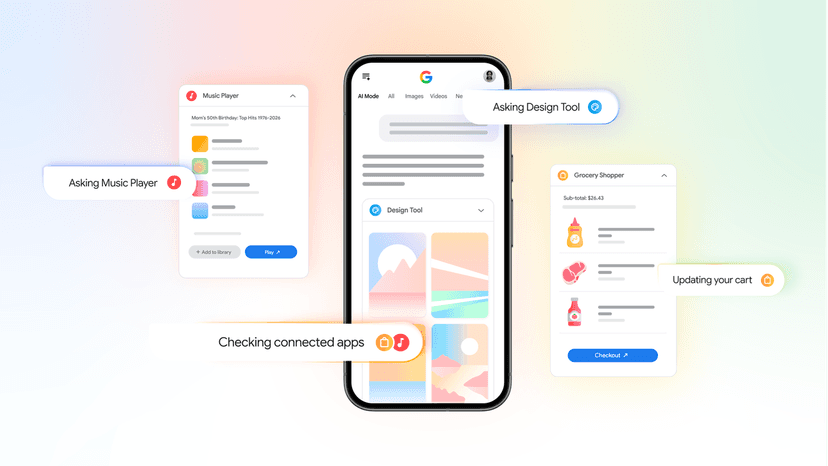
On July 16, Google put up a post on its official blog titled "Connect more of your apps to Search." The gist: AI Mode in Search is getting a feature called connected apps. Link your accounts — third-party services and Google's own — and the AI can turn the answer it just gave you into something actionable without you bouncing out of the results page first.
There are exactly three launch partners: grocery-delivery platform Instacart, design tool Canva, and YouTube Music. The rollout started that same week in the U.S., in English, and it isn't Android-only — it works on desktop and in the iOS Google Search app too.
Here's the deal, and this is the part you need to nail down before anything else. As this news spread, a lot of summaries mutated into "you can now pay for things inside Google Search." That is not what happened. In the Instacart flow, AI Mode's job ends when the cart is assembled. The actual checkout moves over to the Instacart app or website. Google's own blog says so, Search Engine Land says so, TechCrunch says so. Search didn't become a payment counter — it became a gate that hands you off to an app. That distinction is basically the whole story.
The players — the people building AI Mode, and the three partners
Start with the names on the post. It was co-written by Chips Mistry, Senior Product Manager for Search, and Biharck Araújo, Engineering Lead for Search. A product lead and an engineering lead signing jointly is a small tell: this isn't a marketing-flavored feature drop, it's a change that reaches into the search pipeline itself.
Quick refresher on AI Mode. Classic Google Search says "here are ten links, go pick one." AI Mode is the Gemini-powered mode that parses what you actually meant and builds a conversational answer instead. On top of that, starting at the beginning of 2026, Google began layering in a concept called Personal Intelligence — with your permission, AI Mode pulls from your Google Account, Gmail and Calendar to personalize what it tells you. That personalization axis has been widening throughout 2026, and connected apps is the next notch on the same track.
The three partners are a deliberately mixed bag. Instacart is the big U.S. grocery-delivery and personal-shopping platform: you pick a store, a shopper does the run, it shows up at your door. If an AI can spit out a "stuff you need for a BBQ" list, that list converts into a cart almost mechanically. It's about as clean a fit as this feature could ask for.
Canva is the browser-based design tool that lets people who have never opened Photoshop pull together posters, flyers and social cards from templates. And YouTube Music needs no introduction — it's Google's own music service. Which is exactly where a caveat belongs. Plenty of coverage lumps this together as "three third-party apps." YouTube Music is a product Google owns. The genuinely external partners here are Instacart and Canva — two of them. Landing exactly two outside partners for a launch tells you the starting line is a lot more cautious than the ambition behind the feature.
What actually happened — three flows, and the exact point where Search stops
The Instacart flow is the emblematic one. Google's own example scenario: you've got a BBQ saved on your Calendar. You ask AI Mode a shopping question. The AI pulls context from your Google Account, Gmail and Calendar, and builds a list sized to that event. You choose which store to shop from, you look over what landed in the cart. And that is where Search's job ends. Checkout moves to the Instacart app or website, where Google says it wraps up "with just a few taps."
Getting this architecture right matters. Search owns the part where intent gets understood, context gets pulled in, and a concrete artifact — a cart — gets assembled. The moment money moves, it's the partner's app. So no, this is not a story about new payment rails. It should not be lumped in with the separate agentic-checkout and payments work Google has going elsewhere, and nothing about payments was announced here. That's the part worth watching: Google deliberately stopped one step short.
Canva runs the same pattern. Ask AI Mode for something like party flyers and template candidates show up inside the answer. Pick the one you like, and the actual editing and finishing happens in Canva. YouTube Music is identical in shape — name genres or a mood, Gemini generates a playlist that appears in the chat feed, and you save it and open it in YouTube Music to listen. All three cases are unified around the same structure: Search assembles the artifact, the app finishes the job.
The connection mechanics are worth a line, too. You link each app explicitly and deliberately. Nothing is on by default; it's opt-in, and Google leaned on that point given the feature is reaching into personal data. Current scope is U.S. and English, across desktop and the iOS Search app.
It's also worth asking why these three specifically. The common thread: every one of them is a category where a search question terminates in a clearly shaped deliverable. Groceries end in a cart. Design ends in a template. Music ends in a playlist. All three are things an AI can assemble into a definite object, and all three are things you can eyeball in one glance to see if the AI got it right. Notice what's missing: no flight booking, no medical appointments, none of the categories where a mistake is expensive and hard to undo. Google picked the low-risk, easy-to-verify end of the pool first.
One more layer. This quietly changes what a search results page is. Until now, the results page was a place where you choose where to go next. Once carts and templates and playlists start getting laid into the answer itself, the results page starts to resemble a place where you inspect something that's already been made. Your job shifts from picking to approving. With three partners, that shift is barely perceptible in practice. Directionally, though, it's a redefinition of what the search interface is for.
On what comes next, Google left exactly one sentence: it is "working with a range of partners and look forward to launching with more apps soon." Not a single additional partner name. No pricing, no user numbers, no revenue-share terms — all undisclosed.
| Item | Detail |
|---|---|
| Announced | July 16, 2026 (official Google blog) |
| Feature | Connected apps for AI Mode in Search |
| Authors | Chips Mistry (Senior PM, Search) · Biharck Araújo (Engineering Lead, Search) |
| Launch partners | Instacart · Canva · YouTube Music (YouTube Music is Google's own service) |
| Rollout | Started that week, U.S., English |
| Surfaces | Desktop and the iOS Google Search app included |
| Context sources | Google Account · Gmail · Calendar (opt-in connections) |
| Instacart | AI assembles the cart → checkout happens in the Instacart app/website |
| Canva | Template options surfaced → editing happens in Canva |
| YouTube Music | Gemini generates a playlist → save and play in the app |
| Undisclosed | Pricing · user numbers · revenue share · additional partners |
What each side gets — following the incentives
Google is buying the end of the search session. AI Mode's weakness has been obvious for a while: it answers well, but the second you want to do something with that answer, you open a different app. At that instant the session ends and your next move happens somewhere Google can't see. Connected apps is a device for pushing that exit point as far back as possible. "We'll handle everything up to assembling the cart" means Google is claiming the stretch where a vague intent hardens into a specific one — which is, not coincidentally, the most valuable stretch.
Instacart picks up a new acquisition channel. In the U.S., a question like "what do I need for a BBQ this weekend" starts on Google Search more often than anywhere else. Connecting that starting point straight into its own cart means Instacart gets exposure at peak purchase intent without buying an ad. And because checkout still happens in its own app, Instacart keeps the customer relationship and the payment data intact. That's very likely the condition that made this deal acceptable on Instacart's side in the first place.
Canva gets a similar picture from a slightly different angle. Canva's growth engine has always been pulling in people who've never used a design tool. Someone typing "birthday party flyer" into a search box may not know Canva exists. Dropping a near-finished template in front of that person could be the highest-efficiency top-of-funnel Canva has ever had.
Users mostly get fewer steps. You don't re-explain the event that's already on your Calendar, and the list-building chore disappears. In exchange you're opening Gmail and Calendar up to Search's AI, which is the same convenience-for-privacy trade everyone recognizes by now. The opt-in requirement is the one meaningful guardrail.
Precedents — what worked and what didn't
This is not the first attempt at this shape. The most famous flop was Google Now on Tap and the family of "app actions" experiments around it. Google has been sketching a "search operates your apps for you" picture for years, and it spent a long time seeding app indexing and deep links into Android. Most of it died quietly. The reasons were mundane: every app integrated differently, so maintenance was a nightmare, and users never gave up the habit of just tapping the app icon.
On the other side sits the lesson of Amazon's Alexa Skills. Alexa threw open the doors to tens of thousands of third-party skills, and what people actually used repeatedly was a handful of things — timers, music, weather. It was a very expensive demonstration that partner count does not convert into usage. It's also a decent explanation for why Google's launch here is three partners deep instead of three hundred. The caution looks learned.
For the success case, look at Apple's "open in app" style handoffs and the iPhone share sheet — cases where the OS standardized passing work between apps. The key thing there is that the OS never tried to impersonate the app. It stayed strictly in the handoff role and let the app own the final job. That's why developers attached themselves to it instead of resisting. Google keeping checkout out of Search looks like exactly the same calculation. The moment you touch a partner's payments and customer relationship, the negotiation gets very hard.
So history offers two hints. First, integrations like this are decided not by partner count but by whether they capture one or two genuinely repeated daily uses. Second, if a platform tries to strip partners of their core assets — payments and customers — the ecosystem refuses to show up. Google's design here is visibly conscious of both. Being conscious of a failure mode and avoiding it are different things, though, and right now this is a three-app experiment in one country and one language.
How rivals counter
Honestly, Google is not the leader in this particular race. OpenAI's ChatGPT has been running external app integrations inside the conversation for a while, and Anthropic's Claude has too. TechCrunch framed this announcement precisely that way — positioning Google against ChatGPT and Claude, which already offer app integrations. So this isn't Google blazing a trail. It's Google taking a pattern already validated in chatbots and porting it into a far larger front door.
Which points at Google's actual weapon: the entry point. To connect an app inside ChatGPT or Claude, you first have to be someone who opens ChatGPT or Claude. Google Search is something people open dozens of times a day without thinking about it. Google is late, but the distribution isn't remotely comparable. Add Gmail and Calendar as pre-existing personal context and the same feature can carry a different density of personalization.
OpenAI's counter is probably depth. ChatGPT can absorb far longer back-and-forth inside a single conversation, and it can differentiate by pushing a task all the way to done. Search is structurally a short, fast session, which is a bad fit for complicated multi-step work. "Google hands you off; we finish the job" is a plausible line to draw.
Apple's response is worth watching too. Apple holds the OS, the default apps and the payment instrument, so in theory it's positioned to build the smoothest handoff of anyone. Execution speed has always been the variable there.
And then there's the partners' own math, which is itself part of the counter-play. For Instacart or Canva, a search integration is free traffic — but it also risks training users not to think of your app first. Right now the balance holds because they still own the decisive step, checkout or editing. If Google ever tries to cross that line, partner enthusiasm will change overnight.
So what actually changes
If you're a developer — the question to sit with is whether your app can become the execution target of a search answer. Search has spent its whole life surfacing web pages; if AI Mode starts assembling app actions, the unit of exposure migrates from a page to a capability. That said, Google has not published an open integration spec or a partner sign-up channel. What's confirmed is three partners and the phrase "more apps soon." Prepare, don't sprint.
If you're an investor — start from the fact that this announcement contained zero numbers. No user counts, no revenue-share terms, no pricing. Reading it as a revenue event is a stretch. Read it structurally instead, on two axes: Google is conceding the endpoint of the session to apps in order to own the step right before it, and search may become a new zero-cost acquisition channel for companies like Instacart and Canva. With three partners in one language market, though, it's far too early to talk about scale.
If you're a regular user — if you're in the U.S., searching in English, and you hold an Instacart or Canva account, you can feel this starting this week. Practically it means getting a grocery list or a flyer draft straight out of the search box. It hasn't reached other countries, and no expansion timeline was announced. And the thing to hold onto: no money leaves your account inside Search. Even when the Instacart cart is built for you, you pay in the Instacart app yourself, and the app connection only starts once you switch it on explicitly.
🥄 Three Things You're Probably Wondering
— So can I actually buy stuff from the search box now? No. This is the single most mangled part of the coverage. AI Mode goes as far as assembling the Instacart cart, and checkout moves over to the Instacart app or website. Google's blog, TechCrunch and Search Engine Land all drew that boundary explicitly.
— Is this coming to other countries soon? Right now it's rolling out in the U.S., in English only. No schedule was announced for other countries or languages. Google's "more apps soon" line was about partner expansion, not geographic expansion, so guessing at timing is premature.
— Is it safe to open Gmail and Calendar to Search's AI? Connections are opt-in and you switch them on yourself, and Google emphasized that the linking is secure. Still, this is plainly a convenience-for-personal-data trade. How narrowly the actual data handling stays scoped is something you can only judge after the feature spreads, so it's too early to call.
Sources
- Connect more of your apps to Search
- Google's AI Mode now lets you link and interact with select apps
- Google AI Mode now integrates with Canva, YouTube Music and Instacart
- Google AI Mode adds Instacart, Canva and YouTube Music integrations
- Google AI Mode gets more useful with Canva, Instacart and YouTube app integrations
- Google Search Now Connects to Instacart, Canva and YouTube Music
- Google Search's AI Mode works with Canva and YouTube Music
Numbers are as of announcement and may change.