We Can Now 'Search' for Matter — and Bezos Opened His Wallet Again
On July 20, 2026, Cambridge, UK-based materials-discovery startup CuspAI announced a $450 million Series B. The round was co-led by two Silicon Valley heavyweights, Kleiner Perkins and NEA, with heavy participation from Jeff Bezos' personal fund, Bezos Expeditions. That single raise vaulted CuspAI to a $2.6 billion valuation. Here's the eye-opener: just nine months earlier, an extended seed round pegged the company at $520 million — so its valuation swelled almost five-fold in under a year. A company barely two years old has now pulled in more than $650 million in total.
But the money isn't even the most interesting part. On the same day, CuspAI unveiled something it calls the AI Materials Foundry — a coalition of more than 45 technology and industrial firms. The founding roster reads like a who's-who: Nvidia, Meta, Samsung, Hyundai Motor Group, Applied Materials, Tokyo Electron, Lam Research, Henkel and more. The pitch is to pool compute, labs, proprietary data and scientific expertise, and change the speed at which humanity finds new matter. Borrowing "foundry" — the word for a chip fab — and bolting it onto materials discovery is a deliberately loud move. It signals the size of the ambition.
The whole thesis fits in one founder line: "The world simply can't make the progress it needs to with known materials, that much is clear." Cheaper carbon capture, longer-lasting batteries, cleaner water, and the exotic materials that advanced chipmaking needs — all of it, CuspAI argues, is waiting on materials that haven't been discovered yet. Instead of humans stumbling onto them over decades of trial and error, CuspAI wants to design them with AI and find them many times faster.
Who Is CuspAI — The VAE Inventor Meets a Quantum-Computing Founder
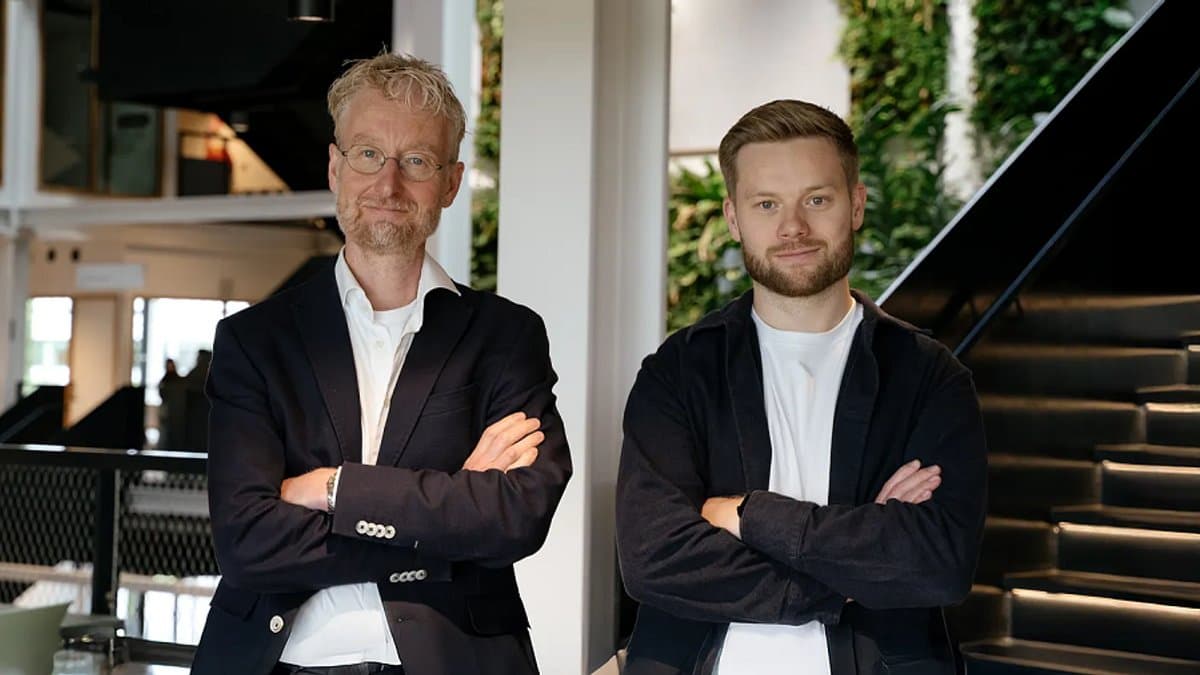
CuspAI was founded in 2024 by two people. One is CEO Dr. Chad Edwards — a chemist who pivoted into deep-tech entrepreneurship. He was the commercial co-founder of Cambridge Quantum Computing and later served as VP of Strategic Partnerships at Quantinuum. In short, he's someone who knows how to connect hard science to commercial reality.
The other founder is the company's true center of gravity. Prof. Max Welling is a legend in machine learning: he's the co-inventor of the Variational Autoencoder (VAE), one of the foundations of modern generative deep learning. He earned his PhD under Nobel laureate Gerard 't Hooft and trained under the godfather of deep learning, Geoffrey Hinton. Crucially, right up until founding CuspAI, Welling was a Distinguished Scientist and VP at Microsoft Research AI4Science — and before that VP of Technology at Qualcomm. In other words, someone standing at the very frontier of "AI for science" walked out and started this company.
Why does that pairing matter? Because materials discovery is neither a pure AI problem nor a pure chemistry problem. You have to thread the whole needle: models that predict properties, atomic-scale simulation, the recipe to actually synthesize the material, and validation in a real lab. Welling is a world-class expert on the front end (models and simulation); Edwards understands the back end (chemistry and industrial partnerships). Together they cover both.
The company started with a $30 million seed in June 2024 — and even then, its partnership with Meta on carbon-capture materials was a talking point. Going from seed to Series B and a $2.6 billion valuation in under two years is abnormally fast even by deep-tech standards. That pace itself is a signal: capital is piling into the "AI × materials" combination.
MIRA and the Foundry — Matter Built to Order
The heart of CuspAI's tech is a proprietary platform called MIRA. Here's what it does in one line: a researcher specifies "I need a material with these properties," and MIRA designs candidate materials that meet those targets using generative and agentic AI. This isn't database search — it's generation, conjuring structures that didn't previously exist. And it doesn't stop there: MIRA runs the full cycle in one place, from generative design through property simulation, synthesis-route planning, and coordinated experimental validation.
The AI Materials Foundry puts MIRA at the center and pulls in the resources a startup can't own alone. Look at who contributes what, and the picture snaps into focus.
| Component | Who provides it | Role |
|---|---|---|
| Compute infrastructure | Nvidia | GPU power to run large-scale AI training and simulation |
| Foundation model | Meta FAIR | The 'UMA' (Universal Model for Atoms), a frontier atomistic chemistry model |
| Semiconductor validation | Applied Materials, Lam Research, Tokyo Electron | Proving materials in chip-making tools and processes |
| Industrial application & data | Samsung, Hyundai Motor Group, Henkel, Kemira | Real demand and data in batteries, autos, materials, water |
| Capital & strategy | Kleiner Perkins, NEA, Bezos Expeditions, Temasek | Funding and long-term partnership |
The coalition runs regional hubs across the US, Europe and APAC, with core focus areas in semiconductors, clean energy and advanced manufacturing. The semiconductor angle stands out. Today's advanced chip processes lean on scarce metals like ruthenium and iridium — expensive, supply-constrained materials. CuspAI has flagged replacing these bottlenecked metals with AI-designed alternatives as a marquee challenge. That explains why the three semiconductor-equipment giants — Applied Materials, Lam Research and Tokyo Electron — signed on.
Meta's UMA model deserves a note too. Built by Meta's Fundamental AI Research (FAIR) team, it's an atomistic chemistry model that predicts material properties at the atomic level. For CuspAI, it's a powerful, free tool to validate the candidates its generative model produces; for Meta, it's a chance to plant its model in a real industrial problem. Each side gets exactly what it needs.
What Everyone Gets Out of It — Why 45 Firms Showed Up
A coalition like this only spins if each participant's math checks out. Break it down.
CuspAI gets what it could never own alone. Buying Nvidia GPUs for its own data centers would cost a fortune, and semiconductor pilot lines are simply off-limits to an outsider. Bundle it into a foundry, and compute, labs and industrial data arrive at once. On top of that, each of the 45 partners is a potential customer and validator. The classic startup valley of death — "we have the tech, but we don't know if it works in a real industry" — gets skipped from day one.
Nvidia and Meta are planting their weapons in a new market. Nvidia wants AI-driven materials discovery to become a new bulk consumer of GPUs; Meta wants its UMA model to become the standard in science. Both are racing to own the position of "you can't do AI materials without our infrastructure."
Samsung and Hyundai Motor Group are buying first-mover access to future materials. Samsung is desperate for advances in chips and batteries; Hyundai for EV batteries and lightweight materials. If AI really does surface new materials, grabbing them before rivals is a competitive edge — and a relatively cheap way to secure the option.
The investors are betting on a deep-tech supercycle. Kleiner Perkins and NEA are buying the big-picture thesis that "AI is crossing from software into the physical world," and Bezos has long backed climate and energy tech — carbon capture and clean-energy materials sit right in his wheelhouse. The UK government also supported the round, layering in an industrial-policy motive: cultivate a homegrown deep-tech champion.
The Track Record — AI Materials Isn't a Debut, It's a Race
The idea of finding materials with AI didn't start with CuspAI. If anything, the giants already laid the groundwork, and CuspAI is now charging in on the commercialization front.
The success story people cite most is Google DeepMind's GNoME. In late 2023, DeepMind said its graph neural network predicted 2.2 million new stable crystal structures — and judged roughly 380,000 of them likely to be synthesizable. In one stroke it multiplied the experimental materials data humanity had accumulated over its entire history. It was the milestone that convinced academia AI genuinely works for materials discovery.
The other is Microsoft's MatterGen, a generative materials model unveiled in early 2025. Give it target properties (magnetism, electronic behavior, etc.) as a condition, and it directly generates new material structures to match. If GNoME was about "scanning a lot," MatterGen was about "making what you want." The delicious twist: CuspAI's Welling comes straight from that Microsoft AI4Science lineage. So MIRA is both an extension of that lineage and an attempt to bolt on experimental validation and industrial partnerships — turning "research papers" into "shippable product."
The cautionary precedents are just as clear. Getting from an AI-predicted material to one that's actually synthesized and used in industry is still brutal. Of the hundreds of thousands of materials GNoME predicted, only a tiny fraction have actually been made and validated in a lab. There's a wide chasm between "a structure a computer calculated as stable" and "a material you can actually make and that's useful." CuspAI built a foundry stitched to 45 industrial partners and their labs precisely to fill that chasm. Plenty of companies already predict well; the real contest, in CuspAI's read, is won at synthesis, validation and commercialization.
How the Competitors Play It
Now that CuspAI has openly formed a "foundry" camp, the competitive lines will sharpen.
The most direct rivals are Google DeepMind and Microsoft. Both hold world-class AI-materials research and their own cloud and compute. The difference: for them, materials is one research branch of a giant platform, not the whole company. CuspAI, by contrast, is a pure-play all-in on materials — betting on speed and industrial intimacy that big companies can't match. The flip side: if DeepMind or Microsoft decide to "launch our own commercial foundry," the pressure on CuspAI spikes.
The second axis is other AI-materials startups — the US's Radical AI, various European deep-techs, and companies pitching "self-driving labs" all compete in the same space. This $450 million round is an uncomfortable signal for them: if CuspAI locks up capital, compute and partners all at once, latecomers struggle to catch up. In response, rivals will likely specialize into niches (say, batteries-only or catalysts-only) to carve out defensible ground.
The third is subtle — the big corporates inside the foundry themselves. Samsung and Hyundai are CuspAI's partners and run their own materials R&D. They cooperate today, but if AI materials becomes a genuine core competency, they could move to internalize it: "we'll just do it ourselves." For CuspAI to remain the indispensable central platform, it has to keep widening MIRA's technical lead and the network effect of the foundry. That's the strength of a coalition — and simultaneously its weakness.
So What Actually Changes
For researchers and scientists — this is a shift in methodology. Until now, discovering new materials leaned heavily on intuition, trial and error, and luck. If the AI-foundry model takes hold, "on-demand discovery" — set the properties first, then reverse-engineer the material — could become the norm. Worth remembering, though: the experimental science of actually making and validating AI's candidates still carries huge weight, so labs aren't disappearing — they're being restructured.
For investors — this is a flare marking AI's center of gravity shifting from "software" to "the physical world." Capital that piled into chatbots and coding tools is now spreading into physical deep tech: materials, bio, energy. But materials take a long time to commercialize and fail often. Keep a cool head about the fact that a $2.6 billion valuation still rests more on expectation than revenue.
For everyday users — nothing tangible changes right now. But if, a few years out, you see longer-lasting EV batteries, cheaper carbon-capture rigs, or chips freed from supply crunches, there's a good chance AI-driven materials discovery sits at the root. It's the early stage of a quiet change in how the "ingredients" of our everyday products get made.
For Korean industry — Samsung and Hyundai Motor Group joining as founding members carries weight. Korea's strengths in chips and batteries map exactly onto the foundry's core areas. Played well, it's a chance to ride next-gen materials early; played poorly, it's a structure where core AI-materials tech depends on a UK startup. Balancing cooperation against self-reliance remains the challenge.
🥄 Three Things You're Probably Wondering
— So what does this mean for me? No direct impact. But if you touch the EV, semiconductor or battery worlds — as an operator or an investor — the "design materials with AI" trend could reshape those industries' costs and competitiveness within a few years. Right now, you're watching the board get set.
— Why is this much money pouring in now? Research like GNoME and MatterGen proved AI can cross from language and images into the physical world of atoms and molecules. Layer in real, money-on-the-line problems — scarce-metal supply crunches in chips, surging carbon-capture demand — and investors decided "this time it's real." Whether the expectation converts into actual products, though, is still too early to call.
— Is CuspAI ahead of Google and Microsoft? Hard to say so. On pure research muscle, DeepMind and Microsoft are probably still ahead. CuspAI's play isn't "best tech" — it's execution speed: binding 45 industrial partners to reach real commercialization first. Who wins will take a few more years to see.
References
- SiliconANGLE — AI materials science startup CuspAI raises $450M in funding
- CuspAI Official Blog (Medium) — Launching our 'AI Materials Foundry' and $450M Series B
- CuspAI Press Release (BusinessWire) — CuspAI Launches 'AI Materials Foundry'
- TechFundingNews — From $520M to $2.6B in 9 months
- TheNextWeb — CuspAI signs up Nvidia and Meta for AI materials push
- Foreign Policy Journal — Jeff Bezos-Backed CuspAI Raises $450M for chipmaking materials
Numbers and criteria are as of announcement and may change. Investment calls are yours to make!