The company that always rented just picked up a shovel
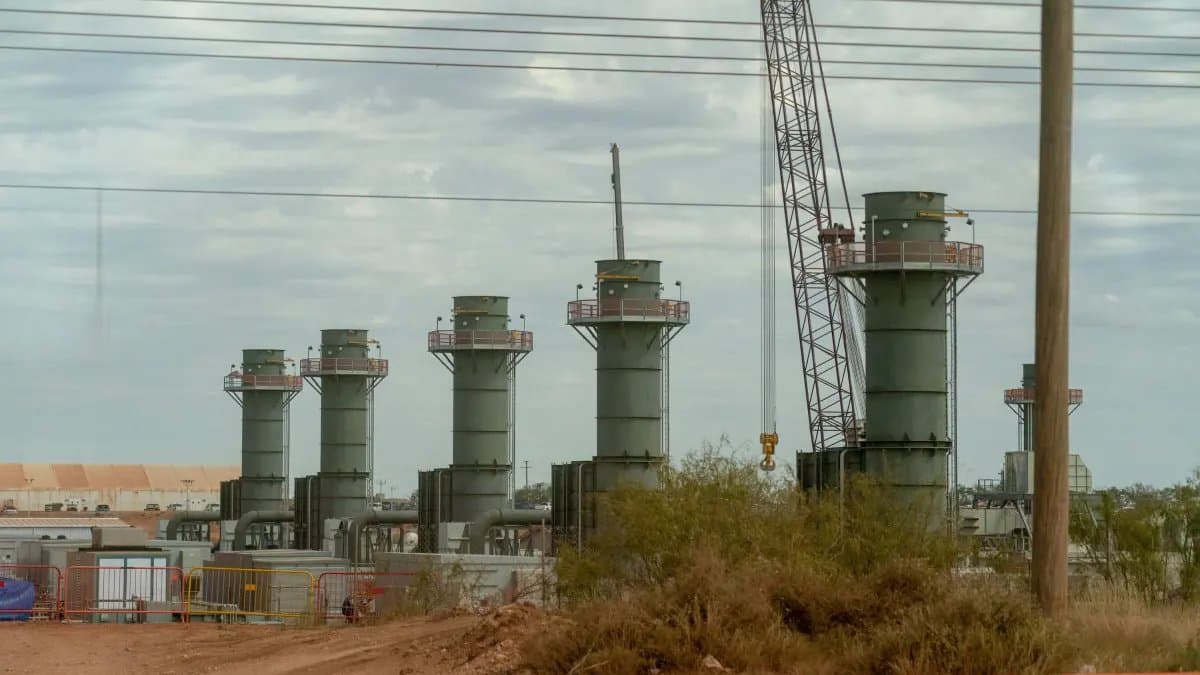
On July 22, 2026, OpenAI announced a data center campus in Effingham County, Georgia, called Project Camellia. Here are the numbers: 1,400 acres, four buildings, up to 3.2 gigawatts of power from Georgia Power, and $20 billion committed up front. Sachin Katti, OpenAI's VP of compute strategy, said total project cost will exceed $30 billion by the time it's fully operational. Power ramps in stages from 2028 through 2032, with the first few hundred megawatts energizing in 2028.
The $20 billion isn't the interesting part. This sentence is: it's the first data center OpenAI designs and builds itself.
Every bit of compute OpenAI has ever used belonged to somebody else. It started on Microsoft Azure. Then Stargate arrived, and the structure got more elaborate but no less rented — Oracle bought the hardware, developers like Crusoe, Vantage, and STACK put up the buildings, SoftBank helped fund the power. OpenAI was the tenant. It signed contracts. It did not pour concrete.
Camellia flips that. OpenAI owns the site. OpenAI does the design. And the counterparty on the 25-year power supply agreement with Georgia Power is OpenAI itself — not Oracle. That's the whole story in one line: tenant becomes developer. Which also means the risk moves onto OpenAI's balance sheet.
The timing says something too. On the same day, OpenAI raised its compute spending outlook through 2030 to $750 billion — up 25% from an estimate published just months earlier. Meanwhile, back in March, OpenAI and Oracle quietly killed a planned 600MW expansion at the flagship Abilene, Texas campus. Reporting at the time pointed to drawn-out financing negotiations and OpenAI's shifting demand forecasts. So: cancel an expansion with a partner in March, announce something bigger under your own name in July.
Sachin Katti, the Intel import who runs compute strategy
The face of this project isn't Sam Altman. It's Sachin Katti.
OpenAI hired him in November 2025 from Intel, where he was CTO and head of AI, and handed him the infrastructure organization. He's a former Stanford electrical engineering professor — networking and wireless by training — who ran Intel's data center and AI group before taking the CTO seat. A company that buys silicon just hired someone who spent years looking at the whole system from the silicon side, and told him to go build.
Katti's logic for building in-house is refreshingly plain. Having iterated on compute across two or three generations, his team learned a lot about how these facilities should be designed to cut cost and speed up construction. In practice, that means OpenAI engineers have been reworking building layouts, redoing networking architecture, and standardizing system design to pull deployment schedules forward.
That distinction matters more than it sounds. Sliding racks into a box somebody else designed is a different exercise from deciding the rack topology first and designing the building around it. Power density and cooling efficiency swing hard on that ordering.
Katti went further. Per Bloomberg, he plans to publish a standardized data center reference design as public material for the industry. Build your own campus, extract a reference architecture, hand it out — roughly what Nvidia does when it ships reference server designs alongside GPUs. When infrastructure is the ceiling on your growth, making everyone else build faster is in your own interest.
On the other side of the table is Georgia Power. It's the Southern Company subsidiary that runs Georgia's grid, and the utility that brought Vogtle units 3 and 4 online — the first new US nuclear reactors in roughly three decades. Georgia has been ground zero for data center recruitment, and the Douglas–Coweta corridor west of Atlanta is now one of the densest data center clusters in the country. For Georgia Power, a single 3.2GW customer is a re-plan-everything event.
The land came from the Savannah Gateway Industrial Hub in Effingham County — about 40 minutes by car from the Port of Savannah, a 2,600-acre industrial park of which Camellia takes 1,400. Port, rail, and interstate access were supposed to attract logistics and manufacturing. AI got there first.
Anatomy of the campus: a 25-year contract and a gigawatt of demand response
The power terms are where the deal gets specific. Georgia Power supplies up to 3.2GW phased in from 2028 to 2032 under a 25-year agreement. Local outlets translate 3.2GW into roughly 2 to 2.4 million US homes. In exchange, OpenAI covers the full cost of transmission and distribution buildout plus the cost of electric service. Georgia Power has stated flatly that this project will not raise rates for Georgia customers.
The second clause is the more interesting one. OpenAI committed to flexibly curtailing up to 1,000MW — about a third of contracted capacity — during peak demand periods. Georgia Power called it the largest single-facility demand response commitment in the country. On a brutal summer afternoon when the grid tightens, OpenAI slows training jobs or drops racks. If that holds up in practice, Georgia Power builds fewer peaker plants.
Local incentives came bundled. Effingham County approved a 50% property tax abatement over 15 years, and Camellia is still projected to become the county's largest taxpayer. OpenAI is putting $80 million into education, public safety, healthcare, and small business support, plus up to $71 million worth of Codex credits for Georgia colleges and technical schools. Cooling is closed-loop, so water use stays minimal and the campus doesn't draw on local water sources — that's the company's account, anyway.
| Item | Detail |
|---|---|
| Project name | Project Camellia |
| Announced | July 22, 2026 |
| Location | Savannah Gateway Industrial Hub, Effingham County, Georgia |
| Site / buildings | 1,400 acres / 4 data center buildings |
| Power | Up to 3.2GW, phased 2028–2032, 25-year Georgia Power agreement |
| Demand response | Up to 1,000MW curtailment commitment at peak |
| Investment | $20B committed minimum, $30B+ projected at completion |
| Jobs | 400 permanent (scaling to 1,000), thousands during construction |
| Tax | 50% property tax abatement for 15 years |
| Community | $80M local fund + up to $71M in Codex credits |
| Cooling | Closed-loop water, no local water sources |
The schedule: a Development of Regional Impact (DRI) application was filed July 22, and construction starts once approvals clear. First few hundred megawatts light up in 2028; the full 3.2GW lands in 2032.
There's friction already. Locals have pointed out that the DRI filing contained almost no environmental or economic detail, and that the zoning change permitting data centers was buried inside a 771-page document. OpenAI says it will gather resident input and fold it into a "Georgia Community Compact." Frank Dutton, a 50-year resident, put it less diplomatically — he said the county kept it quiet for a long time and then outright denied it.
What everyone is getting out of this
OpenAI gets control. Until now it was a compute buyer, which meant being hostage to a supplier's schedule and a supplier's financing conditions. The Abilene expansion collapse was exactly that failure mode. Build it yourself and you own design, procurement, and timeline. It also books as an asset rather than a lease, which pushes long-run cost per unit of compute down. And practically speaking, a company that just publicly committed to $750 billion of spend through 2030 cannot fill that number with leases alone. The physical supply isn't there.
Georgia Power gets a 25-year anchor. Every data center recruitment fight eventually runs into the same question: is this load actually going to show up? A 3.2GW long-term contract is the answer. The 1GW demand response commitment is a bonus card — it reduces the peaking capacity the utility needs to build. And because the Georgia Public Service Commission amended its data center rules in January 2025 to push infrastructure costs onto the facility, Georgia Power has regulatory backing when it says this deal isn't being socialized onto regular ratepayers.
Effingham County gets revenue and jobs. Even after halving the property tax bill, Camellia is expected to become the county's largest taxpayer — enough that officials floated "Project Zero," a plan to cut homeowner property taxes by up to 40%. Permanent headcount starts around 400 across operations, maintenance, security, and data safety roles, with room to reach 1,000. Construction runs into the thousands, and the company has promised to prioritize local contractors.
Nvidia and the broader supply chain get 3.2GW of confirmed demand. Do the math on GPUs, networking gear, and electrical equipment per gigawatt and a single Camellia rivals a national-scale procurement. This isn't abstract for Korea either: in October 2025, Samsung Electronics and SK hynix signed letters of intent with OpenAI to supply DRAM wafers at roughly 900,000 units per month. The more sites OpenAI designs and orders directly, the more room memory vendors have to coordinate volume with the end user instead of routing through a cloud middleman.
And there's a clear loser. Oracle is OpenAI's largest partner, contracted to supply roughly $300 billion of capacity over five years — and that customer just started building for itself. Oracle is nearly the only large player funding its AI buildout with debt; it's carrying north of $100 billion in borrowings with free cash flow turned negative. Abilene's canceled expansion followed by OpenAI pivoting to self-build is not a good look for Oracle's credit story.
What Abilene taught them, and the expansion that died
Start with the success. Abilene, Texas is Stargate's first campus and still the furthest along. Crusoe built it, Oracle owns the hardware, four of eight buildings are running Nvidia Blackwell, and the target is 1.2GW at completion in Q4 2026. The first two buildings went up at a pace that genuinely impressed the industry — and that experience became the training data for OpenAI's conclusion that it could do this itself.
Then the failure, on the same site. In March 2026, Oracle and OpenAI withdrew a planned 600MW expansion at Abilene. The reasons cited: financing negotiations dragging on, and OpenAI's demand forecasts moving too often. Capacity Crusoe had secured was reportedly being redirected to Meta, brokered by Nvidia. That's the partner model's weakness laid bare — three companies' financing timelines and demand projections all have to line up before dirt moves, and one misalignment stops the whole thing.
The deeper lesson predates all of it. Multiple reports agree that OpenAI spent much of 2025 trying to build its own data centers and couldn't raise capital on competitive terms. Lenders offered much better pricing when a high-credit tenant like Oracle signed the lease, so OpenAI shifted its locus of control from buildings to hardware. That the company is back to self-building a year later means either the financing environment changed or OpenAI's own credit standing improved enough to matter. Probably some of both.
Community pushback is worth studying too. The Stargate site in Saline Township, Michigan drew fierce local opposition. On the Georgia coast, Garden City and Camden County have imposed data center moratoriums. In Effingham, Maddie Greer — who lives near the Ogeechee River — said she has watched data centers elsewhere cause not just water pollution but noise and tree loss. Jeff Bovay of the environmental group One Hundred Miles said the decisions were already made and residents are playing catch-up. Whether $80 million in community funding quiets those voices is a live question.
How the competition responds
Google, Amazon, and Microsoft have built their own data centers for years. The message this announcement sends them is closer to "OpenAI is starting to do it our way." But there's a structural gap: Google has TPUs, Amazon has Trainium, and OpenAI's own accelerator — co-developed with Broadcom — isn't deployed yet. OpenAI now controls the building. The silicon inside it is still heavily Nvidia.
Meta will likely answer differently. It's already running gigawatt-class self-built campuses — Hyperion in Richland Parish, Louisiana and Prometheus in Ohio — financed through SPVs and private credit. The reported plan for Meta to absorb Crusoe's stranded Abilene capacity fits that pattern exactly. Buying up the space OpenAI vacates is a strategy that can repeat.
Anthropic has bet on efficiency over scale. It runs on both Google TPUs and Amazon Trainium, riding partner campuses like Amazon's Project Rainier. While OpenAI converts capital into fixed costs, Anthropic will probably keep spending its on models and enterprise sales. Which approach was right gets settled by the cost-per-unit-of-compute curve around 2028, not by press releases.
Oracle's counterplay is the one to watch. Its concentration in a single customer is extreme, and that customer turning into a developer erodes the lease pipeline over time. Oracle's options are to diversify capacity toward non-OpenAI customers — Meta, xAI, government — or to productize construction and operations and come back as the operating partner on OpenAI's own campuses. Same goes for developers like Crusoe and Vantage. OpenAI's promise to publish standardized designs can be read, uncharitably, as a subcontracting pitch: build to our drawings.
Utilities are about to compete harder too. Georgia Power just created a template — 25-year term plus 1GW of demand response — and utilities in other states will find that template sitting on the negotiating table. For regulators, "the facility pays for infrastructure, and it curtails at peak" is a politically defensible combination. There's a real chance this becomes the standard shape of US data center power contracts.
So what actually changes
For developers, nothing immediate. Camellia produces zero tokens before 2028. But the direction is worth tracking. If OpenAI's in-house design genuinely optimizes power density and networking, training and inference costs come down, and that eventually shows up in API pricing, context limits, and rate limits. If the standardized design documents actually get published, data center architecture starts circulating like open source documentation — infrastructure engineers should grab those the day they land.
For investors, two signals. First, OpenAI is shifting from lease-heavy to asset-heavy, which makes the capital structure heavier. A company with reported annual revenue around $25 billion has committed to $750 billion of spend through 2030, and a single site costing over $30 billion means large-scale project finance or fresh capital raises are coming. Second, the valuation question for the intermediary layer — Oracle, Crusoe, and friends. When your largest customer starts building for itself, that layer's growth story needs recalculating.
For Georgia residents, the issues are rates, water, and noise. OpenAI and Georgia Power point to full cost coverage and closed-loop cooling as reasons rates won't rise. But the regulatory filings still show that a large share of Georgia Power's new generation buildout is natural gas — roughly 5.8GW by one analysis, with about a quarter of that in higher-polluting simple-cycle turbines. And the PSC's Public Interest Advocacy Staff has noted that large industrial customers push other customers' average fuel costs up 5–11% per month. Whether "rates won't rise" matches the actual bill is verifiable starting in 2028, not before.
For Korean industry, it's demand-side good news. Another confirmed 3.2GW campus means that much more locked-in demand for HBM, server DRAM, and power and cooling equipment. Samsung and SK hynix signed those 900,000-wafer-per-month LOIs with OpenAI; Samsung's Pyeongtaek P5 targets 2028 and SK hynix's M15X targets mid-2027. Camellia's power ramp (2028–2032) overlaps those fab timelines almost too neatly. Keep the caveat in mind: an LOI is not a binding contract, and OpenAI's demand forecasts can move — Abilene proved that.
For the industry overall, the question of who owns the infrastructure is open again. The grammar of AI infrastructure in 2024–2025 was "model companies do models; partners handle construction and financing." Camellia shows that division of labor isn't permanent. Get big enough and you vertically integrate — the path semiconductors and cloud already walked, and the one OpenAI just stepped onto.
🥄 Three Things You're Probably Wondering
— So what does this mean for me? Not much directly. It's a construction site with no power until 2028. But if OpenAI succeeds at cutting compute costs through its own designs, that could show up in API pricing or free-tier policy a few years out — and if the $30 billion bill bites instead, it could show up as price increases. Too early to call which.
— Is Oracle and Stargate over now? No. The five-year, $300 billion Oracle agreement is alive, and the Shackelford, Milam, Doña Ana, Michigan, and Wisconsin sites are still under construction. Camellia reads as a parallel track rather than a replacement. That said, the sequence — Abilene expansion canceled, then self-build announced — suggests the center of gravity is shifting.
— Will Georgia electricity rates really stay flat? That's what the company and Georgia Power say, and they have grounds: OpenAI covers transmission, distribution, and service costs in full, and the PSC changed its rules in January 2025 to assign those costs to the facility. But fuel costs are shared across the whole customer base, and PSC staff analysis says large customers raise average fuel costs for everyone else. A flat rate schedule and a flat bill are different things, so hold off on a verdict.
Sources
- OpenAI — Building AI infrastructure with the Effingham County community (official announcement)
- The Current — $20 billion OpenAI data center to open in Effingham County (local reporting: resident reaction, tax terms, DRI process)
- The Georgia Virtue — Georgia Power Signs 25-Year Agreement With OpenAI for 'Project Camellia' (power contract and demand response terms)
- Data Center Dynamics — OpenAI plans 3.2GW data center campus in Effingham County, Georgia
- TechCrunch — OpenAI's AI spending spree has ballooned to $750B (spending outlook revision, gas generation mix)
- Axios — OpenAI plans Savannah, Georgia data center
- Epoch AI — OpenAI Stargate: where the US sites stand (site-by-site Stargate progress)
- Georgia PSC — Data Center Fact Sheet (March 2026) (regulator materials)
- OpenAI — Samsung and SK join OpenAI's Stargate initiative (Korean memory supply LOIs)
- OpenAI — Five new Stargate sites (partner model expansion)
Numbers and criteria are as of announcement and may change. Investment calls are yours to make!