A Coding Agent Company Just Bought an AI That Lives in Your Texts
On July 23, 2026, Cognition — the company behind the autonomous coding agent Devin — announced it had acquired The Interaction Company of California. Interaction builds Poke, a personal AI agent that has no app and no website. It lives inside your text message threads. The price was described as "low nine figures," meaning somewhere between roughly $100 million and $300 million. Neither side disclosed the exact number.
By Cognition's standards that's not a huge check. Two months earlier, on May 27, 2026, the company raised $1 billion at a $25 billion pre-money valuation and disclosed $492 million in annual recurring revenue. The interesting part is who it spent the money on: a ten-person startup whose product is a chatty bot in your SMS inbox. A company that writes code bought a company that makes small talk. That deserves an explanation.
Cognition's explanation is blunt. AI personality is becoming a competitive advantage. Model quality converges every few months, the argument goes, but how many times a day a person actually talks to an agent is decided by voice and surface area, not benchmarks. Cognition co-founder Scott Wu wrote in the official announcement that Devin is used by the world's best companies for software engineering while Poke is loved by hundreds of thousands of people as a daily partner. Bolt them together and you get a coding agent that feels like a coworker. That's the bet.
Here's the part that got less attention: this was Cognition's second acquisition in three days. On July 20, investor Accel announced that Cognition had acquired TierZero, which automates operations after deployment. An agent that writes code (Devin), an agent that handles incidents after it ships (TierZero), and an agent that talks to humans (Poke) — three pieces pulled under one roof inside seventy-two hours.
Who These Two Companies Are
Cognition showed up in March 2024 with Devin and the phrase "the first AI software engineer." The launch demo drew heavy criticism for overstating what the product could do. Two years later the enterprise revenue is real. The customer list disclosed around the May round includes Mercedes-Benz, NASA, Goldman Sachs, and Santander, and the company said enterprise usage had grown 50% month over month for six months. Valuation went from $10.2 billion in September 2025 to $26 billion post-money eight months later.
Roughly half of how Cognition got here is M&A. On July 14, 2025, immediately after Google pulled Windsurf CEO Varun Mohan and a co-founder out in a $2.4 billion reverse-acquihire, Cognition bought everything Google left behind — IP, product, trademark, brand, and the remaining staff. OpenAI's $3 billion offer for Windsurf expired, Google moved within hours, and days later Cognition swept up the wreckage. It remains one of the most dramatic M&A sequences the industry has produced.
Interaction is a different animal entirely. Ten people in Palo Alto, founded by Marvin von Hagen. If the name rings a bell, it's probably from early 2023, when he was the student who coaxed the system prompt out of the first version of Bing Chat and then got into a public argument with the chatbot about it. He now builds a personal agent that runs inside text messages.
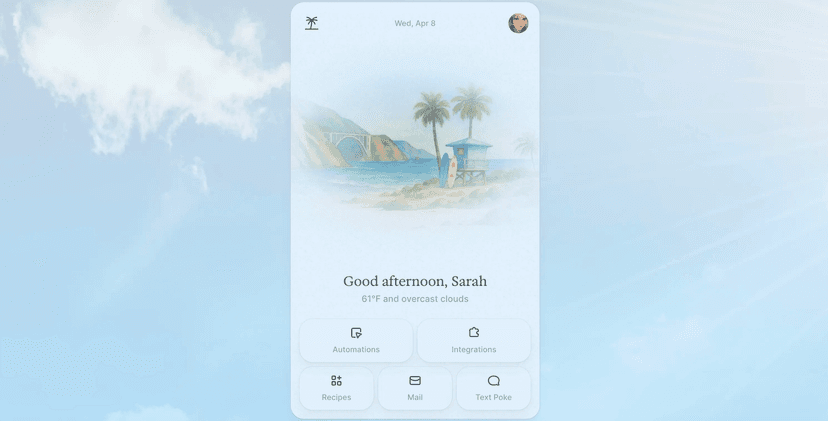
Poke launched publicly in March 2026. It works over iMessage, SMS, Telegram, and WhatsApp in some markets — whatever messenger the user already has open. It handles email triage, reminders, to-dos, and tasks around travel, health, finance, and education. Critically, it is proactive: it opens the conversation first, with things like "want to look at this before tomorrow's meeting?" before you ask. The tone isn't a stiff assistant either. It uses slang and jokes like a friend would.
One more piece of context matters more than it looks. Cognition's Scott Wu and co-founder Walden Yan were early angel investors in Interaction. They had watched the team for years, which almost certainly compressed diligence and negotiation. That prior relationship is a plausible reason Cognition could close two deals in three days.
What Actually Happened
The announced terms are simple. Cognition acquires the entire Interaction team, and Poke continues to operate as a product. The official blog states plainly that existing users can keep using it exactly as before. In the near term, Cognition plans to put its own models and infrastructure under Poke to make it faster and more reliable. In the other direction, Poke's conversational patterns and interaction model get ported into Devin. Two products stay alive while technology flows both ways.
The most interesting asset here isn't code or a model. It's the relationship with Apple. On June 4, 2026, Poke became the first third-party AI agent approved for Apple's Messages for Business. That channel was built so airlines, hotels, and retailers could talk to their own customers over iMessage. It had never been opened to an independent AI agent. To get through, Interaction had to prove it could hand off to a human agent when needed, label the AI clearly, and conform link previews, buttons, and other interface elements to Apple's style guidelines. Von Hagen says that process alone took a couple of months.
The usage numbers hold up too. Cognition disclosed that more than 100 million messages moved through Poke in the three months before the announcement, across hundreds of thousands of users. Given the March launch, that's effectively the product's entire life to date. For something with no app download and no tab to switch to, that's fast accumulation.
The valuation math is worth sitting with. Reporting from early June put Interaction at a $300 million post-money after a $15 million seed plus an additional $10 million, with Spark Capital and General Catalyst on the cap table. If this deal is genuinely "low nine figures," the price may be at or below where the company was marked two months earlier. This looks less like an explosive up-round exit and more like a strategic purchase of a distribution channel and a team. Worth noting: General Catalyst also co-led Cognition's May round, so the same investor sat on both sides of the table.
| Item | Detail |
|---|---|
| Announced | July 23, 2026 (TechCrunch report July 24) |
| Acquirer | Cognition (maker of Devin) |
| Target | The Interaction Company of California (maker of Poke) |
| Price | Low nine figures — roughly $100M–$300M, exact amount undisclosed |
| Poke launch | March 2026 |
| Apple Messages for Business approval | June 4, 2026 — first third-party AI agent |
| Messages, last 3 months | 100M+, hundreds of thousands of users |
| Interaction size | ~10 employees, Palo Alto |
| Previous acquisition | TierZero (July 20, 2026) — two deals in three days |
| Cognition's last raise | May 27, 2026, $1B at $25B pre-money, $492M ARR |
What Each Side Gets — And What Could Break
Cognition gets three things. First, a distribution channel that is genuinely hard to copy. Apple opening the door once doesn't mean anyone can walk through it, and right now exactly one operator has cleared the review bar and the live-support requirement. Second, conversational interface design talent. Devin today runs in an IDE, a web dashboard, and Slack — all surfaces the user has to deliberately open. Third, consumer data and retention know-how, which is a completely different muscle from closing enterprise contracts.
Interaction's math is just as rational. A text-based personal agent has brutal infrastructure economics. You have to answer whatever the user throws at you, and being proactive means running inference in the background constantly. A ten-person team with no model of its own, absorbing that cost structure while going head to head with OpenAI and Google in consumer, is not a realistic plan. Riding on the models and infrastructure of a $26 billion company solves a large chunk of the unit-cost and latency problem. Von Hagen has emphasized that Poke can orchestrate multiple Devin sessions and carry memory across them.
For investors the outcome is ambiguous. Low nine figures against a $300 million post-money from two months prior means the valuation may not have moved much, and the fact that early angels became the buyers raises the obvious question about how the price got set. On the other hand, given how hard it is for an independent consumer AI agent to survive, selling while you still hold a distribution asset is defensible timing.
The risk splits two ways. First, integration risk. Cognition has already shown how it runs one. Three weeks after buying Windsurf, it offered the roughly 200 remaining employees a nine-month severance buyout and told anyone who stayed to expect six-day weeks and 80-plus hours. Scott Wu wrote at the time that the company does not believe in work-life balance. Whether a ten-person consumer team keeps its own voice inside that culture is an open question.
Second, platform risk. If Poke's biggest asset is Apple's approval, then Apple decides how long that asset lasts. If Cupertino opens Messages for Business to other AI agents, the moat thins immediately. If it decides third-party agents conflict with its own AI strategy, the channel can close outright. Cognition has put nine figures on top of a gate it does not control.
Precedents — What Worked and What Didn't
Buying personality and conversational tone as an asset isn't new. The biggest example came in August 2024, when Google signed a roughly $2.7 billion non-exclusive licensing deal with Character.AI and brought co-founders Noam Shazeer and Daniel De Freitas back in-house. Character.AI was a company whose product was literally personality, and it was famous for session lengths nobody else could match. Google didn't buy the company — it bought the people and technology access. Shazeer went on to co-lead Gemini, and the visible improvement in Google's conversational products since is not unrelated.
Microsoft's absorption of the Inflection AI team in March of the same year followed the same logic. Inflection's Pi was widely described as the most empathetic chatbot available, and Microsoft took Mustafa Suleyman and most of the core staff to build Microsoft AI. Fortune read the pattern at the time as a sign that part of the AI startup world was starting to implode. Add Amazon absorbing the Adept team, and 2024 was the year of the teardown deal — buy the personality and the people, leave the corporate shell.
The failure case is just as clear. In September 2023, Meta filmed 28 real celebrities — Tom Brady, Kendall Jenner, Snoop Dogg, MrBeast, Paris Hilton and more — and turned them into AI characters inside its messaging apps. World-class distribution across WhatsApp, Instagram, and Messenger. The most famous personalities on the planet. Meta shut it down quietly in under a year. The reason was simple: nobody used it. Follower counts on the AI personas came nowhere near the celebrities' own accounts.
That's the strongest counterargument to this deal. Personality alone doesn't retain anyone. It makes the first conversation fun. What brings people back is whether the agent actually gets something done. Poke likely hit 100 million messages in three months not because the tone is funny but because it handled calendars, email, and bookings. Even Character.AI never converted personality into a durable business, and it later got tangled in litigation over minors, settling alongside Google in January 2026. Personality is a powerful front door. It has not yet been a moat.
How Rivals Counter
On the coding side, Cognition's direct competition is OpenAI's Codex, Anthropic's Claude Code, Cursor, GitHub Copilot, and Replit. Most of them already treat tone as a product decision. Claude Code's habit of explaining its plan in the terminal is part of its identity. Cursor is engineered above all to not break the developer's flow inside the editor. "Personality" is not a new concept to any of them.
The counterplays diverge by company, though. OpenAI and Google have no reason to buy personality — they own the models and the consumer surface already. ChatGPT is a conversational interface hundreds of millions of people use. Gemini ships inside Android and Workspace by default. If anything their problem is the inverse: too general, so the character blurs. OpenAI pushing browser automation with Operator, and Google layering personalization onto Gemini, are both bets on capability over voice.
Cursor and GitHub Copilot have a structurally different distribution story. They already sit inside the editor a developer keeps open all day, which is precisely the always-open window Cognition just paid for. Flip the logic around and this purchase reads as a self-diagnosis: Devin isn't as natural inside a developer's default working environment as Cursor is. Microsoft, which also owns the code repository itself through GitHub, is in the most comfortable position of anyone in this interface fight.
Anthropic will likely answer on a different axis. It has pushed conversational quality and safety of the model itself as the differentiator, which makes it the best-positioned company to argue that personality is a thin layer. If conversational tone is actually set during model training, then it isn't something you can acquire — it hardens as you build the model. Under that reading, the more accurate description is that Cognition didn't buy personality. It bought an Apple approval.
The personal agent side isn't quiet either. If Apple opens Messages for Business to other operators, OpenAI and Google walk in first, and Poke's status as the only approved agent evaporates that day. If Apple instead decides to fill the message thread itself through a rebuilt Siri, the third-party slot may shrink altogether. How many quarters Poke's moat lasts is a decision made in Cupertino, not at Cognition.
So What Actually Changes
For developers, almost nothing changes right now. Devin's UI is not moving into a text thread overnight, and porting Poke's conversational model into Devin takes time. The direction is worth watching, though. Instead of opening a dashboard to ask a coding agent for status, the agent texts you first: "this PR needs review, want to look now?" If von Hagen's idea of bundling multiple Devin sessions into one conversation ships, the work shifts from running agents to managing them.
If you buy software for a company, look at something else. In three days Cognition swallowed TierZero and Interaction, wiring code generation, deployment, operations, and human communication into a single stack. TierZero was already used by tens of thousands of engineers at companies like Brex, Discord, and Drata, plugging into observability tooling and CI/CD to handle incidents automatically. If your organization is deciding between multiple vendors and one, read this as a signal that Cognition is going for full-lifecycle single-vendor. That means it's time to weigh lock-in against integration convenience deliberately, not by default.
For investors there are two takeaways. One: the realistic exit path for consumer AI agent startups is narrowing to absorption by a large infrastructure company. A company that went from a $15 million seed to a $300 million valuation and sold four months after launch says a lot about how hard independent scale is in consumer AI. Two: access to a distribution channel is now being priced as a separate asset. What Cognition bought is, functionally, a passed Apple review and the team that passed it.
If you just use Poke, you can keep using it for now. Cognition explicitly said there is no plan to shut it down, and claims response speed and reliability will improve. That said, the history of acquired consumer products is that feature priorities drift toward the parent's strategy. Keep open the possibility that Poke slowly shifts from personal assistant toward notification channel for engineering work.
Zoom out and this deal poses one question to the whole industry. When model performance levels off, is the remaining differentiator really interface and tone — or is that a thin layer anyone replicates in a few months? Meta's celebrity chatbots voted for the latter. Character.AI's session times and Poke's 100 million messages in three months vote for the former. The answer shows up over the next few quarters in one place: Devin's retention numbers.
🥄 Three Things You're Probably Wondering
— So what does this mean for me? Not much directly. But if this pattern holds, AI stops being an app you open and starts arriving in the window you already have open — texts, chat, wherever you live. Worth thinking now about how you'll manage the notification fatigue that comes with proactive agents.
— If Apple opens the door to other AI agents, is Poke finished? The moat does get thinner, no question. But the user habits built by going first, and the institutional knowledge of how to pass Apple's review, don't disappear. Apple has published no roadmap for when or how it would open the channel, so it's too early to call.
— Low nine figures — did the founders make out well? Given reports that the post-money was $300 million two months earlier, this may not be a big markup. The deal structure — cash versus stock, retention conditions — wasn't disclosed, so what anyone actually pockets is unknown. Too early to call.
References
- TechCrunch — Why Cognition bought Poke: AI personality is becoming a competitive advantage (2026.07.24)
- Cognition — Welcoming The Interaction Company (2026.07.23)
- TechCrunch — Apple approves Poke as the first AI agent on its Messages for Business platform (2026.06.04)
- TechCrunch — AI coding startup Cognition raises $1B at $25B pre-money valuation (2026.05.27)
- TechCrunch — Cognition, maker of the AI coding agent Devin, acquires Windsurf (2025.07.14)
- Accel — Cognition Acquires TierZero: Building the Autonomous Engineering Agent (2026.07.20)
- TechCrunch — Three weeks after acquiring Windsurf, Cognition offers staff the exit door (2025.08.05)
- CNBC — Cognition valued at $10.2 billion two months after Windsurf purchase (2025.09.08)
- 9to5Mac — Apple's Messages app on iPhone now has a third-party AI agent (2026.06.04)
- TechCrunch — Character.AI CEO Noam Shazeer returns to Google (2024.08.02)
- Fortune — Google's hiring of Character.AI's founders is the latest sign that part of the AI startup world is starting to implode (2024.08.02)
- TechCrunch — Meta filmed Mr Beast, Paris Hilton and 26 more to build celebrity AIs based on Llama 2 (2023.09.27)
Numbers are as of announcement and may change.