The week your sales agent pitched a customer, your service agent was still fixing that customer's complaint
HubSpot shipped Agent Hub and Agent Builder as a public beta on July 23, 2026. Every customer on a Professional or Enterprise tier is eligible. No waitlist, no invite code — if you're on the tier, you can switch it on in your account that day.
The thing HubSpot led with in the announcement wasn't a feature list. It was a scene. A sales prospecting agent emails a new pitch to an account the same week a contact center service agent is sitting on an unresolved complaint ticket for that exact account. Neither agent knows the other exists. From the customer's side it reads as "you haven't even fixed my problem and you're upselling me." From the company's side, it's the paradox where adding more automation makes the customer experience worse.
HubSpot CPTO Duncan Lennox framed it this way in the official announcement: the problem isn't managing one agent in isolation. The moment you have several, they fragment, each working off a different picture of the customer — or worse, no picture at all. Agent Hub is his answer to that: one place to see agent performance, with everything working from shared context.
So the point here isn't "HubSpot can build agents now." It's been doing that under the Breeze name since 2024. What's different is that multiple agents now sit on top of a single customer view, and an admin turns them on, off, and audits them from there. That's HubSpot conceding in product form what the 2025-2026 SaaS fight actually became: not "can you build an agent," but "can you orchestrate several of them."
Why HubSpot, why now
HubSpot is the SMB CRM incumbent. While Salesforce locked down the enterprise, HubSpot grew on the promise of an all-in-one marketing, sales, and service suite that a company with no IT staff could actually run. Its asset was never an algorithm. It's customer data — campaign records, deal history, contact records, call transcripts, tickets, buying signals, all piled into one place under the Smart CRM label.
In the agent era that pile suddenly became a weapon. For an agent to be useful, what it knows about this specific customer matters more than how smart the model is. Anyone can buy a frontier model through an API. Nobody else has "this account requested a refund three weeks ago, its owner changed twice, and pricing came up in the last meeting." That context lives inside the CRM. What HubSpot is selling here is the context, not the model.
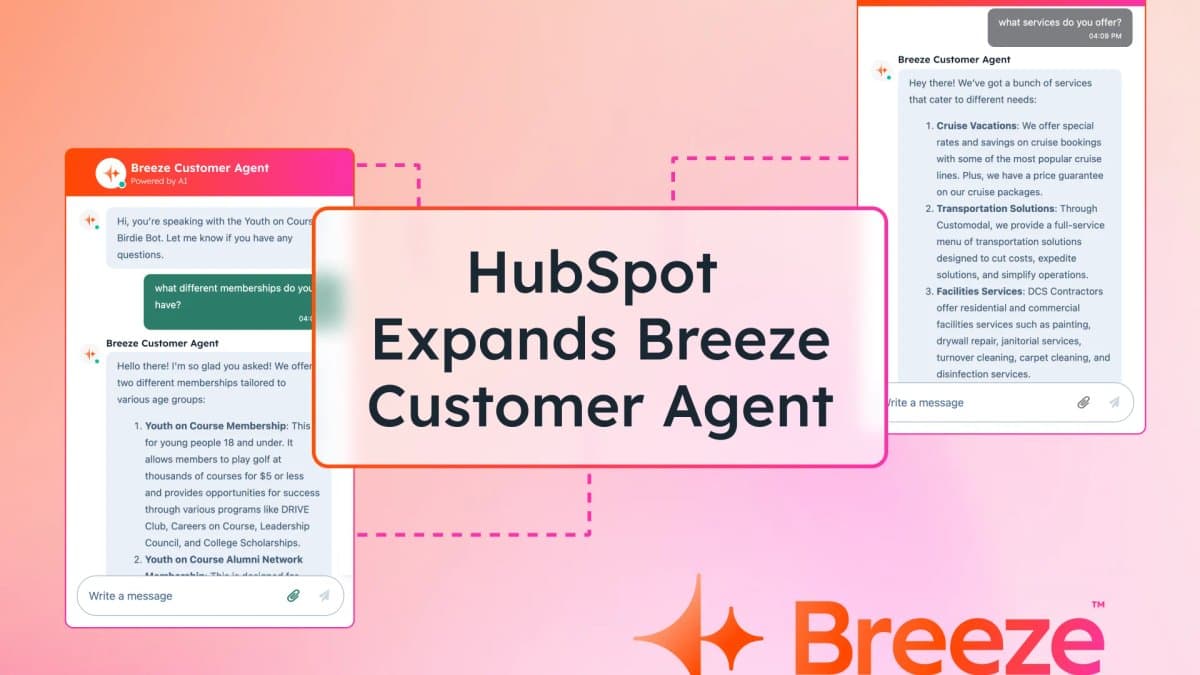
Agent Hub is the control tower that sits on top of it. Per HubSpot's product documentation, Agent Hub gathers prebuilt agents, customer-built custom agents, and agentic workflows into one screen. Each agent card shows live status and recent results, and agents are grouped not by function but by the outcome they drive — generating demand, closing deals, keeping customers happy, scaling growth. The prebuilt roster listed in the docs: an AEO agent (AI search visibility), a data agent (CRM data quality and enrichment), a prospecting agent, a deal progression agent, and a customer agent.
Agent Builder is the workshop bolted next to it. You describe what you want in plain language on a no-code canvas, and assemble a custom agent out of data that's already in the CRM. The docs list three families of actions available on that canvas: HubSpot actions (fetch data, create things, run things), basic actions (web browsing, reading and writing CRM records), and external integrations through MCP (Model Context Protocol, the spec for wiring agents to outside systems). That last one matters — it's the door that lets an agent reach past HubSpot's own fence.
Admin tooling shipped alongside. HubSpot says you can dig through execution logs to see what an agent decided and why it acted, track performance by team, and confirm agents are staying inside company guidelines from a single workspace. You can also require an approval step before an agent runs autonomously. One useful default: Agent Builder doesn't open until a super admin turns on the account's AI settings first, so random employees spinning up agents behind the org's back is blocked out of the box.
The moment credits switch on, so does the calculator
The numbers make the shape of this beta clearer. Agent Hub and Agent Builder are included in Professional and Enterprise subscriptions — there's no new SKU to buy. But every time a custom agent built in Agent Builder actually performs a configured action, it draws down HubSpot Credits. Each tier includes a credit allotment; run out and you buy more. Existing automation and workflows, meanwhile, keep running credit-free.
HubSpot built two guardrails to blunt the cost anxiety. First, test runs don't consume credits. You can hammer an agent before deployment to check whether it responds in the right format and pulls from the right data source. Second, you can set a monthly run limit, capping the blast radius if one agent goes haywire and starts torching credits. HubSpot's own docs also note that credit estimates derived from test runs are just that — estimates — and that actual costs may differ.
| Item | Detail |
|---|---|
| Announced | July 23, 2026 (public beta) |
| Eligibility | All Professional and Enterprise customers |
| Products covered | Marketing / Sales / Service / Data / Content Hub + Smart CRM (Pro, Enterprise) |
| Agent Hub | Unified console for prebuilt and custom agents, live status and recent results, grouped by outcome |
| Prebuilt agents | AEO, data, prospecting, deal progression, customer |
| Agent Builder | No-code canvas, natural language plus Smart CRM context |
| Available actions | HubSpot actions (fetch, create, execute), basic actions (web browsing, CRM read/write), MCP external integrations |
| Billing | HubSpot Credits drawn on custom agent actions; included per tier, top-ups available |
| Cost controls | Free test runs, monthly run limits, approval step before autonomous execution |
| Access gate | Super admin must enable account AI settings first |
| Early case | Ignite Reading — 25+ states, 350+ hours saved per year |
The contentious row in that table is billing. Seat-based SaaS was easy to forecast: headcount times price, done. Consumption is different. The better your agents run, the bigger the invoice, and the highest-performing teams pay the most. "Cost scales with outcomes" sounds coherent from the seller's chair. From the buyer's chair — where budgets get locked at the start of the fiscal year — it's unpredictability. PPC Land flagged the same open question: per-action pricing and credit burn rates weren't disclosed at beta launch.
Worth noting this isn't a sudden swerve. CMSWire reported that HubSpot moved some Breeze agents to pay-per-result billing in April 2026, and PPC Land reported that the AEO tooling launched April 14 of the same year was priced at $50 a month. The Agent Hub credit model is a continuation of a direction HubSpot has been inching toward for several quarters.
The launch customer story is Ignite Reading, an online literacy tutoring operation running across more than 25 states. It handed a custom agent the job of finding and parsing academic calendars scattered across individual school districts. Manual work that took 15 to 20 minutes per district collapsed to seconds, and HubSpot and PPC Land both report 350-plus hours recovered per year. It's not a flashy revenue story — it's boring data collection automation, which is exactly why it lands as credible. It's also an honest picture of the range where agents are currently reliable.
What each side walks away with, plus the risk nobody's holding
HubSpot walks away with lock-in. If your agents grow on top of Smart CRM context, then switching CRMs vaporizes every custom agent and workflow you built. Data migrates, one way or another. What doesn't migrate is the asset you carved into that canvas: the encoded sequence of how your organization makes decisions. CRM lock-in used to be about data. Going forward it's about operating logic. And HubSpot gets room to grow revenue per account without ever selling a new SKU — it just calls it credits.
SMB customers walk away with headcount they don't have to hire. A marketing manager assembling an agent in natural language, with no dedicated developer or AI engineer, means the kind of automation you used to pay a consultancy tens of thousands for is now something you can attempt in-house. Ignite Reading is precisely that shape. And because testing is free, the cost of failing is low. That combination could genuinely accelerate SMB adoption.
Existing partners and agencies aren't in a bad spot either. No-code doesn't mean everyone builds well. Which actions get approval gates, what data an agent is allowed to see, where you set the run limit — those are design decisions. Implementation partners in the HubSpot ecosystem get a new billable line item called agent design and governance.
The risks split three ways. First is liability. When an agent contacts the wrong customer at the wrong moment, whose fault is that? The wider the range of judgment automation takes over from humans, the blurrier the line between "the customer configured it that way" and "the platform built it to behave that way." Once marketing-send regulation, personal data handling, or communication rules in regulated industries like finance and healthcare enter the picture, this stops being a philosophical debate and becomes an actual fine.
Second is whether the audit log is any good. Having execution logs and being able to reconstruct what happened from those logs are two different things. LLM-based agents can respond differently to the same input, which makes "why did it decide that" hard to explain from logs alone. How deep governance and approval workflows go at this beta stage hasn't been fully disclosed, and both CMSWire and PPC Land left it flagged as unverified.
Third is cost shock — with a twist. Setting a credit cap stops the runaway, sure, but an agent that hits its cap simply stops. A customer-facing agent that burns its monthly credits and goes dark in the last week of the month is a worse service incident than the cost incident it prevented. Consumption billing creates a zone where "save money" and "don't break service" point in opposite directions.
Precedents — What Worked and What Didn't
The most direct precedent is Salesforce Agentforce. At its September 2024 launch, pricing was $2 per conversation. The trouble was the definition of "conversation." A one-shot question and a ten-turn support escalation both cost $2. Cost wasn't tied to delivered value, budgeting was guesswork, and a lot of organizations stalled before large-scale rollout. The seller called it outcome-based. What buyers felt was an unpredictable invoice.
Salesforce eventually turned the wheel. On May 15, 2025 it announced Flex Credits by press release, and the core change was billing per action instead of per conversation. One action costs 20 Flex Credits — roughly $0.10 — and credits sold at $500 for a bundle of 100,000. A Flex Agreement shipped alongside it, letting customers shift budget between user licenses and digital labor. That was, in practice, an admission that the original pricing model was blocking adoption. Reports afterward showed quarter-over-quarter growth in customers expanding Agentforce, though contracts mixed in pilot and seeded licenses, so the scale of genuinely paid expansion is still argued over.
You can see HubSpot took notes. It started at per-action credits from day one, with free testing and monthly run limits built in as standard safety rails. It's launching from the point Salesforce took eight months to reach. Skipping a new SKU and folding this into existing Professional and Enterprise subscriptions is the same calculation: get people using it, recover revenue through consumption.
On the success side, the reference point is per-resolution pricing, which Zendesk and Intercom pushed hard. You only pay when a customer inquiry is actually resolved, which lets buyers relax — if the AI doesn't do the work, you don't pay. That design was only possible because customer support has a crisp definition of success. Flip that around and you get the constraint: where outcomes can't be cleanly defined, the model doesn't work. Marketing content generation or sales research, where you can't immediately judge whether the result was good, ends up back at action-based credits. That's exactly where HubSpot is standing.
Microsoft Copilot Studio left a different lesson. It's a consumption model where you buy message and credit packs, and burn rates vary by capability — scripted responses cost little, generative responses and agent actions cost more, reasoning models cost far more. The metering is precise, and the recurring complaint is that it made invoices harder to forecast, not easier. Precise metering doesn't automatically produce a good buying experience. HubSpot opening a beta without publishing credit burn rates carries that same weight.
How Rivals Counter
Salesforce Agentforce is still the most direct opponent. Its strengths are enterprise penetration and large-scale data unification through Data Cloud; its weaknesses are complexity and total cost of ownership. HubSpot's play here aims straight at the weakness. "An agent console one admin can switch on in half an afternoon" is a deliberate contrast with an Agentforce rollout that needs a dedicated architect. That said, as organizations get larger there's a crossover point where Salesforce's data integration breadth wins again — and where that line sits is the fight for the next few quarters.
Microsoft Dynamics 365 plus Copilot Studio applies pressure on a different axis. As of 2026, Copilot inside Dynamics apps like Sales and Service is bundled into those SKUs with no separate license; only externally facing agents pull a Copilot Studio license and burn credits. Microsoft's weapon isn't CRM context — it's work context spanning Office, Teams, and Entra identity. If HubSpot fights on "what we know about your customer," Microsoft fights on "what we know about everything your employees do." In an org already standardized on M365, that argument is strong.
Zoho digs underneath on price. It's spent years shipping an all-in-one suite at a far lower unit price, and its agents will likely lead with minimizing incremental cost. With credit burn rates still undisclosed, that's a real opening for budget-sensitive SMBs to walk. Intercom Fin and Sierra come in from the opposite direction — narrow and deep. They focus on customer support alone, put resolution rate itself on the line as the performance metric, and use outcome-based pricing to lower purchase resistance. That's where HubSpot's customer agent meets them head-on, and "we orchestrate multiple agents" isn't much of a differentiator inside a single support domain.
One piece of news from the same week shows another angle of counter. Ushur announced the Ushur Agentic Platform on July 22, 2026, built specifically for regulated industries like insurance, banking, and healthcare with governance baked in from the start. Its pitch is finishing processes — coverage changes, claims progression, bank onboarding, patient care guidance — rather than just conversing about them. While HubSpot expands horizontally (every industry, shallow), vertical players drill in on "auditable agents in regulated industries." Their argument is that a general-purpose console's execution logs aren't enough where compliance is strict, and that's a fairly persuasive rebuttal.
Zendesk defends with the ticket data and knowledge base it already holds. For customer support specifically, plenty of accounts have thicker conversation history there than in HubSpot. Which is the shape this whole market is converging into: not "who builds the best agent," but "whose data does the agent run on top of." HubSpot's answer to that question is Smart CRM.
So What Actually Changes
For developers and technical owners, the thing to watch is MCP. Being able to attach external systems from the canvas means a no-code tool can now produce agents that touch internal systems, not just automation confined to HubSpot. Convenient in exact proportion to how dangerous it is. If you don't set policy now on which MCP servers are permitted and how far write access opens, in a few months you'll find an agent nobody remembers building touching production data. Use the super admin gate to your advantage: document your approval and logging policy before you flip AI settings on.
For enterprise buyers and ops leaders, start with the calculator. Find out how many credits your account already includes, then use test runs to measure how many actions your intended agent consumes per unit of work. Free testing isn't a marketing line — it's the single most practically useful feature here. And when you set run limits, don't anchor on "cost ceiling." Anchor on "what customer experience breaks if this agent stops." Customer-facing agents and internal data-cleanup agents should not share a limit policy.
For investors, the point is the shift in revenue recognition. Seat-based SaaS earned premium multiples on predictable recurring revenue. As consumption grows as a share, revenue gets more upside and more volatility at the same time. HubSpot choosing to layer credits into existing tiers rather than launch a new SKU is a bet: cut adoption friction now, tie revenue growth to how much actually gets consumed. Over the next few quarters, the number that matters isn't accounts with agents enabled — it's credit consumption growth per account, and whether the company discloses that figure at all is itself a signal.
For regular people — meaning us, receiving emails and chats as somebody's customer — it splits two ways. Done well, you get responses that already know about the inquiry you filed yesterday, and less of the current experience where every department tells you something different. Done badly, you get far more automated outreach, far faster than before. More agents doesn't mean more courteous communication. What makes the difference isn't the tool; it's whoever put an approval gate in front of it.
One last thing. It's interesting how little performance bragging HubSpot did here. Which model, what benchmark score — none of that is up front. Instead the words that repeat are "fragmentation," "shared context," and "one workspace." The center of gravity in the agent race has moved from model performance to operations and governance, and you can now see it at the level of the marketing copy.
🥄 Three Things You're Probably Wondering
— So what does this mean for me? Not much directly if you're not on HubSpot. But if your company runs automation on top of a CRM, then within a few quarters someone will ask you how many agents you're running and under what rules they coordinate. The answer that matters won't be a tool choice — it'll be your approval and logging policy.
— Doesn't this just make everything more expensive because of credits? Maybe, maybe not. Per-action pricing and credit burn rates haven't been published, so calculating a total right now is impossible. The upside is that test runs don't consume credits, so run your real scenarios, measure actual consumption, then decide. Too early to call.
— If an agent screws up, who's liable? Contractually the usual answer is whoever configured it. Whether execution logs can actually reconstruct how a decision was made when a compliance violation hits hasn't been verified, and at public beta there isn't enough information on how deep governance goes. For now, putting an approval step in front of customer-facing actions is the most realistic defense you have.
References
- HubSpot — Meet Agent Hub and Agent Builder: One place to build and manage AI agents with shared context (2026.07.23)
- HubSpot Community — Introducing Agent Hub and Agent Builder (public beta) (2026.07.23)
- HubSpot Knowledge Base — Create and customize agents in the agent builder (2026.07)
- HubSpot Knowledge Base — Understand Agent Hub (2026.07)
- CMSWire — HubSpot Launches Agent Hub and Builder in Public Beta (2026.07.23)
- PPC Land — HubSpot agent cuts 350 hours a year for Ignite Reading across 25 states (2026.07.24)
- Salesforce — Salesforce Introduces New Flexible Agentforce Pricing to Accelerate the Digital Labor Revolution (2025.05.15)
- GlobeNewswire — Ushur launches the Ushur Agentic Platform: AI agents that finish the job (2026.07.22)
Numbers are as of announcement and may change.