One year old, day zero of public existence, $1.2 billion
Here's the deal: on July 22, 2026, a company called Glow came out of stealth. The numbers attached to its first-ever public announcement were $180 million raised at a $1.2 billion valuation. The company was founded in 2025 — roughly a year of existence — and this was the day it told the world what it builds.
Those numbers have an explanation, and it's on the cap table. Sequoia, Cyberstarts, Greenoaks and Redpoint co-led, with Index Ventures, Swish Ventures, Lux Capital and Holly Ventures participating. That combination — Sequoia alongside Cyberstarts specifically — carries weight in Israeli cybersecurity. A long list of security companies that grew into multi-billion-dollar outcomes, Wiz included, started from exactly this pairing.
What's interesting is the market Glow picked: endpoint security. Twenty-plus years old, thoroughly consolidated around CrowdStrike and Microsoft. Not an obvious place for a new company. Glow's argument is that AI changed the assumptions the entire category rests on.
The cast — three founders and the companies they left
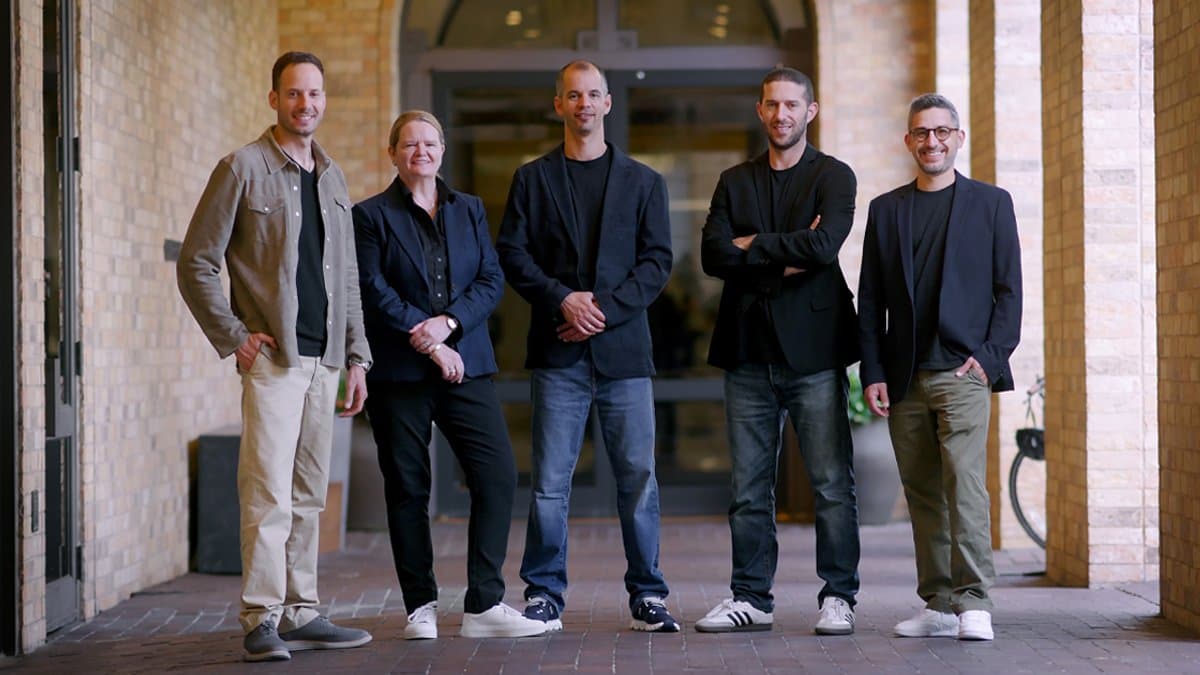
The founding team's résumés account for roughly half of this round.
Roi Tiger is CEO. He spent nine years as a VP of Engineering at Meta. Before that he founded Onavo, the mobile data analytics company Facebook acquired — which is how he landed at Meta in the first place. Onavo analyzed users' mobile traffic, and that lineage isn't incidental to what he's doing now. This is someone who has spent a very long time reading traffic and behavior patterns coming off devices.
Omer Singer is CTO. He ran cybersecurity strategy at Snowflake. Snowflake is a data warehouse company, and Singer is known in security circles for pushing the security data lake concept: collect logs and telemetry into customer-owned storage rather than a vendor's closed console, and run detection logic on top of that. Incumbent security vendors were not fond of the argument.
Ophir Arie is VP of R&D. He held the same title at Claroty, which secures industrial control systems. Claroty's specialty is detecting threats in environments where you cannot install an agent — factory floors, power plant control networks. Also not a coincidence.
Put the three together and the shape emerges: large-scale consumer traffic analysis, security data architecture, and detection in environments that resist instrumentation. Combine them and you get a system designed to observe and judge what happens on an endpoint through different machinery than the incumbents use.
Worth noting the investor side too. Cyberstarts, founded by Gili Raanan, is an Israeli cyber-specialist fund known for an unusual method: founders validate the problem with customer CISOs before building anything. Wiz and a string of others came out of that model. Sequoia co-leading signals that this is viewed as a full US market assault, not a niche play.
What the company actually builds
Glow's product description is still fairly abstract. Per the official materials:
| Item | Detail |
|---|---|
| Raised | $180 million |
| Valuation | $1.2 billion |
| Announced | July 22, 2026 |
| Lead investors | Sequoia, Cyberstarts, Greenoaks, Redpoint |
| Participating | Index Ventures, Swish Ventures, Lux Capital, Holly Ventures |
| Founded | 2025 |
| Founders | Roi Tiger (CEO), Omer Singer (CTO), Ophir Arie (VP R&D) |
| Product concept | AI-driven adaptive prevention — environment mapping, risk analysis, automated policy enforcement |
| Use of funds | US go-to-market expansion, Glow Labs research arm |
The central idea is adaptive prevention, and understanding why it might matter requires a bit of history.
Endpoint security has been through two generations. Generation one was antivirus: maintain a list of known malware signatures and block on match. Its limitation against novel attacks was obvious. Generation two is EDR (Endpoint Detection and Response), the category CrowdStrike defined — continuously observe process behavior, raise alerts on anomalous patterns, respond. That's the current mainstream.
Glow's thesis is that the "normal" EDR is measured against is coming apart. Consider what an AI coding tool or agent does on a laptop. It reads broadly across the filesystem. It executes shell commands. It sends data to external APIs. It writes code and then runs that code. From the vantage of behavior-based detection, that is nearly indistinguishable from a textbook malware profile. Block all of it and you paralyze the company's productivity tooling. Allow all of it and you can no longer distinguish it from actual exfiltration.
There's a compounding problem: agents hold credentials. An AI agent on a developer's laptop frequently has GitHub tokens, cloud credentials and database connection strings within reach. A single prompt injection can hand those privileges to an attacker — a risk repeatedly demonstrated over the past year, not a theoretical one.
Glow's stated sequence — environment mapping → risk analysis → automated policy enforcement — reads as an answer aimed at that problem. Map which AI tools run on this device with which permissions doing what; assess the risk of each behavior; adjust policy automatically instead of making humans hand-write rules. How much of that is actually implemented isn't public. Which is normal for a company at the stealth-exit stage.
What each side gets
Glow gets time. A $180 million first disclosed round is unusually large, and the message it carries isn't "produce revenue fast" — it's "don't worry about money until it's right." Security products take years to earn trust, and an enterprise CISO's decision to swap an endpoint agent moves on multi-year cycles. This round buys the runway to survive that interval.
Investors get a category option. The archetypal cyber VC bet: when an existing category gets redefined by a technology shift, bet that a company founded at that exact moment takes the whole category. Wiz did it in cloud security. CrowdStrike did it in EDR. If the hypothesis that AI agents redefine the endpoint holds, this is that moment.
Enterprise CISOs get nothing yet. General availability, OS support, whether it coexists with an existing EDR — none of that is public. But there is one real effect: it forces incumbents to address the same problem faster. The speed at which CrowdStrike and Microsoft put "AI agent visibility" on a roadmap goes up because of news like this.
Israel's security ecosystem gets another data point. Talent from elite units and industrial security firms founds a company on American VC money and sells into the US market — the pattern repeats. What's slightly different here is that this team's lineage runs through big tech and data infrastructure rather than military signals intelligence.
How companies like this have fared
The success case is Wiz. Founded 2020, entering cloud security where Palo Alto and others were already established. One technical differentiator: scan an entire cloud estate through APIs without installing an agent. Removing the friction of deploying an agent to every server made adoption dramatically faster, and five years later Google acquired the company for $32 billion. The lesson: a mature market reopens for anyone who removes the adoption friction.
The other success case is CrowdStrike. In 2011, antivirus was completely locked up by Symantec and McAfee. CrowdStrike abandoned signatures for cloud-based behavioral analysis and displaced the incumbents. What Glow now wants to do to CrowdStrike is precisely what CrowdStrike did to Symantec.
The failure cases are numerous. Between 2015 and 2018, dozens of "next-generation antivirus" companies raised large rounds and almost none survived independently. Cylance became a unicorn on AI-based malware detection, sold to BlackBerry for $1.4 billion, and effectively disappeared. The problem wasn't the technology — it was distribution. An endpoint agent is a high-switching-cost product, and being somewhat better is not sufficient reason to displace an incumbent. Remember that Wiz's winning feature was "you don't have to install anything." Friction decided both outcomes.
A third failure mode is timing. Diagnosing the problem correctly while customers aren't hurting from it yet. That's Glow's biggest exposure. The argument that AI agents undermine endpoint security's assumptions is persuasive, but whether incidents have already happened at a scale that moves CISO budgets is a separate question. Today this still looks closer to "about to be a problem" than "currently a problem."
How the incumbents counter
CrowdStrike is already moving this way. Layering AI-tool context onto telemetry its agent already collects is easier for CrowdStrike than for a startup — it's installed on millions of endpoints, and that install base is the strongest defense in the category. Adding a feature is far cheaper than convincing someone to deploy a new agent.
Microsoft comes from a different angle. Defender ships inside Windows and effectively sells for free bundled into E5 licensing. Microsoft also builds Copilot, meaning it can argue "we know best what our own agent is doing." Bundling and integration make it the most dangerous competitor here.
A counterattack is also coming from identity security. That frame defines the AI agent problem as privilege management rather than device security. Okta, CyberArk and others are extending into controlling the credentials and permissions granted to agents. If that framing wins, the market Glow defined gets absorbed into a different category entirely.
And the AI companies themselves compete here. Anthropic and OpenAI keep adding sandboxing, permission-approval flows and audit logging to their coding agents. If the tool vendors build good enough guardrails, the reason to buy a separate security layer shrinks. Glow's homework is demonstrating clearly what the tool vendors structurally cannot do.
What actually changes for you
If you run security, there's something you can do this week without a budget: inventory which AI coding tools are running on your developers' laptops and with what permissions. Most organizations do not have that list. Whether or not you ever buy a product like Glow, you cannot make any decision here without that visibility.
If you're a developer, audit the blast radius of the credentials your local agent can reach. Personal access token scopes, cloud CLI session lifetimes, shell-execution approval settings. Prompt injection is a demonstrated attack path, not a hypothetical.
If you're a founder, the signal in this round isn't the dollar amount — it's what the investor combination says. Sequoia and Cyberstarts in the same deal means they see a category where large budgets are about to appear. If you're weighing a company adjacent to AI security, this is evidence the funding window is open.
If you're an investor, the metric that matters isn't the announced valuation. It's paid customer count twelve months from now. Early security valuations are set by team pedigree and category size; actual validation comes from the rate at which enterprise pilots convert to paid contracts. That data doesn't exist at stealth exit.
If you're a general user, no direct relevance. Though the fact that companies like this keep appearing is itself evidence that AI tools are genuinely in use inside enterprises. Security markets only move money when the problem is real.
🥄 Three Things You're Probably Wondering
— Does a $1.2 billion valuation at one year old make any sense? It's rare but not unprecedented in cybersecurity — Wiz became a unicorn in eighteen months. Early valuations in this market are set by team pedigree and category size, not revenue. It's worth being explicit, though: this is expectation, not validation. Nobody knows yet how the actual product lands with buyers.
— If I already run CrowdStrike, do I need to buy this too? There isn't enough information to answer that. It isn't even publicly clear whether Glow replaces an existing EDR or layers on top of one. What is clear is that incumbent EDR vendors know about the same problem and have it on their roadmaps. No rush — the right first step is understanding what risk AI agents actually create in your own environment.
— Are AI agents a genuine security threat, or is this marketing? Some of both. Prompt injection hijacking agent privileges has demonstrated real-world cases, and the number of agents holding credentials and executing shells keeps growing. At the same time, there's obvious commercial pressure to turn that into a new product category. The honest answer today: the risk is real, but there isn't yet enough data to say whether it's large enough to justify a separate purchase.
References
- Glow Emerges From Stealth to Reinvent Endpoint Security in the AI Era — Glow newsroom
- Glow Emerges From Stealth With $180 Million to Reinvent Endpoint Security in the AI Era — GlobeNewswire
- Glow emerges from stealth at $1.2B valuation to challenge endpoint security in the AI era — TechCrunch
- Endpoint Security Firm Glow Launches With $180M in Funding at $1.2B Valuation — SecurityWeek
- Glow exits stealth with $180 million to secure the AI-enabled endpoint — Help Net Security
- Ex-Meta founder's Glow raises $180M for AI endpoint security — The Next Web
- AI security startup Glow emerges from stealth with $180 million at $1.2 billion valuation — CTech
Numbers and criteria are as of announcement and may change. Investment calls are yours to make!