You Have to Go Back Four and a Half Years to Find a Number Like This
Amazon dropped its second-quarter results on Thursday, July 30, right after the US market closed. Near the top of the release, in a line the company chose to pull out and set apart from everything else, sat this: AWS revenue up 37% — fastest growth in 18 quarters, with an annualized run rate of $169 billion. Eighteen quarters is four and a half years. That takes you back to early 2022, right before the cloud market rolled over from the tail end of the pandemic boom into the great cost-optimization hangover.
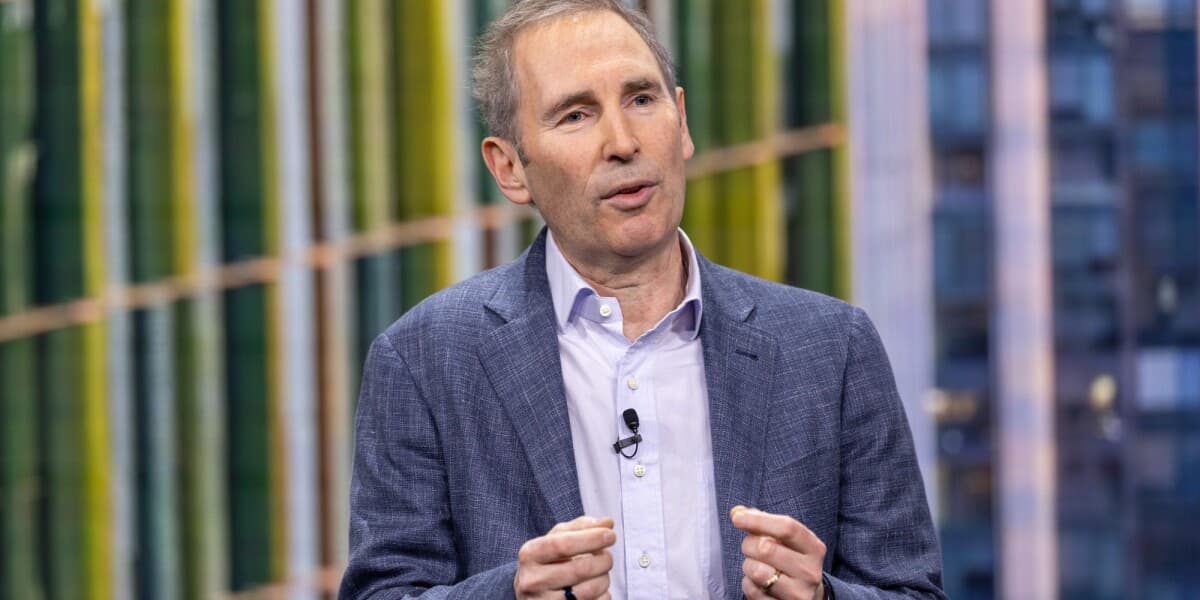
Andy Jassy's quote went further. "AWS is booming, growing 36.7% year-over-year in Q2, and our AI and Chips businesses each eclipsed run rates of more than $25 billion." Twenty-five billion for AI. Twenty-five billion for chips. Both, the company added, growing triple digits. Amazon stock jumped more than 9% in after-hours trading.
Here is the thing, though. The same press release carries another number: net income of $62.6 billion, or $5.75 per diluted share. A year ago that same quarter was $18.2 billion and $1.68. So profit more than tripled. Cloud did not do that. Inside the $62.6 billion sits $53.4 billion of pre-tax non-operating other income — a markup that Amazon says came "primarily from our investment in Anthropic." The money Amazon actually earned from running businesses was operating income of $27.5 billion.
One more line on the same page. Trailing twelve-month free cash flow is negative $7.6 billion. A year ago it was a positive $18.2 billion. The reason is purchases of property and equipment, which rose $66.1 billion on a TTM basis, an increase the company says "primarily reflects investments in artificial intelligence." And on the call, Jassy raised 2026 capital expenditures from roughly $200 billion to about $220 billion. The stated reason: memory prices going up.
So this earnings report does not read in one direction. Cloud is sprinting faster than it has since 2022, cash flow has flipped negative, and most of the reported profit is a mark-to-market gain on a stake Amazon has not sold — held in a company that also happens to be one of AWS's biggest customers. Let us take it apart piece by piece.
The Four Parties Standing Behind This Income Statement
Start with Jassy. He launched AWS as an internal project back in 2003 and took the CEO chair from Jeff Bezos in 2021. His entire career compresses into a single sentence: spend heavily on infrastructure before demand shows up, then collect for a decade. When he says he is going to spend $220 billion, he is rewriting that sentence for the AI era. He also said the 2028 demand Amazon has already contracted is "impressive," and that even $220 billion will not be enough to serve all the demand landing in 2026.
Second is AWS itself. Revenue of $42.2 billion, operating income of $16.6 billion. That 39.4% operating margin is the highest in six quarters, and it matters more than it looks. When a cloud provider is building data centers at full tilt, depreciation typically arrives before the revenue does, which squeezes margin. AWS ran the other way: revenue growth outpaced the depreciation ramp. Of Amazon's $27.5 billion in total operating income, AWS produced $16.6 billion — roughly 60% of company profit from a segment that is 21% of company revenue.
Third is Anthropic. On April 20, 2026, Amazon and Anthropic announced an expanded partnership. Anthropic committed to spending more than $100 billion on AWS technology over the next decade and to securing up to 5 gigawatts of compute. Amazon put in another $5 billion at signing, with up to $20 billion more tied to commercial milestones, layered on top of the $8 billion already invested. This quarter's $53.4 billion gain is what happens when that stake gets re-marked on the books.
Fourth is Amazon's silicon organization, whose roots go back to the 2015 acquisition of Israeli chip designer Annapurna Labs. That team produced Graviton (general-purpose CPUs), Inferentia (inference), and Trainium (training). In this quarter's release Amazon announced general availability of Graviton5, said 98% of its top 1,000 EC2 customers now use Graviton, and reported that Graviton revenue commitments nearly tripled quarter over quarter. On the Trainium side, the release names both Anthropic and OpenAI as having signed multi-year, multi-gigawatt commitments.
The real structure of this quarter is that those four are wired into a single loop. Amazon invests in Anthropic. Anthropic spends that money — plus its own — on AWS Trainium capacity. That shows up as AWS revenue and as "chips business run rate." Strong results push Anthropic's valuation up, which puts a markup on Amazon's balance sheet. The circle closes. None of that is fraudulent or even unusual in venture-adjacent finance. It just means you need the loop in your head before you read any single number in isolation.
Working Through the Numbers in Order
Company-wide first. Q2 net sales were $200.6 billion, up 20% year over year, and 20% excluding foreign exchange too. North America came in at $116.2 billion, up 16%, with $9.1 billion of operating income. International was $42.2 billion, up 15%, with $1.7 billion of operating income. And AWS was $42.2 billion. Note the coincidence: AWS revenue landed exactly on top of the entire International segment this quarter. Same revenue, but $16.6 billion of operating income versus $1.7 billion. Almost ten to one.
Advertising had a quietly excellent quarter too. Ad services revenue hit $19.8 billion, up 26%, after four straight quarters hovering around 22%. That is acceleration in a second business, not just cloud. Third-party seller services grew 16% to $46.8 billion, and subscription services grew 12% to $13.7 billion. So no, the retail core did not die to fund the AI buildout.
Lay the AWS acceleration out quarter by quarter and the story gets much sharper. Growth rates below are on an FX-neutral basis.
| Quarter | AWS revenue | Growth (FX-neutral) | Operating income | Operating margin |
|---|---|---|---|---|
| Q1 2025 | $29.27B | 17% | $11.55B | 39.5% |
| Q2 2025 | $30.87B | 17% | $10.16B | 32.9% |
| Q3 2025 | $33.01B | 20% | $11.43B | 34.6% |
| Q4 2025 | $35.58B | 24% | $12.47B | 35.0% |
| Q1 2026 | $37.59B | 28% | $14.16B | 37.7% |
| Q2 2026 | $42.23B | 37% | $16.62B | 39.4% |
Five consecutive quarters of acceleration. From 17% to 37% in eighteen months — more than a doubling of the growth rate. And the important part is that Amazon did not buy that acceleration by discounting: margin climbed from 32.9% to 39.4% over the same stretch.
Now put the same three months — April through June — next to the competition. Microsoft calls it fiscal Q4 2026 and Alphabet calls it Q2 2026, but all three closed the same period on June 30.
| Metric | AWS | Microsoft | Google Cloud |
|---|---|---|---|
| Quarterly revenue | $42.2B | Intelligent Cloud $39.3B | $24.8B |
| Revenue growth | +37% | +32% (Azure alone +43%) | +82% |
| Quarterly operating income | $16.6B | Not broken out | $8.81B |
| Operating margin | 39.4% | Not broken out | 35.6% |
| Quarterly capex | $54.2B | $35.8B | $44.9B |
| Annual capex plan | $220B | FY26 actual $115.9B | $195B–$205B |
Put all three in one table and the "37% is the headline" framing wobbles immediately. On growth rate alone, Google Cloud's 82% is in another league, and Azure's 43% also beats AWS. What makes 37% meaningful is the base it is compounding on. Adding 37% to $42.2 billion and adding 82% to $24.8 billion produce similar dollars: AWS added $11.4 billion of year-over-year quarterly revenue, Google Cloud added $11.1 billion. Effectively a tie in absolute new revenue.
Finally, the Q3 guide. Net sales of $197.0 billion to $202.0 billion, growth of 9% to 12% year over year. That looks like a hard deceleration from 20%, and Amazon's explanation is Prime Day timing — excluding the shift, the company says the growth rate is nearly 400 basis points higher. FX is modeled as an 80 basis point headwind. Operating income is guided to $22.5 billion to $26.5 billion, which at the midpoint is roughly 40% above the $17.4 billion posted a year ago.
Who Actually Walked Away With Something
Jassy took the biggest win. For two years he has been answering the same question in different accents: why is AWS slower than Azure? Through the first half of 2025, with AWS stuck at 17% while Azure printed 30%-plus, the consensus view was that Amazon had slept through the generative AI cycle. This 37% is the rebuttal. And notice what happened next: he told the market he was raising capex to $220 billion and the stock went up 9% anyway. That is investors starting to read his spending as a backlog rather than a bill.
Anthropic gained too. A $53.4 billion markup on Amazon's books is an accounting statement that Anthropic's equity value was re-rated by roughly that much. Amazon did not disclose the carrying value of the stake, so nobody outside can back out an implied valuation. But directionally, the fact that your largest infrastructure supplier just printed its biggest quarterly profit ever off your equity is real leverage in the next financing round and the next compute negotiation. Delivering on a 5-gigawatt commitment takes an enormous amount of capital, and Anthropic will be raising it.
The silicon team got its proof of existence. Amazon has been pushing Trainium for years, and the market's stock response has been the same all along: cheaper than Nvidia, weaker software ecosystem. This release says not only Anthropic but OpenAI has signed a multi-year, multi-gigawatt Trainium commitment. Two direct competitors standing on the same accelerator changes the shape of the ecosystem argument, because it means the toolchain cleared a bar that two very different research organizations both had to clear. Amazon also name-checked NEURA Robotics, Odyssey, TwelveLabs, Decart, and Poolside alongside larger customers like Uber and Pinterest.
Shareholders made 9% in a day, but the comparison sitting right next to it is instructive. Eight days earlier, on July 22, Alphabet posted 82% cloud growth — a far flashier headline — and the stock fell because of the capex increase attached to it. Same month, same category of announcement, opposite market reaction. The difference is that Amazon paired its spending increase with revenue-side evidence: $25 billion here, $25 billion there, triple-digit growth. Spending alone reads as risk. Spending next to a run rate reads as a purchase order.
Who lost? Nvidia, at least at the margin. If AWS's chips business is on a $25 billion run rate growing triple digits, that is accelerator demand flowing into non-Nvidia silicon. But there is a catch worth holding onto: AWS remains one of Nvidia's largest customers, and a sizable share of the $220 billion capex plan is still going to buy GPUs. Custom silicon and Nvidia are not a zero-sum trade yet — they are two lines in the same purchase order.
Why You Should Not Take the Words "Run Rate" at Face Value
Here is where the skepticism belongs. "Run rate" is not a GAAP term. It is the most recent period's revenue annualized, but whether that means the quarter times four, the last month times twelve, or the sum of contracted annual values is entirely up to whoever is speaking. Amazon's release does not define what the "AI business" or the "Chips business" includes, and it does not show how the $25 billion figures were calculated. So these are not audited financial statement line items. They are management-selected metrics.
You can measure exactly how inflated a run rate sounds using Amazon's own numbers. The $169 billion annualized run rate the company advertised for AWS is Q2 revenue of $42.2 billion times four. But what AWS actually billed over the trailing twelve months is $148.4 billion. That is a $20.6 billion gap — the run rate is 14% higher than the real last-twelve-months result. And the faster a business grows, the wider that gap gets, because the most recent quarter increasingly outruns the trailing average.
| Metric | Amount | What it actually is |
|---|---|---|
| AWS Q2 2026 actual revenue | $42.2B | Audited financial statements |
| AWS annualized run rate | $169B | Quarter × 4 extrapolation |
| AWS trailing-12-month actual revenue | $148.4B | Audited financial statements |
| Gap between run rate and actual | $20.6B (+14%) | Artifact of acceleration |
| AI business run rate | $25B+ | Definition and formula undisclosed |
| Chips business run rate | $25B+ | Definition and formula undisclosed |
The second problem is double counting. Add $25 billion and $25 billion and you get $50 billion, which against a $169 billion AWS run rate is about 30% of the business. But when Anthropic trains Claude on Trainium, is that revenue AI business or chips business? Probably both. Amazon never drew the boundary, so nobody can verify that $50 billion is $50 billion of distinct revenue. Note that the company wrote "each," not "combined" — technically correct, and conveniently unfalsifiable.
The third is that circular structure. Amazon has invested $8 billion in Anthropic, added $5 billion in April, and committed up to $20 billion more against milestones. Anthropic committed to spending over $100 billion on AWS over ten years. When an investor funds a customer and that customer buys the investor's services, revenue growth and investment markups will naturally rise together. The uncomfortable version is that they also fall together. If Anthropic's valuation compresses, Amazon books a mark-to-market loss at the same moment its biggest AI customer's spending capacity shrinks. Those are not independent risks — they are the same risk wearing two hats.
Fourth is cash. Negative $7.6 billion in free cash flow is a number Amazon has not seen in a long while. Trailing twelve-month net purchases of property and equipment ran $169 billion, up 64%. And here is an accidental symmetry worth pausing on: AWS's proudly advertised $169 billion annualized run rate and Amazon's $169 billion of trailing capex are the same number. Amazon is putting a full year of AWS revenue into infrastructure every twelve months. Jassy conceded the mechanics himself — roughly two years from capital deployment to revenue, roughly three years to break even. Which means the verdict on $220 billion does not arrive until something like 2028.
The $5 Billion of 2015, the Cisco of 2001, and the Groupon of 2011
Start with the success case, because Amazon has run this play before. In Q1 2015, Amazon broke out AWS as a reportable segment for the first time: $1.57 billion in revenue, up 49%, with $265 million of operating income. And Amazon used the phrase "$5 billion run rate" then too. The market read that disclosure as proof that Amazon was not a low-margin retailer but a high-margin infrastructure company, and the stock jumped hard on the print. Eleven years later that $5 billion is $169 billion. So there is a real precedent for Amazon naming a new business with a run rate and then actually delivering it. "AI $25 billion, chips $25 billion" is running the exact same script.
Now the failure case. Cisco sat at the center of the late-1990s internet infrastructure boom and built inventory and capacity aggressively into what looked like limitless demand. In the quarter ending April 2001 it announced a $2.25 billion excess inventory write-down, among the largest in corporate history at the time. Cisco did not die and is still a substantial business, but it took more than twenty years to reclaim its March 2000 share price. The lesson is not "the demand was fake" — internet traffic did explode. The lesson is that it exploded a few years after Cisco bought the gear, and the gap between spend and demand is where the damage lives.
Then the case where the metric itself was the problem. Heading into its 2011 IPO, Groupon led with a homegrown measure called Adjusted CSOI — Adjusted Consolidated Segment Operating Income — which excluded new-subscriber acquisition costs and certain non-cash items. The SEC pushed back, Groupon withdrew the metric, and what remained underneath was a quarterly loss. The takeaway: a company-defined metric shows you exactly what the company wants you to see. This is not a claim that Amazon's "AI business" and "chips business" are Adjusted CSOI. It is a claim that an undefined metric stays provisional until the definition is published.
One more, this time about how markets price capex. In October 2022 Meta paired third-quarter results with a large spending plan including Reality Labs, and the stock dropped nearly 25% the next day, ending the year down more than 70% from its high. Then in 2023 Mark Zuckerberg declared the "year of efficiency," cut costs, and the stock roughly tripled in twelve months. It looks like the market punishes spending. What the market actually punishes is spending without revenue evidence attached. Amazon up 9% on a capex raise and Alphabet down on one eight days earlier is the same rule applied twice.
Azure at 43%, Google Cloud at 82%, and Google Selling TPUs by the Box
The competition already answered. Microsoft reported in late July that Azure and other cloud services grew 43% in its fiscal fourth quarter, ahead of its own 39% to 40% guidance. Two side details matter more than the headline. First, Azure crossed $100 billion in annual revenue for the first time, growing 41% for the year. Second, commercial remaining performance obligation — contracted revenue not yet recognized — reached $678 billion, up 84%. And Microsoft guided September-quarter Azure growth to 45% in constant currency. That is a growth rate going up, not down.
Alphabet's print was even more dramatic. In Q2, reported July 22, Google Cloud revenue was $24.8 billion, up 82% from $13.6 billion a year earlier — nearly a double. Operating income went from $2.83 billion to $8.81 billion, more than tripling. On the call management said cloud backlog reached $514 billion, having grown by more than $50 billion in a single quarter, and that they expect a bit more than half of it to convert to revenue within 24 months.
Buried in Alphabet's segment definitions is the line Amazon should actually worry about: Google Cloud's product revenue is described as being derived primarily from sales of TPU systems. Google is selling its custom AI silicon as systems, not just renting it by the hour. Trainium, meanwhile, is still something you can only touch inside AWS. If custom-silicon competition shifts from "who rents it cheaper" to "who ships hardware to your data center," that is a different game with different economics and a different set of buyers.
Nvidia's counterplay deserves a line too. Even at a $25 billion chips run rate, Amazon remains a massive Nvidia customer, and a large share of that $220 billion goes straight to GPUs. Nvidia's answer has always been the same: compress the generational cadence so in-house silicon never catches up. If Trainium ships one generation while Nvidia ships two, the total-cost-of-ownership math tilts back toward Nvidia regardless of sticker price.
And Amazon's real vulnerability is not its growth rate — it is cash. Microsoft spent $115.9 billion on property and equipment this fiscal year while running a 45% operating margin. Alphabet spent $44.9 billion in the quarter with an enormous cash engine sitting underneath it. Amazon raised capex to $220 billion with free cash flow already negative. The company with the thinnest financial cushion of the three is placing the largest bet. That is not automatically bad. It does mean Amazon has the least room for execution error.
So What Actually Changes for You
If you are a developer — the tangible deliverables here are Bedrock and Graviton5. Amazon says it added more than ten foundation models to Bedrock, and the roster is the interesting part: OpenAI's GPT-5.6, Anthropic's Claude Opus 5, Google DeepMind's Gemma 4, and SpaceXAI's Grok 4.3, all reachable from one console. Being able to call competing labs' newest models through a single API is genuine value if avoiding model lock-in is on your list. Graviton5 is claimed at 30% to 40% better price performance than comparable instances and 25% better compute performance than Graviton4. If your actual problem is inference cost, running Graviton benchmarks first is probably the more practical sequence than jumping to Trainium.
If you are an investor — the single number to handle most carefully is $5.75 in EPS. Most of it is an Anthropic mark, which means it does not repeat next quarter and can flip negative if Anthropic gets re-marked downward. For the underlying business, look at $27.5 billion in operating income and $16.6 billion of AWS operating income instead. Also weigh the Q3 guide: 9% to 12% growth, and even adjusting for the Prime Day timing shift, that is a lower band than Q2's 20%. As for whether the $220 billion pays for itself, Jassy's own framing puts break-even about three years out.
If you run enterprise IT or infrastructure — the most operationally useful thing Jassy said had nothing to do with growth rates. It was that $220 billion still will not cover all of 2026's demand, and that he raised capex because memory prices went up. Put those two sentences together and the conclusion is singular: accelerator capacity stays hard to get through late 2026 and into 2027, and memory costs have a path into cloud pricing. If you have been sitting on a reserved-instance or multi-year commitment negotiation, waiting is getting more expensive. Amazon's own note that most current capacity is contracted on five-year terms points the same direction.
If you are a regular user — not much changes on your screen this quarter. The closest thing is Amazon Quick, the company's AI work companion, which gained autonomous agents you configure in natural language and that keep running in the background, plus a unified feed pulling email, messages, calendar, and tasks into one view. It works across Slack, Salesforce, Jira, Teams, and ServiceNow while respecting your existing permissions. That is roughly the shape the $220 billion infrastructure race eventually takes when it reaches consumers. A useful rule of thumb: there is about a two-year lag between what is happening in the data center and what shows up on your laptop.
🥄 Three Things You’re Probably Wondering
— So what is the "$25 billion AI business" actually counting? Amazon did not say. Whether it is Bedrock consumption only, or EC2 instances running AI workloads, or how much of it is Anthropic's own spending, is all undisclosed. Until the company breaks out the components, treat it as a management-selected metric rather than an audited figure, and hold off on any confident claim about what is inside it.
— Could the $53.4 billion Anthropic gain just disappear? In accounting terms, yes. This is not cash from selling shares; it is a revaluation of a carrying amount. If Anthropic's valuation is marked lower in a future round, Amazon records a loss through the same mechanism. Amazon has not disclosed the stake's carrying value, though, so nobody outside the company can calculate how sensitive that number is.
— Will the $220 billion in capex actually come back? Nobody knows yet. Jassy himself described roughly three years from capital deployment to break-even, asset lives of five to six years, and said most current capacity is under five-year contracts. If those contracts get honored, the payback structure works. The open question is whether chips bought today are still economically useful five years out, and given how fast semiconductor generations turn over, that is the least certain part of the whole story.
Further Reading
- AMAZON.COM ANNOUNCES SECOND QUARTER RESULTS — full Q2 2026 earnings release PDF
- Amazon Q2 2026 earnings report — About Amazon newsroom breakdown
- Anthropic and Amazon expand collaboration for up to 5 gigawatts of new compute — Anthropic, April 20, 2026
- AWS activates Project Rainier: one of the world's largest AI compute clusters — Trainium2 cluster details
- Microsoft FY26 Q4 press release — Azure and other cloud services up 43%
- Alphabet Announces Second Quarter 2026 Results — Google Cloud up 82%, full PDF
- Amazon hikes 2026 capex to $220 billion due to higher memory costs — CNBC
- Amazon Q2 Profit More Than Triples As Anthropic AI Bet Pays Off Big Time — TheWrap
Numbers and criteria are as of announcement and may change. Investment calls are yours to make!