In a South Dakota Cornfield, Two Hundred Steel Boxes Are Glowing White Hot
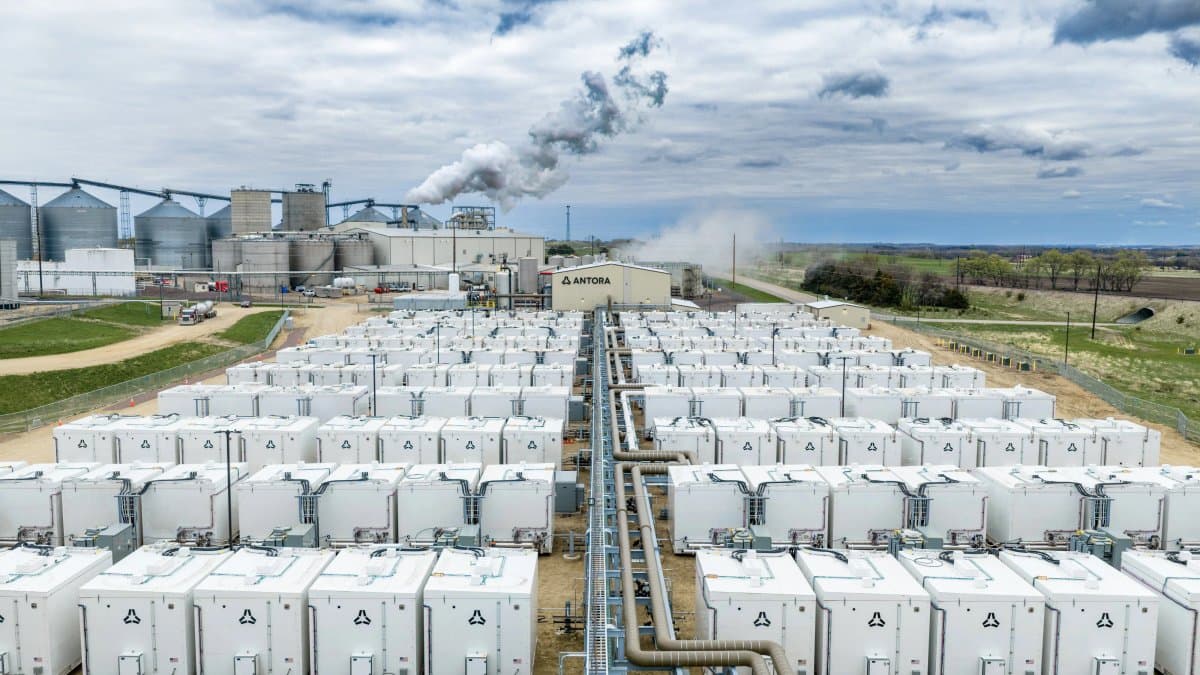
Big Stone City sits on the eastern edge of South Dakota, right up against the Minnesota line, with a population you could fit into a mid-size office. It has an ethanol plant run by POET, the largest biofuels producer in the world. Fermenting corn into fuel-grade alcohol takes an enormous amount of steam, and for decades that steam came from burning natural gas. Then, in May 2026, part of that steam started coming from somewhere else entirely: a field of more than two hundred insulated steel modules parked next to the plant. Inside each one is a stack of solid carbon blocks. Not coal. Not lithium. Just carbon.
Here's the deal, and it's almost insultingly simple. When the wind rips across the northern plains at two in the morning, wholesale power on that grid gets cheap — sometimes so cheap it goes negative, because there is more generation than load and nobody wants it. That is exactly when these boxes wake up, pull electricity through a big resistive heating element, and cook the carbon until it glows. Hours or days later, when the plant needs steam and power is expensive, the radiant heat pours back out. Canary Media described the machine as "an enormous toaster," which sounds like a joke until you realize it is a technically accurate description of the charging side.
On July 30, 2026, the company that builds those toasters announced it had closed a $550 million Series C. Antora Energy said the round was oversubscribed. G2 Venture Partners and Eclipse co-led. New money came from Ribbit Capital, Salesforce Ventures, Activate Capital, Westly Group, StepStone Group, Liberty Mutual Strategic Ventures — and John Doerr, personally. Existing backers piled back in too: Decarbonization Partners (the BlackRock and Temasek joint venture), Breakthrough Energy Ventures, Lowercarbon Capital, Trust Ventures, and Impact Science Ventures.
Now look at the headline Antora put on that release: "to Meet Surging Energy Demand and Reindustrialize America." Read it twice. There is no mention of decarbonization, no mention of emissions, no mention of climate. This is a company that spent most of its life pitching itself as an industrial-decarbonization play, and it just announced its largest round ever using the vocabulary of American manufacturing policy. Then look at the cap table again: Salesforce Ventures. Why would the corporate venture arm of an enterprise software company write a check into a heat battery startup? There is exactly one answer that makes sense, and it has three letters in front of it. AI data centers.
Who's Actually at This Table
Antora came out of Stanford in 2017. Co-founder and CEO Andrew Ponec has spent the better part of a decade on a problem most people in tech never think about: industrial heat. Everyone argues about electricity, but a huge share of the energy humanity actually consumes isn't electricity at all — it's temperature. Melting steel, calcining cement, cracking hydrocarbons, distilling grain. None of that runs on electrons in any direct sense; it runs on heat, and that heat is overwhelmingly produced by setting fossil fuels on fire. Cheap solar panels did not solve this. Getting a furnace to 1,500°C is a categorically different engineering problem than powering a laptop.
Antora's answer was storage rather than generation. Renewable electricity is already cheap; the problem is that it disappears when the sun sets and the wind drops. So take it when it's nearly free, hold it as heat for hours or days, and release it when it's worth something. Storing energy as heat is dramatically cheaper per kilowatt-hour than storing it electrochemically. Lithium-ion cells need lithium, nickel, cobalt, and graphite — all of them supply-constrained, most of them dominated by non-US supply chains. Carbon blocks need carbon. It is abundant, it is cheap, it can be sourced and processed domestically, and it doesn't degrade the way a cell chemistry does after a few thousand cycles.
This is where Antora splits from the rest of the heat-battery field. Most thermal storage companies heat bricks or crushed rock to roughly 700–750°C. That is not a limitation born of laziness — 750°C is enough to serve about 75% of US industrial heat demand, so it's a rational target. Antora goes to roughly 2,400°C instead, and the reason is optical. At that temperature carbon glows brilliantly, and you can point that glow at a semiconductor and harvest it as electricity. The technology is called thermophotovoltaics, or TPV. It's a solar cell, except the "sun" is a block of incandescent carbon sitting a few centimeters away, and you can switch it on and off.
How real is TPV? A 2022 paper in Nature reported a two-junction III-V cell with 1.4/1.2 eV bandgaps hitting 41.1 ± 1% conversion efficiency against a 2,400°C emitter, at a power density of 2.39 W/cm². That's a lab measurement, not a fleet average, and it deserves to be labeled as such. But it is a serious number. Antora announced in January 2023 that it had opened what it called the world's first dedicated TPV cell manufacturing line, starting at roughly 2 MW of annual cell capacity. Forty-plus percent is below a modern combined-cycle gas turbine's 55–64%, but a combined-cycle plant is a building full of spinning turbomachinery. A TPV stack has no moving parts at all, needs almost no maintenance, and can ramp in seconds instead of minutes.
The two firms leading this round tell you something about how the deal was framed. G2 Venture Partners specializes in bringing new technology into old industries; partner Jake Tauscher said Antora "is meeting demand today" and is "deploying at scale, on budget, and on rapid timelines customers need." Eclipse is a manufacturing and physical-infrastructure fund; partner Joe Fath said Antora "has moved beyond proving the technology to demonstrating manufacturing and deployment at remarkable speed and scale." Notice what neither of them said. Nobody is talking about whether it works. Both are talking about delivery schedules. That is the language of infrastructure procurement, not climate venture capital.
Ponec's own line was blunter: "From factories to data centers, energy is the bottleneck to industrial growth. Antora has shown we can help break that bottleneck." The word "bottleneck" is doing enormous work in that sentence, and the rest of this article is basically an examination of whether it's earned.
The Numbers, and How Much to Trust Each One
Start with what is confirmed by the company itself. The round is $550 million, described as oversubscribed, announced July 30, 2026. The valuation is where things get murky. Antora did not disclose it — Crunchbase News stated explicitly that the company declined to reveal a valuation — while Bloomberg and several follow-on outlets reported a figure of roughly $2.47 billion. So treat $2.47 billion as reported, not confirmed. Cumulative funding is similarly fuzzy: Crunchbase News put total capital raised at $770 million since the company's 2017 founding, while Canary Media described roughly $1 billion when project financing is included alongside corporate equity. Both can be true; they're counting different things.
| Item | Detail | Confidence |
|---|---|---|
| Announcement date | July 30, 2026 | Company statement |
| Round | Series C, $550M, oversubscribed | Company statement |
| Co-leads | G2 Venture Partners, Eclipse | Company statement |
| New investors | Ribbit Capital, Salesforce Ventures, Activate Capital, John Doerr, Westly Group, StepStone Group, Liberty Mutual Strategic Ventures | Company statement |
| Returning investors | Decarbonization Partners, Breakthrough Energy Ventures, Lowercarbon Capital, Trust Ventures, Impact Science Ventures | Company statement |
| Valuation | ~$2.47 billion | Reported only; company did not disclose |
| Total raised | $770M corporate, or ~$1B including project finance | Varies by outlet |
| Prior round | $150M Series B, February 2024, led by Decarbonization Partners | Company statement |
| Storage medium | Solid carbon blocks, resistively heated, up to ~2,400°C | Company and press |
| Output modes | Steam / high-temperature process heat, or electricity via TPV | Company materials |
| TPV efficiency | 41.1 ± 1% against a 2,400°C emitter | Nature, 2022 (lab result) |
| Flagship project | Big Stone City, SD, POET ethanol plant, 5 GWh, 200+ battery modules | Company statement |
| Big Stone timeline | Groundbreaking to energy delivery in under 12 months; commissioned May 2026; full operation expected later in 2026 | Company statement |
| First pilot | Fresno, CA, with Wellhead Electric, 5 MWh, late 2023 | Press reports |
| Manufacturing | Three-building campus in San Jose, CA; second US hub planned | Company statement |
| Jobs | 300+ across South Dakota and California during install and manufacturing | Company statement |
| Use of proceeds | Large-scale deployments, production capacity, second US manufacturing hub, domestic supply chain | Company statement |
Now put the scale in perspective, because this is the part that actually matters. The 2023 Fresno pilot with Wellhead Electric was 5 megawatt-hours. Big Stone is 5 gigawatt-hours. That is a factor of one thousand in roughly three years, and the site went from initial construction to delivering energy in under twelve months. In the energy world that timeline is genuinely strange. A new combined-cycle gas plant typically takes three to five years from notice to proceed. A nuclear unit takes upward of a decade. Antora got there by refusing to do site construction in the traditional sense: the modules are built on a factory line in San Jose, shipped on trucks, and connected on site with piping and wiring. It's the same logic that gave us prefabricated data center halls and modular substations.
There's one more piece, and it's arguably more important than any of the hardware. Canary Media called it the "hidden innovation," and it isn't a material or a cell — it's a tariff. Antora worked with the local utility, Otter Tail Power, to create a thermal market energy pricing rider: a rate structure that steers the battery to charge specifically during periods of surplus renewable generation, and rewards it with a very low energy price for doing so. Heat batteries beat gas on economics not because the steel is cheap but because somebody got a novel rate approved by a state regulator. Whether that rider can be replicated in Texas, Virginia, Ohio, Georgia, and every other state where data centers want to land is the single biggest open question about Antora's scalability, and no press release answers it.
As for the data center thesis, the evidence is concrete but incomplete. Canary Media reported that Antora has signed agreements with major data center operators, and that the systems under discussion are five to ten times the size of the 5 GWh South Dakota installation — meaning 25 to 50 GWh installations. Which hyperscalers, and whether those agreements are binding offtake contracts or non-binding memoranda, has not been disclosed. That distinction is the difference between a backlog and a wish list, and right now we cannot tell which one it is.
Who Gets What Out of This
For Antora, $550 million buys time — the one thing a hardware company can't manufacture. Thermal batteries are a manufacturing business, and manufacturing businesses are won or lost on the capacity ramp. The money goes into a second US manufacturing hub, more lines at the San Jose campus, and locking down domestic supply for carbon blocks and TPV cells. It's also a moat. The race Antora is running isn't really against other startups; it's against GE Vernova's production slots. If a hyperscaler can get a turbine in 2031 or a heat battery in 2027, the heat battery wins on schedule alone — but only if Antora has the factory capacity to say yes. Without capital, you don't even get to the starting line.
For the investors, the framing has shifted underneath the sector. Climate tech funding is not having a great decade. Crunchbase data put seed-through-growth cleantech investment at more than $15 billion in the first half of 2026, on pace to slightly exceed 2025 — and 2025 was the lowest annual total in several years. So the sector as a whole is still frozen. What's hot inside that frozen sector is anything you can credibly label "AI power." Antora's $550 million is among the largest cleantech rounds of the year, and it got there by repositioning from an emissions story to a load-growth story. G2 and Eclipse are not buying carbon abatement. They're buying a call option on electricity scarcity.
Salesforce Ventures' participation is the most interesting signal on the list. A software CVC writing into thermal storage is probably not a pure financial trade. Every company selling AI-powered software is ultimately reselling compute, and compute pricing is chained to power pricing. Liberty Mutual Strategic Ventures is a similar tell from a different direction: insurers have to underwrite emerging infrastructure asset classes, and getting inside early is how you learn to price them. And John Doerr putting his own name on the round carries symbolic weight. Doerr was one of the central figures of the 2006–2011 cleantech boom that torched enormous amounts of venture capital. Him showing up again on a thermal storage deal is, at minimum, a statement.
Industrial customers like POET get something more mundane and more valuable: a price hedge. Energy is a dominant line item in ethanol production, and natural gas prices lurch around every winter. A heat battery lets a plant lock in cheap surplus wind at a contracted rate for years. Decarbonization is a side effect; the primary product is cost predictability. South Dakota gets construction and operations activity — Antora said the project supported more than 300 jobs across South Dakota and California during installation and manufacturing.
Data center developers get exactly one thing, and it is the only thing they currently care about: earlier access to megawatts. To be precise about what a heat battery is not — it is not a power plant. It generates nothing. It time-shifts electricity you have already contracted for or can buy cheaply off-peak. But if your binding constraint is interconnection capacity rather than energy cost, raising the utilization of the capacity you already have beats waiting years for more. And because there are no critical minerals in the bill of materials, you're not competing with EV manufacturers for the same lithium.
We've Seen This Movie Before — Both Endings
Thermal storage is not a new idea, and its history includes some spectacular failures. Concentrated solar plants in Spain and the American Southwest have been storing heat in molten salt tanks since the 2010s. The cautionary tale is Crescent Dunes in Nevada: close to a billion dollars deployed, chronic problems with molten salt tank leaks and availability, long outages, and eventually bankruptcy proceedings. The lesson was not that storing heat is hard physics. Storing heat is easy physics. The lesson was that building a heat storage system that is simultaneously cheap and reliable is brutal engineering. Antora's choice of solid carbon over any liquid medium is partly a direct response to that history. Liquids leak, freeze, and corrode. A solid block just sits there.
The broader cleantech boom of 2006–2011 is the sector's collective trauma. Silicon Valley venture firms put well over $20 billion into solar, biofuels, and batteries, and lost most of it. Solyndra went bankrupt despite a federal loan guarantee and became a political punchline. A123 Systems went public and then went bankrupt. The common cause of death was almost never the science — it was that scaling manufacturing requires far more capital, and far more patience, than a venture fund's ten-year clock allows. That is precisely the stretch of road Antora is on right now. A $550 million Series C is exactly the size of check you write to cross that valley. Whether it's enough is not knowable yet.
But there are successes worth naming. Tesla's stationary storage business looked like a curiosity when Powerpack launched in 2015. Then the Hornsdale installation in South Australia started earning real money providing frequency regulation on a real grid, and the argument ended. Grid-scale lithium storage is now completely mainstream. The turning point wasn't a technical breakthrough; it was one flagship project demonstrating that the thing runs and the revenue actually settles. Big Stone is Antora's shot at a Hornsdale moment. The honest caveat: Big Stone is not yet in full operation, and there is no multi-year availability data. Anyone declaring victory now is getting ahead of the evidence.
And then there's the most recent, most painful example: Northvolt. Europe's battery champion raised more than $15 billion, could not get manufacturing yield under control, and filed for bankruptcy protection in 2024. It didn't die of capital starvation. It died of execution failure while awash in capital. Heat batteries are a far simpler artifact than a lithium cell — but "make thousands of simple things identically and ship them on schedule" is its own discipline, and plenty of companies with better technology have failed at it. This is exactly why the Big Stone datapoint matters more than any efficiency number: two hundred-plus modules, built and installed inside twelve months, is evidence of repeatable production rather than a successful one-off.
How the Competition Punches Back
The most direct rival is Rondo Energy, which uses refractory bricks at roughly 750°C. Founder John O'Donnell's position has always been that most industrial heat demand doesn't need extreme temperatures, and he has the numbers on his side — 750°C addresses roughly 75% of US industrial heat load, and lower temperature means cheaper, more forgiving materials. Rondo brought a 100 MWh heat battery online at a California fuel facility in October 2025 and is building a 100 MWh unit at Covestro's Brunsbüttel site in Germany, slated for operation by the end of 2026, with support from Breakthrough Energy Catalyst and the European Investment Bank. Its backers include Microsoft, Aramco Ventures, and SABIC. But the funding gap is now brutal: reported totals for Rondo range from around $107 million to north of $160 million depending on the source, which is less than a third of what Antora just raised in a single round.
Fourth Power, an MIT spinout, is technically the closest analogue — it circulates liquid tin through graphite blocks at roughly 2,400°C and recovers power with TPV, essentially the same thermodynamic architecture as Antora. It raised a $20 million Series A+ in September 2025 led by Munich Re Ventures with DCVC and Breakthrough Energy Ventures following on. Interesting technology, but a twentyfold capital disadvantage means it isn't currently in the same weight class. Malta Inc., the molten-salt company spun out of Google X, opened a 14 MWh demonstration site in Puertollano, Spain — still demonstration scale.
Form Energy is a different animal. Its iron-air chemistry targets 100-hour discharge, electricity in and electricity out, and it has started shipping from its West Virginia gigafactory. The Great River Energy project in Minnesota is expected to be fully operational in 2026, and in March 2026 Form announced an agreement to deploy a 10 MW / 1,000 MWh system in northwest Ireland by 2029. Form and Antora only really collide in one segment — multi-day backup power for large loads — but in that segment they collide head-on, and Form's product is electricity-native while Antora's is heat-native with an electricity option.
The genuinely scary competitor isn't a startup at all. It's the gas turbine. GE Vernova's gas turbine backlog went from 100 GW in Q1 2026 to 116 GW in Q2, and the company expects at least 125 GW under contract by year end. The catch is supply. Per Utility Dive's reporting, GE Vernova expects to deliver about 20 GW of gas turbine output in 2026, 24 GW in 2028, and is working toward 30 GW by 2030 — against a backlog that already represents years of production. The company is taking reservations for 2031 deliveries, and eight-year lead times have become common across major turbine manufacturers. Gas won the argument on economics and lost it on scheduling. That gap is the window heat batteries are climbing through.
Small modular reactors show up constantly in hyperscaler press releases, but the timeline math doesn't work for this decade. Most SMR designs target commercial operation in the early-to-mid 2030s. If you need power in 2027 or 2028 — which is what AI capex schedules actually demand — an SMR is not an answer, it's a press release. Antora's real selling point isn't efficiency and it isn't even cost. It's "twelve months." If that number replicates across the next five projects, this company wins a large market. If Big Stone turns out to be the exception rather than the template, Antora is a company that ran one exceptional pilot.
There's one more counterplay worth watching, and it comes from the utilities themselves. Heat battery economics rest on that Otter Tail rate rider. As utilities start designing dedicated tariffs for large industrial loads and data centers, the ground shifts. In some jurisdictions a utility may prefer to own storage assets directly and put them in the rate base, which would demote Antora from partner to equipment vendor and compress its margins accordingly. Regulation is simultaneously this company's biggest ally and its biggest single-point risk.
So What Actually Changes
If you build AI infrastructure, a new variable enters the siting model. Until now, data center location has been decided by fiber, water, land, and your position in the interconnection queue. As of early 2026, US interconnection queues held roughly 2,600 GW of proposed generation and storage — more than double the country's entire operating capacity. In ERCOT alone the large-load queue stands at about 410 GW, with data centers making up roughly 87% of it. Reported wait times for data center projects run from 24 to 72 months. A heat battery does not shorten that queue. What it does is let you run the interconnection capacity you already hold much closer to around-the-clock. When capacity is the binding constraint, raising utilization is faster than waiting for more capacity.
If you're an engineer or developer, the relevant shift is in the cost stack. Power is a growing share of the marginal cost of compute. In January 2026, the EIA forecast the strongest four-year growth in US electricity demand since 2000, driven by data centers. Goldman Sachs has projected US data center power demand rising from about 31 GW in 2025 to 41 GW in 2026 and 66 GW the following year. When power gets expensive, inference gets expensive, and when inference gets expensive, when and where you schedule a job becomes an architectural decision rather than an ops detail. Batch inference shifted into cheap overnight hours is already a real cost lever for some operators, and storage assets like Antora's are what make those cheap hours exist in the first place.
If you're an investor, take this deal out of the climate bucket and reclassify it. The multiple being paid for thermal storage today isn't priced off carbon abatement — it's a call option on AI-driven electricity scarcity. Which means it's correlated to AI capex, not inversely correlated to it. If hyperscaler capex rolls over, this valuation rolls over with it. If the cycle holds, Antora becomes a hardware company with unusually fast revenue recognition, because a twelve-month build cycle converts backlog to revenue far faster than power plant developers can. Three things to track: whether the data center agreements are binding volume or memoranda, where and when the second manufacturing hub comes online, and Big Stone's actual annual utilization once it reaches full operation. And keep remembering that $2.47 billion is a reported figure the company has not confirmed.
If you work in heavy industry, this may be the most immediately practical news on the list. Steel, cement, chemicals, and food processing have been the hardest sectors to electrify, because you can't run a kiln off a wall socket. A heat battery is a retrofit that mostly touches the steam header rather than the core process, which makes the adoption barrier unusually low. The caveat is uncomfortable: if Antora is pivoting its production toward data center customers ordering installations five to ten times larger than Big Stone, mid-size industrial buyers may find themselves further back in the queue. Factory lines fill from the biggest order down.
If you just pay an electricity bill, the effect cuts both ways. On the good side, heat batteries absorb surplus renewable generation that would otherwise be curtailed, and shift load off peak, both of which relieve pressure on the system. On the bad side, data center demand itself is pushing retail rates up, and fights over how to allocate those costs are already underway in front of regulators in multiple states. Antora doesn't end that fight. If storage lets utilities serve new load without building new plants, it might soften the increase somewhat. How much "somewhat" is worth, nobody can honestly quantify yet.
If you follow policy, look hard at that word "Reindustrialize" in the press release headline. It tells you how energy startups sell themselves in America in 2026: not with emissions curves, but with manufacturing jobs, supply chain sovereignty, and freedom from critical minerals. When Antora emphasizes that its batteries need "no supply-constrained critical minerals," that's a technical fact being deployed as political positioning. It's a sentence engineered to survive any change in the subsidy environment, which is a rational thing to engineer for right now.
🥄 Three Things You're Probably Wondering
— So what does this mean for me? Directly, nothing today. But if you work somewhere that pays a cloud bill, the price of compute in 2027 and 2028 will likely hinge more on power availability than on GPU supply. Operators who locked in power early will price differently from those who didn't.
— Can heat batteries really replace gas turbines? Not wholesale. A thermal battery is storage, not generation — no cheap input electricity, no output. But with turbine lead times stretching toward eight years, it isn't being sold as a replacement so much as a bridge, and the bridge market alone is enormous.
— Is the $2.47 billion valuation solid? No. Antora didn't disclose a valuation, and Crunchbase News said so explicitly. The $2.47 billion figure comes from press reporting, so it's too early to state it as fact. The $550 million round size and the investor list are confirmed by the company itself.
Sources
- Antora Closes $550 Million in Series C Funding to Meet Surging Energy Demand and Reindustrialize America (Antora Newsroom)
- Antora Closes $550 Million in Series C Funding (Business Wire press release)
- Antora and POET Commission 5 Gigawatt-Hour Thermal Battery Project (Antora Newsroom)
- Antora snags $550M for heat batteries to run data centers (Canary Media)
- The hidden innovation behind Antora's massive new heat battery (Canary Media)
- Antora Energy closes US$550 million Series C to scale US thermal battery deployment (Energy-Storage.news)
- Thermophotovoltaic efficiency of 40% (Nature)
- Antora Energy Begins Production of Highly-Efficient Thermophotovoltaic (TPV) Cells (Antora Newsroom)
- GE Vernova gas turbine backlog climbs to 116 GW (Utility Dive)
- EIA forecasts strongest four-year growth in U.S. electricity demand since 2000 (U.S. EIA)
- What Rondo's first full-size unit means for heat batteries (Latitude Media)
- Antora, POET commission 5GWh thermal battery system in South Dakota (Power Technology)
Numbers and criteria are as of announcement and may change. Investment calls are yours to make!