One Day Before the Deadline, OpenAI Flipped On a Rival's Tech
It was Friday, July 31. Exactly one day before Article 50 of the EU AI Act became applicable across all 27 member states. OpenAI posted a quiet blog update, and buried in it were a few lines that changed how a very large amount of synthetic speech travels through the world. From that day, audio generated with GPT-Live through ChatGPT Voice and the OpenAI API carries a watermark. On its own that is a boring compliance story. Shipping a compliance feature the day before a compliance deadline is practically a tradition in this industry.
Here's the part that isn't boring: the watermark is SynthID. That's Google DeepMind's technology. The same Google OpenAI is fighting in chatbots, in search, in cloud inference, and in the market for research talent. The most famous AI company on earth decided to stamp a signature designed by its sharpest competitor onto its own voice output. And it did it in audio — the one modality where deepfake harm is not a thought experiment but a line item in fraud reports.
Two other things shipped alongside it. OpenAI's public verification tool, which previously only accepted images, now accepts audio files. And OpenAI opened API access for verification, so developers and organizations can wire provenance checks into their own workflows instead of manually uploading files to a web page. A newsroom screening a leaked recording, a platform scanning uploaded voice notes, a compliance team checking outbound call audio — all of that becomes programmable. Shipping the detection plumbing at the same time as the marking is the genuinely substantive half of this announcement.
But the questions stack up fast. Why license a competitor's watermark instead of building one? How much re-encoding, noise, and clip trimming can an audio watermark actually survive? Who is realistically going to run the detector? What is the relationship to C2PA Content Credentials, which OpenAI has been pushing since early 2024? And the sharpest question of all: does any of this actually reduce voice-cloning fraud? Let's take them one at a time.
Who's Standing Where
Start with OpenAI's own side of the board. GPT-Live shipped on July 8, 2026. Two models — GPT-Live-1 and GPT-Live-1 mini — replaced Advanced Voice Mode as the default voice experience in ChatGPT. The headline architecture is full duplex: the model listens while it talks and talks while it listens, instead of taking strict turns. During a conversation it repeatedly evaluates whether it should interrupt, search the web, or run some other task, and it routes harder requests to GPT-5.5. Paid tiers get GPT-Live-1, free users get mini, and the rollout hit iOS, Android, and the web at the same time. OpenAI has said more than 150 million people use ChatGPT's voice and dictation features weekly — that's a company-reported figure, so treat it as directional rather than audited.
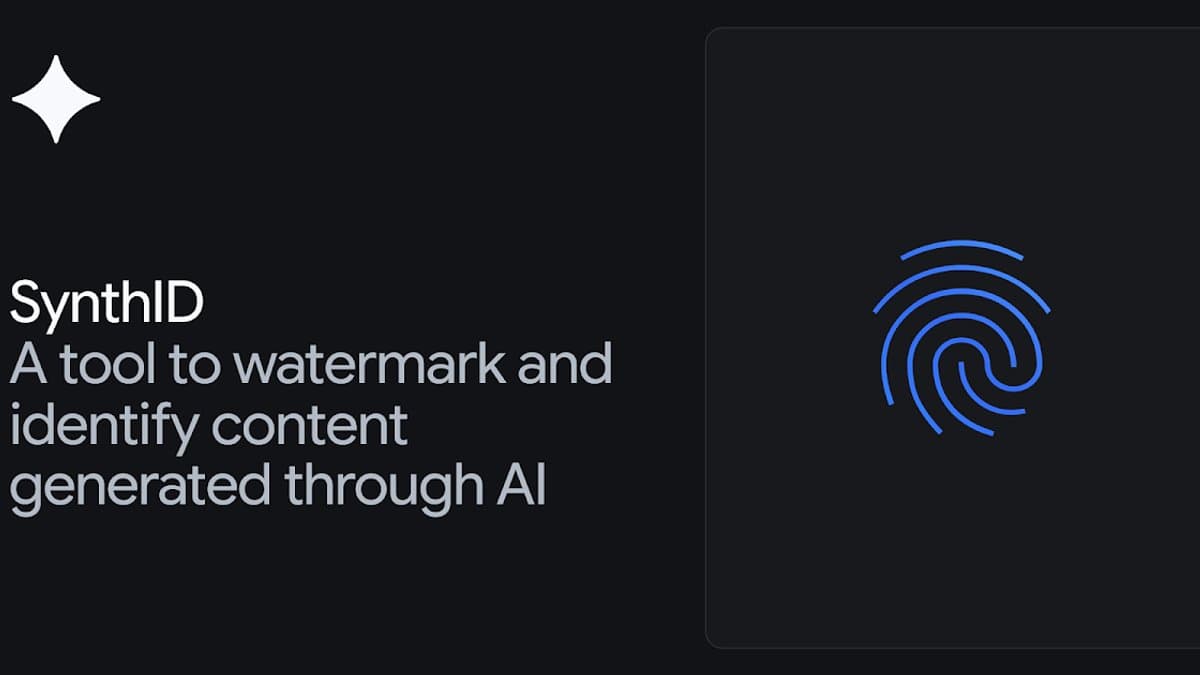
Google DeepMind's position here is genuinely odd. SynthID started as an internal tool for marking Google's own generative output. It covers four modalities — images, video, audio, and text — and the audio version first landed in Lyria, Google's music model, and in the podcast generation feature of NotebookLM. DeepMind describes the audio mark as inaudible to the human ear and says it can't be removed by common modifications like adding noise, MP3 compression, or changing playback speed. Then on May 19 at Google I/O 2026, the strategy changed shape: Google announced that OpenAI, Kakao, and ElevenLabs were integrating SynthID into their own platforms. NVIDIA had already been deploying it since 2025 through its Cosmos foundation models. Google says SynthID has now been applied to more than 100 billion images and videos, plus the equivalent of 60,000 years of audio.
The third player isn't a company at all. C2PA is a standards body — started by Adobe, now with Google, Microsoft, Meta, and OpenAI on the steering committee. What C2PA defines is Content Credentials: signed metadata attached to a file recording who made it, with what tool, and when, bound cryptographically to the content. OpenAI started attaching Content Credentials to DALL·E 3 images in early 2024 and joined the steering committee in May of that year. The known weakness is that metadata is fragile. One screenshot, one upload through a platform that strips headers, and it's gone. That's exactly why the C2PA spec added soft bindings — watermarks and content fingerprints that let a stripped file be matched back to its original manifest in a provenance store. The combination of a cryptographic hard binding plus a soft binding is what the spec calls a durable Content Credential.
The fourth player is the EU, and we're not going to re-explain the regulation here. Two facts are enough to understand the timing. First, Article 50 requires providers of systems generating synthetic audio, image, video, or text to mark outputs in a machine-readable format using solutions that are, in the Commission's words, effective, interoperable, robust, and reliable as far as is technically feasible. Second, the penalty ceiling is up to €15 million or 3% of worldwide turnover. The Commission's FAQ notes a limited grace period running to December 2, 2026 for marking obligations on systems placed on the market before the application date. There's also an ongoing omnibus discussion about adjusting those deadlines, so the final shape isn't settled — treat any single reported date on that front with caution.
One more piece of context that makes the timing less mysterious. By the end of July 2026, roughly 190 organizations had signed the EU's Code of Practice on Transparency of AI-generated Content. Both OpenAI and Google appear among the Section 1 provider signatories, and Google confirmed its own signature on July 24 via its policy blog. So this audio watermark isn't a panicked last-minute bolt-on. It's the final piece of a compliance track that's been assembling in public for months.
What Actually Shipped
Three concrete things changed. GPT-Live audio now carries a SynthID watermark. OpenAI's public verification tool accepts audio in addition to images. And a verification API is now available so the check can be automated. The marking scope covers both ChatGPT Voice and the OpenAI API, which matters more than it sounds — it means the voice a consumer hears in the app and the voice a startup pipes into its own product through the API both carry the same signal.
The verification tool's usage guidance is unusually specific, and it's the most technically revealing part of the whole release. OpenAI's help documentation says that for audio you should upload clips between 10 and 60 seconds for best results, one file at a time. For images it advises against cropping or converting to another format such as PDF. Those instructions are a direct readout of the physics. A statistical watermark embedded in a waveform needs a certain amount of signal to accumulate before a detector can call it with confidence, and detectors have processing windows that very long files exceed. A three-second voice message dropped into the tool with the question "is this AI?" is outside the design envelope of what shipped.
The more important caveat is what a negative result means. OpenAI's documentation states plainly that if no signal is detected, that doesn't mean the content wasn't AI-generated. The metadata may have been stripped or tampered with, the watermark may have degraded, the file may have come from a legacy model, or it may predate provenance signals entirely. And the scope is limited to OpenAI-origin audio. Feed it something made with another provider's model or an open-source voice clone and you get nothing back. That "nothing" means "no OpenAI SynthID watermark detected," not "a human said this." If that distinction collapses in practice, the verification tool becomes actively dangerous rather than merely limited.
Here's the shape of the whole thing, with the sourcing for each row.
| Item | Detail | Basis |
|---|---|---|
| Audio watermarking live from | July 31, 2026 | OpenAI provenance post |
| Scope | GPT-Live audio via ChatGPT Voice + OpenAI API | OpenAI provenance post |
| Watermark technology | Google DeepMind SynthID (audio) | OpenAI / DeepMind |
| Metadata layer | C2PA Content Credentials (pre-existing) | OpenAI Help Center |
| Verification tool | openai.com/verify — images + audio | OpenAI Help Center |
| Recommended audio clip length | 10–60 seconds | OpenAI Help Center |
| Verification API | Newly opened to developers and organizations | OpenAI provenance post |
| GPT-Live launch | July 8, 2026 (GPT-Live-1 / mini, full duplex) | OpenAI / SiliconANGLE |
| Weekly voice + dictation users | 150 million+ (company-reported) | OpenAI |
| EU AI Act Article 50 applies | August 2, 2026 | European Commission FAQ |
| Article 50 penalty ceiling | €15M or 3% of worldwide turnover | European Commission FAQ |
| SynthID cumulative reach | 100B+ images/videos; ~60,000 years of audio | Google Blog (2026-05-19) |
| SynthID adopters named | Google, OpenAI, NVIDIA, ElevenLabs, Kakao | Google Blog (2026-05-19) |
Mechanically, SynthID audio embeds its signal into the waveform itself rather than into a file header. That's the whole point. Metadata lives in a container and dies when the container changes; a waveform-embedded mark travels with the sound. So you can transcode an MP3 to a WAV, strip every tag, and in principle the signal is still there. DeepMind's public description says the mark holds up against added noise, MP3 compression, and speed changes. Read that carefully, though — it's a list of transformations that are claimed to be survivable, not a claim that all transformations are.
This is where the independent research gets uncomfortable, and it's worth being precise about what it does and doesn't cover. A systematization-of-knowledge paper on audio watermarking robustness evaluated nine schemes — Timbre, AudioSeal, WavMark, SilentCipher, FSVC, Patchwork, Norm-Space, audiowmark, and RobustDNN. SynthID was not among them, so none of these numbers apply to SynthID directly. But the paper's headline conclusion is blunt: none of the surveyed schemes is robust enough to withstand all tested distortions in practice. Some specific failures are stark. Shift the pitch by 100 cents and Timbre's detection accuracy fell to 6.37% on one speech dataset. Re-record the audio physically through a microphone and AudioSeal dropped to 42.5%. That physical re-capture scenario — play it through a speaker, record it on a phone — is precisely what happens in a real voice-fraud call chain.
Newer work goes further. A paper accepted to Interspeech 2026 and posted to arXiv in late June describes an adaptive attack that exploits the fact that watermark decoder message probabilities follow predictable distributions, then steers decoded probabilities back into the expected range. Reported results: removal attacks driving detection rates to 0%, and replacement and creation attacks pushing detection below 10%, tested across two watermarking methods and three voice datasets. Again, no commercial system is named, so don't map this onto SynthID as a finding. Map it onto the category. Watermarks are strong against careless handling and weak against a motivated adversary who has read the literature.
Then there's the re-encoding problem, which may matter more than deliberate attacks. Benchmark work in this space distinguishes between surviving MP3 compression and surviving a neural codec round-trip, and they are not the same claim at all. Passing audio through neural codecs of the EnCodec or DAC family has been reported to drive watermark bit-error rates to extreme levels for schemes that handle classical compression fine. The awkward part is that modern voice pipelines — real-time calls, streaming, low-bandwidth conferencing — increasingly use neural codecs by default. Which means the signal can be degraded by an ordinary transmission path, with nobody attacking anything. Neither OpenAI nor Google has published numbers on how SynthID audio behaves under that specific condition, and until someone does, the honest answer is that we don't know.
What Each Side Gets Out of It
OpenAI's payoff is straightforward, and it has two parts. The first is regulatory defense. Turning on audio marking before August 2 creates a dated record, and when a regulator asks how the "robust and interoperable" requirement was satisfied, "we adopted the marking technology that the rest of the industry already uses" is a far easier answer than "we built our own and here's why you should trust it." Interoperability is written into the statutory language, which means a proprietary format is itself a compliance risk. The second part is time. Building an audio watermark from scratch means research, perceptual evaluation, robustness testing, and model-side integration — quarters of work minimum. GPT-Live shipped July 8. Article 50 landed August 2. There was no version of this timeline where OpenAI built its own.
Google's payoff is larger and more strategic. Owning the marking layer means owning the detection layer, and detection is where the leverage lives. Google pulled OpenAI in on images first, and this release extends the same relationship to audio. With NVIDIA, ElevenLabs, and Kakao alongside, SynthID has become the default candidate for how synthetic media gets labeled industry-wide. Google isn't monetizing this through licensing fees in any visible way. What it gets is structural: if a large share of the world's synthetic media carries a signal Google designed, then the answer to "is this AI-generated?" routes through Google's infrastructure. Every regulator, newsroom, and platform that needs that answer strengthens Google's position by asking.
Developers and enterprises get the verification API, and this is a bigger shift than the watermark itself. Until now, most AI-audio detection was post-hoc classification — extract features, run a model, produce a probability. That approach has an irreducible false-positive and false-negative problem, and it degrades badly against systems it wasn't trained on. Watermark verification works differently. If the signal is present, provenance is established, and the answer is deterministic rather than probabilistic. For a bank handling call-center recordings, a newsroom handling tipster audio, or a platform handling user uploads, that's at least one category of content that can now be cleared automatically instead of argued about.
European regulators benefit too, in a way that's easy to miss. Article 50 requires marking but deliberately doesn't mandate a technology. That was intended as flexibility, but it created a real risk: if every provider marked content in a different proprietary way, nothing would interoperate and enforcement would be impossible. Voluntary convergence on a common technology solves that without the Commission having to pick a winner. The Code of Practice signature count — roughly 190 organizations by late July — points the same direction. A de facto standard has emerged without anyone being forced into it.
So who loses? In the short run, nobody, and that's the structural trap. Watermarks only get applied by honest generators. Someone building a voice-fraud operation simply won't use a service that marks its output, or will strip the mark if they do. Dozens of open-source speech synthesis models are in circulation right now, and most carry no watermark at all. What this measure actually prevents is the redistribution of unmodified OpenAI-generated speech — not AI-generated fake voices in general. To OpenAI's credit, its own documentation admits the gap rather than papering over it. But the gap is the whole ballgame.
We've Seen This Movie Before, Twice
Start with the success. C2PA on images has been imperfect but genuinely productive. Adobe kicked it off in 2019, a real specification emerged, and camera makers, editing software, and platforms attached themselves over time. OpenAI adding Content Credentials to DALL·E 3 in early 2024 and joining the steering committee that May is part of that same arc. Two lessons came out of it. One: a provenance standard can't be driven by a single company, because the value is entirely in adoption breadth. Two: metadata alone is insufficient, because it gets stripped in ordinary use. That second lesson is precisely what is being replayed in audio right now, which is why the watermark layer exists at all.
Then the failure. Remember OpenAI's AI text classifier from 2023? It was pulled within months because its accuracy was too low to be useful. There were repeated incidents of student work being wrongly flagged as machine-written, and the underlying reason was structural: text is a low-entropy medium that doesn't retain much statistical fingerprint after light editing. The lesson OpenAI drew from that failure is exactly the strategy on display today — stop guessing after the fact, mark at generation time. That's the right direction. But a post-hoc detector failing doesn't guarantee that pre-hoc marking succeeds. It changes the failure mode from false positives to circumvention, which is a better problem to have but not a solved one.
Music DRM in the 2000s is the third reference point, and it's the least flattering. The industry spent a decade embedding protection into audio files. People who wanted to circumvent it circumvented it, and the friction landed almost entirely on paying customers. Watermarking avoids DRM's worst property — it doesn't block playback, so honest users experience nothing at all. But the asymmetry is identical. The defender has to work in every case; the attacker only has to win once. And audio in particular has a permanent analog hole: a speaker and a microphone will always exist, and passing sound through that gap is a documented way to degrade watermarks badly.
The closest precedent, though, is photo EXIF data. Capture information gets written into image files, and most social platforms strip it on upload. That gap is the direct reason C2PA introduced soft bindings, and audio is now following the same logic: if the metadata is stripped, the watermark survives; if the watermark survives, the original credential can be looked up again. It's an elegant two-layer design on paper. What's missing is public field data on how often both layers survive a realistic distribution path at the same time. Until that data exists, the durability claim is architectural rather than empirical.
How the Competition Plays This
ElevenLabs sits in the most awkward seat. It's a voice synthesis specialist, and it was named among the SynthID adopters at I/O in May. Its entire business is built on cloning and generating voices, so it has been absorbing provenance pressure longer and harder than anyone. With OpenAI now marking on the same technology, the industry floor rises: a voice service that ships unmarked audio starts to look conspicuous rather than merely unregulated. That's straightforwardly good for companies with compliance budgets and rough on small ones — a classic regulatory moat forming in real time.
Meta and Microsoft are running different calculations. Meta open-sourced its own audio watermarking research as AudioSeal, and here's the irony: AudioSeal is one of the systems the robustness papers cited above beat up on most thoroughly. It's public, so researchers can attack it, so they do, so its weaknesses are documented in detail. That's the price of openness, and it's not evidence that AudioSeal is worse than closed alternatives. SynthID's implementation details are not public in the same way, which means it hasn't been subjected to comparable independent scrutiny. Right now that reads as an advantage. It also means its robustness claims can't be independently verified, which is a real limitation when the claims are being used to satisfy a legal standard that includes the word "robust."
Apple has said nothing. Some coverage has listed Apple among Google's SynthID partners, but that hasn't been confirmed by Apple itself — that's single-outlet reporting, so treat it as unconfirmed. Apple's architecture makes the question genuinely hard rather than merely undecided. A company built around on-device processing and data minimization doesn't fit neatly into a model where verification runs through a cloud API. How you mark audio generated locally on a phone, and who gets to verify it without the file leaving the device, is an open problem for the entire industry, not just Apple.
China is on a different track entirely. Chinese regulation already requires explicit labeling of generated content, combining visible labels with file-level metadata rather than relying on invisible marks. So the West is converging on "imperceptible watermark plus voluntary standard," while China runs "perceptible label plus mandate." Those two regimes don't obviously interoperate, and for globally distributed content that's a real problem nobody has solved. A file that satisfies one framework doesn't automatically satisfy the other.
And the most serious competitor may not be a company at all. It's the removal tooling. As covered above, academic work is already publishing methods that drive detection rates to zero. The pipeline from here is well established: papers become reference implementations, reference implementations become GitHub repos, and repos become web services with a file upload button. That's exactly the arc image watermark removal followed. There's no structural reason audio will behave differently, and the real test of this whole approach will be what OpenAI and Google ship in response when it happens.
So What Actually Changes
If you're a developer, there's work on your desk this week. If you generate speech through the OpenAI API, your output now carries a watermark, and your post-processing chain becomes a variable you should think about. Volume normalization, noise gating, pitch correction, re-encoding into a different codec — nobody has published figures on how much each of those degrades the signal, and the neural codec question above is a live risk if your delivery path uses one. On the verification side, if you're wiring in the API, bake the 10-to-60-second guidance into your UI so users submit clips the detector can actually handle. And whatever you do, never render a null result as "human-made." That single string in your interface is the thing most likely to end up in a legal complaint later.
If you're an investor, read this as a cost-structure story. Provenance marking and verification infrastructure have moved from optional to a condition of doing business in the EU, with a ceiling of €15 million or 3% of worldwide turnover for getting it wrong. A small voice AI company without the resources to build its own marking system now chooses between licensing someone else's and skipping the EU market. That is a moat forming, and it favors incumbents. On the other side, demand is appearing for verification as a service across media authentication, content moderation, and financial fraud detection. But note that OpenAI opened its own verification API directly, which suggests margins in that layer will be thin — the platform is offering the primitive for free or near-free, and the value will accrue to whoever builds the workflow around it, not to whoever resells the check.
If you're a regular person, the honest answer is that you'll notice nothing. ChatGPT's voice sounds exactly the same as it did last week, and an inaudible watermark is by definition inaudible. The change shows up later, in a specific scenario: someone sends you audio impersonating a family member, and if it was made with OpenAI's tools you now have a way to check. The reverse doesn't hold. A clean verification result does not mean a real human spoke. So your actual defenses are the same ones they were before — call back on a number you already know, agree on a family code word, and treat any urgent request to move money as suspect regardless of whose voice is asking. The watermark is a supplement to those habits, not a replacement for any of them.
If you run a company or an institution, the design question is where verification sits in your workflow. The FBI's IC3 reporting for 2025, published in April 2026, logged 22,364 complaints referencing AI with $893.35 million in adjusted losses. That figure mixes multiple fraud types rather than isolating voice cloning, and researchers consistently argue that reporting rates for this category are low, so read it as a floor rather than a measurement. Either way, there's a clear case for adding voice verification at chokepoints: call centers, payment approvals, and any process where a spoken instruction from an executive triggers an action. Just don't make watermark verification the only gate. The distance between "no OpenAI watermark present" and "a human said this" is enormous, and a control that treats them as equivalent is worse than no control at all, because it manufactures false confidence.
Newsrooms and fact-checking organizations are probably the most consequential users of this tool. Tipster audio, allegedly leaked recordings, clips circulating as statements by public figures — for all of those, one branch of the investigation can now be resolved mechanically in seconds. The hard part is reporting the result correctly. "OpenAI watermark detected" is strong evidence of provenance. "No watermark detected" is very close to no information at all. If that asymmetry doesn't survive the edit, verification tooling becomes a machine for spreading confident wrong conclusions, which is a worse outcome than not having the tool.
🥄 Three Things You're Probably Wondering
— So what does this mean for me? Practically nothing today. ChatGPT's voice sounds identical and the watermark is inaudible by design. The one thing that changed is that if you get a suspicious audio file, you can upload a 10-to-60-second clip to openai.com/verify and see whether it carries an OpenAI provenance signal.
— Does this stop voice-cloning scams? Too early to say it does. The mark only lands on audio made with OpenAI's tools, and a scammer has no reason to use a service that marks its output. Published research has already demonstrated attacks that push detection rates to zero on other watermarking schemes, and simply playing audio through a speaker and re-recording it has been shown to degrade watermarks badly.
— Why use Google's technology instead of building their own? The stated logic is interoperability — the EU rule asks for interoperable marking, so adopting what the industry already runs is the safer answer. But look at the calendar: GPT-Live launched July 8 and the obligation started August 2, which left no realistic window to build and validate an audio watermark from scratch. OpenAI hasn't said which reason weighed more, so both readings stay on the table.
References
- OpenAI — Advancing content provenance for a safer, more transparent AI ecosystem
- OpenAI — Introducing GPT-Live
- OpenAI Help Center — Provenance signals (Content Credentials, SynthID) in OpenAI-generated content
- Google DeepMind — SynthID: Watermarking AI-generated content
- Google Blog — Making it easier to understand how content was created and edited (2026-05-19)
- European Commission — Transparency obligations under Article 50 of the AI Act (FAQ)
- European Commission — Strong backing for the Code of Practice on Transparency of AI-generated Content
- C2PA — Content Credentials Explainer 2.2
- Content Authenticity Initiative — Durable Content Credentials
- arXiv — SoK: How Robust is Audio Watermarking in Generative AI Models?
- arXiv — Learning to Evade: Adaptive Attacks on Audio Watermarking (Interspeech 2026)
- NeurIPS 2024 — AudioMarkBench: Benchmarking Robustness of Audio Watermarking
- SiliconANGLE — OpenAI launches GPT-Live voice model series
- Tech Times — GPT-Live Voice Gets SynthID Watermarks One Day Before EU AI Act Enforcement
Numbers are as of announcement and may change.