800,000 people tapped "notify me." Nothing ever arrived
Tapping pre-register in an app store is the lowest-commitment thing a person can do. No money changes hands, no account gets created, no promise is made. You tap it, you forget it, and one day the app quietly installs itself and you either open it or you don't. Which is exactly why pre-registration counts are usually a soft, half-meaningless metric. But roughly 800,000 people tapping it — for a developer tool, across both the App Store and Google Play, for software literally nobody outside Google had ever touched — is not soft. That is a loud demand signal in a category that almost never produces loud demand signals.
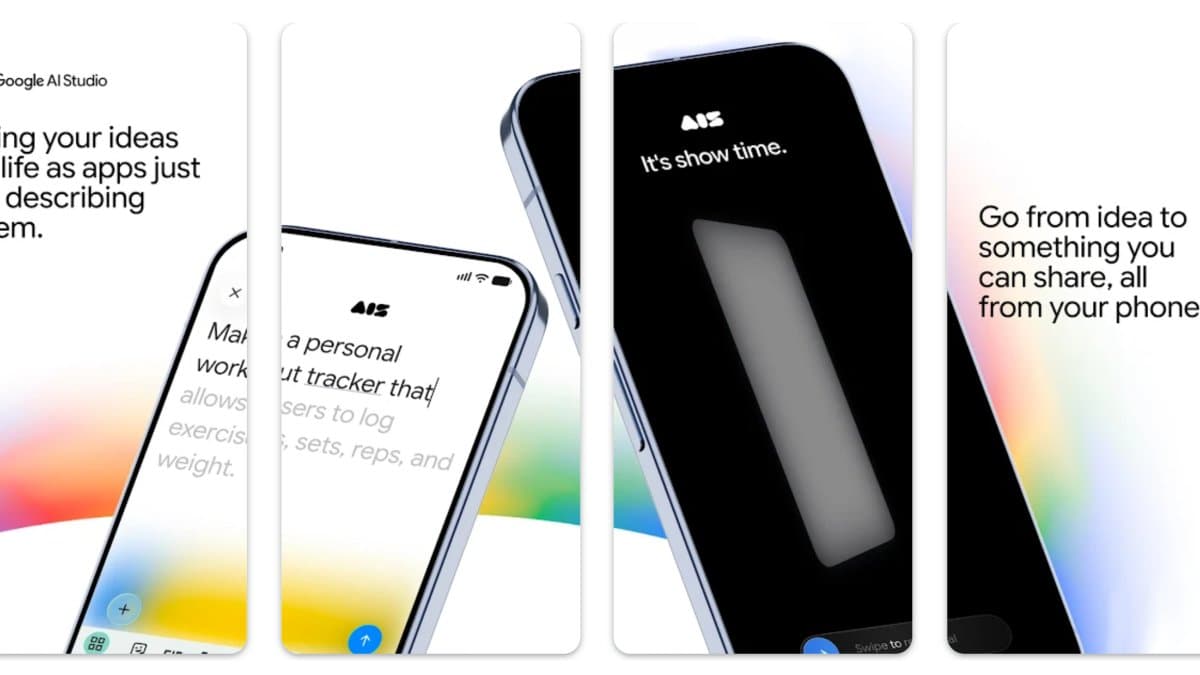
On July 31, 2026, the Google AI Studio team posted on X that the app was not happening. Not delayed. Not scaled back. Canceled, with the store listings pulled down, before a single build ever shipped to a user. The team opened with gratitude: "thank you to the ~800,000 of you that pre-ordered our mobile app on iOS and Android — it's clear that people are interested in building software on the go." Then came the pivot: "instead of asking you to download yet another app we've decided to take an entirely different approach: one where apps emerge naturally, in the course of your everyday conversations with Gemini."
Read as a sentence, it's graceful. Read as a decision, it means a product that Google put on stage at I/O on May 19 and then collected sign-ups for over the next ten weeks got erased before anyone used it. The replacement is "the same capabilities, inside the Gemini app, on mobile and desktop," and there is no date attached. Google's own words were that "the teams are working hard on bringing this to life, more to share on this later." If you pre-registered, there's nothing to do and nothing to refund — no money was ever involved. The thing you opted into simply stopped existing.
Here's the deal, though: the interesting story isn't "Google killed another product," even though that joke writes itself. It's structural. For a decade Google was the company that sprayed apps everywhere — Hangouts, Allo, Duo, Messages and Chat all running at once; Assistant and Gemini coexisting for years. That instinct is now being inverted hard. Everything is being funneled into one surface, and that surface is the Gemini app, which Sundar Pichai said hit 950 million monthly active users on the Q2 earnings call. Torching 800,000 pre-registrations is the most expensive proof yet that Google means it this time.
The people and org charts behind the call
Start with what AI Studio actually is, because most people conflate it with Gemini. It's a developer surface. It launched at I/O in May 2023 as MakerSuite, then relaunched on December 13, 2023 as Google AI Studio alongside the Gemini API. It's a browser workspace where you throw prompts at Gemini models, tune system instructions, test multimodal inputs, and grab an API key. There's a free tier that needs no credit card — with the tradeoff that on the free tier your prompts and responses can be used to improve Google's products, while enabling Cloud Billing keeps that data out. In funnel terms, AI Studio is the very top of the pipe that pulls developers into the Gemini ecosystem.
Then in 2026 the tool changed character. At I/O on May 19, Google turned AI Studio into something closer to an app factory: you can now build genuinely native Android apps in it, in Kotlin with Jetpack Compose, with an Android Emulator running inside the browser, Android Debug Bridge support so you can sideload straight to a phone over USB, and access to hardware sensors like GPS, Bluetooth and NFC. Finished builds can be pushed directly to the Play Store's Internal Test Track, or exported wholesale into Google Antigravity with the conversation history and project files intact. TechCrunch summed it up as collapsing weeks of setup and coding into minutes.
The I/O post announcing all of this was written by Ammaar Reshi, AI Studio's product and design lead, and Mike Taylor-Cai, a product manager on the team. Pre-registration for the mobile app opened in that same post. The pitch was full build mode on a phone: iterate on code, preview builds, remix other people's projects, sync projects across devices. Alongside it came Workspace integration so apps could read Sheets, Drive and Docs; Nano Banana generating custom art assets; an annotation tool for tweaking components right in the preview window; and the first two app deployments to Google Cloud free, no card required. As developer-conference packages go, it was a strong one.
On the other side of the decision sits the Gemini app team, and their numbers are the actual explanation here. On July 22, in Alphabet's Q2 2026 results, Pichai said "the Gemini app, which now has 950 million monthly active users, with daily active users tripling in the last year." He also said AI Mode in Search had passed 1 billion monthly users since going global last October. Back at I/O in May, Gemini was at 900 million users across 230 countries and 70-plus languages. That's 50 million added in about two months. Against that backdrop, "ship a separate developer app people have to install" starts to look like a rounding error, 800,000 sign-ups or not.
The third actor is the Gemini app's own strategic repositioning, announced at that same I/O. Google declared it was turning Gemini from a thing that answers questions into a thing that does work: Gemini Spark, a 24/7 background agent wired into Gmail, Docs and Slides that runs recurring tasks and builds workflows while pausing for approval on high-stakes actions; Daily Brief, a morning digest agent; the Gemini 3.5 Flash model; Gemini Omni for cinematic video generation; and a full interface redesign called Neural Expressive. Google's own framing was that "Spark represents a big shift for Gemini, transforming it from an assistant that answers questions into an active partner doing real work." App generation slots into that narrative perfectly. You're talking to Gemini, you say "make me a thing that does X," and a thing appears.
And then there's the outside pressure. TechCrunch's I/O coverage explicitly placed Google's new build tools in a fight with Cursor, Replit, Lovable and Claude Code. More pointedly, OpenAI had already reached the same distribution conclusion Google just announced: on May 14, 2026 it put Codex, its cloud coding agent, inside the ChatGPT mobile app on iOS and Android. Not a separate app. The one hundreds of millions of people already have. When Google says it won't ask you to "download yet another app," it's arriving at a place a competitor got to ten weeks earlier.
What the canceled app actually was
The timeline is short. May 19, 2026: I/O developer keynote, native Android app building lands in AI Studio, mobile app pre-registration opens the same day. July 31, 2026: the AI Studio team posts the cancellation on X. Store listings come down. Pre-registrants need to do nothing; there was no charge, so there's no refund. Some outlets described the cancellation as landing a day before an expected launch, but I could not verify that Google ever publicly committed to a specific release date — the honest reading is that no official launch date was ever disclosed.
What the app was supposed to do was clear enough. Run AI Studio's build mode on a phone. Generate an app from a prompt, iterate on the code, preview the result, remix someone else's project, and sync projects across devices — Android Authority specifically noted app remixing and cross-device project syncing as promised features. So it wasn't a stripped-down viewer for the web tool. It was meant to be a companion workbench: idea strikes on the train, you prototype it on your phone, you pick it back up on the laptop at home.
Two things survive. First, the web version at aistudio.google.com stays and keeps getting investment — Google positioned it as the serious environment where prototypes become products and businesses. Second, the app-creation experience itself goes into Gemini on mobile and desktop; Google said it is "partnering with the Gemini app team to make that a reality on mobile and desktop." So the feature isn't dead, the delivery truck changed. What's missing is the arrival time.
That gap matters more than it looks, because the web tool and the Gemini app serve wildly different populations. Web AI Studio is where people who care about API keys and token quotas live. The Gemini app is a consumer product opened by 950 million people a month, the overwhelming majority of whom couldn't tell you what Kotlin is. The canceled mobile app sat precisely between those two worlds — for people who aren't developers but who want more than a chatbot. A serious chunk of those 800,000 sign-ups were exactly that middle tier. Right now that tier has nowhere obvious to go.
| Item | Detail | Basis |
|---|---|---|
| App unveiled | May 19, 2026, at I/O 2026 (pre-registration opened same day) | Google official blog (AI Studio at I/O 2026) |
| Cancellation announced | July 31, 2026, via AI Studio team post on X | 9to5Google |
| Pre-registrations | ~800,000 across iOS and Android | Google's own figure, via 9to5Google / Android Authority |
| Official launch date | Never publicly disclosed | Digital Trends (none specified); no date in Google's post |
| Replacement path | Features fold into the Gemini app on mobile and desktop | AI Studio team statement |
| Integration timeline | Not disclosed — "more to share on this later" | AI Studio team statement |
| Web version | aistudio.google.com continues, keeps getting investment | AI Studio team statement |
| Action for pre-registrants | None; no charge was made, so no refunds | PhoneArena |
| Gemini app MAU | 950 million (daily actives tripled year over year) | Alphabet Q2 2026 earnings, July 22 |
| Gemini at I/O 2026 | 900 million users, 230 countries, 70+ languages | Google official blog |
| Search AI Mode | 1 billion+ monthly users | Pichai, Q2 remarks |
| Alphabet Q2 2026 revenue | $119.8B, up 24% year over year | Alphabet Q2 2026 earnings |
| Build features shown at I/O | Native Kotlin/Jetpack Compose apps, in-browser emulator, ADB, direct-to-Play Internal Test Track, Antigravity export | Google blog, TechCrunch |
The heaviest row in that table is "integration timeline: not disclosed." Everything else has a defensible explanation. Folding the feature into Gemini is strategically coherent. Keeping the web tool is sensible. Nobody losing money is genuinely true. But with no date, all of that becomes an IOU. One word — "September," "this fall," anything — would have changed the tone of every article written about this, including this one.
The second heaviest row is the 800,000 itself, mostly because Google volunteered it. Nothing forced the team to publish that number while announcing a cancellation; it's not a flattering context. Two things are being said by including it. One: "we didn't kill this for lack of demand." Two: "this much appetite exists, so putting it inside Gemini will do more, not less." And honestly, the second claim is probably right. 800,000 versus 950 million isn't a close comparison.
Who actually comes out ahead
The biggest winner is the Gemini app — or more precisely, Gemini as a surface. Home screen real estate is finite and the number of apps a human opens in a day is finite. That's the lesson Google has been absorbing the hard way for years: any feature shipped in a new app has to survive a three-stage funnel of install, sign in, and come back, and roughly half the audience evaporates at each stage. Put the same feature into an app that's already open and the funnel has zero stages. Ship app generation inside Gemini and, in principle, it has 950 million potential users on day one.
Second winner: Google's own engineering org. A standalone mobile app means two codebases, two store review processes, separate crash reporting, separate A/B infrastructure, separate accessibility work, separate localization, and above all a separate team that has to keep existing. In a market where AI product assumptions get rewritten every six weeks, that's a real tax. The Gemini app already has all of that machinery. Consolidating means the headcount that would have maintained a second shell goes into models and features instead. It's the same logic Phil Harrison used when he wound down Stadia and wrote that many team members would carry the work forward elsewhere in the company — except Google is doing it here before the product exists rather than after it fails.
Third, non-developers plausibly gain. If you want to make something on your phone, "install AI Studio, sign in with your Google account, open build mode" is already a losing instruction. "Ask Gemini to make it" wins. Google's line about apps emerging "naturally, in the course of your everyday conversations" is marketing language, but the underlying instinct is user-centered and correct. Handing a development tool to someone who doesn't know Kotlin is worse than having the chatbot they already use every day just produce the artifact.
Now the losers. First, the serious subset of those 800,000. For the people who wanted a lightweight, focused, phone-native place to prototype and sync projects, "an unscheduled Gemini integration" is not a like-for-like substitute. PhoneArena put it about as sharply as it can be put: these were people who registered interest and opted in, and Google is now telling them the thing they opted into doesn't exist. No financial harm doesn't mean no trust cost.
Second, whoever inside Google proposes the next standalone app. The precedent this sets is unambiguous: "can Gemini do this?" is now the first gate every new mobile product concept has to pass. Good discipline, real side effects. Ideas that don't fit Gemini's chat-shaped interaction model may never get started. And developer tooling is full of things that don't fit a chat window — file trees, log streams, device output, side-by-side comparisons. How many of those forms survive the migration is genuinely unknown right now.
Third, and subtler, the Android creator pipeline takes a hit. The picture painted at I/O was that anyone could build an app on a phone and push it to Play's Internal Test Track, with an "Ask Play" conversational overlay helping users discover apps on the other end — creation and discovery both becoming conversational. Canceling the mobile app defers the creation half. The web tool still works, but for a creator in an emerging market whose only computer is a phone, web AI Studio is meaningfully harder to reach. Given where Android's growth actually comes from, that's not a trivial loss.
Google has shot this movie several times before
Start with the success. Inbox by Gmail launched in 2014 as an experimental email client that pioneered bundles, snooze and pinning. Google shut it down in 2018 with a post literally titled "Inbox is signing off: find your favorite features in the new Gmail," with service ending in late March 2019. The logic was identical to today's: we learned things in the experiment, we folded them into the flagship, now there's one product. And it worked — snooze and Smart Compose landed in Gmail, which remains the largest email service on earth. The consolidation itself was a genuine success.
But there's a warning attached to that success, and it's the exact warning this story needs. Bundles — the feature Inbox loyalists loved most — never actually made it over. That promise to "find your favorite features in the new Gmail" was, for a meaningful chunk of the user base, unfulfilled years later. Consolidation is not feature transfer; it's feature triage. Somebody always loses something in the move. The same will be true here: ADB connections and an embedded emulator are structurally hostile to a chat interface, and the likeliest outcome is that those stay web-only forever.
Second reference case: the messaging pile-up. Google shipped Allo (smart messaging) and Duo (video calling) simultaneously in 2016. In December 2018 the company announced it was ending support for Allo, explaining that it had already paused investment and moved Allo's most-loved features — Smart Reply, GIFs, desktop support — into Messages, with Allo running until March 2019. Then in 2022 it merged Duo into Meet, rebranding the Duo mobile app as Meet. Two lessons. One: when Google says it's consolidating apps, it's sincere and it executes. Two: users experience that execution as multiple years of churn, being told each time that this is definitely the final answer.
The painful failure is Stadia. Launched with enormous ambition in 2019; on September 29, 2022 VP Phil Harrison published the wind-down. His line was that while "Stadia's approach to streaming games for consumers was built on a strong technology foundation, it hasn't gained the traction with users that we expected." Google refunded all hardware and store purchases and redirected the underlying tech toward YouTube, Play and AR. But Stadia's real legacy isn't technical, it's reputational. It hardened a belief among both developers and consumers that spending money or time on a new Google service is a bad bet, and turned "killed by Google" into a permanent meme. That accumulated memory is precisely why a canceled app nobody had used is getting this much attention.
The last reference is still unfinished: Assistant to Gemini. On March 14, 2025, Brian Marquardt, senior director of product management for the Gemini app, wrote that "over the coming months, we're upgrading more users on mobile devices from Google Assistant to Gemini; and later this year, the classic Google Assistant will no longer be accessible on most mobile devices." That schedule slipped. The full transition moved into 2026, and once you count smart home, cars and wearables it's still ongoing. Announcing a consolidation takes a day; executing one takes years. There is no reason to assume the Gemini app integration will move any faster.
How rivals punch back
OpenAI got here first, which is the uncomfortable part. On May 14, 2026 it brought Codex into the ChatGPT mobile app on iOS and Android — again, not a new app, the one already installed everywhere. The architecture is smart, too: rather than dragging a codebase onto the phone, the phone becomes a control surface for Codex sessions already running on a laptop, Mac mini, devbox or managed remote environment. You start work, inspect active threads, approve commands, switch models, add context, and watch terminal output, screenshots, diffs and test results stream in live. It shipped in preview to every ChatGPT tier including free, alongside Slack, a Chrome extension and an SDK. Google's "we won't ask you to download yet another app" is a strategy OpenAI already demonstrated.
The dedicated vibe-coding companies will counter-punch in the opposite direction. Lovable and Replit don't have app generation as a side feature — it's the entire company. When Google folds building into Gemini, everything lands in one conversation thread, which is delightful for a casual user and increasingly awkward for anyone actually shipping something. Deployment, custom domains, databases, collaboration, version history, rollbacks: none of that fits neatly in a chat window. The specialists' moat is everything that happens after generation. TechCrunch naming Cursor, Replit, Lovable and Claude Code as the competitive set in its I/O coverage is pointing at exactly that layer of the fight.
Apple exerts a different kind of pressure. On iOS, the path from "app I generated" to "app on a device" still runs through Apple, and there is no settled rulebook for how AI-generated apps clear App Store review. Google can draw a picture where a Kotlin app goes from a browser straight into Play's Internal Test Track precisely because Google owns Android end to end. Flip that around and it means most of this feature's real value was always concentrated on the Android side, which weakens the case for maintaining a separate iOS app at all. Canceling both simultaneously is not unrelated to that asymmetry.
Microsoft and GitHub dig a trench on the other flank, and their message never changes: real development happens in an IDE and a repository. Copilot lives inside VS Code and GitHub workflows and already ships the enterprise plumbing — org management, permissions, audit trails, policy. Conversational app building can take the hobbyist and consumer tier without moving the center of gravity of professional software development much at all. Google clearly knows this, which is why the Antigravity export path exists. Prototype in Gemini, do the actual work in an IDE — that division of labor is likely the default for a while.
And there's internal competition too. The Gemini app, web AI Studio, Antigravity and Search's AI Mode all overlap in claims on user time. Pichai's Q2 line that "we recently brought together AI Overviews and AI Mode into one seamless Search experience" is the same instinct expressed in a different product. Surface reduction is happening in Search at the same time it's happening in Gemini. This cancellation isn't an isolated event; it's the visible edge of a company-wide cleanup.
So what actually changes
For a normal person, almost nothing changes today. If you pre-registered, do nothing — no charge was made, and the store entry resolves itself. What you should watch for is the moment the Gemini app starts offering to build things for you in the next few months; that's this decision arriving. Set your expectations now, though. What web AI Studio produces today is closer to a working prototype than a shippable commercial app, and squeezing that into a chat thread will probably tighten the constraints, not loosen them.
For developers and practitioners, there's one concrete action. If "use AI Studio on mobile" was anywhere on your roadmap, delete that line. The supported path is web AI Studio at aistudio.google.com, which Google explicitly committed to keeping and investing in, so build your workflow there. If you're doing real code work, validate the Antigravity export path now rather than later. The only thing this announcement actually guarantees is the web tool; the Gemini integration has no date, and planning around undated features is the oldest self-inflicted wound in software. If your team doesn't yet have a rule about not building dependencies on freshly announced Google apps, this is a reasonable moment to write one.
If you're building a business on AI-generated apps, take one more read from this. Google is prioritizing a consumer AI surface over a developer tools market, which means it sees app generation as a retention mechanism for Gemini rather than a product to sell. That makes it far more likely to be bundled into a Gemini subscription tier than priced independently, and far less likely to grow the deployment, collaboration and operations features that specialist tools sell. The head-on collision with Lovable and Replit will happen in "hobby projects and prototypes," not in "software that runs in production."
For investors, two things stand out. The first is pure scale logic: 950 million Gemini app monthly actives, 1 billion-plus on Search AI Mode, $119.8 billion in Q2 revenue at 24% growth. At that weight, 800,000 pre-registrations for a new app cannot move a decision. Google's AI strategy hardening from "many products" into "one enormous entry point" also means the ad and subscription monetization design concentrates on that entry point. The second is the corresponding risk: when you bet everything on one surface, a degraded experience on that surface costs everything. Whether a single app can absorb chat, agents, video generation and software creation without collapsing under its own complexity is genuinely unproven.
For policy people, one line. Moving app creation into a conversation means more software gets created and shared outside the app store review path. The "share with family and friends" capability teased at I/O points that direction, and inside Gemini the scale changes by orders of magnitude. Who authored the code, what permissions it requests, and where the data goes are questions today's rules don't answer cleanly. This cancellation pushes the reckoning back a few months; it doesn't change the direction of travel.
🥄 Three Things You're Probably Wondering
— So what does this mean for me? If you didn't pre-register, nothing direct. But when the Gemini app starts offering to build small apps for you, that's this decision shipping, and the barrier to making something on a phone drops a lot. If you want AI Studio on your phone right now, just open aistudio.google.com in a browser — the web version isn't going anywhere.
— Why is this happening now specifically? Because the Gemini app hit 950 million monthly users in the July 22 earnings report, and because at I/O in May Google redefined it as an agent that does work rather than a chatbot that answers. App generation fits that story natively, and a separate app filters out most users at the install and sign-in steps. It's the same motion as absorbing Assistant into Gemini and merging AI Overviews into AI Mode in Search. The timing isn't a coincidence.
— Is Google ahead of its competitors here? Too early to call. On distribution strategy alone, OpenAI reached the same conclusion first by putting Codex inside the ChatGPT mobile app on May 14, so Google is following rather than leading. What Google has that nobody else does is Android and Play — only Google can draw a line from a conversation straight to a real device and a store listing. The catch is that the Gemini integration has no announced date. Until an announced direction becomes a shipped feature, "ahead" isn't a claim worth making.
Sources
- 9to5Google — Gemini will create mobile & desktop apps as AI Studio for Android, iOS is canceled
- Google Blog — Bring any idea to life: Google AI Studio at I/O 2026
- TechCrunch — Google's AI Studio now lets anyone build Android apps in minutes
- Android Authority — Google abruptly cancels its unreleased AI Studio mobile app
- Digital Trends — Google just canceled its AI Studio mobile app, and it's not all bad news
- PhoneArena — I was one of 800,000 people who preordered this AI app
- Google Blog — Alphabet earnings call Q2 2026: Sundar Pichai's remarks
- Google Blog — The Gemini app becomes more agentic, delivering proactive 24/7 help
- Google Blog — The Assistant experience on mobile is upgrading to Gemini (March 14, 2025)
- Google Blog — The latest on Messages, Allo, Duo and Hangouts
- Google Blog — Duo, meet Meet: One upgraded app for video calling and meetings
- Google Blog — Inbox is signing off: find your favorite features in the new Gmail
- Google Blog — A message about Stadia and our long term streaming strategy (September 29, 2022)
- Forbes — 950 million people now use Gemini each month as Alphabet posts earnings beat
- The New Stack — OpenAI brings Codex to the ChatGPT mobile app
- Google Blog — 100 things we announced at Google I/O 2026
Numbers are as of announcement and may change.