A 2.8-trillion-parameter Chinese model showed up in Copilot's model picker
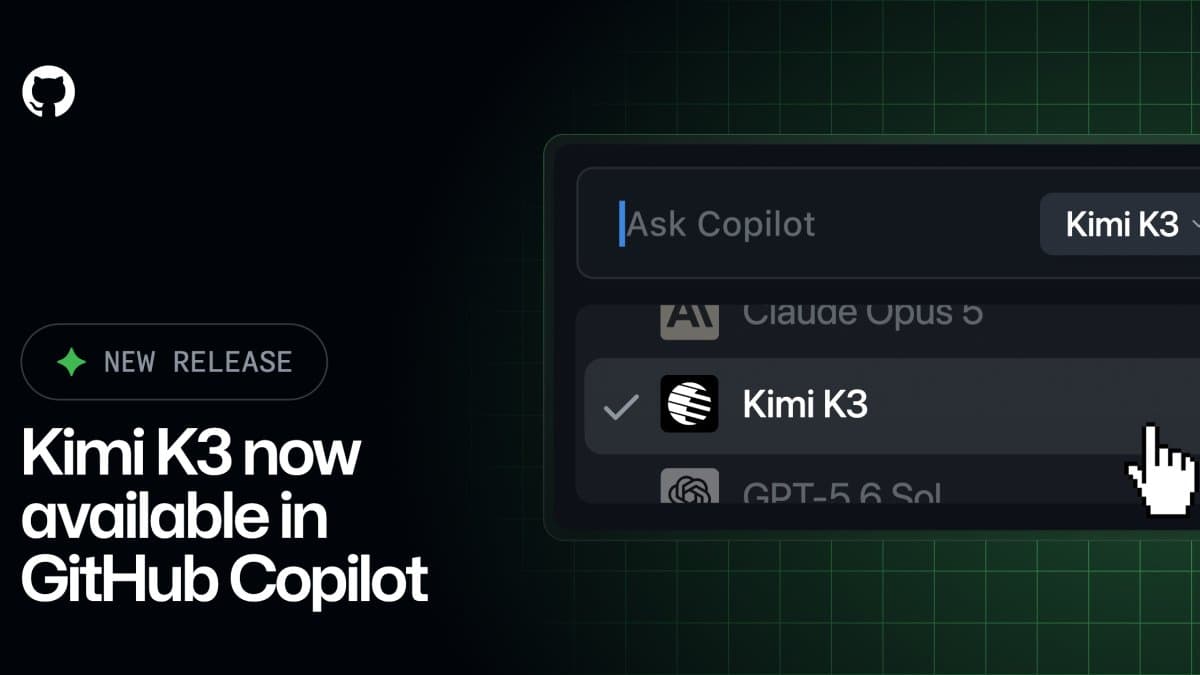
On August 6, a short post landed on the GitHub changelog titled "Kimi K3 is now available in GitHub Copilot." It's a two-minute read. The first line of the body: "Kimi K3, an open-weight model, is now generally available in GitHub Copilot. The model shows frontier-level abilities on agentic coding with highly cost-effective pricing."
The most interesting part of that page isn't the body. It's the two editor's notes stacked above it. The lower one reads: "We have temporarily paused the roll-out of Kimi K3 while we mitigate an incident with GitHub Actions. We will resume the roll-out as soon as possible and update docs with Kimi K3 pricing, which will be $3 per 1M input tokens, $15 per 1M output tokens, and $0.30 per 1M cached input tokens." The one above it is shorter: "We have resumed rolling out Kimi K3 in GitHub Copilot."
Both notes are dated August 6. So GitHub announced general availability, halted it, and restarted it inside a single day. The reason was an Actions outage that hit the same afternoon. GitHub's status page incident qcvjkzcs7j74 opens at 15:22 UTC on August 6 with "We are investigating reports of degraded performance for Actions" and closes at 02:04 UTC on August 7. That's 10 hours and 42 minutes. Along the way the log records workflow job success rates at "a low of 30 to 40%," webhook throughput down to "approximately 15% of webhooks," and GitHub Pages, hosted runners, Enterprise Importer migrations, Copilot code review, and the Copilot coding agent all pulled into the blast radius.
Here's the deal: this story has three layers. The surface layer is a product announcement — Copilot added a Chinese open-weight model to its default menu. The second layer is an operations story: that GA landed in the same browser tab as GitHub's own CI infrastructure falling over. The third layer is the one nobody put in a headline. Put the price sheet GitHub called "highly cost-effective" next to GitHub's own published per-model rates, and the phrase starts to wobble.
Moonshot, Fireworks, and Copilot — the three parties and their weight class
Start with who built the model. Moonshot AI is a Beijing-based startup that ships under the Kimi brand. Kimi K3 went live as an API on July 16, 2026, and the weights actually dropped on July 27. Per the Hugging Face model card: 2.8 trillion total parameters, 104 billion activated per token, 896 experts with 16 firing at a time. Context length is 1,048,576 tokens — a clean million. The 93 layers are a mix of 69 Kimi Delta Attention (KDA) layers and 24 gated MLA layers, alongside what Moonshot calls a Stable LatentMoE framework and Attention Residuals. Weights ship natively in MXFP4 with MXFP8 activations, and that quantization isn't a post-hoc squeeze — Moonshot applied quantization-aware training from the supervised fine-tuning stage onward. Simon Willison clocked the actual download at 1.56TB. It is the largest open-weight model anyone has published.
Moonshot's balance sheet transformed in roughly seven months. The company was valued around $4.3 billion in December 2025, climbed to roughly $20 billion in a May 2026 round, then raised about $3.5 billion in late July at a reported ~$35 billion valuation. That round was led by China's National AI Industry Investment Fund — the same state vehicle behind DeepSeek. Reporting since suggests Moonshot is sounding out a ~$50 billion pre-money round with a Hong Kong listing on the table as early as this year. An 8x valuation move in seven months, and most of the lift traces to one model release.
Now who runs the model. GitHub's changelog states plainly that "Kimi K3 is hosted by GitHub on Fireworks AI." Fireworks is an inference infrastructure company built specifically around serving open-weight models, and it closed a $1.505 billion Series D in mid-July at a $17.5 billion valuation, led by Atreides Management, Index Ventures, and TCV, with Nvidia among the participants. Per the company's own announcement, Fireworks crossed $1 billion in annualized revenue run rate — 5x year over year — and now serves more than 40 trillion tokens a day, up from 15 trillion. Open-weight serving stopped being a hobbyist market some time ago.
And finally the distribution channel. Microsoft disclosed roughly 4.7 million paid GitHub Copilot subscribers on its FY26 Q2 earnings call on January 28, 2026, up about 75% year over year. GitHub says 90% of the Fortune 100 use Copilot, and Microsoft has reported roughly 77,000 enterprise customers for the product. That's the part that matters. Kimi K3 didn't land in a hobby router where anyone can paste an API key. It landed in the tool that 90% of the Fortune 100 already pays for. Of all the pipes through which a Chinese model can reach American enterprise codebases, this is the fattest one, and a valve just opened.
One more piece of background belongs here. In mid-July, The Information reported that Microsoft was in the process of adding Kimi K3 to Azure, and that engineers on Copilot planned to evaluate whether the model could power features currently running on OpenAI and Anthropic systems. An internal estimate of up to $600 million in inference cost savings surfaced with that report. That figure carries real caveats — no stated time period, no named products, no assumed share of workload shifted, and no Microsoft confirmation. But the direction is unambiguous, and the August 6 changelog is the first public evidence that the evaluation became a product decision.
Line the price sheet up and "cost-effective" gets complicated
Let's pin down what actually shipped. GA is the label, but the body text says Kimi K3 "is beginning to roll out to Copilot Pro, Pro+, Max, Business, and Enterprise plans," and adds that "rollout will be gradual and we'll continue to monitor the model's quality and performance." So the badge says generally available while the switch flips in stages. Client coverage is broad: the model appears in the picker in Visual Studio Code, Visual Studio, Copilot CLI, the GitHub Copilot cloud agent, the GitHub Copilot app, github.com, GitHub Mobile on iOS and Android, JetBrains, Xcode, and Eclipse. Ten surfaces.
There's a condition attached. For Business and Enterprise, the default is off. "Plan administrators must enable the Kimi K3 policy in Copilot settings before anyone in their organization can select it. If the policy is left off, the model stays unavailable to that organization." GitHub then adds a sentence you don't usually see in a feature announcement: "We recommend administrators review open-weight models against their own security, compliance, and data-governance requirements before enabling them." That line existing at all tells you GitHub understands the political weight of what it just shipped.
Now the numbers. Here is GitHub's own published per-model token pricing, side by side.
| Model | Input (per 1M) | Cached input | Output (per 1M) |
|---|---|---|---|
| Kimi K3 (new) | $3.00 | $0.30 | $15.00 |
| Kimi K2.7 Code | $0.95 | $0.19 | $4.00 |
| Claude Sonnet 4 / 4.5 / 4.6 | $3.00 | $0.30 | $15.00 |
| Claude Opus 4.5–5 | $5.00 | $0.50 | $25.00 |
| Claude Haiku 4.5 | $1.00 | $0.10 | $5.00 |
| GPT-5.5 | $5.00 | $0.50 | $30.00 |
| GPT-5.6 Luna | $0.20 | $0.02 | $1.20 |
See it? Kimi K3's $3.00 / $0.30 / $15.00 matches the Claude Sonnet line to the cent. Inside Copilot, Kimi K3 is not a cheap model. It is a model that costs exactly what Sonnet costs. GitHub's "highly cost-effective" claim only parses against the top frontier tier — Opus at $5/$25, GPT-5.5 at $5/$30 — not against the mid-tier workhorse most developers actually run all day. And note the awkward internal comparison: Moonshot's own Kimi K2.7 Code, which entered Copilot a month earlier, sits at $0.95 / $4.00. Within the Moonshot lineup, K3 is 3.75x more expensive on output.
There's a reason for that, and it's in the changelog too: "This model is billed at provider list pricing under usage-based billing." Moonshot's own API charges exactly $3 per million input tokens, $0.30 per million cache-hit tokens, and $15 per million output. GitHub passed the list price straight through — no markup, no discount. For contrast, OpenRouter lists Kimi K3 at $2.80 input and $14 output, so running it inside Copilot costs roughly a 7% premium over the cheapest routed path. What you buy with that premium is picker integration, billing consolidation, and enterprise policy control.
On the capability side, Moonshot's model card reports Terminal-Bench 2.1 at 88.3, DeepSWE at 67.5, GPQA Diamond at 93.5, and BrowseComp at 91.2. The same table lists GPT-5.6 Sol at 88.8 / 73.0 / 94.1 / 90.4 and Claude Opus 4.8 at 84.6 / 59.0 / 91.0 / 84.3. So on the agentic-coding benchmark that matters most here, K3 lands half a point behind GPT-5.6 Sol and comfortably ahead of the Opus figure Moonshot chose; on BrowseComp it wins outright. Third-party aggregators put K3 at #3 on Artificial Analysis's Intelligence Index, #2 on Vals AI, and #1 in Frontend Code Arena. All the usual caveats apply: these are largely self-reported numbers run on different harnesses, and subtracting one vendor's table from another's is a good way to reach a wrong conclusion. What you can safely say is that GitHub calling this "frontier-level" isn't a marketing stretch.
Who actually gets paid in this trade
GitHub gets cost structure. Copilot collects a subscription and burns inference against it, so with 4.7 million paying seats running agents daily, model cost is margin. Depend only on OpenAI and Anthropic and you have no lever when either one moves list prices. Simply having a comparable model in the picker changes the negotiating table. The reported up-to-$600-million savings estimate hints at the size of that math — and note that those savings don't come from a lower rate card, they come from moving traffic. That's exactly why K3 arriving at Sonnet parity matters. GitHub wasn't shopping for a cheaper model. It was shopping for a substitutable one.
Moonshot gets distribution. The hardest wall for a Chinese AI lab isn't benchmarks, it's American enterprise procurement. No matter how good the evals look, a Fortune 500 security team is not signing a contract with a Beijing company. But when the name appears in the Copilot model picker, the counterparty is Microsoft. GitHub's hosting documentation nails this down: Kimi models "have publicly available weights," and "customer prompts and responses are not sent to the original model developers." Open weights function as a trust bypass. Moonshot doesn't capture the token revenue here — Fireworks serves the traffic — but it collects something that's arguably worth more to a company at a $35 billion valuation eyeing a Hong Kong IPO: a reference logo reading "official option inside the largest developer platform in the United States."
Fireworks gets an anchor tenant. For a company already serving 40 trillion tokens a day, Copilot traffic matters less as revenue than as signal. There is no better billboard for killing the idea that open-weight serving is a startup toy. And there's a technical tell worth noticing: a month earlier, Kimi K2.7 Code ran on "US-based Azure AI Foundry infrastructure managed by GitHub and Microsoft." This time it isn't Azure. Serving a 2.8-trillion-parameter, 1.56TB model at a million tokens of context apparently calls for a specialist stack. Microsoft handing Copilot inference to a serving vendor outside its own cloud says something about the difficulty of the job.
Developers get one more option, and if we're being honest, limited upside. At Sonnet parity there's no cost argument for switching. The switch only makes sense in two places: work that genuinely needs the million-token context on a large codebase, and domains like front-end code where K3 tops arena-style evaluations. For everything else, staying on whatever you already use is the rational call.
The party absorbing the burden is the enterprise administrator. Policy-off-by-default isn't a convenience feature, it's a transfer of responsibility. GitHub recommended reviewing the model against security, compliance, and data-governance requirements — and if you skip that review, flip the switch, and something goes wrong, that was your organization's decision. The person deciding whether a Chinese-trained model runs inside a corporate coding tool is now an IT admin, not a regulator in Washington.
The dress rehearsal five weeks earlier, and DeepSeek's two endings
This didn't come out of nowhere. Exactly five weeks earlier, on July 1, GitHub made Kimi K2.7 Code generally available in Copilot, with this sentence in the changelog: "This is the first open-weight model offered as a selectable option in the Copilot model picker." K2.7 opened the door; K3 is the second guest through it. The rollout mechanics were rehearsed too. K2.7 shipped to Pro, Pro+, and Max first with Business and Enterprise deferred by "the coming weeks," whereas K3 started across all five plans at once. Off-by-default policy and the security-review recommendation appear verbatim in both posts. In one month, GitHub turned open-weight model onboarding into a template.
The bigger precedent is DeepSeek in January 2025. When R1 landed at a shockingly low price, the market reacted to the rate card rather than the leaderboard, and U.S. hyperscalers had DeepSeek models on their platforms within weeks. That story split into two endings. On one side, open-weight models genuinely reset the floor for enterprise inference cost. On the other, politics caught up: as of 2026, DeepSeek is restricted on many U.S. government devices. There's no blanket ban on private companies, but public sector and critical infrastructure are effectively closed. Kimi K3 is standing at precisely that fork.
There's a third precedent that cuts against the optimistic read, and it's the license. Kimi K2 shipped under a Modified MIT license. K3 ships under a bespoke document Moonshot calls the Kimi K3 License. It reads like MIT for most of its length, then attaches two conditions. If a licensee or its affiliates operate a Model-as-a-Service business and aggregate revenue exceeds $20 million over any consecutive 12 months, the licensee must sign a separate agreement with Moonshot before any commercial use. Separately, products above 100 million monthly active users or $20 million in monthly revenue must display "Kimi K3" prominently in their interface. Moonshot itself never says "open source" in official materials — only "open weight." What's on offer is a revenue-gated conditional license wearing openness as a jacket, and that's the paragraph an enterprise legal team will stop on.
Anthropic and Washington already have counter-plays loaded
Anthropic feels this most directly. Kimi K3 and Claude Sonnet now sit at identical rates inside Copilot, which means the de facto monopoly Anthropic held at that price point is gone. Anthropic's defense isn't capability, it's contract. Per GitHub's hosting doc, Anthropic models run on Amazon Web Services, Anthropic PBC, and Google Cloud Platform, and GitHub maintains a zero data retention agreement with Anthropic for generally available Anthropic features — same arrangement as with OpenAI. Enterprises are already paying for the clause that says their data won't train anyone's model. Open-weight models answer that with a structural argument instead: the weights are public, so nothing goes back to the original developer. Those are different kinds of assurance, and which one clears a given procurement review depends entirely on the reviewer.
Anthropic's other counter-play is policy. It has been among the most vocal U.S. labs calling for tighter restrictions on Chinese AI. On the other side, 179 Silicon Valley startups sent a letter to the administration arguing for preserved access to open models, Hugging Face CEO Clément Delangue pushed back on the distillation narrative — crediting "really, really good research teams" using collaborative approaches — and Microsoft CEO Satya Nadella criticized the premise that distillation amounts to theft, noting the irony of firms claiming fair-use training rights while restricting distillation. That Nadella's company shipped Kimi K3 to GA on August 6 points in the same direction as his words.
The Washington timeline runs right alongside. On July 8, CNBC reported that U.S. lawmakers had begun probing the growing use of Chinese AI models inside American companies. On July 20, Axios reported the Trump administration was weighing a wholesale ban on Chinese open-source models. The next day, Treasury Secretary Scott Bessent said on Fox Business: "This administration supports open source models, but what we do not support is IP theft." He said the administration is examining leading Chinese open-weight models for evidence they copied intellectual property from U.S. frontier labs, and has the ability to sanction them if it finds it. The model he named was Kimi K3. Sixteen days later, that model became an official option in the largest developer platform in the country. Regulatory debate and commercial adoption are proceeding in parallel while ignoring each other.
Competing tools were mostly there already. Editor-first products like Cursor and Windsurf route across many models by design, so bolting on an open-weight option costs them almost nothing, and K3 has been live on OpenRouter through multiple providers since release. GitHub's move isn't first-mover on availability — it's first-mover on availability inside a channel with enterprise policy controls and audit trails. And Microsoft holds one more card: GitHub's docs list MAI-Code-1-Flash as "a first-party Microsoft model hosted on Azure in GitHub's tenant." Growing an external open-weight option and an in-house model at the same time reduces OpenAI dependence from both ends.
So what actually changes
For developers, today's action item is small: open the model picker, and if K3 isn't there, wait a few days — GitHub said the rollout is gradual. Before switching, do the arithmetic. Token rates match Sonnet, so there's no savings to bank, and only two reasons to move: you actually need the million-token context, or you're in a domain like front-end where K3 grades relatively strong. One practical note on billing — Copilot's usage-based charges are denominated in GitHub AI Credits at $0.01 per credit, and once you exceed your plan's included allowance the rates in the table above apply directly. If you run long agent sessions, auditing your cached-input hit rate will save you more money than swapping models.
For enterprise administrators, a decision just appeared on the desk: enable the Kimi K3 policy for Business and Enterprise, or leave it off. Three facts frame it. First, inference is hosted by GitHub on Fireworks AI infrastructure, and per GitHub's documentation prompts and responses are not sent to Moonshot. Second, the entity that trained the model is still a Chinese company, and both Congress and the executive branch are actively reviewing this whole category. Third, leaving the policy off makes the model invisible to your org, which means "off pending review" is the zero-risk default. For public sector or regulated industries the calculus is even simpler — there's no pressing reason to turn it on today.
For investors, the significance isn't revenue, it's the cost curve. The largest unresolved variable in Microsoft's AI business is inference cost, and Copilot's model is to cover that cost with subscription revenue. An open-weight model entering a production channel means there's now a mechanism to cap it. Read from the other side, this is the first time a major distribution channel has offered a substitute for Anthropic and OpenAI at parity pricing. Whether the up-to-$600-million estimate holds is unverifiable from outside. What is verifiable: as of August 6, a non-U.S. model charges the same rate as Sonnet inside Copilot.
For general users, nothing changes directly. Two things change indirectly. One is the familiar story — cheaper coding tooling eventually shows up as faster shipping in the apps you use. The other is subtler. Open weights effectively defeat border controls. Once 1.56TB of parameters are on the internet, no government can pull them back, and the only remaining lever is governing who serves them and where. The August 6 changelog shows that the front line of that governance is no longer a federal rule. It's a checkbox in a Copilot admin settings page.
Compress the whole thing into one sentence: GitHub didn't bring in a cheaper model, it brought in an interchangeable one. The savings come from leverage, not from the rate card, and the risk comes from geopolitics, not from the technology. And both landed on the day GitHub's own CI stopped working for 10 hours and 42 minutes.
🥄 Three Things You're Probably Wondering
— So what does this mean for me? If you don't use Copilot, nothing. If you do, it's one more entry in the model picker — and since the token rates match Claude Sonnet exactly, your bill won't go down. On a company account you may not even see it, because an administrator has to enable the policy first.
— Why is this happening now? The Kimi K3 API went live July 16 and the weights dropped July 27, and a month ago Kimi K2.7 Code became the first open-weight model in Copilot, which built the rollout and policy template. Layer on The Information's report about an internal review of up to $600 million in inference savings. That said, Washington was simultaneously debating sanctions and bans on Chinese open-weight models, so this reads less like good timing and more like two unrelated clocks happening to overlap.
— Is it actually ahead of the competition? By Moonshot's own numbers — Terminal-Bench 2.1 at 88.3, DeepSWE at 67.5 — it's in the frontier conversation and wins some line items outright. But one of the comparison models in that table is Claude Opus 4.8, which makes it a shaky proxy for Anthropic's newest, and subtracting self-reported figures run on different harnesses from another vendor's chart is bad practice. Whether it genuinely displaces Sonnet inside Copilot is too early to call with a rollout that just started.
Sources
- GitHub Changelog — Kimi K3 is now available in GitHub Copilot (including both editor's notes)
- GitHub Changelog — Kimi K2.7 Code is generally available in GitHub Copilot (July 1, first open-weight model)
- GitHub Docs — Hosting of models for GitHub Copilot (per-model hosting and data retention)
- GitHub Docs — Models and pricing for GitHub Copilot (per-model token rates)
- GitHub Status — Incident with Actions, qcvjkzcs7j74 (full August 6 outage timeline)
- Hugging Face — moonshotai/Kimi-K3 model card (parameters, architecture, benchmarks, license)
- CNBC — China's Moonshot AI unveils Kimi K3 that rivals OpenAI, Anthropic (July 17)
- Interconnects — Kimi K3: The open-weights escalation (architecture and scaling efficiency analysis)
- Simon Willison — moonshotai/Kimi-K3 (1.56TB weights, license clause text)
- Fireworks AI — Fireworks Secures $1.5 Billion in Series D Funding (revenue and token throughput)
- CNBC — Nvidia-backed Fireworks hits $17.5 billion valuation as companies pursue cheaper AI models
- TechCrunch — US threatens sanctions against Chinese AI models over IP theft (Bessent quote)
- Axios — The secret Trump administration battle to fight Chinese AI (July 20)
- CNBC — Lawmakers probe growing use of Chinese AI models in U.S. companies (July 8)
- Unite.AI — Moonshot Opens Kimi K3 Weights Under a Revenue-Tiered License (license thresholds)
- OpenRouter — Kimi K3 model page (context window, routed pricing comparison)
- Rest of World — Why U.S. tech and Washington are divided over Chinese open-weight AI models
Numbers and criteria are as of announcement and may change. Investment calls are yours to make!