The headline isn't the feature. It's that the age floor disappeared.
Here's the deal: as of August 10, Gemini in Classroom is available to K-12 and higher education students of all ages. Web first, with mobile following on August 17.
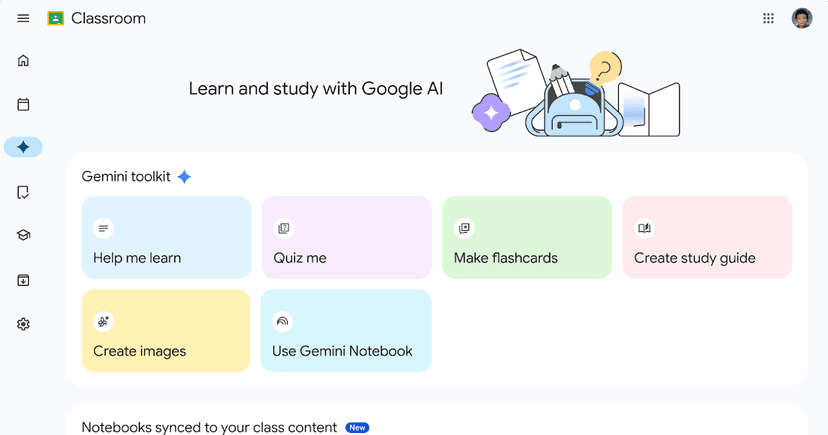
The functionality is modest. A student selects course materials and Gemini converts them into study content — flashcards, practice quizzes tailored to that class. Contextualized starter prompts come along with it, giving students a foothold when they don't know what to ask.
What actually changed isn't the feature, though. It's the phrase "all ages." Google's generative AI tools have carried age floors — 13 or 18 depending on jurisdiction — and elementary students were outside them. This expansion removes that line.
There is a condition. Only students whose school administrators have already granted access to Gemini in Classroom, Gemini, and Gemini Notebook can use it. This is an institutional decision, not an individual sign-up.
So while it reads as a product update, it's really Google answering a contested question: at what age should generative AI enter a classroom?
What Google already owns in schools
To weigh this decision you have to understand Google's position in education.
Google Classroom and Chromebooks have dominated American public education for over a decade. Chromebooks spread through schools on cost and manageability, and Google Workspace for Education layered on top — documents, email, assignment submission, and gradebooks all bound to one account.
That's an asset no other AI company has. OpenAI and Anthropic can ship education products, but they don't start from the account system and admin console a school already runs. Google can add one toggle in an admin console and reach tens of millions of students.
Admin-gated rollout works precisely because of that structure. Enabling or disabling at the domain level matches how educational institutions actually decide things. The adoption curve looks nothing like per-teacher or per-student contracting.
Google has been layering AI onto this asset in stages. Teacher tools came first — lesson planning, adjusting reading levels, quiz generation — and student-facing features followed. Education technology events like BETT 2026 have featured Gemini and Classroom updates as headline announcements. The all-ages expansion is the next step in that sequence.
Gemini 3.6 Flash was a separate announcement — but the two connect
One clarification. Gemini 3.6 Flash and 3.5 Flash-Lite frequently come up alongside this Classroom expansion, but those models shipped on July 21 — three weeks before, not alongside.
The two are still related, and the connection is cost.
| Model | Input ($/1M tokens) | Output ($/1M tokens) | Notes |
|---|---|---|---|
| Gemini 3.6 Flash | $1.50 | $7.50 | 17% fewer output tokens than 3.5 Flash, better agentic planning |
| Gemini 3.5 Flash-Lite | $0.30 | $2.50 | ultra-low latency, built for high-volume automation and subagents |
The headline improvement in 3.6 Flash is efficiency rather than capability. Same work, 17% fewer output tokens, at a lower price than the prior generation. Google framed it as a response to developer complaints about verbose output.
Here's where it meets education. Offering AI features free to tens of millions of students requires inference costs that survive contact with that scale. One student generating flashcards and quizzes a few times a day becomes an enormous aggregate token load. Without a cheap, fast model tier in place, this kind of expansion simply doesn't pencil.
Worth noting: July's release included no 3.5 Pro-class model. Google shipped the Flash line plus a cybersecurity-specialized variant and teased Gemini 4. Tuning the low-cost, high-volume tier before the frontier tier looked like an odd priority at the time. This expansion explains the ordering.
Who gets what
Google gets habit formation. Students carrying their school tools into adult life is a long-observed pattern in education markets — it's how Google Docs and Gmail entrenched themselves. If that repeats with generative AI, today's elementary students grow up with Gemini as the default.
There's a data dimension too: how students actually use AI while learning. Google has maintained a policy of not training models on education account data, and this area sits directly under regulatory scrutiny, so it's handled carefully.
Schools and teachers get a tool. Building practice problems calibrated to individual students is time-expensive, and automating it frees that time. But teacher concern is real: if a student gets the answer immediately, the thinking that produces learning may not happen.
Students get access. For those without tutoring or supplemental instruction, tailored practice material can matter substantively — that's the equity argument. The counter-argument is that habitual AI dependence costs more in the long run than it saves.
Parents are split. Some welcome AI in school, some don't, and the concern is sharpest at elementary ages. Admin-gated rollout is partly a design choice that leaves room for schools to reflect local parent sentiment.
What happened when education technology entered classrooms before
The history offers some clues about how this goes.
Google Classroom itself is a success case. Launched in 2014, it exploded during the pandemic. The reason wasn't features — it was low friction. It worked with accounts schools already had and it was easy for IT to manage. Education technology outcomes hinge on deployability more than capability.
There are plenty of failures. Large district-scale tablet programs collapsed in the early 2010s over budget and content quality. MOOCs were supposed to displace universities and instead posted dismal completion rates. Education keeps demonstrating that providing a tool and producing learning are different problems.
For AI tools specifically there's a fresher example. Numerous districts blocked ChatGPT immediately after launch and reversed within months, once blocking proved unenforceable and the emphasis shifted to teaching with it. That episode surfaced the false-positive problem in AI detectors and pushed the conversation toward redesigning assignments rather than policing them.
The determining factors here will be similar. Not how good the feature is, but whether teachers integrate it meaningfully and whether student outcomes actually improve. There's very little data on the second point.
How competitors respond
OpenAI approaches education separately, with products aimed at universities and districts and features like study modes. Without an existing school account infrastructure, though, every deployment requires its own contract — a structural disadvantage in diffusion speed.
Anthropic leans toward higher education, emphasizing university partnerships and learning-support features. Being cautious about K-12 is defensible given the regulatory burden at those ages.
Microsoft holds the position closest to Google's, with an Office and Teams-based education suite and Copilot layered on. Google's Chromebook share in K-12 gives it the edge in a head-to-head on the same strategy.
Education technology specialists face pressure. Some, like Khan Academy, built their own AI tutors, but differentiation gets hard when the platform vendor gives away equivalent functionality. Language learning, problem practice, and study management are the most exposed.
Regulators are the largest variable. COPPA in the US and European data protection rules treat minors' data strictly. The EU AI Act classifies education as high-risk, which means European deployment may face conditions US deployment doesn't — particularly anywhere AI touches student assessment.
A different clause of that same law shows up elsewhere in this week's news: Anthropic's decision to watermark Claude-generated text came from the AI Act's transparency requirements. The two threads meet in classrooms. If AI-generated student work carries machine-readable marks, teachers gain a detection method they've never really had. Whether Google applies comparable marking to Gemini output, and whether schools adopt the tooling, are separate open questions.
The ordering of teacher-facing versus student-facing features is also informative. Google shipped lesson planning and reading-level adjustment tools for teachers well before opening anything to students. That sequence reflects how education technology actually lands — teachers have to be fluent with a tool before student deployment functions at all. Reversing it produces classrooms where the tool is loose before anyone knows how to teach with it.
So what actually changes
If you're a parent, it's worth asking whether your child's school has enabled this. It's admin-gated, so it varies school by school, and there's room to weigh in on policy. Two things to ask: which ages get what scope, and how learning data is handled.
If you teach, assignment design deserves another look. When a student can convert course material into a quiz instantly, recall-checking assignments lose their point. Work that requires showing process or applying concepts holds up better. This is a continuation of the argument that started with ChatGPT.
If you work in education technology, the competitive terrain is shifting. The band of functionality that platform vendors give away for free keeps widening, and figuring out what sits above that band is the job.
If you follow the AI industry, this demonstrates why the cheap model tier matters. Efficiency gains like 3.6 Flash's 17% output-token reduction are what make free deployment at population scale possible. Competition at this tier drives actual user counts as much as frontier competition does.
If you're the student, it's one more tool. Having AI make your flashcards and organizing the material yourself are different cognitive processes, though, and there isn't much validated data on the learning outcomes yet. How you use it will likely matter more than whether you use it.
🥄 Three Things You're Probably Wondering
— Will this turn on automatically at my kid's school? No. It applies only to students whose administrators have granted access to Gemini in Classroom, Gemini, and Gemini Notebook. It's an institutional decision, so both adoption and scope vary widely.
— Is it okay for elementary students to use AI? Too early to say with confidence. There's a real case that tailored practice material improves access, and a real concern that it lets students skip the thinking that produces understanding. Long-term outcome data barely exists — this rollout is part of how that data gets made.
— Did Gemini 3.6 Flash ship with this? No, 3.6 Flash and 3.5 Flash-Lite were announced July 21, separately. They're connected, though: opening AI features free to tens of millions of students requires a cheap, fast model tier to exist first. The model work came first, and the distribution followed.
Sources
- Gemini in Classroom (Google Blog) — the primary source, describing the feature set and Google's framing for classroom use.
- Gemini in Google Classroom is expanding to users of all ages (Google Workspace Updates, 2026-08) — the official notice with the August 10 web / August 17 mobile rollout dates and the admin-grant condition.
- Introducing Gemini 3.6 Flash, 3.5 Flash-Lite, and 3.5 Flash Cyber (Google Blog, 2026-07-21) — the July model announcement, source for the token efficiency and pricing structure.
- Google releases three new Gemini models — but no 3.5 Pro (TechCrunch, 2026-07-21) — analysis of why Google shipped only the Flash tier.
- Google launches Gemini 3.6 Flash and 3.5 Flash-Lite, teases Gemini 4 (9to5Google, 2026-07-21) — the price table and the 17% output-token reduction figure.
- BETT 2026: Google announces major AI updates to Gemini and Classroom (EdTech Innovation Hub) — context on the Classroom AI roadmap as presented at an education technology event.
Numbers and criteria are as of announcement and may change.