A frontier lab is spending $6 billion, and it isn't buying a model
Bloomberg broke the story on August 13: Anthropic is in talks to acquire Decart, a Tel Aviv-based AI startup, for roughly $6 billion. If it closes, it would be Anthropic's largest acquisition ever and one of the biggest purchases of an Israeli technology company on record.
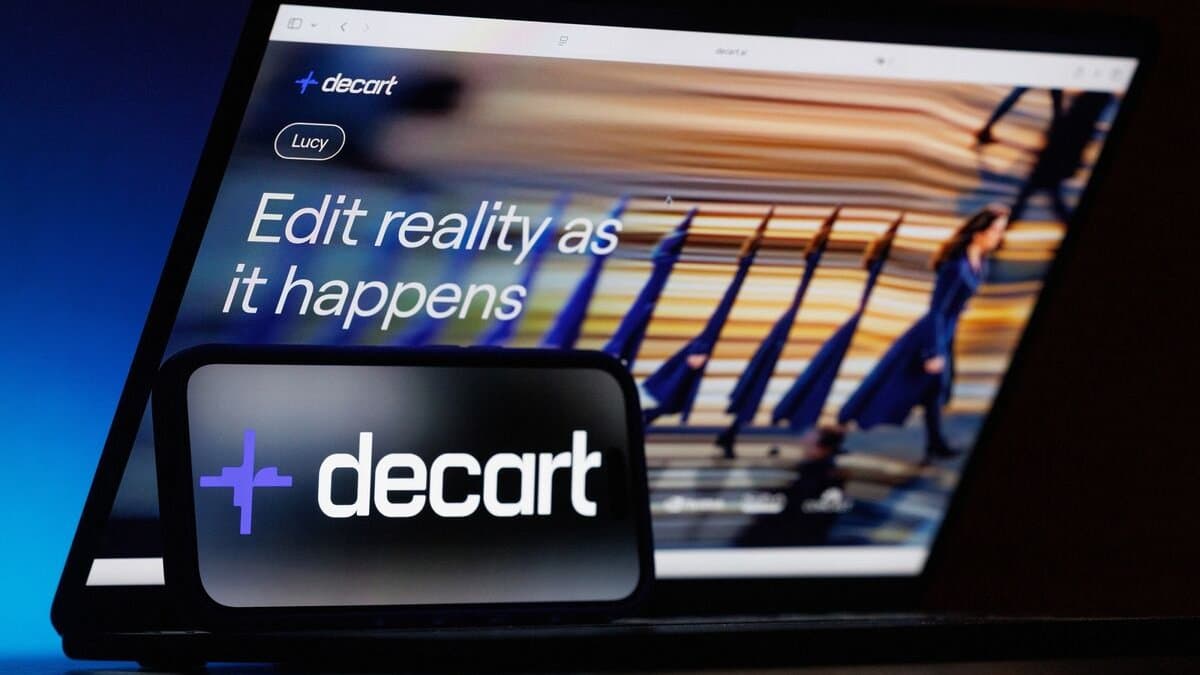
Here's the part that doesn't add up at first glance. Decart is famous for real-time generative video. Its models can swap a person's clothing, replace a background, or transform a character in a live stream with essentially no lag. Anthropic doesn't generate images or video. Claude makes its money on text, code, and agents. Consumer video generation is Sora and Veo territory — never Anthropic's.
The rationale Bloomberg reported closes the gap. According to people familiar with the talks, the purpose of the deal is to help Anthropic's existing computing infrastructure absorb more demand, and Decart's technology would be folded into Anthropic's inference team. So what Anthropic actually wants isn't the flashy video model. It's the software that squeezes more tokens out of the same silicon.
To see why that's worth $6 billion, look at what Anthropic has already committed to compute over the past year: up to 5 gigawatts with Amazon, another 5 gigawatts with Google and Broadcom, $30 billion of Azure capacity through a Microsoft-NVIDIA partnership, a $50 billion American infrastructure build with Fluidstack, the entire capacity of SpaceX's Colossus 1 data center, and — just ten days ago — a $10 billion deal with Volta. At that point you've bought nearly everything that's for sale. If it still isn't enough, one option remains: make the chips you already have run faster.
Anthropic and Decart, and how each of them got here
Anthropic's 2026 is a story told in numbers. On May 28 the company announced a $65 billion Series H at a $965 billion post-money valuation, co-led by Altimeter, Dragoneer, Greenoaks, and Sequoia. In the same post, Anthropic disclosed that run-rate revenue had "crossed $47 billion earlier this month" — up from roughly $9 billion at the end of 2025. That's five-fold in six months. And on August 13, CNBC reported that CFO Krishna Rao is holding early IPO meetings with investors.
Five-fold revenue means five-fold inference load. Anthropic's own May 6 post shows what that pressure feels like from the inside. The company announced a deal to take all of the compute capacity at SpaceX's Colossus 1 — more than 300 megawatts, over 220,000 NVIDIA GPUs — coming online within the month. But half of that announcement was about product limits: doubling Claude Code's five-hour rate limits across Pro, Max, Team, and Enterprise, removing the peak-hours reduction, and raising Opus API rate limits considerably. When a company loosens its throttles the same day new capacity lands, it's telling you the throttles existed because capacity was short.
Decart comes at the problem from the opposite direction. It was founded in September 2023 by CEO Dean Leitersdorf, 27, and CPO Moshe Shalev, 38; several reports also name Dean's brother Orian Leitersdorf as a co-founder. Israeli outlets consistently describe the founding team as Unit 8200 alumni. Headcount is around 100. Calcalist estimates revenue in the "several tens of millions of dollars" range.
The company's shape is unusual. Decart is really three things stacked on top of each other. Lucy is the real-time world-editing model. Oasis is an interactive world model for physical AI. And DOS — the Decart Optimization Stack — is the hardware optimization layer underneath both, supporting NVIDIA, AWS Trainium, and Google TPU. The company's own framing is that it builds "the infrastructure and models that make AI run at the speed of reality." Lucy and Oasis got the attention. DOS is what makes this deal make sense.
The funding history: $100 million at a $3.1 billion valuation in August 2025, then $300 million on May 18, 2026, led by Radical Ventures. NVIDIA came in new on that round, alongside Adobe Ventures, Toyota Ventures, eBay Ventures, Atreides Management, and Valor Equity Partners, with Sequoia, Benchmark, and Zeev Ventures following on. Andrej Karpathy and former Disney CEO Michael Eisner joined as individual backers. Total raised: about $450 million. The headline Decart chose for that announcement is worth noting — tech leaders backing the company as both customers and investors. Adobe, Toyota, and eBay weren't just writing checks; they were running the product.
Then, on August 10, Calcalist got there first. It reported Decart was nearing a sale at $6–7 billion, with Elon Musk's SpaceX circling — Musk had reportedly been tracking Decart since 2024 and stayed in regular contact with Leitersdorf. Earlier talks with NVIDIA had fallen through, and Amazon and Nebius had shown interest. Three days later Bloomberg attached Anthropic's name to it.
From $4 billion to $6 billion in three months
Put the numbers side by side and the deal's character shows up.
| Item | Figure |
|---|---|
| Reported deal value | ~$6B (Calcalist: $6–7B) |
| Prior valuation | $4B (2026-05-18, $300M round) |
| Premium | ~50%, over roughly 3 months |
| Valuation before that | $3.1B (2025-08, $100M round) |
| Total raised | ~$450M |
| Estimated revenue | Several tens of millions (Calcalist) |
| Headcount | ~100 |
| Price per employee | ~$60M |
Run the revenue multiple and you land well north of 100x. This isn't a deal that buys revenue. It buys technology and people — and $60 million per head says the people part is doing most of the work.
So what exactly is the technology? The most concrete figures come from Decart's own May announcement of DOS 2.0: over 1,600 tokens per second for agentic inference, against roughly 200 tokens per second the company cites as the industry average — an 8x gap. Full-HD video and world-model inference at up to 100 FPS. A claimed 100x improvement in cost efficiency. And one line that would have jumped off the page in Anthropic's inference org: Lucy2 hitting 80% Model FLOPS Utilization on Trainium3.
That number matters because Anthropic already runs on Trainium. Per the April 20 joint announcement with Amazon, Anthropic uses more than one million Trainium2 chips, with nearly 1 gigawatt of combined Trainium2 and Trainium3 capacity arriving by the end of 2026 and the agreement extending through Trainium4. Custom silicon is cheaper per chip but its software stack is less mature than NVIDIA's, which historically means lower utilization. Moving MFU from 40% to 60% adds 50% more throughput on hardware you've already paid for and powered. That's a data center you don't have to build.
The product specs tell you what kind of team this is. Lucy 2.5, released July 16, does 1080p at 30 FPS in real time — and to get there the team hand-built MXFP8 and NVFP4 low-precision quantization paths, dynamic sparse attention with custom kernels, and deeper kernel fusion. Oasis 3, released June 10, generates 512×768 interactive worlds at 22 FPS with under 200 ms latency on CoreWeave infrastructure and NVIDIA HGX B200 systems. This isn't a paper-writing research group. It's a kernel-carving team, which is exactly the scarcest kind of engineer a frontier lab can hire right now.
Who gets what
Anthropic gets three things. First, inference cost relief: at a $47 billion run rate, a few points of margin improvement is hundreds of millions of dollars a year. Second, roughly 100 kernel and quantization engineers in one transaction — a team that would take years to assemble through individual hiring. Third, a margin story at exactly the moment its CFO is sitting down with pre-IPO investors. "We don't just buy compute, we own the efficiency layer" is a useful sentence in those rooms.
Decart's investors book a 50% markup in three months. That includes Radical Ventures, NVIDIA, and Adobe Ventures from the May round. NVIDIA's position is the interesting one: if Calcalist is right that NVIDIA's own acquisition talks collapsed and it settled for equity, it captures the financial upside while watching the technology walk into a customer's proprietary stack.
The founders get a multibillion-dollar exit at 27 — with a cost attached. Lucy and Oasis target consumer, commerce, media, and autonomous-vehicle markets. Inside Anthropic, those product lines have no obvious home. Anthropic has been consistent about this: when it acquired Stainless in May, it wound down the hosted products and kept the technology. Decart's consumer-facing stack could easily follow the same path.
Amazon sits in a strange spot. It's both a major Anthropic investor and its Trainium supplier. If Anthropic buys the company that gets 80% MFU out of Trainium3, AWS's silicon strategy gets a validation it badly wants — but the know-how becomes Anthropic's private asset, not something other AWS customers benefit from. That tension probably explains why Calcalist listed Amazon among the interested buyers.
Israel's tech ecosystem adds another landmark exit, following Intel-Mobileye ($15.3B), NVIDIA-Mellanox ($6.9B), and Google-Wiz. The character is different this time, though. Those were mature product companies. This is a three-year-old startup priced at over 100x revenue.
Consumers are the ones who arguably lose. Lucy was already in use at commerce platforms like eBay and across streaming and advertising. Under Anthropic there's little reason to keep pushing that business. One of the strongest independent players in real-time video generation gets absorbed as an infrastructure component.
When labs bought efficiency: Apple's win, Intel's two losses
The canonical success is Apple. It bought P.A. Semi for $278 million in 2008 and Intrinsity in 2010, and those two teams became the foundation of Apple Silicon. At the time, "why is a phone company buying chip designers?" was a fair question. Fifteen years later the answer is a performance gap nobody has closed. The lesson is simple: when your critical bottleneck sits outside your walls, buy it and bring it inside. For frontier labs in 2026 the bottleneck is compute, and Anthropic's logic sits squarely in this lineage.
The closest precedent by size is NVIDIA's $6.9 billion purchase of Mellanox in 2019 — almost exactly this deal's price tag. A GPU company buying a networking company looked odd until it became obvious that AI data centers are decided not by single-GPU performance but by the interconnect binding tens of thousands of them. It's now widely called NVIDIA's best acquisition. Same structure: they bought a bottleneck, not a product.
Intel supplies both failure cases. It bought Nervana Systems for roughly $400 million in 2016 and Israel's Habana Labs for $2 billion in 2019, both under the banner of acquiring AI acceleration efficiency. Nervana was quietly shelved after the Habana deal. Habana's Gaudi line kept a roadmap but never took meaningful share. The problem wasn't the technology — it was integration. If you can't dissolve an acquired team's stack into your existing software ecosystem, all you bought was patents and payroll. That Habana was also an Israeli company makes the parallel uncomfortably tight.
Two more worth holding in mind. AMD bought SeaMicro for $334 million in 2012 and shut it down in 2015. And NVIDIA's $40 billion bid for Arm never happened at all — regulators killed it. A $6 billion cross-border deal has to clear regulatory and national-security review, and a company staffed with alumni of Israel's signals intelligence corps may draw a longer process. Bloomberg itself was explicit that the talks aren't final and could fall apart.
How rivals push back
SpaceX is the live variable. Calcalist reported Musk had been following Decart since 2024 and that an acquisition would have established SpaceX's first Tel Aviv R&D center. That creates an odd triangle, because Anthropic is currently renting the entire capacity of SpaceX's Colossus 1. The compute seller and the compute buyer are bidding on the same target — and the seller is in a position to raise the price.
NVIDIA has two moves. One is to strengthen its own inference stack (TensorRT-LLM, Dynamo and friends) and bundle the optimization layer for free, structurally deflating the value of third-party optimization companies. The other is to cash its Decart stake and go acquire a comparable team. NVIDIA's worst case here is clear: software that extracts several times the throughput from the same GPU becoming one customer's exclusive property. That's a headwind to hardware volume.
OpenAI already designs custom silicon with Broadcom and runs inference-efficiency work internally. But Decart would have had a second use for OpenAI that it doesn't have for Anthropic — it operates Sora, so real-time video generation plugs straight into a shipping product. Watching a rival buy that asset and use it purely as plumbing is the kind of thing that makes a company more aggressive about the next comparable startup.
Google is the most relaxed. It designs TPUs and owns its compiler stack end to end, so the optimization layer is already vertically integrated. Google's counter-play isn't M&A, it's pricing: keep Gemini API rates low enough to demonstrate that the efficiency gap is something it already has.
Meta and the Chinese open-weight labs apply pressure from a different angle. Meta pushes its own world-model research, and the DeepSeek lineage has repeatedly shown that pure software optimization can collapse cost curves. Which raises the honest counterargument: is this technology really scarce enough to justify $6 billion? Kernel optimization diffuses fast through papers and open source, and today's 8x edge is not guaranteed to survive eighteen months. The deal only makes sense if what Anthropic is buying is the team that keeps producing those wins — and whether that team stays post-acquisition is a separate question entirely.
What actually changes for you
For developers, this is a good medium-term signal. If Anthropic locks in inference efficiency, that shows up as looser rate limits or lower token prices. There's precedent: in May, the moment new capacity landed, Claude Code limits doubled. But it takes time — integration runs multiple quarters, and whether savings go to price or to margin is a choice a pre-IPO company gets to make.
For investors, the multiple is the whole debate. Over 100x revenue is not a financially justified number; it's a strategically justified one. Two things to track: whether Anthropic's gross margin actually improves, and how many Decart engineers are still there in a year. In an acqui-hire, broken retention means the money never comes back.
For enterprise practitioners, add a line to your vendor-risk review. If Lucy or Oasis is in your pipeline, ask about the roadmap now. Anthropic wound down every hosted Stainless product after that acquisition. Decart's consumer and commerce products could plausibly go the same way. Start scoping alternatives before you're forced to.
For everyday users, this points toward Claude hitting fewer walls. Most of the "capacity constrained" and slow-response experiences trace back to hardware supply. The flip side: one strong option in real-time video generation may quietly disappear.
For founders, the market signal is unambiguous. What frontier labs are paying the most for right now is not a novel model architecture — it's technology that extracts more from hardware that already exists. That's why a three-year-old, 100-person company is fielding $6 billion conversations. The logic holds as long as compute is the bottleneck. The moment compute gets abundant, the premium evaporates.
🥄 Three Things You're Probably Wondering
— Is this deal actually happening? Not yet. Bloomberg was explicit that talks aren't final and could fall through. Both companies declined to comment, and three days earlier Calcalist had SpaceX as the leading suitor. Both the price and the buyer can still change.
— Does this mean Claude will generate video? Probably not. The reported rationale is compute infrastructure efficiency, with Decart's tech going into the inference team. Anthropic has never shipped an image or video generation product, and it has a track record of retiring acquired companies' consumer products. That said, calling it settled would be premature — companies do change direction.
— Isn't $6 billion wildly expensive? On pure financials, yes — over 100x an estimated revenue base in the tens of millions. But measured against the tens of billions Anthropic has committed to compute, paying for a double-digit percentage efficiency gain on all of it computes differently. Which framing is right depends entirely on integration, and integration is exactly where Intel's Habana bet died.
Sources and further reading
- Anthropic Said in Talks to Buy AI Startup Decart for $6 Billion (Bloomberg, 2026-08-13) — the original report: $6B scale, Anthropic's largest deal to date, the "absorb more demand" rationale, and the caveat that talks could collapse.
- Anthropic said in talks to buy startup Decart for $6 billion (Fortune, 2026-08-13) — founder lineup, funding history, the detail that Decart's tech would join Anthropic's inference team, and both companies declining to comment.
- Israeli AI startup Decart nearing $6 billion sale, Musk's SpaceX circling (Calcalist/Ctech, 2026-08-10) — the local report that preceded Bloomberg by three days: the SpaceX/NVIDIA/Amazon/Nebius field, ~100 employees, revenue in the tens of millions.
- Decart raises $300M — tech leaders back the company as both customers and investors (Decart official, 2026-05-18) — source for DOS 2.0's 1,600+ tokens/sec, the 100x cost-efficiency claim, and 80% MFU on Trainium3.
- Lucy 2.5: Raising the Bar for Live AI (Decart official, 2026-07-16) — 1080p/30 FPS live editing plus the MXFP8 and NVFP4 quantization and custom-kernel work that defines this team.
- Introducing Oasis 3, the first interactive world model for physical AI (Decart official, 2026-06-10) — the autonomy and robotics side: 22 FPS, sub-200 ms latency, running on CoreWeave and NVIDIA HGX B200.
- Anthropic raises $65B in Series H funding at $965B post-money valuation (Anthropic official, 2026-05-28) — the $47B run-rate disclosure and the stated use of funds: expanding compute to meet demand for Claude.
- Higher usage limits for Claude and a compute deal with SpaceX (Anthropic official, 2026-05-06) — all of Colossus 1 (300+ MW, 220,000+ GPUs) and the rate-limit increases that followed. Hard evidence of the capacity squeeze.
- Anthropic and Amazon expand collaboration for up to 5 gigawatts of new compute (Anthropic official, 2026-04-20) — 1M+ Trainium2 chips in use, ~1 GW by end of 2026, agreement running through Trainium4.
- Anthropic acquires Stainless (Anthropic official) — the template: absorb the technology, wind down the hosted products. The best guide to what happens to Lucy and Oasis.
Numbers and criteria are as of announcement and may change. Investment calls are yours to make!