Everyone said "world's first 2nm." Google never did.
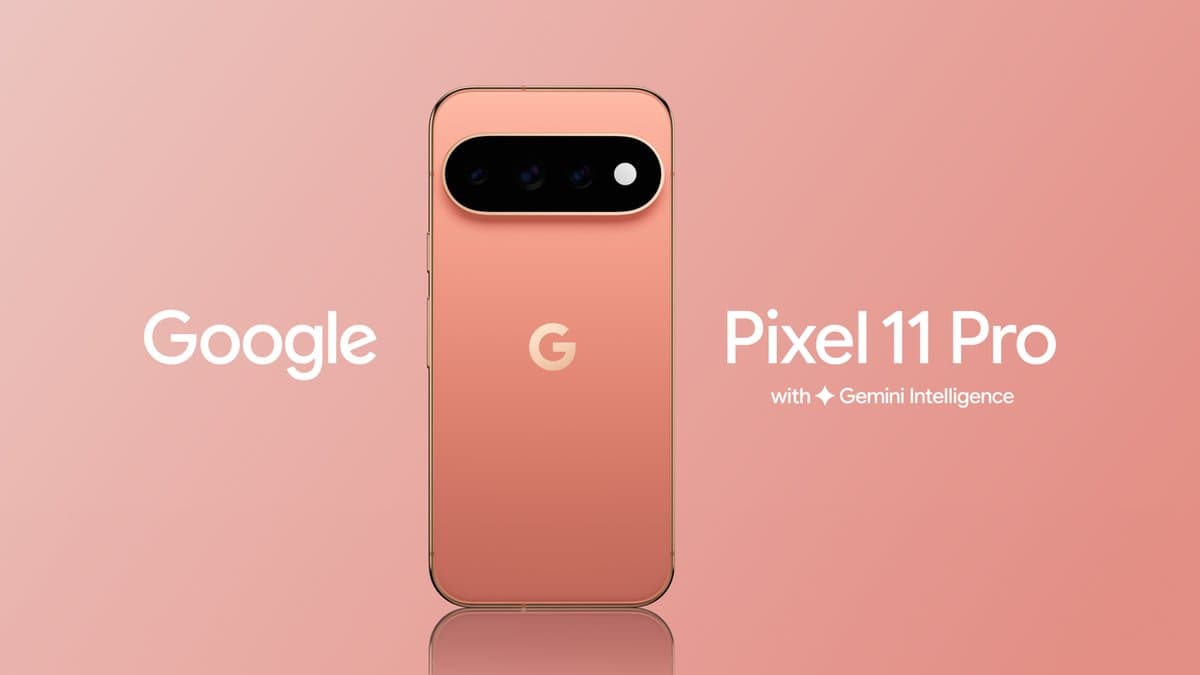
Here's the deal: on August 12 in New York, Google announced four phones at once — Pixel 11, Pixel 11 Pro, Pixel 11 Pro XL, and Pixel 11 Pro Fold. Preorders opened the same day and all four hit shelves on August 20. Prices run $899, $1,099, $1,299, and $1,899 for the Fold at 16GB/256GB.
For weeks beforehand, one sentence dominated the coverage: Tensor G6 would be the first smartphone chip built on TSMC's 2nm N2 node, beating Apple to it, putting Gate-All-Around transistors into a mainstream Android chip for the first time. That claim got repeated from July onward until it hardened into something everyone treated as settled.
Then the actual announcement landed and there was not a single mention of a process node in it. What Google published was entirely relative numbers: 20% better CPU power efficiency, 25% faster web browsing, 15% quicker app launches, 50% more TPU compute, on-device AI running up to 3.5x faster on up to 3.5x less energy. No nanometers anywhere.
A day later, on August 13, Google hardware VP Peng Yu-chun told Taiwan's Central News Agency at the Pixel 11's Taiwan launch that Tensor G6 is built on an upgraded TSMC 3nm process. Not 2nm. 9to5Google, Tom's Guide, and Android Authority all picked up the correction; Android Authority noted it had asked Google for confirmation and had no response by publication. For the record, the "first 2nm GAA smartphone chip" title was already claimed back in December 2025 by Samsung's Exynos 2600.
The interesting part isn't whether anyone lied — Google never made the claim. The interesting part is that while the entire industry framed the contest as a nanometer race, Google spent its transistor budget somewhere else entirely. It spent it on the TPU.
Who's who — six years of custom silicon, and the cost of switching foundries
Google started building its own mobile silicon in 2021 with the first Tensor in the Pixel 6. Look back at how Google introduced it and the framing is remarkably consistent with today: not benchmark scores, but "a milestone for machine learning." The demos were live translation, Magic Eraser, better speech recognition — things that only work if on-device ML is fast enough.
The four years after that were rough. Tensor G1 through G4 were fabricated at Samsung Foundry, and they took criticism on thermals and efficiency every generation. Throttling, modem trouble, weak sustained performance under load — these were fixtures of Pixel reviews. Google's standing answer, "we don't optimize for benchmarks," got less persuasive each time it was deployed.
The turn came with 2025's Tensor G5 in the Pixel 10, when Google moved to TSMC's N3E. That was the first generation where design freedom and process quality showed up together, and reviewers actually registered the improvement in heat and battery behavior. Tensor G6 is year two of the TSMC era, not a fresh start.
TSMC's side matters too. N2 is currently the most expensive and most constrained line in the industry. Apple has locked up the bulk of early capacity on leading nodes for several generations running, and data center customers like Nvidia and AMD are queued behind it. Pixel ships a small fraction of iPhone volume. Getting early N2 wafers was always an economically strange proposition for Google, which makes "upgraded 3nm" the more natural answer in hindsight.
One more thing from that same Taiwan appearance: Peng talked about rising memory costs across the industry and said the chip was designed with system-level optimizations to offset them. That's context worth holding onto. Through 2026, DRAM and HBM capacity has been pulled hard toward data centers, pushing mobile memory pricing up. When a phone maker brings up memory bill-of-materials at a chip launch, it tells you where the pressure in this industry actually is right now.
What actually shipped — fewer cores, a much bigger TPU
Break down the Tensor G6 CPU and the generation's personality shows up immediately. It's a seven-core layout on Arm v9.3: one C1-Ultra prime core at 4.1GHz, four C1-Pro performance cores at 3.4GHz, two C1-Pro efficiency cores at 2.65GHz. Tensor G5 had eight cores — one Cortex-X4 at 3.78GHz, five Cortex-A725 at 3.05GHz, two Cortex-A520 at 2.25GHz.
So Google dropped a core and pushed the prime clock up. That's a trade: single-threaded responsiveness and power efficiency in exchange for aggregate multi-core throughput. Leaked Geekbench results point exactly that way — 2,112 single-core, up about 7% over G5, and 5,196 multi-core, down about 12%. The GPU moved to a PowerVR C-series part with six compute units at 1.3GHz and scored 7,757 in Geekbench Compute, roughly 80% above early G5 figures.
The gap to rivals is still wide, though. Qualcomm's Snapdragon 8 Elite Gen 5 with Adreno 840 delivers roughly triple the GPU throughput, and the Pixel 11 Pro XL measures about 39% behind the iPhone 17 Pro and about 49% behind the Galaxy S26 Ultra in multi-core. When Google says it isn't fighting the benchmark fight, that isn't modesty. It's a description.
| Spec | Tensor G5 (Pixel 10) | Tensor G6 (Pixel 11) | Change |
|---|---|---|---|
| Process | TSMC N3E | TSMC upgraded 3nm (per Google VP) | Within-generation step |
| CPU layout | 8 cores (1x X4 + 5x A725 + 2x A520) | 7 cores (1x C1-Ultra + 6x C1-Pro) | One fewer core, 4.1GHz prime |
| CPU efficiency | Baseline | Up to 20% better | Google's own testing |
| Everyday speed | Baseline | Web +25%, app launch +15% | Google's own testing |
| TPU compute | Baseline | +50% | The headline change |
| Memory bandwidth | Baseline | ~2x | Unblocks the TPU |
| On-device AI | Baseline | Up to 3.5x faster / 3.5x less energy | Google's own testing |
| Security chip | Titan M2 | Titan M3 + quantum-safe boot | First refresh in ~5 years |
| Geekbench single/multi | Baseline | 2,112 / 5,196 | +7% / −12% (leaked) |
The rows to stare at are TPU compute and memory bandwidth. The 50% compute jump is real, but doubling memory bandwidth may matter more. On-device language model speed usually hits a bandwidth wall before it hits a compute wall, because every generated token requires streaming weights out of memory. Raising both together signals Google understood which constraint actually binds and budgeted accordingly.
The ISP changed too. A dedicated hardware accelerator for video portrait processing enables 4K Portrait Video on a Pixel for the first time. Instant Night Sight captures low-light shots up to 4.5x faster, and Pro Zoom reaches 120x on the Pro models. The Fold sits out both 4K Portrait Video and Instant Night Sight because of physical layout and sensor constraints — same chip, different feature set.
On camera hardware: the Pixel 11 gets a new 48MP main sensor with 56% more light sensitivity, a 5x telephoto, and 30x Super Zoom. The Pro and Pro XL get a redesigned main sensor plus a 48MP telephoto with 30% more light sensitivity, Portrait Mode enabled at 5x, and Pro Zoom to 120x. Displays hit 3,600 nits on Super Actua panels, the anti-scratch coating is twice as resistant as last generation, and the camera bar is 40% thinner.
What each side gets out of it
Google gets hardware justification for its software roadmap. Look at the feature list and the direction is unmistakable. Gemini Intelligence handles multistep tasks across 40+ apps proactively. Rambler takes loose, unstructured voice input. Sign-to-Text, built with the Deaf community on a Google DeepMind model, converts sign language to text. Magic Capture analyzes roughly 400 frames on-device to pull one well-timed 12MP shot. Live Translate does real-time speech-to-speech and auto-dubs video. Every one of those is latency- and power-bound. Round-trip to a data center and the experience collapses. That's why the TPU budget went up.
TSMC wins either way. Pixel not getting N2 means N2 capacity went to customers paying more for it, and the upgraded-3nm volume still books as TSMC revenue. Since Google moved over from Samsung Foundry, the Tensor line has become a steady mid-tier TSMC customer — filling the second wave on advanced nodes behind Apple and the accelerator vendors.
Android developers get a meaningfully higher on-device inference ceiling. One reason so few apps actually use on-device Gemini Nano is that the performance sat in an awkward middle: if a summarization pass takes long enough to notice, you may as well call a server. Make the TPU 50% faster and double the bandwidth and that break-even moves. The catch is that this is a Pixel-only story for now. It only becomes an ecosystem story when Qualcomm and MediaTek parts land in the same neighborhood.
Enterprise IT gets a security story. Titan M3 is the first major refresh of that chip in about five years, and the boot chain now uses post-quantum cryptography. Seven years of OS, security, and Pixel Drop updates still holds. Being able to plan a seven-year device lifecycle is a real line item in procurement, not a marketing bullet.
Deaf and hard-of-hearing users get Sign-to-Text, which Google says was developed with the Deaf community. This is a good example of silicon determining whether a feature is usable at all — push sign recognition to the cloud and the latency makes conversation impossible. On-device throughput is the difference between a demo and an accessibility tool.
Apple and Samsung are the quiet winners. With the 2nm narrative collapsed, the "first 2nm in a mainstream phone" title is open again. Apple's next A-series Pro part is widely expected on TSMC N2, and Samsung already pre-claimed the crown with Exynos 2600. Google's own correction handed a competitor's marketing line back to them.
Precedents — the custom silicon that worked and the kind that didn't
Start with Apple. The early A-series generations didn't have a decisive edge over merchant silicon; the edge appeared once Apple co-designed hardware and OS. When Apple put the Neural Engine in the A11 in 2017, there wasn't much to do with it. Years later that installed base was the precondition for on-device features shipping at all. Ship the hardware before the software needs it — structurally, that's what Google is doing with the TPU right now.
Now the other half of the Apple story, the failure half. Apple Intelligence paid a real trust cost for the gap between announcement and delivery, and for features that slipped. The lesson is blunt: an AI accelerator in the die is necessary, not sufficient. What was promised has to arrive on schedule at the promised quality. Google put multistep agentic task handling front and center with Pixel 11, and that's precisely the category of feature where failure rates are visible to users within a week.
The failure case people cite most is Samsung's Exynos. Splitting the same Galaxy model between Snapdragon and Exynos by region produced years of performance-gap controversy, and in 2022 the Game Optimizing Service throttling episode escalated it into a benchmark-integrity problem. Google's Tensor took similar reputational damage during the Samsung Foundry years. The actual risk in custom silicon isn't raw performance — it's the compounding distrust that builds when your explanations of performance keep missing. The 2nm episode was exactly that species of risk, and Google correcting it itself was the better version of the outcome.
Fourth: Huawei's Kirin. On design capability alone it was a successful custom chip, and it collapsed when access to advanced nodes was cut off politically. Process nodes are a function of supply chain and geopolitics, not just engineering. Google not getting N2 wasn't a capability problem either — it was volume and price. Those constraints will keep recurring.
How the competition answers
Apple's response is the most direct. If the next iPhone Pro runs on TSMC N2, Apple can use the "first 2nm in a mainstream phone" line verbatim. Apple has always merchandised node transitions aggressively, and it layers a privacy narrative on top by pairing on-device processing with Private Cloud Compute. Google bets on TPU throughput; Apple counters with process generation plus integrated experience.
Samsung is playing both sides. Exynos 2600 already took the 2nm GAA title, while a good share of Galaxy's AI features lean on Google's Gemini. Competing on silicon, cooperating on models. The best available message for Samsung is "our chip got there first, and we ship Google's models too," which is roughly what it's saying. It's muddied by the fact that Exynos doesn't go into every unit — Snapdragon still fills large chunks of the lineup by region and model.
Qualcomm simply outmuscles. Snapdragon 8 Elite Gen 5 is around triple the Tensor G6's GPU throughput, and it ships in nearly every Android flagship that isn't a Pixel — Samsung, Xiaomi, Oppo and the rest. The counter writes itself: higher performance, vastly higher volume. Qualcomm is also pushing its own NPU hard, and its strategic goal is to make sure Google's TPU differentiation never escapes the Pixel.
MediaTek pushes from below. Upper-tier Dimensity parts keep closing on flagship performance at lower prices while dragging on-device generative AI features down into mid-range phones. If on-device AI stops being a premium differentiator and becomes table stakes, the marketing shelf life of Google's TPU advantage gets short.
Chinese OEMs are running custom SoCs and domestic models simultaneously. Xiaomi has shipped its own SoC; Oppo and vivo pair custom imaging silicon with domestic models. Google services are blocked there, so domestic models fill the Gemini slot — meaning Google's own "own the chip, own the model" formula is being replicated cleanly in a market Google can't sell into. That's the strategic irony worth watching.
So what actually changes
If you're on a Pixel 10, the case to upgrade is weak. Multi-core CPU actually went down, and the felt improvements are mostly camera and on-device AI responsiveness. If 4K Portrait Video or 120x Pro Zoom maps to shooting you actually do, fine. Otherwise this is a year you can skip.
If you're coming from a Pixel 8 or earlier, or from another Android, the delta is large. The seven-year update commitment is counted from launch, so the older your current device, the more total supported ownership you gain, and the on-device feature set has moved several generations.
If you're an Android developer, this is the moment to actually test on-device generative AI rather than plan for it. AICore's on-device GenAI features can be toggled through developer options, and Pixel 11 latency lands in a different band than prior generations. Still, design for both paths — on-device and server. Unless Pixel users are an outsized share of your install base, on-device-only features remain an optimization for a minority.
If you follow semiconductors as an investor, there are three observations here. First, early N2 allocation was confirmed to follow volume and price tolerance, not prestige. Second, Peng's remark about memory costs is a margin-pressure signal for the whole mobile industry — how much of the data-center-driven DRAM squeeze gets passed into phone bills of materials should show up in second-half results. Third, the axis of competition in phone silicon has visibly shifted from CPU scores to NPU throughput and memory bandwidth, and this generation made that shift unusually explicit.
If you're evaluating fleet devices, the procurement checklist gains a few items. Seven-year support, Titan M3, and post-quantum boot score real points in security review. The thing to probe in the other direction is data flow: which on-device AI features genuinely stay on the device, and which quietly take a cloud path. Gemini Intelligence reaching across 40+ apps is convenience and complexity in the same feature.
If you're just a person buying a phone, there's one takeaway from this whole episode. The "world's first 2nm" line repeated for weeks did not come from the manufacturer. It came from spec rumors circulating through outlets until they read as fact, and the correction arrived through an executive interview at a regional launch event. Nanometer labels are closer to marketing names than physical measurements anyway, and two chips on "3nm" can differ substantially. Judge what the thing does, not the number attached to it.
🥄 Three Things You're Probably Wondering
— If it's not 2nm, does that mean the performance is bad? No. Process node affects power efficiency and density but doesn't decide performance by itself. Tensor G6 delivered a 20% CPU efficiency gain and a 50% TPU compute increase on an upgraded 3nm process. It does trail Snapdragon and Apple silicon in absolute performance, but that's a consequence of design priorities more than the node.
— A 50% faster TPU — what do I actually feel? Background work gets quicker and cheaper on battery: notification summaries, voice transcription, live translation, photo processing. Google's figure is up to 3.5x faster on up to 3.5x less energy. That's Google's own testing, though, so whether independent reviews reproduce the same multiples is something to watch after launch. Too early to call.
— Why is it news that the Fold ships on the same day? Because Google's foldables have usually trailed the main lineup by a month or two. This time the Pixel 11 Pro Fold ships August 20 alongside everything else, which reads as a sign the foldable production line has stabilized. The trade-off is that the Fold omits 4K Portrait Video and Instant Night Sight, so the same Tensor G6 doesn't mean the same feature set.
Sources and further reading
- Google introduces Pixel 11, Pixel 11 Pro and Pixel 11 Pro XL (Google Blog, 2026-08-12) — the primary source for this piece. The $899/$1,099/$1,299 pricing, the August 20 ship date, the TPU +50% and 3.5x AI figures, Titan M3 and quantum-safe boot are all here in Google's own words.
- Google's most sophisticated foldable: Pixel 11 Pro Fold (Google Blog, 2026-08-12) — the Fold-specific announcement: gearless hinge, glass fiber composite back, 3x the durability of the Pixel 10 Pro Fold, 3,600-nit dual screens, 24-plus hours of battery.
- 7 can't-miss updates from our Pixel 11 launch (Google Blog, 2026-08-12) — Google's own description of Gemini Intelligence across 40+ apps, Magic Capture's ~400-frame analysis, Sign-to-Text, Camera Looks, and Live Translate.
- Made by Google 2026: Latest Pixel devices news (Google Blog event hub) — the full slate, including Pixel Watch 5, the first-ever Pixel Tag tracker using Bluetooth Channel Sounding, and the Pixel Buds Pro 2 and 2a updates.
- Google's Tensor G6 in Pixel 11 isn't a 2nm smartphone chip after all (9to5Google, 2026-08-13) — the correction, sourced to Google hardware VP Peng Yu-chun speaking with Taiwan's Central News Agency, plus how the 2nm claim got started.
- Google announces Tensor G6, bringing 4K Portrait Video and more to the Pixel 11 series (Android Authority, 2026-08-12) — the most detailed public teardown of the seven-core layout, the GPU change, and the new video portrait accelerator in the ISP.
- Did the Pixel 11's Tensor G6 end up a 3nm chip after all? (Android Authority, 2026-08-13) — the follow-up, which states plainly that Google was asked to confirm and had not responded by publication.
- Google Pixel 11 Pro XL benchmarks leak (Tom's Guide) — the source for the 2,112 single-core / 5,196 multi-core numbers and the gaps to the iPhone 17 Pro and Galaxy S26 Ultra.
- Samsung announces Exynos 2600: World's first 2nm smartphone chip (Android Authority) — the basis for saying the first 2nm GAA phone chip title already belongs to Samsung.
Numbers are as of announcement and may change.