The Scary Part Isn't the Label. It's the Sentence After It
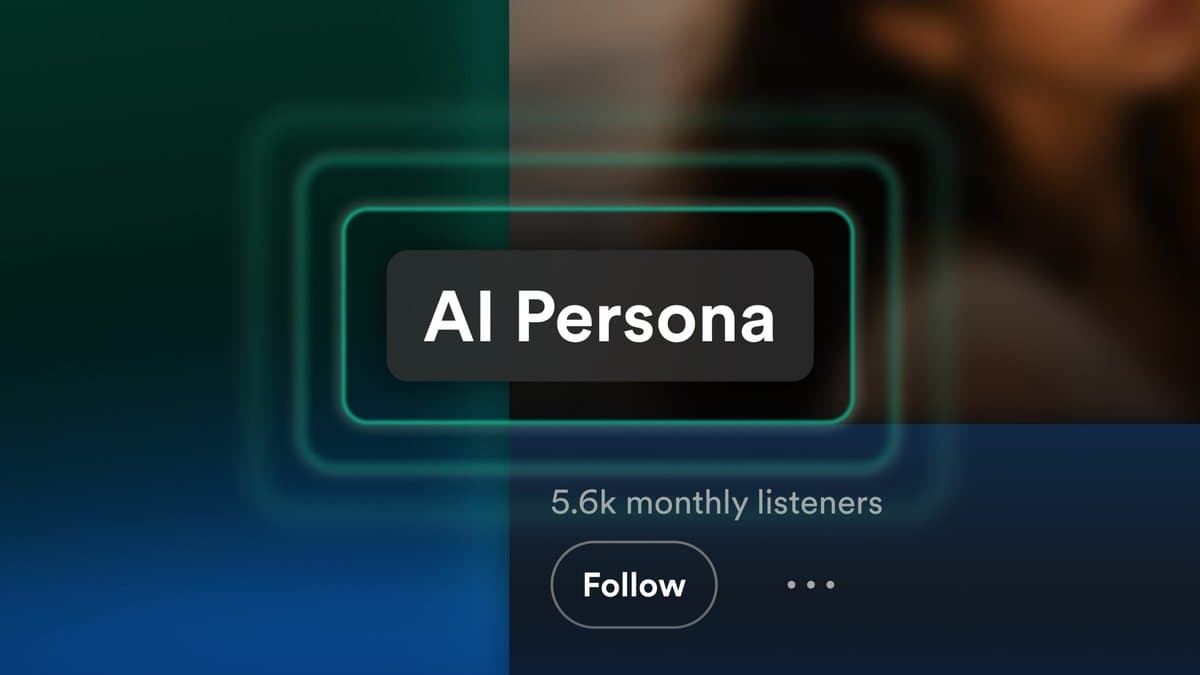
On August 11, Spotify announced the "AI Persona" badge — a label indicating that an artist's identity may be AI-generated and does not represent a real person.
The label itself is predictable. The next sentence isn't. Badged profiles are excluded from editorial and algorithmic recommendations by default. The only exception is listeners who have actively followed them.
On a streaming service, being out of recommendations means being effectively undiscoverable. Most Spotify listening doesn't come from users searching — it comes from playlists and recommendations. The badge is disclosure; the recommendation exclusion is an economic measure.
And before anything else, here's the most misread part of the policy: this is not a label on AI-made music.
What It Attaches To, and What It Doesn't
Spotify is clear about this. The AI Persona badge is a marker on artist identity — specifically, photorealistic AI-generated identities presented as artist personas.
How the music was made is unrelated to the badge. A musician who uses AI tools in songwriting, mixing, or visual design does not automatically become an AI Persona. That information is handled by two separate mechanisms: AI Credits and SongDNA.
This distinction matters because using no AI in music production is now the rarer case. Mastering, stem separation, noise removal, lyric ideation — AI is in all of it. Label all of that and the label stops meaning anything. The line Spotify drew isn't about process. It's about whether you're presenting as a person you aren't.
How the Label Works
| Item | Detail |
|---|---|
| Announced | August 11, 2026 |
| Badge appears | Mid-September 2026 |
| Placement | Artist profile banners and About sections, search results, playlist track rows |
| Tapping the badge | Shows whether it was self-disclosed or determined by Spotify's review team |
| Self-disclosure | Available in Spotify for Artists starting August 11 |
| Review scope | Profiles meeting defined audience thresholds |
| Appeals | Notified artists may self-disclose or appeal |
| Recommendations | Excluded by default from editorial and algorithmic surfaces (unless followed) |
| Listener reporting | Coming in the following months |
| Related policies | Verified by Spotify, Artist Profile Protection, AI Credits, SongDNA |
The most operationally interesting row is that tapping the badge reveals its provenance. Same badge, two origins, and users can see which. Self-declared and caught are distinguishable — which gives artists a real incentive to disclose first.
Spotify's explicit refusal to rely on self-disclosure matters too. The announcement puts it this way: "We hope artists will be transparent, so we are giving them the opportunity to disclose, but we won't rely on self-disclosure alone." A review team assesses whether an artist's name, identity, or images appear to be the product of generative AI and applies the label directly.
Worth flagging, though, that review is scoped to profiles above defined audience thresholds. Not every profile gets examined. Small AI Personas will likely stay unlabeled for a while, and the listener reporting feature arriving in a few months reads as an attempt to close that gap.
What Each Side Gets
Spotify gets trust and time. A flood of AI-generated tracks creates two problems: it dilutes the royalty pool for human artists, and it makes users start wondering whether anything on the service is real. The second is the dangerous one — once catalog trust erodes, the reason to keep subscribing goes with it. This policy is the compromise that protects that trust without banning AI music.
Human artists get recommendation real estate. Recommendation slots are a finite resource, and every slot an AI Persona takes is exposure a human artist doesn't get. Default exclusion hands some of that competition back.
Creators who make music with AI split into two groups. If you perform under your own name and face while using AI tools, this policy isn't about you. If you've built a fictional persona and run it as though it were a real artist, this lands directly. The clarity of that split is the policy's strength — and also where the argument will be.
Labels and distributors get predictability. When the rules for what gets pulled from recommendations are published, you can plan around them. An unfavorable rule beats no rule.
Listeners get information, though of a limited kind. The badge only tells you the artist persona may be AI. It says nothing about how the music was made. Miss that difference and you'll read unbadged tracks as "made without AI," which isn't what the badge means.
Precedents for Platforms Labeling Content
Platform labeling isn't new, and it hasn't always worked.
The successes attached material consequences to the label. Label something and leave distribution untouched and nobody cares — sometimes the label even gets consumed as a genre tag and neutralizes itself. Spotify pairing the badge with recommendation exclusion looks like that lesson applied.
The failures fall into two patterns. First, opaque adjudication. If nobody can explain why this account got labeled and that one didn't, the creator community stops trusting you. Spotify building in an appeals path and showing badge provenance suggests awareness of this risk.
Second, circumvention. When a label carries economic cost, evasion follows: mixing human photos into an AI persona, or fronting a real person while running generated content behind them. And if adjudication leans substantially on whether a name, identity, or image "appears to be the product of generative AI," it gets harder as image quality improves. That's a fight Spotify will be having continuously.
Third, the threshold itself is a gap. If review only covers profiles above an audience bar, the strategy becomes running many small profiles below it. That's presumably why listener reporting is on the roadmap.
Suno Cleaned Up the Other End the Same Week
One day after this announcement, on August 12, Suno announced a global licensing alliance with BMG in which only music whose artists individually opt in can be used for training and generation.
Line the two up and you can see the rules for AI music being written from both ends simultaneously. Suno's deal governs inputs — which music can be material, decided by rightsholder consent. Spotify's policy governs outputs — making sure what gets generated can't pass as human at the distribution layer, and pulling it from recommendations.
If that combination holds, the AI music market splits into two tiers: built on licensed data and disclosed as AI, versus not. The first tier gets a narrow but legitimate place. The second gets pushed out of distribution.
Rival platforms are the next thing to watch. If Apple Music, YouTube Music, and Amazon Music adopt equivalent measures, this becomes an industry standard. If they don't, AI Persona content migrates there. YouTube already has generated-content disclosure policy, so extension looks straightforward; Apple, with its heavier curation, may approach it differently.
AI music services have an obvious counterplay: build the licensing and disclosure apparatus so outputs from their tools don't get penalized downstream. Suno's expanding label deals are exactly that.
One large question remains open: is an AI persona actually bad? Virtual idols and character-driven music projects predate AI entirely. This policy could sweep those into recommendation exclusion too, and Spotify hasn't published enough detail about where that boundary sits.
So What Actually Changes
For artists, there's something to check. If your profile imagery or artist identity could plausibly read as AI-generated, get ahead of it rather than waiting for a review determination. The badge distinguishes self-disclosure from adjudication, so the order you do this in matters.
For anyone running a virtual AI artist, it's time to revisit the business model. Out of recommendations means new-listener acquisition is effectively shut. Without an existing follower base, the growth path is gone.
For music marketers and distribution teams, mid-September is an operational date. Audit whether any artists in your roster could be labeled, and whether playlist pitching plans need adjusting, before then.
For listeners, learn to read the badge precisely. No badge does not mean no AI. The badge only indicates that the artist may not be a real person; production information lives in AI Credits and SongDNA.
For music businesses generally, there's a reusable frame here: connect labeling to distribution policy. The premise of this policy is that disclosure without distribution consequences does nothing, and that principle transfers to any platform considering something similar.
🥄 Three Things You're Probably Wondering
— If I make a track with AI tools, do I get labeled? No. The badge marks artist identity, not production method. Use AI for composition, mixing, or visual design and perform as yourself, and you're not in scope. Production details are handled separately by AI Credits and SongDNA.
— Does a label mean removal? No — not removed, not blocked. It still appears in search, and followers still get recommended it. It's just excluded from editorial and algorithmic recommendations by default, which in practice narrows the path for new listeners to find it.
— What if it's applied wrongly? You're notified and can either self-disclose or appeal, and tapping the badge shows whether it came from self-disclosure or the review team. The detailed adjudication criteria haven't been fully published, though, so how well the appeals process actually works won't be clear until after September.
References
- Introducing a New Label for AI-Generated Artist Identities on Spotify (Spotify Newsroom, 2026-08-11) — The primary source, and where nearly everything here comes from: the badge definition and scope, placement across profiles, search, and playlist track rows, the self-disclosure versus review-team distinction shown on tap, the "we won't rely on self-disclosure alone" line, the default recommendation exclusion, the mid-September start, the planned listener reporting feature, and the division of labor with AI Credits and SongDNA.
- Spotify will label 'AI Persona' profiles and exclude their music from recommendations (TechCrunch, 2026-08-11) — Coverage centered on the practical effect of the recommendation exclusion.
- Spotify will now label AI creators posing as human artists (NPR, 2026-08-13) — Source for the enforcement mechanics — the review team assessing whether names, identities, or images appear generative — and the appeals path.
- Spotify Strikes Back Against AI Artists With 'AI Persona' Label (Variety, 2026-08-11) — Reads the policy inside the broader tension between the music industry and AI artists.
- Suno inks global licensing deal with BMG (Music Business Worldwide, 2026-08-12) — The same-week counterpart governing the input side, and the source for the artist opt-in structure covering both training and outputs.
Numbers and criteria are as of announcement and may change.