A Domestic Model Is Handling Tens of Millions of Searches a Day
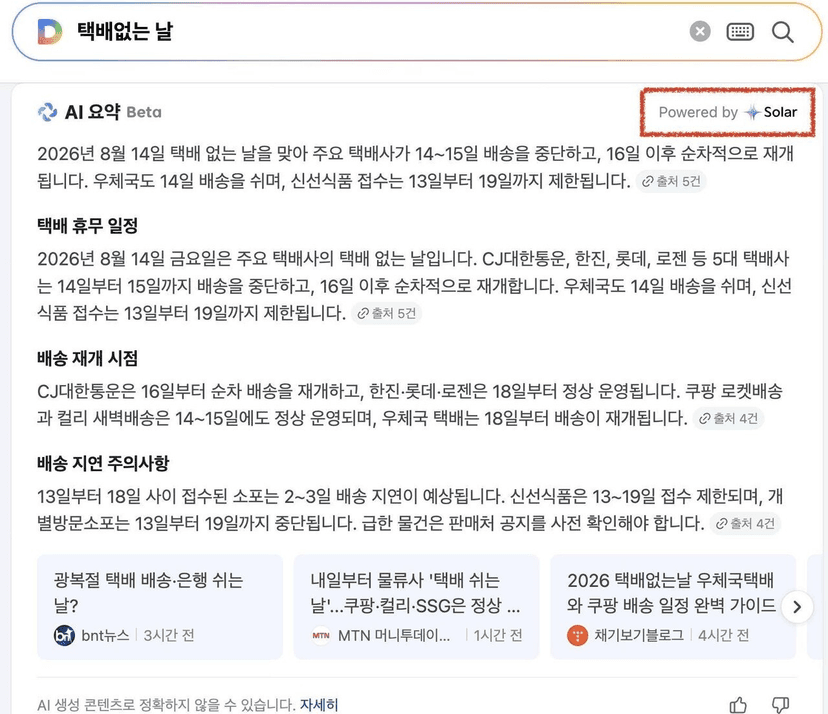
Here's the deal: on August 17, Upstage CEO Sung Kim said this — "The AI summaries provided in Daum search are now generated 100% by Solar large language models."
Short sentence, heavy contents. A Korean-built foundation model is handling all of a commercial search product's AI output — not a pilot, not a demo, but a service that processes tens of millions of queries a day. Most Korean AI announcements to date have stopped at "we launched it" or "we beat this benchmark." This is a different kind of claim.
The numbers sharpen it. As of July 15, Solar handles roughly 20% of all Daum searches — one in five queries gets an AI-generated summary. Reaching that took about seven months. Naver's "AI Briefing" needed eight to nine months to hit the same mark.
How This Combination Came Together
Upstage is a Korean AI startup founded in 2020. Sung Kim was a professor at HKUST and headed Clova AI at Naver before founding it. Its flagship products are the in-house Solar language model family and a document-processing engine. Solar was positioned from the start as "small but actually usable in production" — instead of going head-to-head with frontier labs on scale, it competes on cost-performance in Korean and specific tasks. Upstage recently used Solar Pro 4 to publish a free full translation of Homer's Odyssey — demonstrating capability through output rather than eval scores.
Daum once split the Korean portal market with Naver. Its search share has fallen far since, but it retains meaningful traffic and assets in news and communities. Per AI Times, this AI summary feature is the first serious deployment of Solar after Upstage acquired Daum's operator.
What makes this pairing interesting is that a model company now owns a service. Normally the model company sells an API and someone else builds the product — which means the model company never sees real usage and the product company can't change the model. Upstage holds both ends, so the loop closes. It can see exactly which queries produce bad summaries and feed that back into training.
The timeline: Daum's AI summary launched in December 2025. A Solar-based beta went public on July 1, 2026, covering six everyday domains — trending issues, finance, entertainment, health, dictionary and daily life. Full deployment was confirmed in August.
By the Numbers
| Item | Detail |
|---|---|
| Model | Solar (Solar-31B) |
| Share of Daum AI summaries | 100% |
| Share of all searches | ~20% (as of July 15) |
| Time to 20% | ~7 months |
| Naver AI Briefing comparison | 8–9 months |
| Initial launch | December 2025 |
| Solar-based transition | July 2026 |
| AI Mode | Due by end of 2026 |
How should you read 20%? It's also a proxy for the share of queries where a summary is worth generating at all. Navigational searches — "go to this site," "find this address" — don't need one. Restricted to informational queries, coverage is considerably higher.
Over the same period Upstage also moved the model itself. Solar Pro 4, released in August, scored 42 on the Artificial Analysis Intelligence Index — a large jump from Solar Pro 3's 14. It carries a 524K-token context window and supports Korean, English and Japanese along with tool calling and structured output.
Pricing is aggressive: $0.30 per million input tokens and $1.20 output, with a 90% launch discount ($0.03/$0.12) running through September 10. It became the first Korean model formally listed on OpenRouter, and Kim said cumulative token consumption passed 100 billion within three days of listing.
For context, frontier flagship models typically run several dollars per million input tokens. Solar Pro 4's list price is already far below that, and the discounted rate is close to free. The strategy is explicit — accept lower ceiling performance, win by one or two orders of magnitude on price. For workloads like search summarization, where call volume is enormous and task difficulty is moderate, that trade genuinely works.
The OpenRouter listing matters on its own. Korean models have historically been available only through domestic clouds or vendor consoles, which means developers comparing options never even see them. On OpenRouter you call it with the same code as anything else. 100 billion tokens in three days is what happens when that barrier disappears.
What Building Search Summaries Actually Requires
"AI summary" sounds simple. Attaching one to search is a different problem from building a chatbot, because three constraints bind simultaneously.
Speed. Search results need to appear within a second. Push a user to two seconds and abandonment measurably rises. But an LLM generates token by token, which is inherently slow. So you use a small model, cap summary length, or precompute aggressively. Choosing Solar-31B is a decision that falls out of this constraint — a several-hundred-billion-parameter model in front of search is unaffordable in both latency and cost.
Cost. Search earns almost nothing per query; a small slice of ad-clicked searches subsidizes everything else. Adding an LLM call rewrites that math. Covering 20% of searches also means deliberately not covering 80% — and deciding which queries deserve a summary is itself the engineering.
Accuracy. When a chatbot is wrong, the person can push back. When a search summary is wrong, it gets consumed as fact. That was exactly Google AI Overviews' early problem. So search summaries aren't free-form generation — they're grounded extraction constrained to the retrieved documents. Daum's implementation states it provides the summary alongside its supporting evidence.
Put those three together and the pull toward a domestic model becomes legible. Controlling latency and cost means tuning the model and keeping the infrastructure close. A foreign API gives you neither.
What Each Side Gets
Upstage gets proof of use. This is what Korean AI companies have most lacked. Models shipped, but nothing ran at scale, so performance had to be argued through benchmarks. Owning Daum produces a different sentence: "a model processing tens of millions of queries daily." That travels much further in overseas sales and fundraising than an eval score.
Daum gets a differentiator. It has been losing the search share fight for years. New interfaces like AI summaries reset the board somewhat, and outpacing Naver's ramp is a real result.
Korea's AI ecosystem gets a precedent. "Domestic models aren't production-ready" has been a durable assumption. A national consumer service running 100% on one undermines it, and it will get cited in public-sector procurement debates.
Users get an ambiguous deal. Summary quality is theirs to judge, and which model sits behind it was never their concern. But the click-through problem applies here as everywhere: summaries reduce traffic to source sites. Domestic or not, the structure is identical.
Government and public sector get a policy datapoint. Sovereign AI — running models and infrastructure domestically — has been debated for years with thin evidence. A July announcement had Upstage, Daum and FuriosaAI commercializing a Korean full-stack sovereign AI setup, and this rollout extends it. Model, service and silicon sourced domestically, actually running.
Other Attempts to Put AI Into Search
Google AI Overviews is the biggest case. Putting an AI summary atop results drew serious criticism early for factual errors, and Google expanded it anyway — now adding AI Mode for complex and follow-up questions. It is working: in July, Google's app passed Naver in Korean monthly active users for the first time, with rising Gemini usage cited as a main driver.
Naver AI Briefing is the domestic precedent. It started earlier and took eight to nine months to reach 20%. Naver runs its own HyperCLOVA X, so alongside Daum, Korea now has two portals running AI search on two different domestic models. That's an unusual configuration globally — in most countries search is Google, and the summary is Google's model too.
Bing and Copilot teach the opposite lesson. Microsoft expected bolting ChatGPT onto search to move share meaningfully. It barely did. Search habits are stickier than assumed, and AI features alone don't relocate people — search is a fight over defaults, and whoever sits inside the browser and OS has structural advantage.
Taken together, AI summaries look less like a customer acquisition weapon and more like a retention defense. Daum ramping coverage fast is a good result; whether it converts into share recovery is a separate question.
The Competitive Board
Naver is the direct competitor, still expanding AI Briefing and still the strongest combination of in-house model and proprietary data in Korea. Losing MAU leadership to Google raises the pressure considerably.
Google is the one actually taking share. Gemini's Korean MAU hit 9.47 million in July, second only to ChatGPT's 23.67 million. As long as AI Overviews and AI Mode keep deepening inside search, that trend likely continues.
Korean services built on foreign models are the other comparison. On raw capability, wiring up GPT or Claude may win. Upstage's counterargument is cost, latency and data residency — and Solar Pro 4's pricing exists to reinforce it.
Other Korean foundation model efforts should take note. LG, SK, Naver and several startups have all shipped models; almost none secured large-scale real usage. This case makes the requirement explicit: own a service or attach to a large one. Models that aren't used don't generate the data that improves them, and Upstage just secured the entrance to that loop.
So What Actually Changes
For developers, there's a new option. Solar Pro 4 is on OpenRouter, so you can call and compare it like any other model. If your pipeline is Korean-heavy and cost-sensitive, it's worth benchmarking directly — and the discount through September 10 makes testing cheap. The 524K context also puts it in play for long-document work.
For Korean enterprise IT, there's now an answer to "has a domestic model ever run a large-scale service?" For domains where cross-border data transfer is a problem, this is a concrete reference.
For content producers, a caution. Summaries on 20% of Daum searches means correspondingly fewer clicks reaching source pages. Publisher traffic declines after Google AI Overviews are well documented, and the same pattern is likely here. Structuring writing to be quotable in summaries — clear headings, unambiguous factual sentences — is worth considering now.
For investors, the metrics are clear: how much further coverage climbs past 20%, whether the year-end AI Mode actually raises time on site, and whether Solar Pro 4's OpenRouter usage persists or was a launch spike. The third matters most — usage holding after the September 10 discount ends would mean it was chosen on merit, not price.
For everyday users, the change already landed. The summary at the top of your Daum results was written by a Korean model. Summaries can still be wrong regardless of provenance, so checking the source for anything that matters remains the right habit.
🥄 Three Things You're Probably Wondering
— What exactly does "100%" mean here? Every AI summary attached to Daum search is generated by Solar. It doesn't mean all of Daum search runs through AI. About 20% of searches get a summary; within that 20%, Solar does all of it.
— Does a domestic model mean worse quality? Solar Pro 4 scores 42 on the Artificial Analysis index, below frontier models. But search summarization rewards accurate extraction, speed and cost far more than deep reasoning. This looks like picking the right model for the job rather than settling.
— Will Daum's search share go up? Too early. Ramping AI coverage quickly is real, but search share is driven by habit and brand — Bing bolted on ChatGPT and barely moved. The year-end AI Mode response is the thing to watch. That said, with Google shaking up the Korean search market, there's more room for movement than there was when the board was frozen.
References
- Upstage's Solar now powers 100% of Daum's AI search summaries (AI Times, 2026-08-17) — Source for Kim's "100% Solar" statement, the 20%-of-all-searches figure, the comparison against Naver's ramp, and the year-end AI Mode plan.
- Upstage launches AI summary beta on Daum (AI Times, 2026-07-01) — The July beta announcement, the six initial domains, and background on the Daum operator acquisition.
- Solar Pro 4 (Upstage official blog) — Primary source for model specs, benchmarks, the 524K context window and pricing.
- Solar Pro 4 model page (OpenRouter) — Live API pricing and provider details; direct confirmation of the first Korean model listed there.
- Upstage integrates Solar into Daum with a ₩560B upgrade program (THE ELEC) — Industry-trade coverage of the investment scale behind the Daum integration.
- Upstage unveils new AI model Solar Pro 4 (Seoul Economic Daily, 2026-08-14) — English-language confirmation of the Solar Pro 4 release and its OpenRouter and Hermes Agent listings.
Numbers and criteria are as of announcement and may change.