One Prompt In, Real Molecules Out
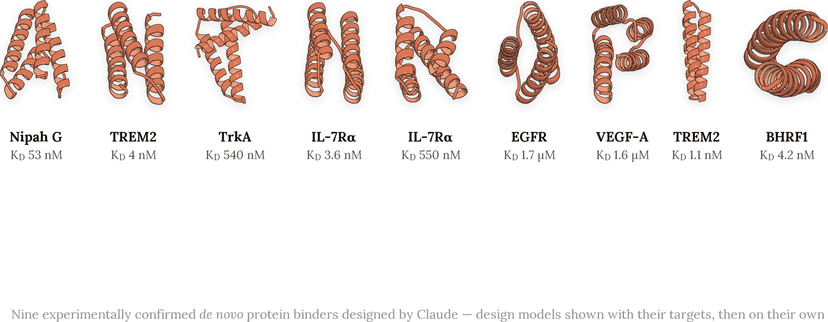
Here's the deal: on August 18, Anthropic published research showing that given only a human-written prompt, Claude designed novel protein binders that actually stuck to their targets in a physical laboratory.
The numbers first. Fourteen of fifteen targets hit. 1,320 designs submitted, 354 confirmed binders. Hit rates of 22.6-26.7% in multi-target mode and 35.1% in single-target mode, against a field norm of roughly 10-15%. Call it double the usual.
The interesting part isn't "AI designed a protein." That story has run continuously since AlphaFold in 2021. The interesting part is who directed the design. The conventional workflow has a human scientist assemble the pipeline: run a structure predictor, run a sequence designer, run filtering tools in order, then pick winners. Here the language model did the directing — selecting tools, ordering them, reading intermediate results, and changing course.
And Anthropic didn't grade its own homework. Adaptyv Bio, which runs an automated wet lab, and Twist Bioscience, which synthesizes DNA, built the proteins and measured them. The designs arrived anonymized.
The Cast: Anthropic, Adaptyv Bio, Twist, and Three Claudes
Anthropic used three models. The primary was Mythos Preview, paired with Opus 4.8, with Opus 5 used only for analytical chemistry tasks. Everything ran through Claude Science, with all designs prompted similarly and given access to the same publicly available tools — a necessary control if you want the model-to-model comparison to mean anything.
Adaptyv Bio is the scorekeeper. The company takes digital protein sequences, turns them into physical proteins, measures whether they bind, and returns the data. Automated workcells do the work instead of hands, which makes it dramatically faster and cheaper than traditional characterization. Sequences come in via a web platform and an API. Think of it as a CI server for protein design. The target sets Adaptyv accumulated through its public design competitions, hackathons, and BenchBB became this benchmark's baseline.
Twist Bioscience handled synthetic DNA — turning designed sequences into actual genes.
How the targets were chosen matters. All sixteen came from Adaptyv's existing public competitions, hackathons, and BenchBB rather than being freshly minted. That means comparison data exists: human teams have already posted scores against these same targets. That's why it's possible to say Claude hit 40% on RBX1 where the competition average was 3.7%.
Proteinbase rounds out the cast. Adaptyv and Anthropic released the actual sequences Claude designed along with the experimental data on that open protein data platform. Publishing verifiable artifacts rather than just claims is the single strongest credibility signal in this announcement.
Reading the Results
| Metric | Value |
|---|---|
| Targets | 15 (14 successful) |
| Total designs | 1,320 |
| Confirmed binders | 354 |
| Hit rate (multi-target mode) | 22.6-26.7% |
| Hit rate (single-target mode) | 35.1% |
| Industry norm | 10-15% |
| Targets with high-affinity binders | at least 6 |
| Targets matching/beating best published affinity | at least 4 |
| RBX1 hit rate | 40% (competition average 3.7%) |
The last two rows carry the most weight.
"Matched or exceeded the best published experimental affinity" means the model reached or beat the best result humans have put in a paper for those targets. Hit rate and peak performance are different claims. A high hit rate can be explained by volume — throw enough designs and some stick. Best-in-class affinity cannot. Hitting that bar on four targets is a signal that this isn't just a numbers game.
The 40% vs 3.7% on RBX1 deserves care. A competition average includes participants across a wide skill range, so it does not mean Claude is ten times better than the best human. What it does establish is that this target was genuinely hard for people.
Quick terminology, since it clarifies the rest: a binder is a small protein engineered to stick to a specific target — cutting a new key for an existing lock. Antibodies are nature's version; de novo design builds shapes nature never made. Hit rate is the fraction of submitted designs that actually bind. Affinity is how tightly they bind. Hit rate answers "how many work," affinity answers "how well."
Two more results stand out. On the TNFα target, Claude produced cross-reactive binders that bind human, monkey, and mouse variants. That property is commercially valuable in a way that's easy to miss: it means the same molecule can carry through preclinical animal studies and into human trials. Normally you build species-specific versions, which costs time and money.
And across six targets, fifteen binders containing β-sheet structure came through. This is notable because existing de novo design tools overwhelmingly favor α-helical architectures — helices fold predictably and models handle them well. Working β-sheet designs suggest the model produced results outside the field's comfort zone.
Who Gets What
Anthropic gains on two fronts. One is scientific reference value: following its Riemann zeta function work on August 14, this reinforces the position that Claude is a research instrument, not a coding assistant. The other is more concrete — an enterprise bio pipeline. Pharma and biotech are among the least price-sensitive AI customers alive. When one failed drug candidate costs hundreds of millions, API spend is a rounding error.
Adaptyv Bio effectively locked in the role of neutral scorekeeper. AI-designed proteins need third-party evaluation, and very few organizations expose an automated wet lab through an API. Future claims from other labs will now attract the question: did you run it through Adaptyv?
Pharma and biotech face a more complicated calculation. On the surface it's good news — compressing binder design compresses the front of the pipeline. But when a step gets cheap, companies that differentiated on that step lose their moat. Startups whose core pitch is de novo binder design need to redraw their positioning.
And the constraint Anthropic disclosed itself inverts the whole picture. In its own words: life science research tasks are currently blocked in its most capable model, and launching an access program for scientists is one of the company's highest priorities. Protein design capability remains unavailable for general access in Claude Fable 5 on dual-use bioweapon grounds.
So the announcement's actual structure is: our model can do this, and we are not letting you do this. Capability demonstration and access restriction in a single document — a posture Anthropic has held consistently.
Precedents: How AI Science Announcements Age
AlphaFold2 (2020-2021) is the bright case. It effectively solved a 50-year-old problem in structure prediction, released a full structure database, and became standard lab equipment. Its success conditions were clear: an established blind evaluation existed (CASP), the output was immediately useful, and distribution was wide. Anthropic's work firmly satisfies the first condition through external wet-lab validation. On the third, it runs the opposite direction.
RFdiffusion and ProteinMPNN (2022-2023) are the previous generation of de novo design. Both came out of David Baker's lab at the University of Washington, both open source, both now field standards. The "publicly available tools" Claude used in this study are very likely dominated by that lineage. Which reframes the result: this looks less like a new algorithm winning and more like orchestration winning. That is not a lesser achievement. The genuine bottleneck in this field has been that good tools exist and skilled operators are scarce.
The counterexamples matter too. Through 2023 a string of companies announced AI-discovered drug candidates; very few produced strong clinical results. There's a long distance between a protein that binds and a molecule that becomes medicine — toxicity, stability, manufacturability, immunogenicity, pharmacokinetics. This study measured the first gate. Translating it into "AI is making drugs" skips several.
IBM Watson Health is worth remembering as the failure mode. The biggest early medical-AI collapse failed not on technology but on verifiability: many performance claims, little externally reproducible data. Against that, publishing sequences and experimental data on Proteinbase is precisely the right move. What other groups find in that dataset six months from now is the real report card.
Competitor Counterplay
Google DeepMind originated this space. Beyond the AlphaFold line it runs Isomorphic Labs as a drug-discovery subsidiary with existing pharma agreements. Anthropic's bet is "a general model directs the pipeline"; DeepMind's is "specialized models solve each step." Neither has won, and the genuinely interesting configuration — a general model calling DeepMind's specialized models as tools — requires cooperation neither company has signaled.
OpenAI has been comparatively quiet on this axis. It has published science work, but no wet-lab-validated bio results. And with its own frontier training currently paused over cyber capability concerns, it has little room to push aggressively into an axis with even heavier dual-use exposure.
Baker Lab and academia run a different calculation. If Claude's results ride on their tools, the ecosystem's value just got demonstrated. At the same time, "the model directs better than people do" redefines what an academic researcher's day looks like. In practice, researchers in this field already use LLMs for pipeline orchestration, so this reads more as confirmation than disruption.
Biotech startups will split two ways. Some move down the stack — synthesis, validation, screening, the physical steps. As design gets cheap, the validation bottleneck grows, which raises the value of an Adaptyv-shaped position. Others move up — target discovery, trial design, regulatory strategy. Being stuck in the middle is the dangerous place.
What Actually Changes for You
If you're a life science researcher: you can't use this yet, and that's the most disappointing part of the announcement. Anthropic explicitly blocks life science tasks in its most capable model, and the scientist access program is still in preparation. What you can do now is read the sequences and experimental data on Proteinbase directly — and decide which of your lab's targets you'd submit first when the program opens.
If you work on AI infrastructure or platforms: there's a transferable pattern here. The model didn't invent an algorithm. It composed existing tools to fit the situation and rerouted based on intermediate results. That pattern generalizes to any domain with strong specialized tools and a shortage of people who can wire them together — chip design verification, materials search, clinical trial design all qualify.
If you invest in pharma or biotech: one diligence question changed. It used to be "what's special about your design algorithm?" It's now "how much better is this than a general model with public tools?" A 27% hit rate is the new floor, and proprietary tech that can't clear it is hard to price.
If you work in biosecurity: the shadow side is the main story. A system where a single prompt yields target-binding proteins is dual-use by construction. That's why Anthropic locked the capability out of its top model, and why agentic bio-capability benchmarks like ABC-Bench on arXiv exist at all. The problem is that this control only works when the controlling party volunteers. If open-weight models reach comparable capability, there's nothing to lock.
If you're just following along: don't read this as "AI made a drug." What was made is a protein that binds a specific target, and turning that into medicine involves years and repeated failure. What is real is that the first step compressed from months to weeks.
🥄 Three Things You're Probably Wondering
— So what does this mean for me? Directly, not much. The capability is gated today, and when it opens it'll be for research. What it signals is more interesting: AI moving into domains scored by experimental data rather than benchmark numbers. Being graded by a test tube instead of a leaderboard is what separates this from most model announcements.
— Is 27% actually good? By this field's standards, yes. The norm is 10-15%, so it's nearly double, and matching best-published affinity on four targets carries real weight. The caveat is that all sixteen targets came from Adaptyv's existing competition sets. Whether the same numbers hold on genuinely novel targets is unknown.
— Does this make protein design experts obsolete? Too early to say. The model directed tools that people built, against targets that people chose as meaningful, validated by people in a lab. What does shrink is the portion of the job spent hand-assembling pipelines — and for some roles that's a large portion.
References
- Anthropic — How Claude is accelerating protein design and analytical chemistry (2026-08-18, primary)
- Adaptyv Bio — Case study: Benchmarking Claude's protein designs in the wet lab
- The Decoder — Anthropic says any lab can now let a language model agent run the whole protein design stack
- Storyboard18 — Anthropic says Claude designed protein binders for 14 of 15 targets in lab test (2026-08-18)
- Anthropic Research — Claude and the Riemann zeta function
- arXiv — ABC-Bench: An Agentic Bio-Capabilities Benchmark for Biosecurity
Numbers and criteria are as of announcement and may change.