Kakao Didn't Pick a Bigger Model — It Picked Cheaper Inference
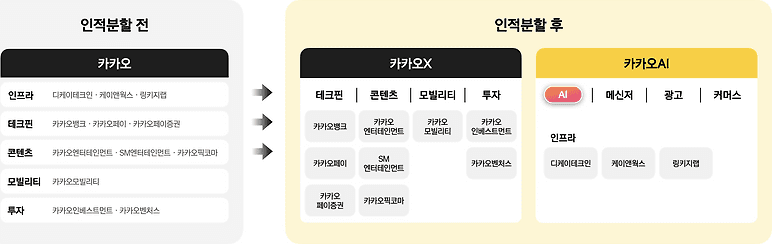
Here's the deal: on August 21, Kakao's board voted to cut the company in half. One half, called KakaoAI, walks away with KakaoTalk, the advertising business, commerce, and everything AI. The other half, KakaoX, keeps the stakes in Kakao Bank, Kakao Pay, Kakao Mobility, Kakao Entertainment and the rest. On the same day, CEO Shina Chung ran an online press briefing to explain what KakaoAI is actually for, and one line from that briefing is the real story: Kakao intends to cut inference costs by as much as 90%.
First, a correction to how this news has been circulating. Several summaries say Kakao "launched" a new AI subsidiary. It didn't. What happened on August 21 was a board resolution to split. An extraordinary shareholder meeting is set for December 17, the split takes effect January 1, 2027, and relisting is targeted for January 27, 2027. So what we're looking at isn't a company — it's a blueprint. And the blueprint is interesting because it deliberately walks away from the assumption Korea's AI industry has been running on for two years.
That assumption goes like this: to do Korean AI, you build your own foundation model and you build data centers. Naver is doing exactly that, teaming with Brookfield and NVIDIA on a roughly $10 billion plan for a 200MW AI factory at its Gak Sejong campus with something on the order of 100,000 GPUs. SK Telecom and LG AI Research are each running 1,000 B200s supplied through the government's sovereign foundation model program. Everyone went bigger. Kakao never got on that track. More precisely, it tried and got cut, and from that position it chose a different road.
The road looks like this. Roughly half of user requests get handled on the phone itself by a lightweight model called Kanana Nano. Whatever goes to a server hits a routing layer Kakao calls the AI Conductor, which judges how hard the request is and picks the cheapest model that can answer it — Kakao's own or somebody else's. The goal isn't to top a benchmark. It's to produce the same answer for less money. And where does that cheap inference get deployed? Onto KakaoTalk, which had 49.63 million monthly active users in Korea as of Q2 2026. That's the hand Kakao is playing.
Four Characters — The Half That Leaves, The Half That Stays, And The Neighbor
The first is Shina Chung. She's Kakao's current CEO and has been named CEO-designate of KakaoAI. A former venture capitalist who took the top job in 2024, she has spent her tenure repeating one priority: make KakaoTalk grow again. What she takes with her in this split is clean — KakaoTalk, TalkBiz advertising, commerce, and the AI assets including the Kanana models and PlayMCP. She drops the burden of managing a hundred-plus affiliates and picks up a number instead: KRW 6 trillion in KakaoAI revenue by 2030.
The second is Kim Do-young, CEO of Kakao Investment and head of group investment strategy at the CA Council, named CEO-designate of KakaoX. KakaoX carries the fintech stack (Kakao Bank, Kakao Pay, Kakao Pay Securities), the content stack (Kakao Entertainment, SM Entertainment, Kakao Piccoma), and mobility (Kakao Mobility). The official framing is "finding and raising the next Kakao Bank." The honest framing is that it's close to an investment holding company. Its 2030 revenue target is KRW 10 trillion or more, at a 13.3% compound annual growth rate.
The third character isn't a person. It's a ratio: 0.36 to 0.64. Based on net asset book value, KakaoAI takes 0.36 and KakaoX takes 0.64. This matters because it's a horizontal spin-off, which in Korean corporate practice means existing shareholders receive shares in both companies at that ratio rather than watching a subsidiary get carved out from under them. That distinction is going to come up again when we talk about Kakao Pay in 2021.
The fourth is the neighbor, Naver. You can't read this announcement without knowing where Naver currently stands. Naver Cloud was eliminated in the first round of Korea's sovereign foundation model program. Its HyperCLOVA X Seed 32B model was found to have borrowed weights from Alibaba's Qwen, with a vision encoder showing 99.51% cosine similarity — which failed the program's originality bar. Then, when applications for the follow-on "AI for All" program closed on August 18, Naver declined to enter, saying it would focus on existing work. Naver's counter-bet is infrastructure: the NVIDIA and Brookfield AI factory, plus HyperCLOVA X upgrades built by fine-tuning NVIDIA's Nemotron 3 Ultra open model.
So the tidy framing of "Kakao doesn't build models, Naver does" isn't accurate right now. Both are mixing in external open models. Neither made the government's elite team. The real difference is where the money goes: Naver into GPUs and megawatts, Kakao into an architecture designed to touch as few GPUs as possible.
What Was Actually Announced
The August 21 package has three parts: the corporate restructuring, the low-cost AI architecture, and the agent ecosystem. We covered the restructuring, so start with the architecture. When Kakao says "full-stack AI," it does not mean what NVIDIA or OpenAI mean by it. Kakao means optimizing across infrastructure, model, platform and service — not owning all of it. What Kakao actually owns outright is the Kanana model family, KakaoTalk as an interface, and PlayMCP as the connective layer.
The load-bearing assumption is that on-device handling covers about 50% of requests. Summarizing a thread, cleaning up a message, sorting notifications, organizing a schedule — none of that needs a server GPU. If the assumption holds, server costs stop scaling linearly with users. If it doesn't hold, meaning people start asking KakaoTalk genuinely hard questions, the cost curve looks exactly like everyone else's. Digital Daily, reporting industry reaction the same day, landed on precisely this: scalability and cost reduction are the test.
On the agent ecosystem, there's another correction worth making. PlayMCP and PlayTools are not new. PlayMCP opened in beta in August 2025 as Korea's first MCP-based open platform. PlayTools, the marketplace layer, was added in November 2025. In May 2026, Kakao added support for the open-source agent OpenClaw, and roughly 200 external MCP servers are registered. The August announcement isn't a product launch — it's a declaration that this year-old platform is now a core asset of the new entity.
Same goes for the Coupang Eats partnership. That wasn't August 21. It came out on August 6, on the Q2 earnings call, where Chung said food delivery would be the first vertical for Kakao's agentic AI and named Coupang Eats as the partner. The flow: someone mentions wanting cold noodles in a KakaoTalk chat, the on-device model reads the context plus accumulated preferences, suggests a dish and a restaurant, and carries it through ordering and payment without leaving the chat window. Commerce, reservations, travel and payments are the stated next verticals.
| Item | KakaoAI (new entity) | KakaoX (surviving entity) |
|---|---|---|
| CEO-designate | Shina Chung (current Kakao CEO) | Kim Do-young (CEO, Kakao Investment) |
| Split ratio (net asset book value) | 0.36 | 0.64 |
| Core business | KakaoTalk, AI, ads, commerce | Fintech, content, mobility |
| Key affiliates | DK Techin, K&Works | Kakao Bank, Pay, Mobility, Entertainment, SM, Piccoma |
| 2030 revenue target | KRW 6 trillion+ (about 20% CAGR) | KRW 10 trillion+ (13.3% CAGR) |
| Character | Operating company | Investment and incubation vehicle |
The dates and numbers in one place: extraordinary shareholder meeting December 17, 2026; split effective January 1, 2027; relisting January 27, 2027. On AI specifically, Kakao targets AI revenue reaching a double-digit share of total revenue by 2028, and by 2030 wants 20 million AI daily active users plus KRW 1 trillion or more in AI revenue. Note that the KRW 1 trillion sits inside the KRW 6 trillion total. Flip that around and it says that even in 2030, KRW 5 trillion of KakaoAI's revenue is still advertising and commerce — and AI's main job is to make that advertising and commerce convert better.
The financial base underneath isn't bad. Q2 2026 revenue was KRW 2.0985 trillion and operating profit KRW 277 billion, both quarterly records, at a 13% operating margin. TalkBiz brought in KRW 643.2 billion, up 12%, with ads and subscriptions at KRW 399.9 billion, business messaging up 20% and display advertising up 28%. Commerce gross merchandise value hit KRW 2.7 trillion. And ChatGPT for Kakao had roughly 13 million cumulative signups as of Q2, with users sending more than six messages a day on average and daily time spent approaching eight minutes by quarter-end. That curve went from 2 million a month after its November 2025 launch, to 8 million in February 2026, to 11 million in May.
Who Gets What Out Of This
Chung and KakaoAI get focus. Until now, Kakao's CEO had to grow KakaoTalk while simultaneously managing risk across a sprawling affiliate structure. After the split, KakaoAI looks at KakaoTalk, ads, commerce and AI, full stop. There's a capital-markets angle too. Kakao's current share price mashes affiliate stakes and the core business into one number that trades at a discount. Split them and you get a growth story on one side and a stake-holding vehicle on the other, each priced on its own terms. Whether the market actually agrees is something you find out after relisting.
OpenAI quietly wins big here. ChatGPT for Kakao already delivered 13 million signups — distribution OpenAI acquired in Korea without spending on marketing. If Kakao formalizes the routing strategy, hard queries keep flowing out to large external models, and a good share of those are going to OpenAI. Kakao calls it a partnership, and it is one, but it's the kind that can invert. If OpenAI pushes its own app hard in Korea, Kakao will have spent its channel growing a competitor's user base.
Coupang Eats gets an unexpected on-ramp in the delivery share war. The most expensive thing in a delivery app's economics is getting someone to open the app. If the order starts in a KakaoTalk conversation, Kakao is effectively paying that cost. For Baemin, the incumbent, this is urgent — a rival just got the national messenger as a funnel. The genuinely odd part is that Coupang and Kakao are direct competitors in commerce. Both sides being willing to sleep with the enemy tells you how pressed they each are.
Developers and startups building MCP servers get something concrete. Put a tool on PlayMCP and, in principle, it can be invoked inside a messenger with around 50 million users. Layer on the fact that Kakao was selected on August 6 as the operator for the Ministry of Science and ICT and NIA's AI Agent Marketplace program, running through December 2027 with a consortium partner in Kakao Enterprise at a combined public-private budget of about KRW 11 billion. That's not a lot of money. But winning the operator seat for a "private-sector-led open agent ecosystem," with government cover attached, is worth more than the budget line.
Existing shareholders get optionality more than immediate gain. Because it's a horizontal split, there's no dilution — you receive shares in both companies at 0.36 and 0.64 and can keep whichever you want. What nobody can promise is how the flows behave right after relisting, especially how steep a discount KakaoX takes as a stake-holding entity.
This Has Been Tried Before — One That Worked, One That Didn't
The success story people reach for is eBay and PayPal. When eBay spun off PayPal in 2015, the argument was that payments needed to grow at a different speed than a marketplace. Within a few years PayPal's market cap comfortably exceeded its former parent's. It proved the underlying logic: forcing two businesses with different growth rates and different capital needs into one company hurts both. KakaoAI and KakaoX are running the same argument. KakaoTalk AI needs aggressive reinvestment; Kakao Bank and Kakao Pay stakes need to be managed for regulation and dividends.
There's a second precedent that maps even more directly: Apple's on-device-plus-routing approach. In 2024 Apple announced Apple Intelligence, handling most requests with its own on-device model and passing hard ones to ChatGPT. Conceptually that's nearly identical to Kanana Nano plus AI Conductor. It did not go smoothly. The personalized Siri features slipped repeatedly, and the on-device model drew steady criticism for falling short of what users expected. If Apple — which owns the hardware, the chip and the operating system — struggled to ship this architecture, that tells you something honest about the execution difficulty Kakao is signing up for.
For the failure case, Kakao doesn't have to look outside its own history. 2021. Kakao took Kakao Pay and Kakao Bank public back to back, drawing heavy criticism in Korea for serially carving out and listing subsidiaries. Kakao Pay executives exercising large stock option grants immediately after listing is still cited as a reference case for destroyed shareholder trust in the Korean market, and the stock spent years failing to recover. That is exactly why Kakao's press release goes out of its way to note that this is a horizontal split, not a vertical carve-out. Existing holders get shares in both companies by design, precisely to avoid a repeat of 2021. A different structure, though, doesn't guarantee a different outcome.
One more worth flagging: HP's 2015 separation into HP Inc and HPE. The split itself was executed cleanly, and then both companies spent years in a growth funk. The lesson is blunt. A split can make existing growth easier to see. It cannot manufacture growth that isn't there. Whether KakaoAI has any comes down to one thing — whether AI makes money inside KakaoTalk.
How Naver And Google Punch Back
Naver's counter is infrastructure and B2B. Working with Brookfield and NVIDIA on a roughly $10 billion program, it plans a 200MW AI factory at Gak Sejong with on the order of 100,000 GPUs, with a first 55MW phase due to come online in the first half of 2027. If Kakao decided to use fewer GPUs, Naver decided to sell them. The picture is selling infrastructure and models together to governments, enterprises and other countries that want sovereign AI — a different ring entirely from the consumer AI market Kakao is chasing. Which is another way of saying these two companies are no longer playing the same game.
Naver's risks are just as visible. Eliminated in round one of the sovereign model program, absent from "AI for All," and upgrading HyperCLOVA X on top of an NVIDIA open model. Meanwhile there's a warning light in its home territory: per Mobile Index, the Google app reached 47.02 million Korean MAU in July against Naver's 46.84 million — the first time Google has led since the tally began in March 2021.
Google honestly has the easiest seat in the room. Between default Android placement, the Gemini app and Chrome integration, it already reaches Korean users without needing a distribution partner. The moment Kakao tries to make KakaoTalk into an OS-inside-an-app, Google can point out that it owns the actual OS underneath. That's the sharpest weakness in Kakao's plan. However strong KakaoTalk is, it runs on Android, and doing on-device inference means depending on handset makers and chipset vendors.
SK Telecom and LG AI Research cleared the second evaluation round on August 18 and are now in a three-way race with Upstage, each running 1,000 B200s to refine models through year-end before two finalists are picked in early 2027. If they take the government-certified "national champion model" title, Kakao has no seat in public sector, financial and defense markets where sovereignty requirements bite. Kakao's decision to enter the "AI for All" program that closed on August 18 reads as a response to exactly that. The rules require at least 50% weighting on the applicant's own Korean model and at least 30% on another domestic company's, which forces consortiums — and with Naver out, Kakao is angling to make that program a public exposure channel for Kanana.
Baemin's response is worth watching too. With Coupang Eats holding a KakaoTalk funnel, Baemin has to either sharpen its own AI recommendations or find a comparable platform partner. The catch is that Korea has exactly one channel at KakaoTalk's scale, and Kakao owns it.
So What Actually Changes
If you're a developer, the question to track is whether PlayMCP becomes a real distribution channel. Right now there are around 200 external MCP servers registered. If that becomes 2,000 and the KakaoTalk agent genuinely selects tools from that pool at runtime, it's a different situation entirely — closer to the early app store dynamic. If instead Kakao routes mostly to its own services (Gift, KakaoMap, Melon), it stays an internal API gateway with a marketplace label. The tell is simple: does a third-party-built tool get invoked in a real KakaoTalk conversation, and does Kakao show it? Growing external entry points, like the OpenClaw integration, count as a positive signal.
If you're an investor, three dates matter: December 17, January 1, and January 27. Between them, two indicators. First, whether AI services inside KakaoTalk reach the stated 10 million MAU target by year-end. Second, whether that 50% on-device assumption shows up as an actual cost-of-revenue improvement. The second one is the important one. Kakao has said meaningful monetization starts in 2027, so how AI costs land in Q1 and Q2 2027 results is the first real report card. For reference, the benchmarks the company set for itself are a double-digit AI revenue share by 2028 and KRW 1 trillion in AI revenue by 2030.
If you're a regular user, the visible change is finishing a food order without leaving a chat window. Convenient, sure, but worth thinking about. An on-device model reading conversational context and taste to make recommendations means your chat content is the raw material for those recommendations. Kakao's position is that processing on the device is better for privacy, which is a reasonable argument — but exactly what stays on the phone and what goes to a server is something you can only verify once the product ships. And the character of the experience changes again the moment ads enter the recommendation. Given that advertising is the backbone of KakaoAI's revenue target, that's a predictable direction, not a cynical guess.
If you're an enterprise practitioner, the procurement question may shift. Korean AI adoption debates have been about which model to use. What Kakao is pushing is which channel to attach to. If your company has customer service, reservation or ordering touchpoints, registering a tool on PlayMCP to get inside KakaoTalk becomes an alternative to building your own chatbot. The flip side is that it means outsourcing distribution to Kakao, which is worth being careful about until fee structures and ranking rules are published.
🥄 Three Things You're Probably Wondering
— So what does this mean for me? Nothing immediate. The split doesn't take effect until January 2027, and how you use KakaoTalk isn't changing before then. If you hold Kakao shares, the December 17 meeting and the relisting schedule are worth calendaring, and once food ordering opens inside chats you'll start to feel it.
— Why now? The surface answer is leverage: Kakao just posted record quarterly results and passed 13 million signups on ChatGPT for Kakao, so it's negotiating from strength. Underneath that sit two other facts — it missed the government's elite model teams, and Google just passed Naver in Korean app MAU for the first time. You could read it as rebuilding the board from a position where the big-model race was already lost. Which factor was decisive is too early to call.
— Isn't this just another holding-company carve-out? That suspicion is fair. The difference from 2021's Kakao Pay and Kakao Bank episode is that this is a horizontal split, so existing shareholders receive shares in both companies rather than getting diluted out of the good part. Structurally it's designed to avoid that fight. But nobody knows yet whether the two companies combined will be worth more after relisting than Kakao is today, and HP is a standing reminder that you can split cleanly and stall anyway.
References
- Kakao Newsroom — Kakao approves spin-off, two engines to drive growth in the AI era (2026-08-21)
- Kakao Newsroom — Q2 2026 results, revenue KRW 2.0985 trillion, operating profit KRW 277 billion (2026-08-06)
- Kakao Newsroom — KakaoTalk meets AI, the 'everyday AI' vision at if(kakao)25 (2025-09-23)
- Kakao Newsroom — Kakao selected to build the government AI Agent Marketplace (2026-08-06)
- Kakao Newsroom — PlayMCP adds support for the open-source AI agent OpenClaw (2026-05-01)
- Kakao Tech Blog — PlayMCP, building an MCP platform from zero
- Digital Daily — Kakao splits in two, doubles down on 'full-stack AI' (2026-08-21)
- ZDNet Korea — Kakao to split into two companies, KakaoAI and KakaoX (2026-08-21)
- ZDNet Korea — Kakao's first agentic AI vertical is Coupang Eats (2026-08-06)
- ETNews — KakaoTalk tops 55 million MAU for the first time (2026-08-10)
- ETNews — Upstage, LG AI Research and SKT advance to the final round of Korea's sovereign foundation model program (2026-08-18)
- Seoul Economic Daily — Naver sits out the 'AI for All' program; three telcos and Kakao join (2026-08-18)
Numbers and criteria are as of announcement and may change. Investment calls are yours to make!