1 Trillion Parameters — But Only 3% Activate Per Token
The headline number is attention-grabbing, but the real story is efficiency. DeepSeek V4 has 1 trillion total parameters, yet only 32-37 billion activate for any given token. That's 3% of the total. This is the power of MoE (Mixture-of-Experts) architecture — and understanding how it works is key to understanding why V4 matters.
Important caveat: As of March 19, 2026, V4 has not officially launched. "V4 Lite" was briefly exposed on March 9. Full release is expected in April 2026. Benchmark figures below are from internal leaks and have not been independently verified.
Background: What Is Mixture-of-Experts (MoE)?
In a standard transformer (like GPT-4 or Claude), every parameter participates in processing every token. A 70B-parameter model uses all 70B parameters for each input token. This is called a "dense" model.
MoE takes a different approach. Instead of one massive feed-forward network (FFN) in each transformer layer, MoE models have many smaller "expert" networks. A router (a small neural network) examines each token and selects which experts should process it.
Traditional Dense Model:
Token → [All Parameters] → Output

MoE Model:
Token → Router → [Expert 3, Expert 7, Expert 15] → Output
                 (selected from 128 experts)
                 (unused experts stay idle)
Why MoE Matters
The advantages are significant:
- Training efficiency: You can train a larger total model with the same compute budget, because each training step only updates selected experts
- Inference efficiency: Only active parameters need to be computed, so a 1T MoE model can run at the speed of a ~35B dense model
- Specialization: Different experts learn different domains (code, math, language, etc.), leading to better performance per parameter
The disadvantage: the entire model still needs to fit in memory (or be efficiently swapped), because the router needs access to all experts. A 1T parameter model at FP16 requires ~2TB of VRAM just for weights. This is why V4 deployment typically requires multi-GPU setups.
How V4's MoE Differs
V4 uses Top-16 routing — meaning 16 experts activate per token, selected from a much larger pool. Compare this to:
| Model | Architecture | Total Params | Active Params | Routing |
|---|---|---|---|---|
| GPT-4 (rumored) | MoE | ~1.8T | ~280B | Top-2 per layer |
| Mixtral 8x22B | MoE | 176B | 39B | Top-2 |
| DeepSeek V3 | MoE | 671B | 37B | Top-2/4 |
| DeepSeek V4 | MoE | ~1T | 32-37B | Top-16 |
Top-16 routing means V4 uses more experts per token than competitors, which should improve quality at the cost of slightly more computation. The net effect is a better quality-to-compute ratio.
Full Specification Table
| Specification | DeepSeek V4 | DeepSeek V3 | Change |
|---|---|---|---|
| Total Parameters | ~1 trillion (1T) | 671B | +49% |
| Active Parameters/Token | 32-37B | 37B | Similar |
| Architecture | MoE Top-16 | MoE Top-2/4 | More experts |
| Context Window | 1 million tokens | 128K | 7.8x |
| Multimodal | Native (text+image+video+audio) | Text only | New |
| Key Innovations | Engram Memory, DSA, mHC | — | — |
| Training Hardware | Huawei Ascend | Nvidia A100/H100 | Different |
Three Architectural Innovations
1. Engram Conditional Memory
Published January 12, 2026. The core idea: O(1) knowledge retrieval.
In standard transformers, recalling a fact requires attention to scan through context — an O(n) operation that gets expensive with long contexts. Engram Memory stores fixed patterns (entity names, idioms, common knowledge) in a hash-based lookup table stored in system DRAM, not GPU VRAM.
The paper introduces the Sparsity Allocation Law: optimal performance requires allocating 20-25% of sparse parameters to memory and the rest to computation.
Practical impact: 1-million-token context costs drop to roughly what 128K costs in standard transformers. Engram handles local dependencies, freeing attention to focus on long-range structure.
Think of it as giving the model a "reference book" it can instantly look up, instead of having to re-read everything in context each time.
2. Dynamic Sparse Attention (DSA)
Standard attention has O(n²) complexity — doubling context length quadruples computation. DSA introduces a "Lightning Indexer" that identifies relevant context segments before computing full attention.
The result: ~50% compute reduction compared to standard attention for long contexts, while maintaining quality on retrieval-heavy benchmarks.
This is conceptually similar to other efficient attention approaches (Flash Attention, Sparse Attention), but DSA operates at a higher level — selecting which context chunks to attend to, rather than optimizing the attention computation itself.
3. Modified Hopfield Continuum (mHC)
At extreme context lengths (500K+ tokens), standard attention becomes numerically unstable. Attention weights become so diluted that the model effectively "forgets" earlier content. mHC provides mathematical guarantees for attention stability at any context length.
The combination: Memory (Engram) + Stability (mHC) + Efficiency (DSA) = solving the three fundamental bottlenecks of long-context transformers simultaneously.
Benchmarks (Leaked, Unverified)
| Benchmark | DeepSeek V4 | Claude Opus 4.6 | GPT-5.4 | What It Measures |
|---|---|---|---|---|
| HumanEval | ~90% | ~88% | ~85% | Code generation (Python) |
| SWE-bench Verified | ~78-80% | 80.9% | 72% | Real-world bug fixing |
| MMLU-Pro | ~88% | ~87% | ~89% | Multi-domain knowledge |
| Multilingual | #1 | — | — | Cross-language performance |
Analysis: V4 leads in code generation and multilingual tasks. Claude maintains an edge in real-world software engineering (SWE-bench). GPT-5.4 leads in general reasoning. No single model dominates across all benchmarks.
Take these numbers with a grain of salt — they're leaked, and benchmark gaming is a well-known phenomenon in the LLM space. Independent evaluations (LMSYS Chatbot Arena, etc.) will provide clearer picture after official release.
Pricing — The Real Disruption
Based on V3 pricing (official V4 pricing not yet announced):
| Tier | DeepSeek V4 (est.) | Claude Opus 4.6 | Difference |
|---|---|---|---|
| Input (cache hit) | ~$0.03/1M tokens | $1.50/1M tokens | ~50x cheaper |
| Input (cache miss) | ~$0.30/1M tokens | $15/1M tokens | ~50x cheaper |
| Output | ~$0.50/1M tokens | $75/1M tokens | ~150x cheaper |
New accounts receive 5 million free tokens.
Why So Cheap?
Several factors:
- Huawei Ascend training: Significantly cheaper than Nvidia H100 clusters (Chinese government subsidies, no US export markup)
- MoE efficiency: Only computing with 3% of parameters per token
- Chinese labor costs: DeepSeek's engineering team in Hangzhou has lower salary expectations than Silicon Valley
- Strategic pricing: DeepSeek may be pricing below cost to gain market share and ecosystem lock-in
What This Means for Developers
If V4 delivers on benchmarks at these prices, the economic calculation for many applications flips:
- A chatbot processing 100M tokens/month costs ~$30 with DeepSeek vs ~$1,500 with Claude
- For cost-sensitive applications (customer support, content moderation, data extraction), DeepSeek becomes the rational choice
- For applications where accuracy is critical (medical, legal, financial), the established players' slight quality edges may justify their premium
API Usage — OpenAI SDK Compatible
from openai import OpenAI

client = OpenAI(
    api_key="your-deepseek-api-key",
    base_url="https://api.deepseek.com"
)

response = client.chat.completions.create(
    model="deepseek-v4",  # Model name TBD at launch
    messages=[
        {"role": "system", "content": "You are a helpful assistant"},
        {"role": "user", "content": "Explain MoE architecture"},
    ],
)
print(response.choices[0].message.content)
DeepSeek's API is fully compatible with the OpenAI SDK. Change base_url and api_key — everything else stays the same. This is a deliberate strategic choice: zero switching cost means developers can try DeepSeek without rewriting any code.
Multimodal API
response = client.chat.completions.create(
    model="deepseek-v4",
    messages=[
        {
            "role": "user",
            "content": [
                {"type": "text", "text": "What's in this image?"},
                {"type": "image_url", "image_url": {"url": "https://example.com/photo.jpg"}},
            ],
        }
    ],
)
V4 is natively multimodal — text, image, video, and audio inputs are processed by the same model without adapter layers or quality degradation.
License — Commercial Use Permitted
- Model Weights: DeepSeek Model License (OpenRAIL-based)
- Source Code: MIT License
- Commercial Use: Explicitly permitted — deployment, fine-tuning, quantization, distillation all allowed
- Derivative Model Open-Source Obligation: None
"Open-weight" is not "open-source." The training code, data, and infrastructure details are not released. But for practical purposes, there are virtually no restrictions on commercial use.
Geopolitical Signal
V4 was trained on Huawei Ascend chips. DeepSeek reportedly denied Nvidia and AMD early access, granting exclusive early access to Huawei instead.
This is significant for several reasons:
- US export controls are not stopping Chinese AI progress — if anything, they've accelerated the development of domestic chip alternatives
- Huawei's AI chip ecosystem is maturing — V4's quality demonstrates that Ascend chips can train frontier models
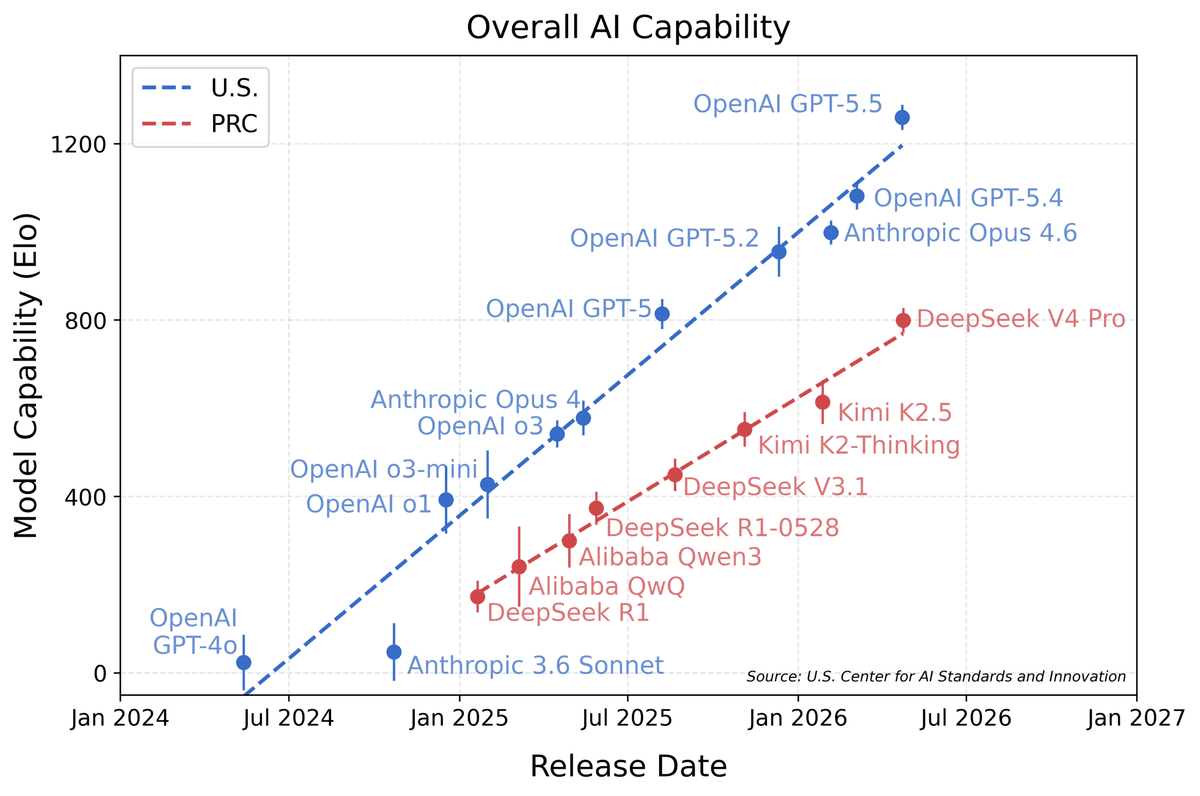
- The AI landscape is bifurcating — US and Chinese AI ecosystems are developing independently, with different hardware and software stacks
Self-Hosting: Running V4 Locally
With efficient quantization (4-bit GGUF), the active portion of V4 can potentially run on consumer hardware:
- 32B active parameters in Q4_K_M: ~18GB VRAM
- Runs on: RTX 4090 (24GB), M4 Max (128GB for full model)
- Tools: Ollama, llama.cpp, vLLM (with MoE support)
The full 1T model requires ~500GB in 4-bit quantization — feasible on multi-GPU server setups but not on consumer hardware. However, the active portion's small size means inference speed can be competitive with much smaller dense models.
What This Means for the Open-Source AI Ecosystem
V4 represents an inflection point:
- Open-weight models are now frontier-competitive: The gap between open and closed models has effectively closed
- API prices will compress: Other providers will need to match DeepSeek's pricing or clearly demonstrate superior quality
- Self-hosting becomes more attractive: With frontier-quality models available for free download, the ROI of self-hosting improves dramatically
- The "moat" question is answered: If a Chinese startup can match GPT-5-class performance with open weights, the moat for proprietary model providers is narrower than assumed
Related Background
The Evolution of MoE Architecture
MoE isn't new. Jacobs et al. proposed it in 1991, and Shazeer revived it in 2017 with "Outrageously Large Neural Networks" applied to LSTMs. Since then: Switch Transformer (2021), GShard, Mixtral 8x7B (2023), and now DeepSeek V3/V4. The core trend: reducing the ratio of active parameters while scaling total capacity.
Open vs Closed Model War
Since Llama 3's release in 2024, open-weight models have rapidly closed the gap with closed models. If DeepSeek V4 matches Claude/GPT at 50–150x lower cost, the enterprise choice is obvious. This puts direct pressure on OpenAI and Anthropic's business models. According to a16z's 2026 AI market report, 67% of startups say they will "switch to open-weight models within a year."
Huawei Ascend and the US-China Chip War
V4 being trained on Huawei Ascend carries significance beyond technical choice. Since the US AI chip export restrictions (October 2022, repeatedly strengthened), Chinese AI companies have been shifting from Nvidia to Huawei Ascend 910B/C. DeepSeek "refusing" Nvidia access symbolizes China's semiconductor ecosystem self-reliance. Training a 1T-parameter model on Ascend chips manufactured on SMIC's 7nm process (not TSMC) raises serious questions about the effectiveness of export controls.
Llama 4 Comparison
Meta released Llama 4 in February 2026. Scout (17B active) and Maverick (17B active) shipped first, with Behemoth (288B active) still training. Both DeepSeek V4 and Llama 4 use MoE, but with different approaches: Llama 4 activates just 1 of 16 experts (extreme sparsity), while V4 activates 16. Which is more efficient will be determined by benchmarks after V4's formal April release.