$23.86B. Up from $8.05B a Year Ago. Nearly 3x.
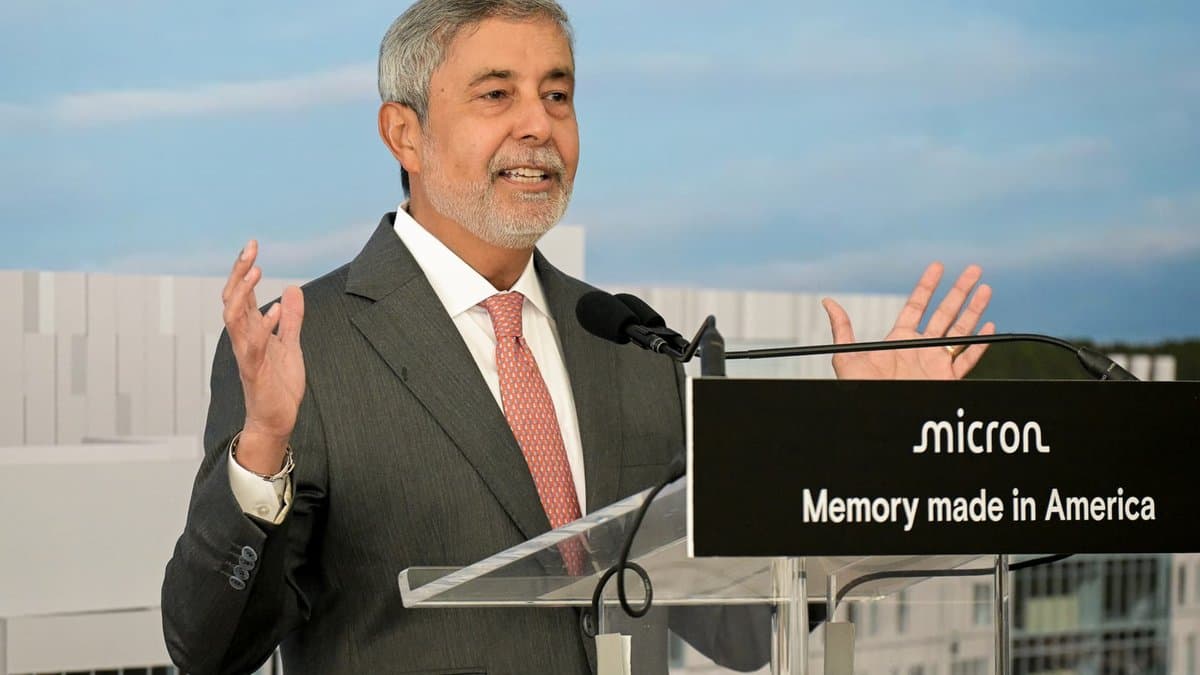
Micron's FQ2 2026 earnings (reported March 18) sent shockwaves through the semiconductor market. Revenue of $23.86B, EPS of $12.20 — beating the $9.19 analyst consensus by 33%. A year ago, the same quarter brought in $8.05B. That's nearly 3x growth in twelve months. No major memory company — not Samsung, not SK hynix — has ever posted this kind of year-over-year acceleration.
The forward guidance is even more staggering: next-quarter revenue of $33.5B with 81% gross margins. An 81% margin in the memory semiconductor business is virtually unheard of — that's software-company territory for what has historically been a commodity hardware business. Something structural has changed.
This isn't just a company earnings story. It's the strongest evidence yet that AI is fundamentally reshaping the memory semiconductor industry.
Background: Why AI Needs So Much Memory
Every AI model stores its parameters (its "brain") in memory and must read them in real-time during inference. Generating a single token requires reading the entire parameter set from memory. Higher memory bandwidth means more tokens per second. This is the memory-bound problem — GPU compute power sits idle because memory can't feed data fast enough.
Training is equally demanding. In distributed training, each GPU holds its slice of model parameters in HBM, running gradient computation → synchronization → update cycles continuously. HBM capacity and bandwidth determine how large a model each GPU can handle and how fast.
What Is HBM?
**HBM **(High Bandwidth Memory) is specialized DRAM stacked vertically on top of the GPU package. While standard DDR5 offers about 50 GB/s bandwidth, the latest HBM4 delivers 22 TB/s — a 440x difference. This massive bandwidth gap is what makes AI accelerators possible.
| Generation | Bandwidth | Capacity/Stack | GPU | Year |
|---|---|---|---|---|
| HBM2e | ~2 TB/s | 64 GB | A100 | 2020 |
| HBM3 | ~3.35 TB/s | 80 GB | H100 | 2022 |
| HBM3e | ~8 TB/s | 192 GB | B200 | 2024 |
| HBM4 | –22 TB/s | 288 GB | **R200 **(Vera Rubin) | 2026 |
HBM4 delivers 2.75x the bandwidth of HBM3e — theoretically translating to ~2.75x faster token generation for memory-bound models. Micron has already begun volume production of HBM4 for Nvidia's next-gen Vera Rubin GPUs.
Earnings Deep Dive — The Numbers
| Metric | FQ2 2026 | FQ2 2025 | Change |
|---|---|---|---|
| Revenue | $23.86B | $8.05B | +196% |
| EPS | $12.20 | $2.12 | +475% |
| Gross Margin | ~68%+ | ~36% | +32pp |
| Next-Q Revenue Guidance | $33.5B | — | +40% QoQ |
| Next-Q Margin Guidance | 81% | — | Unprecedented |
| 2026 Capex Plan | $25B | — | Significantly raised |
Five Key Takeaways
- HBM sold out for all of 2026. Micron's entire HBM production capacity is spoken for. Substantial 2027 capacity is already pre-booked.
- AI datacenters consume 70% of high-end DRAM. Three years ago, this figure was below 20%.
- HBM TAM projected at $100B by 2028 — two years ahead of earlier industry estimates.
- $25B capex commitment — a major portion going to HBM4 production line expansion at new fabs in Idaho and New York.
- Nvidia Vera Rubin supply confirmed — Micron is locked in as a primary HBM4 supplier for Nvidia's next-gen GPU platform.
Why "Supercycle"?
In semiconductors, a supercycle refers to structural, long-term demand growth that breaks the normal boom-bust pattern. Memory chips historically follow 3–4 year price cycles — prices spike, investment floods in, oversupply crashes prices, repeat. AI is breaking this pattern.
| Factor | Traditional Cycle | AI Supercycle |
|---|---|---|
| Demand driver | PC/smartphone refresh | Exponential AI model growth |
| Duration | 3–4 years | 5+ years (2024–2029+) |
| Price volatility | High (boom then crash) | Relatively stable (demand consistently exceeds supply) |
| Peak margins | 50–60% | 81% (unprecedented) |
| Supply response | Build capacity in 2 years | HBM manufacturing is extremely difficult, yield risk |
Seeking Alpha described the results as "Micron enters a profit supercycle." The core dynamic: AI model sizes grow 5–10x annually, but HBM manufacturing capacity simply cannot keep pace. This supply-demand imbalance is what produces those abnormal margins.
The Memory Big Three
The HBM market is effectively a three-company oligopoly:
| Company | HQ | HBM Share | HBM4 Timeline | Edge |
|---|---|---|---|---|
| SK hynix | Korea | ~50% | 2026 H1 | Market leader, closest Nvidia relationship |
| Samsung | Korea | ~30% | 2026 H2 | Foundry + memory vertical integration |
| Micron | US | ~20% | 2026 H1 | Only US memory manufacturer, CHIPS Act funding |
SK hynix dominates with ~50% share and was the primary supplier for H100 and B200 HBM. Samsung struggled with HBM3e yields but is pushing its SAINT packaging technology for HBM4. Micron's strategic position is unique: as America's sole memory chipmaker, it's receiving approximately $6.1B in direct CHIPS Act grants plus $7.5B in loans. In the "Sovereign AI" era where nations seek domestic AI supply chains, Micron's value extends beyond pure market economics.
The geopolitical dimension matters too. China is attempting indigenous HBM development, but advanced HBM manufacturing requires ASML EUV lithography equipment — blocked by US export controls. As long as that holds, the Korea-US triopoly remains intact.
Why It Matters
Micron's results are the strongest rebuttal to the "AI bubble" narrative. Bubbles are built on expectations without substance. Micron's 3x revenue growth and 81% margin guidance represent real products selling to real customers building real data centers. CEO Sanjay Mehrotra stated: "AI represents the most transformative technology of our time" — and his company's numbers back it up.
For developers: memory bandwidth increasingly determines AI performance more than raw compute. Frameworks like vLLM and TensorRT-LLM exist specifically because KV cache management is the critical bottleneck. As HBM costs rise (now 30–40% of server cost), model quantization becomes not just a technical optimization but an economic imperative.
$23.86B revenue. 196% growth. EPS beating consensus by 33%. Next quarter: $33.5B at 81% margins. HBM completely sold out. The AI memory supercycle has begun, and we're still in the early innings.