Sixty seconds of audio. In one second.
That's the headline number on Microsoft's new MAI-Voice-1: 60x realtime for speech synthesis. Impressive on its own, but the real story isn't the benchmark.
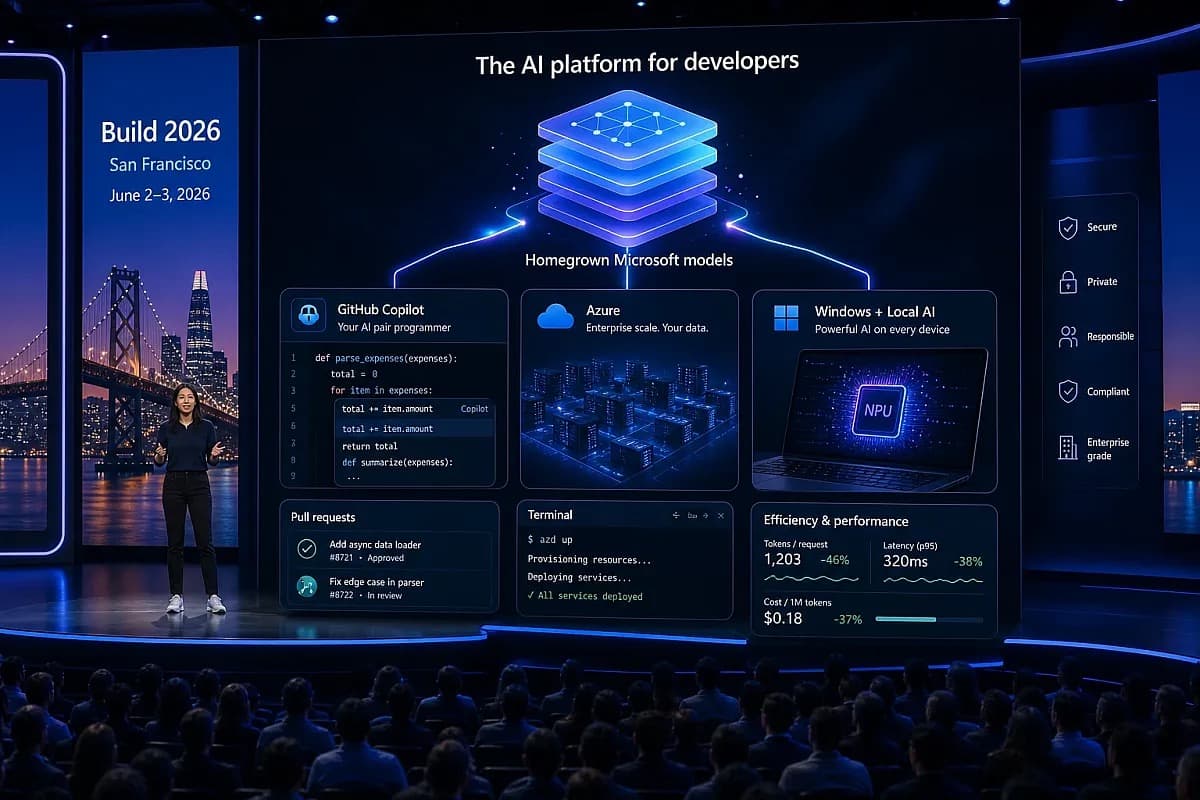
Until now, Microsoft has been OpenAI's biggest customer. Copilot, Azure OpenAI Service, the AI features inside Word and Outlook — all fundamentally GPT-4 and later GPT-5. On April 2, Microsoft pushed something new to Azure Foundry: three first-party foundation models under the "MAI" (Microsoft AI Internal) brand. MAI-Voice-1 for speech synthesis, MAI-Transcribe-1 for ASR, and MAI-Image-1 for image generation. It's the first time the MAI label has shown up in public.
Here's the deal
Microsoft and OpenAI have had a complicated marriage. It started with a $1B investment in 2019, escalated to $10B plus exclusive Azure distribution in 2023, and ran smoothly for years. OpenAI did research, Microsoft wired the models into every enterprise surface it owned.
Cracks began showing in 2025. After the Sam Altman firing-and-return drama, Microsoft started quietly building a "we don't need OpenAI to survive" posture. In March 2024, it hired Mustafa Suleyman and most of Inflection AI's core team to stand up a new Microsoft AI org. The MAI lineup shipping this week is what that team has been cooking for two years.
| When | What |
|---|---|
| 2019 | Microsoft invests $1B in OpenAI |
| 2023 | Additional $10B + exclusive Azure rights |
| Mar 2024 | Inflection AI team joins → Microsoft AI formed |
| Aug 2024 | "MAI-1" codename first leaks |
| 2025 | Copilot begins routing some traffic to MAI-1 |
| Apr 2026 | Three MAI models ship publicly on Foundry |
Without that context, "Microsoft put three models on Azure" doesn't register as news. With it: Microsoft was the last of the three hyperscalers without its own branded frontier-grade models. Google has Gemini, AWS has Nova, and now Microsoft finally has something with its own name on it.
The breakdown
MAI-Transcribe-1 — 2.5x faster ASR
First up is a multilingual automatic speech recognition model supporting 25 languages. Microsoft claims it runs 2.5x faster than Azure Fast Transcription, its previous fastest offering, with comparable word error rate. TechCrunch's reporting suggests the speedup comes from latency reduction rather than accuracy trade-offs.
Why this matters: meeting transcription, call center analytics, live captions — use cases where the gap between realtime and batch processing defines the product experience. Transcribing a one-hour meeting in under two minutes isn't a speed bump, it's a UX category shift.
MAI-Voice-1 — custom voice cloning
Second is the text-to-speech model. The flashy stat is the 60:1 compute-to-audio ratio, but the more interesting feature is custom voice cloning. Users can create a personalized TTS voice from a short sample. That puts MAI-Voice-1 head-to-head with ElevenLabs and OpenAI's Advanced Voice Mode.
It's live in MAI Playground today. Microsoft says it watermarks outputs and embeds provenance metadata, similar to the C2PA standard being applied to Sora and Veo video. Given how every voice-clone launch in 2024–2025 kicked off a fraud cycle, the safety hedge is not a bad idea.
MAI-Image-1
The image model got the least coverage in the launch. TechCrunch didn't report specs, and the Foundry listing wears a "preview" tag. DALL-E 3's relative stagnation since late 2024 has been an open secret, and Microsoft appears to be filling that gap with its own model rather than waiting on OpenAI.
| Model | Purpose | Headline spec | Availability |
|---|---|---|---|
| MAI-Transcribe-1 | ASR (25 languages) | 2.5x faster than Azure Fast | Foundry + MAI Playground |
| MAI-Voice-1 | TTS + voice cloning | 60 seconds of audio per compute second | Foundry + MAI Playground |
| MAI-Image-1 | Image generation | Not disclosed | Foundry (preview) |
The bigger picture
The right read isn't "Microsoft is dumping OpenAI." Microsoft is still the largest OpenAI investor, and GPT-5.4 still powers Copilot's premium tier. What's changing is routing strategy.
Simple voice transcription, subtitles, default TTS can go through MAI to cut costs. Complex reasoning, code generation, and agentic workflows still hit GPT-5.4. In cloud economics, that lower-cost path is where margin lives. Copilot Pro is $20/month — you cannot route every request through a frontier model and make that math work.
Stepping back, every hyperscaler now runs a "first-party + partner" hybrid stack:
- Google: Gemini 3.1 Pro + Gemma 4 (frontier + open)
- AWS: Nova + Titan + Anthropic partnership
- Meta: Llama 4 + MTIA in-house silicon
- Microsoft: Copilot (GPT-5.4) + MAI family
As of April 2, all three major clouds have completed the shift. Companies with pure exposure to OpenAI are now basically just OpenAI itself — and its consumer ChatGPT business.
What actually changes
For developers
Azure OpenAI Service and Azure AI Foundry now share a single API key surface. You can mix GPT-5.4 and MAI-Voice-1 in the same agent without separate contracts, billing, or region setups. That's the biggest quality-of-life improvement for anyone shipping hybrid agents — voice handled by MAI, reasoning handled by GPT.
Pricing hasn't been announced, but Microsoft hinted at "significantly lower" unit costs than Azure OpenAI equivalents. Azure Fast Transcription ran around $0.024/minute; MAI-Transcribe-1 could plausibly land near $0.01/minute, which rewrites the economics of any voice-heavy product.
For enterprise and users
Live captions in Teams, voicemail transcription in Outlook, dictation in Word — invisible features that already touch millions of users will migrate to MAI first. End users won't notice. Microsoft will notice when its OpenAI invoices drop by several million dollars a month.
Read this alongside our coverage of Q1 2026's record AI funding for the full picture. OpenAI is raising $122B from investors while its biggest customer quietly announces it can run large chunks of its stack without them. Capital is flooding in, dependency is flowing out.