$5.8B and 6GW — AMD Has Pulled Up a Chair Next to NVIDIA
Here's the deal: after market close on May 5, AMD reported Q1 2026: revenue $10.3B, non-GAAP EPS $1.37, both beating consensus ($1.27-$1.29). The headline number is data center: +57% YoY to $5.8B, on the back of EPYC server CPU strength and the Instinct GPU ramp. Data center now accounts for 56% of company revenue. Q2 guidance is $11.2B vs. $10.5B consensus (~+46% YoY at midpoint). Analysts model MI400 series generating ~$7.2B in its first year. The clincher came the same week — Meta committed up to 6GW of AMD Instinct GPUs. AMD is now the first credible alternative breaking NVIDIA's single-vendor grip on AI compute.
The Players — AMD, NVIDIA, Meta, OpenAI
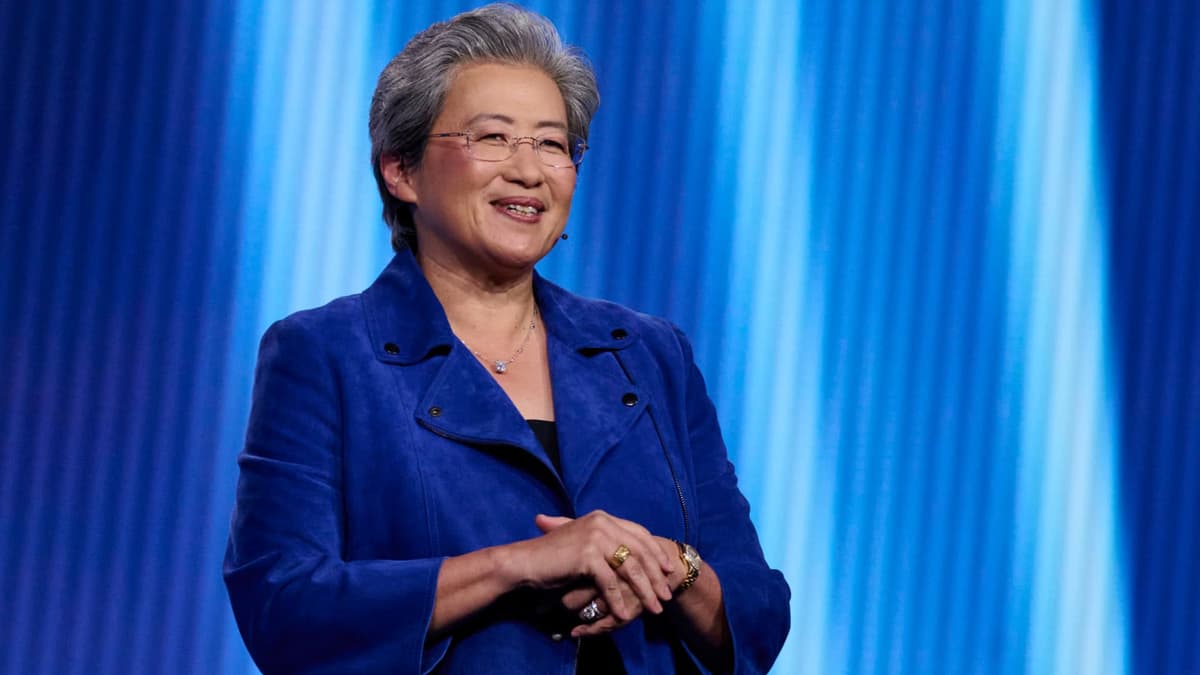
AMD: this is the apex of Lisa Su's 12-year transformation. Since 2014 she's pulled AMD from struggling to a $400B market cap. EPYC 9th, 10th, and 11th-gen pushed server CPU share to ~30%. Instinct MI300X, MI325X, MI350, MI400 cracked NVIDIA's GPU monopoly. On the call, Su said "tens of billions in data center AI revenue next year is clearly within reach" and that the long-term 80% annual growth target will be exceeded.
NVIDIA is still dominant but, for the first time, taking real market-share pressure. NVIDIA Q1 2026 data center revenue ($32B) is 5.5× AMD's, but a year ago the ratio was 8×. More important: hyperscalers are diversifying. AWS, Microsoft, Google, and Meta are all moving AMD to 20-30% share, which suppresses NVIDIA's pricing power on H200/B200/GB200.
Meta is AMD's biggest single new customer this quarter. Mark Zuckerberg's May 4 announcement of a 6GW AMD Instinct commitment translates to $8-10B of AMD revenue across 24 months. Meta plans to train Llama 5/6 on MI400/MI450 — public commitment that NVIDIA single-vendor risk is too concentrated for a hyperscaler.
OpenAI doesn't directly use AMD GPUs but is affected indirectly: Microsoft Azure is aggressively adopting AMD GPUs, so Azure-hosted OpenAI workloads slowly shift mix. Same week as the Anthropic-SpaceX (mostly NVIDIA) compute deal, AMD ramping is the contrasting story.
Q1 Decomposed and the MI400 Ramp
| Item | Q1 2025 | Q4 2025 | Q1 2026 | YoY |
|---|---|---|---|---|
| Total revenue | $7.4B | $9.8B | $10.3B | +39% |
| Data Center | $3.7B | $5.1B | $5.8B | +57% |
| Client | $1.4B | $1.7B | $1.8B | +29% |
| Gaming | $0.7B | $0.6B | $0.7B | flat |
| Embedded | $1.6B | $2.4B | $2.0B | +25% |
| Non-GAAP EPS | $0.62 | $1.05 | $1.37 | +121% |
| Non-GAAP margin | 53% | 54% | 55% | +200bps |
EPS +121% and margin at 55% are the standouts. AI data center mix is dragging margin upward — sitting between Intel (15-20%) and NVIDIA (75%). Lisa Su projects the gap to NVIDIA closes meaningfully over the next 12 months.
MI400 modeling: S&P Global Market Intelligence projects ~258K MI400 units in 2026 at ~$30,926 ASP, generating ~$7.2B in year one (~25% of data center revenue). MI450/Helios rack-scale platform ramps in 2H26 and could add $3-4B more.
Q2 guidance of $11.2B is +6.7% above consensus. At +46% YoY midpoint, the curve is accelerating versus Q1's +39%. Many analysts now model upward revisions for Q3/Q4; the 2026 full-year revenue consensus is migrating from $41-43B to $46-48B.
Who Wins — AMD, Hyperscalers, AI Application Industry
AMD wins three ways. NVIDIA single-vendor → dual-vendor: hyperscalers committing 20-30% AMD share moves AMD data center to $20-25B over 24 months. Margin expansion: AI GPU ASP holding around $30K could pull margins toward 60-70%. Capital flywheel: 25-30% operating margins generate $3-4B per quarter for R&D, fueling MI500/MI600 ramp.
Hyperscalers (AWS, Microsoft, Google, Meta) win on weakened NVIDIA pricing. With AMD as a real alternative, NVIDIA can't keep raising H200/B200 prices. Hyperscaler GPU procurement costs likely fall 15-20% over the next 12 months. ROCm software stack maturing on AMD GPUs also reduces single-vendor lock-in.
AI application industry (cloud rental shops, AI SaaS) gets cheaper GPU capacity. CoreWeave and Lambda Labs raising AMD MI400 mix to 30-40% can drop hourly rates from H200's $4-5 to ~$2.5-3. Inference costs for AI SaaS likely fall 30-40%.
Consumers benefit indirectly through Client +29%. AMD reinvesting AI margin into Ryzen/Radeon R&D pressures Intel Core Ultra and NVIDIA RTX 60-series pricing.
Past Parallels — Wins and Losses
AMD EPYC ramp (2017-2024): from 0% to 30% server CPU share in 7 years, breaking Intel's monopoly. Instinct may follow a similar shape, but GPU markets move faster — a 30% share could come in 4-5 years instead.
NVIDIA H100 ramp (2023): single-product launch drove data center revenue to $13B/quarter. AMD's MI400 ramp curve is structurally similar but starts at a much smaller revenue base.
AMD Bulldozer era (2011-2016): one strong product followed by weak follow-ons cost AMD years of share. If MI500/MI600 cadence slips, the same pattern could repeat in GPU.
Intel data-center GPU ramp failure (2022-2025): Ponte Vecchio and Falcon Shores stalled at $100-200M/quarter because oneAPI software lagged. AMD must close the PyTorch/TensorFlow performance gap on ROCm to avoid the same fate.
Counter-Plays — NVIDIA, Intel, Custom ASICs
NVIDIA absorbs price pressure with software-stack moats. CUDA, cuDNN, NCCL, TensorRT remain 5-10 years ahead of ROCm, justifying price premiums on training/inference performance differences. NVIDIA Rubin's Q4 2026 launch could land 1-2 quarters ahead of AMD MI500/MI600.
Intel has effectively retreated from data-center GPU. Falcon Shores is still on roadmap, but AMD-NVIDIA duopoly leaves little room for #3. Intel's new CEO Lip-Bu Tan is reportedly evaluating divestiture options.
Custom ASICs (Google TPU, AWS Trainium, Microsoft Maia) are double-edged for AMD: they pressure NVIDIA single-vendor exposure (helps AMD), but if hyperscalers raise self-silicon to 30-40%, AMD's share drops too. The real fight over the next 12 months is "AMD vs. custom silicon."
China (Huawei Ascend, Cambricon) is barred from U.S./EU markets by export controls but ramps inside China. AMD's 80-85% revenue concentration in U.S./EU/Japan is a structural risk if Chinese alternatives ever break out.
What Changes — Devs, Founders, Investors, End Users
Devs: AMD ROCm-based LLM training/inference becomes more attractive. Llama, Mistral, DeepSeek strengthening ROCm support means MI400 fine-tuning costs run 30-40% below NVIDIA equivalents.
Founders: AI infrastructure diversification = pricing leverage. AI SaaS COGS could drop 20-30% over 24 months as dual-vendor procurement becomes standard. ARR multiples for application startups improve as a result.
Investors: AMD valuation re-rate likely from $400B toward $600-800B. NVIDIA's $4T market cap ceiling becomes a real question as GPU market dynamics rebalance.
End users: AI service prices stabilize or fall. ChatGPT, Claude, and Gemini may pass through some inference cost reductions to token pricing. GPU rental cost cuts also affect cloud gaming and AI video generation.
Stakes
- Wins: Lisa Su (AMD) — data center +57%, MI400 modeled at $7.2B in year one; Mark Zuckerberg (Meta) — 6GW AMD commit secures NVIDIA negotiating leverage; Jensen Huang (NVIDIA) — losing share but absolute revenue still 5.5×.
- Loses: Lip-Bu Tan (Intel) — data center GPU effectively retreating; Huawei Ascend/Cambricon — export controls block global ramp; NVIDIA's price-raising strategy on H200/B200 — neutralized by AMD pressure.
- Watching: Microsoft, AWS, Google — custom-ASIC vs. AMD-GPU mix calls; OpenAI, Anthropic — indirect cost exposure through Azure/SpaceX; Korean cloud players (Naver, Kakao, Samsung SDS) — domestic AMD ramp share.
The Skeptics — "AMD's Ramp Is a Cycle, Not a Structural Shift"
Stacy Rasgon (Bernstein) frames AMD's +57% data center growth as a short-term ramp that NVIDIA's Rubin launch will reverse. Even if MI400 prints $7.2B in year one, hyperscaler share could shift back to NVIDIA in Q4 2026 with Rubin launch. ROCm catching CUDA on training performance also remains an open question.
Doug O'Laughlin (Fabricated Knowledge) names TSMC 4nm/3nm capacity as the binding constraint. AMD MI400, NVIDIA Rubin, Apple M5, and Qualcomm X Elite all share the same nodes; capacity is undersized by 12-18 months. Even with strong demand, AMD's revenue inflection could slip a quarter on supply.
Two skeptic lines: (1) NVIDIA Rubin reset (Q4 2026), (2) TSMC 4nm capacity bottleneck (12-18 months). Both argue AMD's curve runs slower than the press release implies.
TL;DR
- AMD Q1 2026 revenue $10.3B, EPS $1.37, beating consensus. Data center +57% YoY to $5.8B.
- Q2 guidance $11.2B (+46% YoY midpoint) tops $10.5B consensus; MI400 first-year modeled at $7.2B.
- Meta commits 6GW AMD Instinct — establishing AMD as the first real alternative to NVIDIA single-vendor.