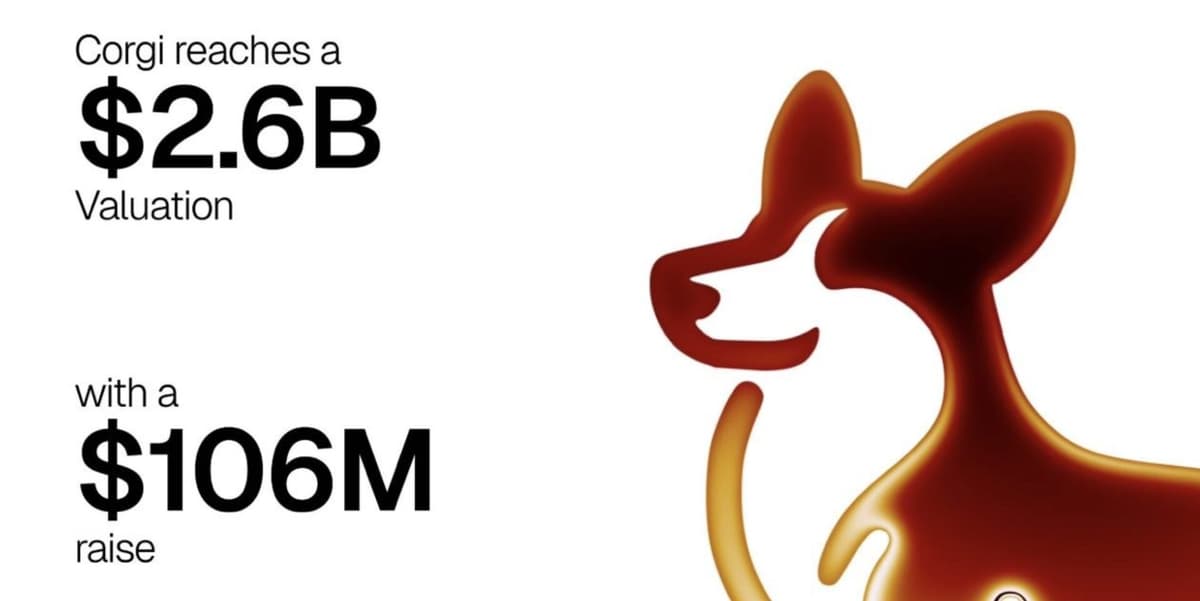
Three weeks. That's how long it took Corgi's valuation to exactly double
Here's the deal: on May 28, AI-native commercial insurance platform Corgi announced a $106M Series B1 at a $2.6B valuation, led by TCV with Prime Capital, Zone 2 Ventures, and Kindred Ventures participating. So far it sounds like routine funding news. The shock is the speed. Corgi closed a $160M Series B at a $1.3B valuation just three weeks earlier — then reopened a round and doubled to $2.6B. Total funding now stands at $378M.
A valuation doubling in three weeks isn't a normal funding cycle. Rounds are usually 12–18 months apart; Corgi stamped a new one in under a month. That's one of two things: (1) the market wants this company so badly investors are lining up, or (2) capital in the AI-insurtech theme is overheating and valuations are decoupling from fundamentals. TechCrunch's own coverage noted some investor skepticism. So this news is both a "Corgi story" and a thermometer for "how far have AI startup valuations gone?"
The players — Corgi, and "AI-native insurance"
Corgi is an insurtech that redesigned commercial (business) insurance from scratch with AI. "InsurTech" — insurance plus technology — is the field rebuilding the old, paper-heavy, slow insurance industry with software. Corgi's core is automating insurance's two hearts — underwriting and claims — with AI. Underwriting decides "do we insure this customer, and at what premium"; claims decides "how much to pay when something goes wrong." Both traditionally took human reviewers days poring over documents; Corgi has AI handle them fast.
"AI-native" matters. Unlike incumbents bolting AI on later, Corgi designed its system assuming AI from day one — data intake, risk assessment, pricing, and claims review flowing through one AI pipeline. With the Series B1, Corgi says it will expand into new lines of commercial insurance — replicating an AI model proven in one line into others to widen the market.
What it looks like with both rounds side by side
Put the three weeks in a table and the abnormal speed jumps out.
| Item | Series B (3 weeks ago) | Series B1 (May 28) |
|---|---|---|
| Raise | $160M | $106M |
| Valuation | $1.3B | $2.6B (2x) |
| Lead | — | TCV |
| Participants | — | Prime Capital, Zone 2, Kindred |
| Total funding | — | $378M |
| Use | — | New commercial insurance lines |
Note the "B1" label. Not a formal Series C — "B1" means an extension of the prior Series B. Extensions usually involve existing investors adding on or new ones entering near the same terms, yet Corgi's valuation doubled in an extension. That signals "demand exploded right after the last round, and the company pulled in more capital at a higher mark" — a savvy move to grab ammunition at peak leverage.
Be clear-eyed, though. Insurance fundamentals like revenue and loss ratio can't double in three weeks. So this jump is a number made by expectation and capital competition, not results. Insurance is ultimately won by "how accurately you price risk," and whether AI actually does that better shows up later in the loss ratio. Today's valuation is a prepaid bet on that proof.
Who benefits — Corgi, investors, and insurance customers
For Corgi, the win is expansion speed. Insurance is regulated, so every new line or state needs licensing, capital requirements, and reinsurance — all of which eat money. Securing more capital at double the valuation in three weeks means Corgi can fund that expansion and grab territory faster than rivals. Insurtech runs a data flywheel — whoever accumulates data first underwrites better — so speed itself becomes a moat.
For investors (TCV et al.), it's a big bet that AI changes insurance unit economics. Insurance is a multi-trillion-dollar global industry with high operating costs (labor, review time) and slow digitization. Automating underwriting and claims with AI runs the same insurance cheaper and prices risk more accurately. Improving the loss ratio by even 1–2 points massively shifts an insurer's profitability. Growth investors like TCV bet on that structural upside — though a fast valuation jump also carries exit risk: can this price be justified later?
For business customers buying insurance, the payoff is fast, fair coverage. Commercial insurance traditionally took days or weeks just to quote, and small businesses struggled to find the right product. AI-automated underwriting can produce quotes in minutes and price more fairly on data, and speed up claims when something happens — easing the old complaint that insurance is "slow and opaque."
History — insurtech's glory and crash
Trying to reinvent insurance with tech and AI isn't new — and that history is the best mirror for "is Corgi's valuation excessive?"
Warning — Lemonade, Root, Hippo (2020–22). The first insurtech generation got astronomical valuations right after IPO, then saw shares crash 80–90% as loss ratios didn't improve as hoped. The "rebuild insurance with tech" narrative was attractive, but insurance only reveals P&L once claims arrive, so early growth didn't convert to profitability. Lesson: insurtech value is validated by loss ratio, not growth. To justify $2.6B, Corgi must ultimately show underwriting accuracy in numbers.
Near-success — B2B and embedded insurtech. Conversely, some insurtechs that went B2B or embedded (selling insurance inside another service) rather than D2C grew more stably — lower customer acquisition cost, better data access, and shared regulatory burden with partners. Lesson: insurtech survival hinges heavily on which channel and line you enter. Corgi choosing commercial insurance — more structured data and higher ticket sizes than volatile personal lines — may be a smart pick.
Macro — 2021 vs 2026 capital climate. Capital flooded insurtech in the zero-rate 2021, then chilled fast as rates rose. Corgi's three-week double raises the question of whether the "AI theme" is replaying that froth. Lesson: capital cycles turn, and quickly-risen valuations can re-rate quickly. To weather the next downturn, Corgi must build a results base worthy of the valuation, fast.
How rivals counter
Big incumbents (AIG, Chubb) defend with data and capital — decades of loss data, huge balance sheets, and regulatory trust. Even if an AI startup leads on tech, insurance ultimately requires the capital strength to absorb claims, so incumbents don't topple easily. Their move: accelerate in-house AI and acquire/partner with promising insurtechs. Buying a company like Corgi or tying it as a partner is the most common counter.
Other AI insurtech startups compete on speed and line capture. Which commercial sub-line (cyber, liability, workers' comp) you grab and build data on first is key, so Corgi's fast fundraising pressures rivals to "raise faster too" — a capital arms race.
Big Tech and existing SaaS are a variable. If large cloud/data firms supply AI underwriting and claims tools to insurers, you get "Corgi replacing insurers" vs "Big Tech arming insurers." While Corgi goes full-stack (becoming the insurer itself), Big Tech can sell "the picks and shovels" and target a broader market.
So what actually changes
For insurance and fintech professionals, the AI-underwriting era is here in earnest. Insurance edge shifts from "how many agents and reviewers you employ" to "how accurately AI prices risk." As core work like underwriting and claims automates, insurer roles reshape from "document review" to "supervising AI models, handling exceptions, and managing regulation." Data quality and model governance become new core competencies.
For the AI and investment world, it's a case to read alongside a valuation-froth warning light. "Double in three weeks" shows capital's heat for AI startups, but also signals a widening gap between fundamentals and valuation. Pair it with this week's Microsoft "AI cost reckoning," and you see a strange polarization: cost discipline starting on one side while valuations sprint on the other. Investors should look at real numbers — unit economics and loss ratios — rather than getting hyped by the "AI label."
For businesses and consumers buying insurance, both upside and new risk arrive. Widespread AI underwriting can speed quotes and claims and rationalize premiums. But new questions emerge: how did the AI assess my risk, was a denial fair, is there data bias? Insurance is a safety net protecting people's lives and businesses, so the faster AI automation goes, the more regulation and oversight of "explainability and fairness" must strengthen alongside. Corgi's explosive growth shows both sides at once.
References
- PR Newswire — Corgi Reaches $2.6B Valuation With $106M Series B1, Three Weeks After $160M Unicorn Round
- TechCrunch — Corgi announces $106M raise at $2.6B valuation, double what it was worth 3 weeks ago
- citybiz — Corgi Raises $106M Series B1 to Expand Into New Lines of Commercial Insurance
- Lemonade/Root first-gen insurtech (historical comparison)
- Corgi official site