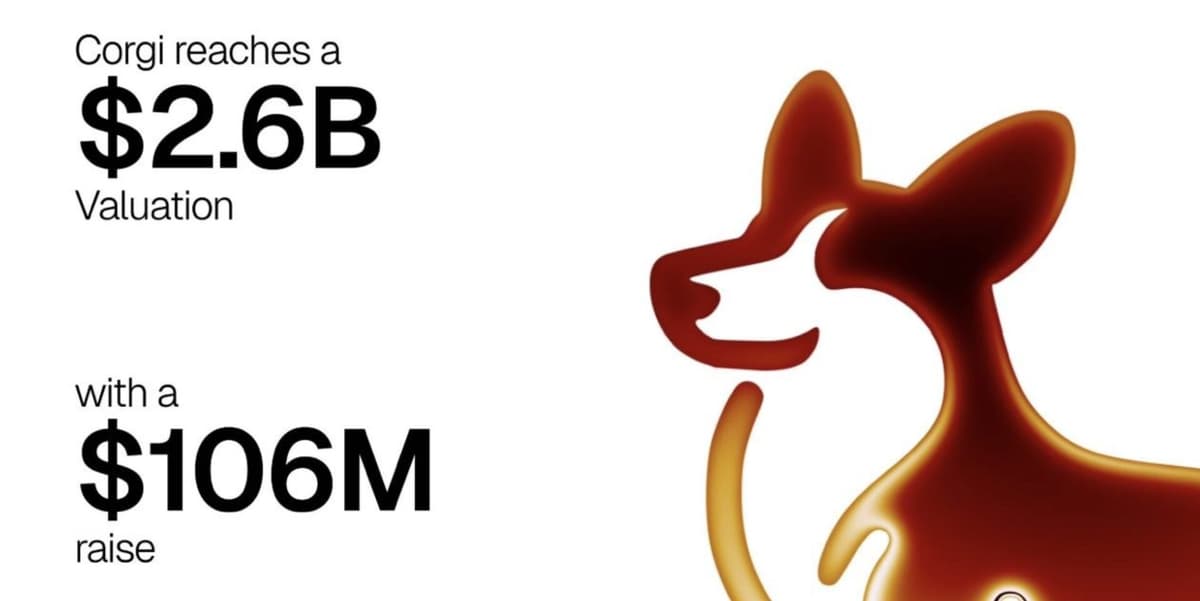
Valuation doubled in three weeks — the AI capital frenzy reached "insurance"
On May 28, Corgi — an AI-native insurance platform for startups — announced it closed a $106M Series B1 led by TCV at a $2.6B valuation. The shocking part is the speed. It had closed a $160M unicorn round just three weeks earlier, and the valuation roughly doubled in between. Given that a startup typically raises once a year, back-to-back rounds three weeks apart with a valuation double is abnormally fast.
Here's why it made the top news: it's a symbolic case of AI capital's frenzy spreading beyond "infrastructure and agents" into "vertical SaaS." Until now, the megacapital mostly piled into the "core of AI" — foundation models, GPU infrastructure, coding agents. But Corgi shows that the same speed of large capital now flows into vertical platforms that bolt "AI-native" onto a traditional, heavily regulated industry like insurance.
The numbers, in short: a prior $160M unicorn round → three weeks later, a $106M Series B1 at a $2.6B valuation. The lead is TCV, a growth-stage specialist VC. Filling two large rounds back-to-back in a short window signals just how aggressively investors are betting on the "AI-native insurtech" category.
The players — Corgi, AI-native insurance, and TCV
Corgi is an AI-native insurance platform built for startups. The crux is in two words: "startups" and "AI-native." Startups change fast, run lean, and are often too small or complex for traditional insurers to serve. Corgi designed insurance these startups need with AI at the core — fast underwriting, pricing, and claims handling. It swapped the people-and-paper work of traditional insurers for AI workflows.
"AI-native" is the key differentiator. Where incumbents added AI later, Corgi was designed with AI as a premise from the start. Underwriting (how to assess this customer's risk), pricing (what premium to charge), claims handling (how to decide payouts) — AI runs through insurance's core processes. Done right, this runs labor-heavy insurance work far faster and cheaper, which translates into margin and speed advantages.
The lead investor, TCV, is a well-known growth-stage tech VC — known for early stakes in companies like Netflix and Spotify. TCV leading reads as a signal that this round isn't a mere early bet but an investment in "validated growth potential." Growth-specialist capital coming in a second time within three weeks is also evidence that Corgi's growth metrics (revenue, customers, contracts) are bending sharply upward.
What's actually in it — what the numbers say
The essence of this story is really "the speed of the numbers." Key figures: a $106M round, a $2.6B valuation, a prior $160M round, and a gap of "about three weeks" between them. The conservatism of insurance and the speed of this round contrast sharply. Insurance is one of the slowest, most heavily regulated industries. A startup there doubling its valuation in three weeks means the market values it not as a "slow insurer" but as a "fast AI company."
| Item | Figure |
|---|---|
| Series B1 size | $106M |
| Valuation | $2.6B |
| Prior (unicorn) round | $160M |
| Gap between rounds | ~3 weeks |
| Lead investor | TCV |
| Close date | 2026-05-28 |
Why so fast? Investor FOMO around AI-native verticals is at work. Everyone agrees AI will reshape traditional industries. The question is "which company becomes that industry's AI-native winner" — and capital piles all at once into whoever looks like the front-runner. So round intervals shorten and valuations climb steeply. Corgi's three-weeks-to-double is a textbook case of this dynamic.
One caveat, though. This story is clear on "deal structure" — round size, valuation, investors — but Corgi's concrete operating metrics (revenue, customer count, loss ratio) weren't disclosed beyond press-release level. So "how fast capital is piling in" is clear, but "whether that valuation is justified by results" is hard to verify externally at this stage. Fast capital inflow and solid fundamentals can be separate things.
What each side gets — Corgi, investors, and startup customers
For Corgi, it's both ammo and a signal at once. $106M is enormous growth capital, and a $2.6B valuation is a strong market-confidence signal. With capital stacked via back-to-back rounds, it can spend aggressively on hiring, tech, and market expansion. In an industry where regulatory readiness and capital matter — like insurance — a thick war chest is itself a powerful competitive edge.
For investors (TCV and others), it's riding a fast-growing theme: "AI-native verticals." Foundation models already carry astronomical valuations and are intimidating to enter, but "traditional industries reshaped by AI" still look relatively early with more growth runway. If AI-native players capture huge traditional markets — insurance, legal, healthcare, logistics — being the winner's early backer is a massive return opportunity. Getting in preemptively on a fast-appreciating company is the core of this bet.
For startup customers, it means faster, more flexible insurance. The fast-changing startup risk that traditional insurers found awkward gets underwritten quickly and priced reasonably via AI. Cumbersome processes like enrollment and claims get simplified through AI workflows. In short, Corgi fills the niche of "insurance for startups, at startup speed."
Echoes from history — the rise and fall of insurtech
"Insurtech" — bolting tech onto insurance — isn't new. The successes and failures of the first generation hold lessons for this wave.
The first-gen disillusionment — Lemonade and others. In the late 2010s, first-gen insurtechs like Lemonade IPO'd splashily on "revolutionizing insurance with AI and apps." After listing, the stocks fell hard. The reason is simple — insurance's essence, managing the loss ratio (claims paid vs. premiums collected), isn't easily solved by tech alone. They built fast growth and slick apps, but actually making money as an insurer was a different problem. For a second-gen AI-native like Corgi to clear this lesson, it has to genuinely solve loss-ratio management with AI, not just "growth."
The second-gen difference — truly AI-native. Where the first generation was "app/UX improvement," today's AI-native runs the very core engine of insurance — underwriting, pricing, claims — on LLMs and AI. If that's real, it has the potential to crack the puzzle the first gen couldn't: lowering loss ratio and operating costs at once. But the difference between "truly AI-native" and "AI bolted onto marketing" must ultimately be proven by results — loss ratio, unit economics. At this stage, capital is betting on the potential.
The two sides of capital concentration — memories of the 2021 bubble. Another thing to remember: short-interval back-to-back rounds and steep valuation jumps were also features of the 2021 low-rate startup bubble. Back then capital piled in and valuations jumped within days — and many later faced down-rounds and restructuring. Whether Corgi's three-weeks-to-double rests on "real fundamentals" or is a premium attached to the "AI-native" label will ultimately be decided by whether the company actually turns a profit as an insurer.
How rivals counter — incumbents, other insurtechs, and Big Tech
Traditional insurers wield capital, regulatory experience, and vast historical data. As AI-natives like Corgi sprint ahead, incumbents will respond by accelerating their own AI adoption or by acquiring and partnering with hot insurtechs. Insurance is ultimately a game of "accurately assessing risk and managing loss ratio," where decades of accumulated data and capital are a strong moat. Startups hold speed; incumbents hold depth.
Other AI-native insurtechs will sprout in droves on the same capital wave. The more Corgi's three-weeks-to-double makes headlines, the more capital piles into similar "AI-native + specific vertical (SMB, sole proprietor, specialty risk)" startups. Who actually improves loss ratio and unit economics with AI separates the wheat from the chaff — but capital piling in too fast risks overheating before that separation happens.
Big Tech and embedded insurance are wild cards. The "embedded insurance" trend — Big Tech like Amazon and Google, or payment/SaaS platforms, selling insurance baked into their services — is growing. If insurance is auto-recommended inside the SaaS and payment tools startups already use, independent platforms like Corgi face "channel competition." So the next task for AI-native insurtech is, as much as "a good insurance engine," "how to seize the startup-customer touchpoint first."
So what actually changes — by persona
If you're a founder or startup operator, there's a practical change: more insurance options. The fast-changing startup risk that traditional insurers found awkward can be taken on more quickly and flexibly by AI-native platforms. Just vet whether a young insurtech can actually pay claims reliably (reinsurance, capital soundness). Slick AI underwriting matters, but whether claims actually get paid is the essence of insurance.
If you're an investor or VC, Corgi signals that "AI capital is spreading from the core (models, infra) into vertical SaaS." The same pattern is likely to appear in the "AI-native reshaping" of huge traditional industries — legal, healthcare, logistics, real estate. But steep valuation jumps like a three-weeks-to-double can be driven more by FOMO than fundamentals, so separate "capital speed" from "actual unit economics."
If you track AI and industry trends, the core message is that "the era of AI-native verticals is opening." Every traditional industry is being reshaped into a contest between "an incumbent that added AI later" and "a challenger that designed AI into the core." Corgi is that challenger in insurance, and capital is betting aggressively on such challengers. The question is whether these challengers can go beyond "growth speed" to solve the actual economics of the industry (for insurance, the loss ratio) with AI. That will decide whether they clear the first-gen insurtech disillusionment.
References
- PR Newswire (Corgi) — Corgi Reaches $2.6B Valuation With $106M Series B1, Three Weeks After $160M Unicorn Round
- Corgi doubles valuation to $2.6 billion with $106 million Series B1 — The Insurer
- Insurtech Startup Corgi Hits $2.6B Valuation In New $106M Funding Round — Crowdfund Insider
- TCV — Technology Crossover Ventures
- Insurtech overview — III (Insurance Information Institute)