Bezos doubled down — a startup running the opposite way from 'bigger models'
Here's the deal: almost every AI headline lately is about going bigger. More GPUs, more data centers, more power. Then on June 4, a big check landed pointing in exactly the opposite direction. Flourish, a startup reverse-engineering how the brain works to rebuild AI from scratch, reportedly raised a $500 million initial round at a $2.5 billion valuation.
The standout is the cap table. Jeff Bezos provided about a fifth of the capital — close to $100 million. He reportedly committed roughly $50M at first, then nearly doubled his stake after a string of high-profile investors piled in. The rest came from Alphabet's venture arm GV, Lux Capital, and healthcare-focused fund Catalio. On names alone, this isn't "fun money."
The core message is simple. AI today is burning power like crazy to push performance, while the human brain does all of it on roughly 20 watts — less than a lightbulb. Flourish's bet is that you don't fix AI's power crisis by building bigger models; you fix it by finding the brain's core algorithm and porting it into silicon. That's closer to a frontal gamble than a proven path — and Bezos just doubled his chips on that gamble.
The players — Flourish, Bezos, and 'connectomics'
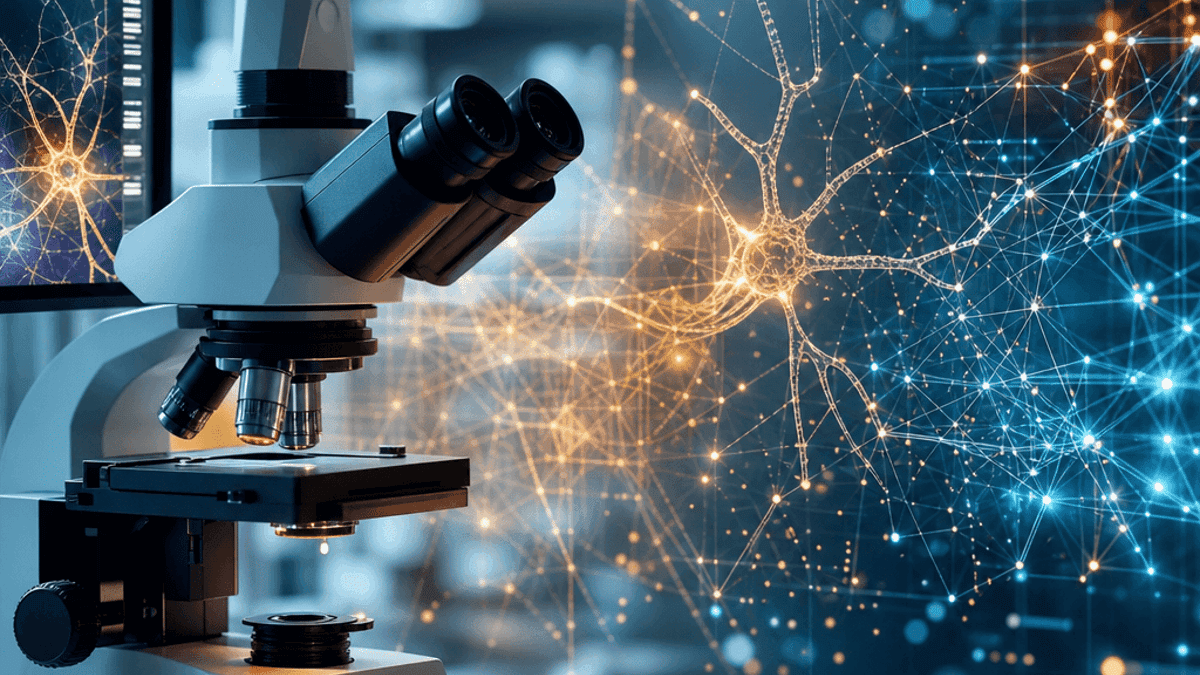
First, Flourish. It's building a system called Cortex AI. Where mainstream AI gorges on internet text and statistically memorizes patterns, Flourish starts from connectomics — mapping real neurons and their connections, strand by strand. In plain terms: put the brain under a microscope and extract the actual rules its circuits run on. The goal is explicit — an artificial brain that, like ours, learns and adapts on a tiny power budget.
Next, Jeff Bezos. The Amazon founder who runs Blue Origin is, this time, betting on the brain rather than space. The telling detail is how he raised his commitment: he grew more convinced as other top-tier firms came in. That signals this isn't one man's whim but a deal where several smart pools of capital saw the same thing. GV joining matters too — the venture arm of Google, a company that runs more AI compute than almost anyone, is betting on low-power brain emulation.
The last players are the co-founders. One is Rob Williams, a former Amazon S-team (top executive) leader. The other is the real talking point: neuroscientist Thomas Reardon. He created Internet Explorer at Microsoft in the 1990s, then pivoted to neuroscience and founded brain-computer-interface company CTRL-labs, which Meta acquired in 2019 for an estimated $1 billion. So a person who holds both software and brain science in two hands is at the center of this company — a combination that gives investors reasons to feel calmer.
What's inside — the numbers and the tech
The core figures, side by side:
| Metric | Detail |
|---|---|
| Round size | $500M (initial round) |
| Valuation | $2.5B |
| Bezos contribution | ~$100M (initially ~$50M) |
| Key investors | Jeff Bezos, GV (Alphabet), Lux Capital, Catalio |
| Target power | Human-brain level (~20–50 watts) |
| Core tech | Connectomics-based 'Cortex AI' |
The first thing to see is the power framing. A single chip in a modern AI training cluster draws many times more than the human brain; scale to a full data center and you're talking gigawatts, which is why grids, nuclear, and fusion are now part of the AI-infrastructure race. Flourish wants to sidestep that race not by building more hardware, but with an algorithm that draws less power in the first place. If it works, it's the kind of bet that changes the rules.
The second is the difference in approach. Mainstream AI says it's "brain-inspired," but in practice it stacks vastly scaled-up versions of simplified neuron models from the 1940s–50s. Flourish instead looks at the actual wiring of biological neurons — how the brain learns on so little energy, remembers what it saw once, and adapts to new situations — and tries to translate that core algorithm into code. The ambition is huge, and it's also the least-validated path.
The third point: these are goals, not results. The 20–50-watt figure is a target Flourish wants to hit, not something it has achieved. Connectomics is academically brutal (mapping even a sliver of a mouse brain takes years), and turning that into a working AI is a different problem entirely. So read this round as early capital backing a direction — "worth betting on" — not as proof that a product exists.
Who wins — Flourish, Bezos, and the AI ecosystem
For Flourish, the raise buys time and talent. Long-horizon research like brain reverse-engineering takes ages to produce revenue, and $500M is at least several years of runway. It's enough to recruit top people across very different fields — neuroscientists, hardware engineers, ML researchers — at once, and a $2.5B valuation is itself a hiring-and-partnership card that says "the leader in this space is here."
For Bezos, it's an asymmetric bet. $100M isn't big money to him, but if Flourish's approach works, he holds enormous upside on "the fundamental fix for AI's power problem." And through Blue Origin and Amazon, he knows better than almost anyone that power and compute are the bottleneck on everything. Limited downside, near-unlimited potential upside — a textbook venture asymmetry.
For the AI ecosystem, it's diversity insurance. Almost everyone is running one way right now — "scale the transformer." What if that path hits a power-and-cost wall? Then it matters whether a fundamentally different architecture is ready. Off-consensus bets like Flourish may look fringe today, but they're a hedge for the whole ecosystem against the mainstream hitting a ceiling. That's why a firm like GV is in.
Past parallels — the promise and the shadow of brain emulation
Brain-inspired AI isn't new. History offers lessons.
A seed of success — deep learning itself. The neural networks behind today's AI boom also started from "mimic the brain's neurons." Treated as fringe in the 1980s, the approach exploded in the 2010s once data and compute caught up. So there's already a precedent of a brain-inspired, off-consensus approach flipping the whole board. Flourish's bet sits in that lineage.
A cautionary case — neuromorphic's slow road. At the same time, neuromorphic chips like IBM's TrueNorth and Intel's Loihi promised "brain-like low-power computing" for years and still haven't displaced mainstream AI. Biological inspiration doesn't automatically become a shipping product. There's always a deep valley between scientifically beautiful and commercially viable.
The two sides of founder risk. Thomas Reardon is a proven founder who sold CTRL-labs to Meta for $1B — a real plus. But one win doesn't guarantee the next, and this time it's not an acquisition but the far harder game of turning fundamental science into commercial AI. Backing the people is rational, but it doesn't erase the technical risk.
Competitor counter-plays — big labs, chip makers, other neuro-AI
First, the big AI labs (OpenAI, Google, Anthropic). They won't sweat Flourish today; scaling transformers is still delivering. But internally they're pouring huge effort into efficiency too — smaller models, distillation, inference optimization. So the underlying problem ("make AI cheaper and less power-hungry") is shared. Flourish attacks it head-on via architecture; the big labs march toward the same destination via incremental optimization.
The chip makers (Nvidia, AMD, Intel) face a subtle calculus. If Flourish succeeds, AI uses less compute, which superficially threatens GPU demand. But historically, the more efficient AI gets, the more it's used, so total demand has grown (Jevons paradox). And Nvidia already invests broadly in inference, efficiency, and new architectures, so if brain emulation takes off, it has room to pivot its hardware that way.
Other neuro-AI and neuromorphic startups face differentiation pressure. With Flourish locking up marquee capital (Bezos, GV) and a $2.5B valuation, latecomers in the space must prove "how are we different" more sharply — by specializing in an application (robotics, edge devices) or showing a faster path to commercialization. The mere signal that capital is flowing into this field is good for everyone, but it speeds up competition just as much.
So what actually changes — by persona
If you watch AI infrastructure or policy, this signals one of two roads to solving AI's power crisis going live. One road is making more power — fusion, like Helion (announced the very same day). The other is making AI use less power, like Flourish. With data-center electricity now a public issue, big capital flowing into the second road is worth noting.
If you're a developer or ML engineer, there's no tool to use today — this is a multi-year research bet, not next quarter's product. But the direction is worth tracking: the industry's center of gravity is shifting from "bigger no matter what" to "same performance on less power and compute." Keywords like small efficient models, edge inference, and adaptive learning will only grow in importance.
If you watch AI broadly, the key takeaway is that the era of the single bet is fading. From a phase where everyone ran one transformer direction, capital like Bezos and Google has started spreading bets onto fundamentally different architectures. Whether it works, nobody knows — it could be a slow road like neuromorphic, or a board-flipper like deep learning. What's clear is that the equation "AI = bigger transformer" now has a serious challenger.
Numbers and figures are as of announcement and may change. Investment calls are yours to make!
🥄 Three Things You're Probably Wondering
— Does Flourish have a working AI right now? Not yet. This is an early-stage round, closer to "raised capital to pursue this direction" than "the product is proven." The 20–50-watt number is a target, not an achievement. So treat $500M as a bet on vision and team, not a reward for results.
— Why did Bezos double his commitment? Reportedly because his conviction grew as other top-tier investors joined. The fact that GV, Lux, and Catalio all saw the same direction acted as a trust signal — in venture, "who's coming in with you" is often as important as "what you're investing in."
— Brain emulation has been tried before — what's different now? True, neural nets and neuromorphic chips have been attempted for decades. The difference is (1) connectomics measurement is far more precise than before, and (2) AI's power problem is no longer "fun research" but a real industry bottleneck. Demand and capability ripened at once. Even so, the valley to commercialization is still deep.
— Does this matter to a regular user or developer today? Almost not at all — there's no product to use. But read it as a signal of a bigger shift: the field is moving its weight toward efficiency. Over the next year or two, small, low-power AI will gain value, and getting comfortable with that direction early will help.
References
- AI startup Flourish reportedly raises $500M round backed by Jeff Bezos — SiliconANGLE
- Bezos commits close to $100M to the startup reverse-engineering the human brain — TechFundingNews
- Catalio's Neuroscience Startup Flourish Emerges With Funding from Bezos, Google Ventures — citybiz
- Jeff Bezos backs Flourish, a $2.5B neuro-AI startup chasing the brain's algorithm — AI Chat Daily
- Bezos Bets $500M on Brain-Inspired AI Startup Flourish — TechBuzz