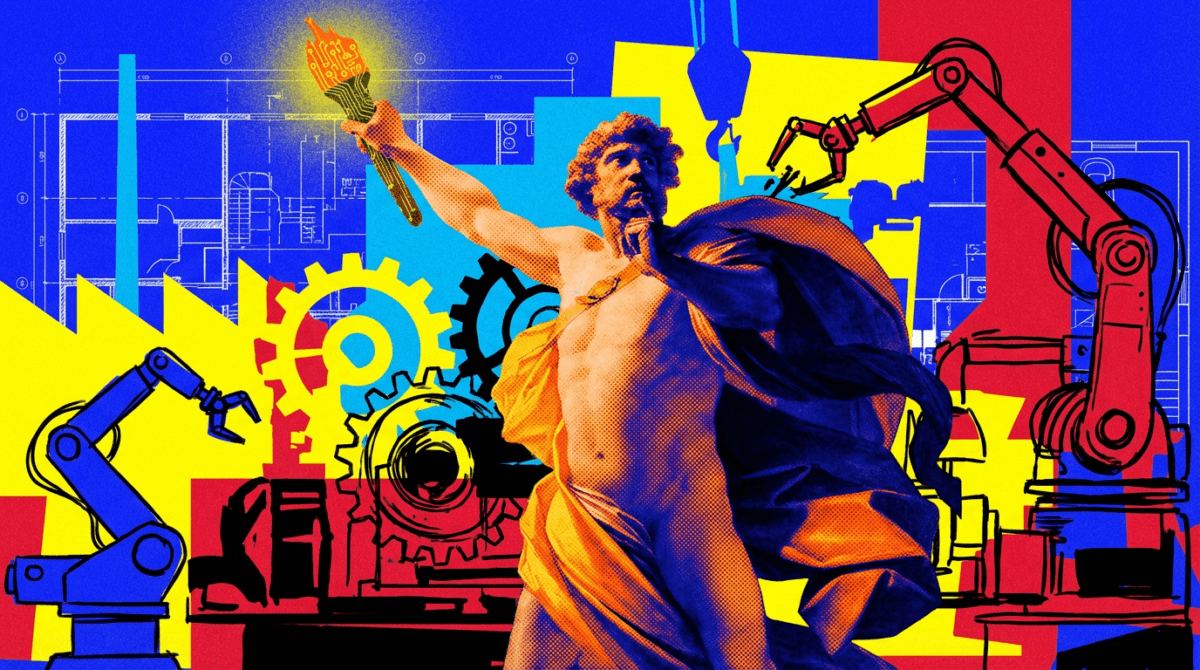
A 150-Person Company Just Raised Another $12B
Here's the deal: on June 11, Prometheus — the industrial AI startup Jeff Bezos co-leads as CEO — announced a $12 billion Series B. The round lifted its valuation to $41 billion and pushed total funding past $18 billion. The truly striking part is that the company has only about 150 employees. That's well over $270 million of valuation per head. Almost no company packs this much capital into this few people.
The investor list explains the buzz. The world's biggest financial institutions — JPMorgan, BlackRock, Goldman Sachs — plus DST Global and Arch Venture Partners all piled in. These are heavyweights who rarely show up at seed or Series A. The prior Series A was $6.2 billion, and Bezos himself was the largest backer in that round. So this company rides two tailwinds at once: Bezos's track record and the explosive expectations around physical AI.
This time, Bezos broke the secrecy and spoke up. In a CNBC interview he said "we're not being secretive," and stressed that AI is a tool to enhance engineers, not replace them. In other words, this isn't automation that cuts headcount — it's a tool meant to multiply human engineering capability.
The Cast — Bezos, Bajaj, and 'Physical AI'
The first lead is, of course, Jeff Bezos. The Amazon founder and Blue Origin owner runs Prometheus as a fully independent venture with no ownership ties to either. The key detail: he's not a passive investor but a hands-on co-CEO. He has rarely run a company directly since Amazon, which signals how serious he is about this bet.
Second is co-CEO Vik Bajaj, a former Stanford School of Medicine professor who co-founded Alphabet's life-sciences company Verily. Pairing a scientist with a chemistry-biology-physics background alongside Bezos signals that this company is aiming squarely at the science and engineering of the real physical world — not just software.
The third character is the concept itself: physical AI. Today's large models mostly learned from text and images. They're great at chatbots and image generation but can't actually design and build a jet engine or a medical device. Prometheus's bet lives here: train models on real experimental data, records of robots interacting with the physical world, and engineering workflows so AI can directly handle physical products.
The Core — What an 'Artificial General Engineer' Means
Prometheus's mission boils down to one phrase: an "artificial general engineer" (AGE). If AGI means "AI that can think about anything," AGE means "AI that can design and build anything." Bezos framed the problem in his Axios interview: "The cycle from dream, to manufacturing at rate, to having it out in the world can be very long." Shrinking that long cycle with AI is the company's reason for being.
| Item | Detail |
|---|---|
| Announced | June 11, 2026 |
| Round | Series B, $12B |
| Valuation | $41B |
| Total raised | Over $18B |
| Employees | ~150 |
| HQ / Sites | San Francisco (London, Zurich teams) |
| Co-CEOs | Jeff Bezos, Vik Bajaj |
| Key investors | JPMorgan, BlackRock, Goldman Sachs, DST Global, Arch Venture |
The target industries are telling. Prometheus is going after complex physical products like jet engines, medical devices, and consumer electronics. Such products take years from idea to mass production, with endless cycles of design, simulation, prototyping, validation, and manufacturing. If AI can compress a big chunk of that cycle, the speed of manufacturing itself changes. In Bezos's words, it's a huge bet on "re-architecting how physical things are made."
The crucial edge is data. Text and images are all over the internet for anyone to scrape, but real physical experimental data is not. Records of a robot failing to assemble a part, how a material changes at a certain temperature, how an engineer revised a design — this data is scarce and expensive. Whether Prometheus can build that data moat will decide its fate.
Who Gains What
For Prometheus, the $12 billion lets it buy three expensive ingredients at once: data, talent, and compute. Physical AI costs far more to feed than text models, so amassing experimental rigs, robots, and top-tier engineers runs into astronomical sums. A 150-person company sitting on $18 billion is a declaration that it can focus only on the hardest problems without money worries for a long time.
For investors, it's a chance to get in early on a physical-AI company Bezos runs directly. Institutions like JPMorgan and BlackRock entering a Series B at this size means they see the next giant market after text AI as AI for the physical world. The risks are clear too: the company has no disclosed product or revenue yet, and an "artificial general engineer" is an unproven vision. The Bezos name and institutional backing are partly papering over that uncertainty.
For engineers and people in manufacturing, it cuts both ways. On one hand there's anxiety about AI replacing jobs; on the other, hope that if AI handles repetitive design and validation, people can focus on the genuinely creative work. Bezos's "enhance, not replace" framing reads as a message aimed at that anxiety.
History — Physical-AI Bets, Hits and Misses
The success template is Bezos's own track record. Both Amazon and Blue Origin were mocked early on as cash-burning machines, but long-term bets produced enormous outcomes. AWS in particular seized the cloud-infrastructure market and opened a vast industry. If Prometheus is an attempt to seize "physical AI infrastructure," it can be read as the same pattern of patient, long-horizon betting.
There's a cautionary side too. Hardware and robotics startups that touch the physical world are far harder and costlier than software. Despite flashy visions and massive funding, plenty have produced gorgeous lab demos that crumble at mass production. Autonomous driving is the classic example: "almost ready" promises slipped by years and tied up huge capital. Prometheus's AGE has to cross the gap between "works in the lab" and "works reliably in a real factory" before its value is proven.
The lesson is clear: in physical AI, it's not the demo but the reproducibility that's everything. Whether Bezos's capital and patience, plus Bajaj's scientific depth, can bridge that gap will decide the company's fate. The money is in hand; what's left is time and proof.
Rivals' Counter-Play
Physical AI is already a hot battlefield. Nvidia eyes the "infrastructure of physical-world AI" with robotics and simulation platforms, and several robotics foundation-model startups are racing to build a "general robot brain." Prometheus's arrival is pressure — "Bezos-grade capital has entered the same market." Rivals' counter is to concentrate on a specific domain (one manufacturing process, one kind of robot) and post real-world results first.
Big Tech isn't standing still either. Google, Meta, and Amazon are each investing in robotics, simulation, and world models. The interesting twist is that Bezos did this as an independent venture, not inside Amazon. The intent reads as escaping a large org's inertia and short-term earnings pressure to make a long-horizon bet at startup speed — perhaps his answer to the many cases of innovation stalling inside big companies.
Ultimately, this market turns on data and reliability: who gathers richer physical experimental data, and who first builds a model that works on a real factory floor. Prometheus holds a commanding capital advantage, but rivals still have room to sprint ahead with domain-specific speed.
So What Actually Changes — By Audience
For engineers and scientists, it's a signal to rethink your career direction. Record capital flowing into physical AI means skills in handling experimental data and co-designing physical products with AI will only grow scarcer. Rather than fearing replacement, standing on the side that uses AI as a tool may be the smart bet.
For investors and founders, read the bigger trend: AI's next battlefield isn't text but the physical world. With the first wave of chatbots and image generation maturing, capital is shifting toward what AI still can't do — making real things. Just remember the barriers to entry are high and validation takes a long time, so don't expect quick wins.
For general observers, grab the picture that AI is starting to step off the screen. Until now AI was mostly text and images on a monitor, but bets like Prometheus aim to pull AI into the design rooms of real products like jet engines and medical devices. If it works, the very way the things we use are made could change. When and how that happens, though, is too early to call.
🥄 Three Things You're Probably Wondering
— So what does this mean for me? No direct impact right now. But if you're an engineer, designer, or in manufacturing, co-designing physical products with AI could become an industry standard within a few years. Getting familiar with that shift early can't hurt.
— $41B for 150 employees? Isn't that a bubble? Too early to call. With no disclosed product or revenue, there's clearly a hefty "Bezos premium" baked in. But institutions like JPMorgan and BlackRock entering at this scale also means they see the potential size of the physical-AI market as enormous.
— Is an 'artificial general engineer' actually possible? Nobody knows yet. There's a big gap between a lab demo and reliable operation in a real factory, and few companies have crossed it. Whether Bezos's capital and patience can bridge it is the question — and it's too early to be sure.
References
- Prometheus, the industrial AI startup from Jeff Bezos, is now worth $41 billion — Axios
- Bezos' AI startup Prometheus raises $12B at $41B valuation — GeekWire
- Bezos opens up about Prometheus after $12B raise — CNBC
- Bezos's Prometheus raises $12B at $41B valuation — The Next Web
- Jeff Bezos Raises $12 Billion for AI Engineering Startup Prometheus — PYMNTS
Numbers are as of announcement and may change.