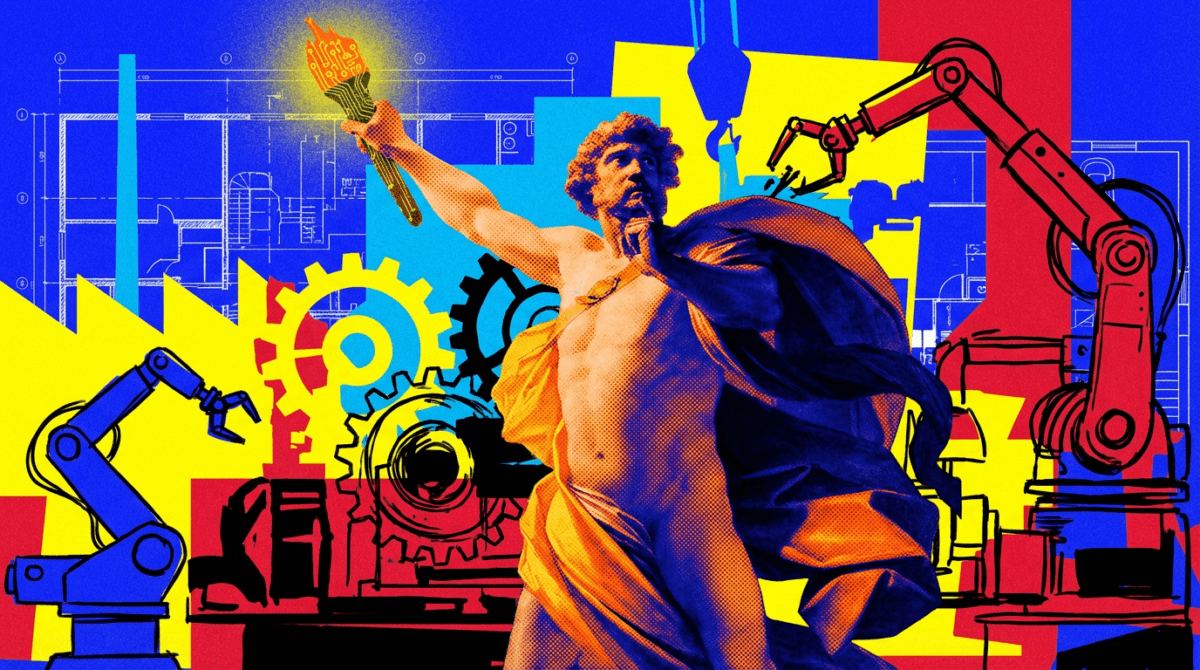
On February 2, 2024, Andy Jassy wrote in Amazon's annual shareholder letter that "Jeff's Day 1 spirit lives on even after his departure." But if Jassy knew what Jeff was actually doing right now, he'd probably need to sit down. Or maybe he wouldn't be surprised at all. Jeff Bezos has always been the kind of person who finishes one game and immediately starts a bigger one.
To tell this story properly, we need to rewind to July 2021. That's the day Bezos stepped down as Amazon's CEO. Most observers figured he'd focus on Blue Origin, tinker with the Washington Post, or just sail his superyacht around the Mediterranean. And for a while, that's exactly what happened. The paparazzi caught his 417-foot sailing yacht Koru being launched from a Dutch shipyard, and the world consumed Bezos's "post-retirement life" as celebrity gossip. The richest man steps back. End of story.
Except it wasn't.
Quietly — very quietly — Bezos was building something else. Starting in early 2025, a strange pattern emerged in Silicon Valley. Key researchers from OpenAI, DeepMind, Meta AI, and xAI were vanishing. LinkedIn profiles switched to "stealth." Conference appearances dried up. One or two departures would be normal turnover. But dozens of people disappearing simultaneously? That's a signal that something massive is being assembled behind closed doors. And behind those doors was Jeff Bezos.
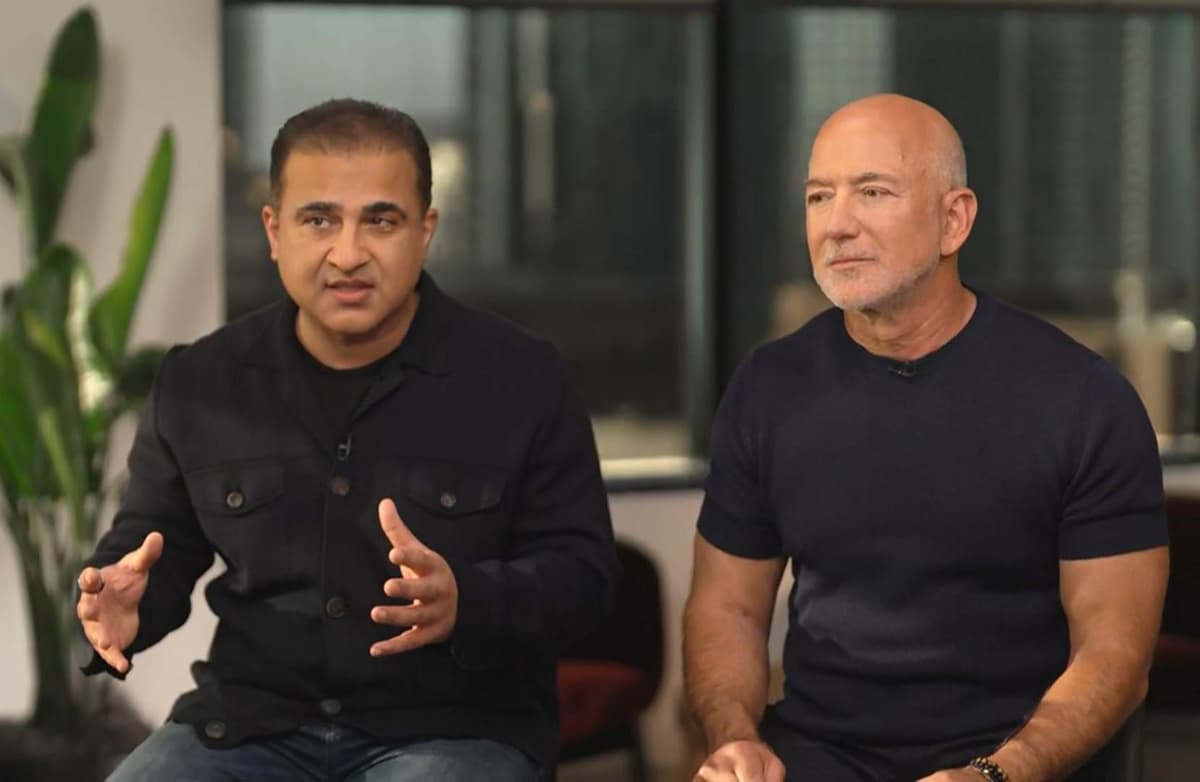
In November 2025, Project Prometheus officially stepped into the light. Initial funding: $6.2 billion. Two co-CEOs: Jeff Bezos and Vik Bajaj.
Here's the thing about Vik Bajaj — almost nobody outside the robotics world has heard of him, but his background explains exactly why Bezos chose him as a partner. Bajaj got his PhD in physical chemistry from MIT. Now, most physical chemistry PhDs end up in academia or pharmaceutical companies. Bajaj took a completely different path. He went to Google X. That's the secretive research lab where Waymo was born, where Wing drones were built, where all sorts of impossible-sounding ideas got tested. At Google X, Bajaj led robotics projects. Think about that trajectory for a second: a physical chemist who understands how matter behaves at the molecular level, turned into an engineer who designs how robots behave in the macro world.
Prometheus has assembled 120+ researchers and engineers from OpenAI, DeepMind, Meta AI, and xAI across offices in San Francisco, London, and Zurich.
Bajaj said something in an eWeek interview that captures everything Prometheus is about: "Software AI understands language. Physical AI understands the world." That single sentence draws the battle line. The AI we use every day — ChatGPT, Claude, Gemini — grew up on text. They swallowed trillions of words from the internet, learned the patterns of language, and became extraordinarily good at talking. They write code, compose poetry, analyze legal documents. But they can't pick up a cup. They can't cross a room. They can't turn a doorknob.
That might sound like a joke, but it's actually AI's most fundamental limitation. When a human baby is born, the first thing it learns isn't language — it's physics. Grabbing things, dropping them, crawling, falling, learning gravity and friction and inertia through direct physical experience. Language comes later, built on top of that physical foundation. Current AI has the whole order flipped. It handles language like a god but understands the physical world worse than an infant. Prometheus wants to fix that inverted order.
Let's get concrete. Picture a robot arm in an Amazon fulfillment center. It needs to pick up a package. Every package is a different size, different weight, different material. There might be a glass on top of one. A bag of liquid next to another. The current approach is to program every scenario with explicit rules. If weight > 5kg, increase grip strength. If surface is slippery, switch to suction pad. You can see the problem — the list of edge cases never ends. The real world has infinite variables.
Prometheus's approach is fundamentally different. Feed millions of object manipulation episodes into a model. Camera feeds, depth sensor data, force-torque readings, inertial measurement unit data — all of it going into one massive foundation model. The idea is that the model develops not if-else rules, but something more like "physical intuition." The same way GPT read trillions of tokens and developed "linguistic intuition," this model would read millions of physical interactions and develop an intuition for how the world works.
The theory is beautiful. The execution is hell. Here's why.
Text data is everywhere on the internet. Wikipedia alone has billions of words. Reddit, news sites, academic papers, GitHub code — there's an essentially infinite supply of free text data. That's why OpenAI could train GPT-3 at a relatively modest cost, and why the scaling law — more data, more compute, better model — kept working as they pushed bigger.
Physical-world data is a completely different beast. To record a single episode of a robot picking up an object, you need the robot, the object, the sensors, and the actual physical act of grasping. Each episode captures a few seconds of data. To collect millions of episodes, you need thousands of robots running non-stop for months. You can supplement with simulation — physics engines like NVIDIA's Omniverse or MuJoCo can generate virtual training data — but there's the sim-to-real gap problem. A robot that performs flawlessly in simulation stumbles in reality. Virtual physics and real physics have subtle but critical differences.
This is the core reason Prometheus has raised an absurd $16 billion. To win this game, you need bottomless capital. Buy thousands of robots. Outfit them with sensors. Build data centers. Stack GPUs to the ceiling. And on top of all that, pay world-class researchers salaries that would make investment bankers blush. This isn't a game a broke genius can start in a garage. This is a game where the world's second-richest person goes all-in with personal wealth.
And that's exactly what happened. On April 23, 2026, Prometheus closed a $10 billion round. Post-money valuation: $38 billion. Cumulative funding: north of $16 billion. Five months since launch. It took OpenAI seven years to reach comparable capitalization. Let that sink in.
| Date | Event |
|---|---|
| November 2025 | Project Prometheus launches with $6.2B initial funding |
| February 2026 | Reports of Bezos planning $100B AI industrial holding company |
| April 21, 2026 | Financial Times reports $10B round under negotiation |
| April 23, 2026 | Round closes. $38B post-money confirmed |
Now, the comparison isn't entirely fair. OpenAI started as a nonprofit. Prometheus was commercial from day one. And Bezos's name alone opens doors that no other founder's can. But even accounting for all of that, $16 billion in five months is a number that has no historical precedent.
The really interesting part of this round isn't the size — it's the investor list. JPMorgan. BlackRock. If you're reading those names and thinking "oh, big investment firms," slow down. These aren't venture capital firms. JPMorgan is the world's largest bank. BlackRock is the world's largest asset manager. Their combined assets under management exceed $15 trillion. For institutions of this scale to directly invest in a zero-revenue startup is extraordinarily unusual.
Even more interesting: there was no lead investor. At this scale, rounds typically have a single lead — a SoftBank, an a16z — who anchors the deal, sets the valuation, takes a board seat, and structures the terms. Prometheus pulled in institutional capital without that structure. That tells you two things. First, Bezos's network is powerful enough to replace the need for a lead investor entirely. Second, no single investor wanted to underwrite the full risk of an unproven category at a $38 billion price tag. Both of those things can be true simultaneously.
Jamie Dimon at JPMorgan and Larry Fink at BlackRock have relationships with Bezos spanning decades. They're the Wall Street titans who believed in Amazon back in the early 2000s when the company was burning cash and critics were calling it "Amazon.bomb." This round wasn't closed on technical conviction alone. It was enabled by twenty-year-old relational capital combining with a technological thesis. Let's be honest — if a different founder walked in with the exact same pitch deck, this round doesn't happen.
But their participation isn't just a favor to an old friend. There's a bigger strategic logic. BlackRock has been pouring billions into AI infrastructure — data centers, energy — since 2025. Until now, they'd only bet on the infrastructure layer. Through Prometheus, they're stepping directly into the model layer. This is traditional finance reclassifying AI from "a subcategory of the tech sector" to "an independent infrastructure asset class." We're witnessing the moment physical AI graduated from "interesting academic research" to "institutional-grade investable market."
The physical AI foundation model race: Prometheus leads on capital, but hasn't shipped a product yet.
Now let's zoom out, because this round is only half the picture.
In February, Inc dropped a bombshell report. Bezos is planning a $100 billion AI industrial holding company with Prometheus at the center. Not just an AI model company. A vertically integrated industrial conglomerate spanning AI chip design, data center infrastructure, robotics hardware, and energy supply. This is Bezos's second Amazon, funded by personal wealth instead of public markets.
To understand this, you have to remember how Bezos built Amazon. It started as an online bookstore, but Bezos always envisioned "The Everything Store." From books to e-commerce. E-commerce to cloud computing (AWS). AWS to logistics networks. Logistics to a delivery fleet. Then Alexa, Ring, Prime Video. Each expansion was lateral, but every move deepened the vertical integration. Prometheus follows the same playbook. Start with an AI model. Then build the chips that run the model. The data centers that house the chips. The energy that powers the data centers. The robot hardware that the model controls. Own the entire stack.
The structural parallel to Elon Musk's empire is hard to miss. Tesla collects autonomous driving data. xAI builds models. SpaceX provides satellite connectivity. Neuralink researches brain-machine interfaces. Each company feeds the others. Bezos is trying to architect that same kind of ecosystem, but under a single holding company from the start rather than building separate companies over two decades.
Prometheus isn't alone in this space. There are serious players already in the physical AI category.
| Company | Recent funding | Valuation | Approach |
|---|---|---|---|
| Prometheus | $10B (Apr 2026) | $38B | General physical AI foundation model |
| Physical Intelligence | $400M (Nov 2024) | $2.4B | Robot generalist policy model (pi0) |
| Skild AI | $300M (Jul 2024) | $1.5B | Scalable robot foundation model |
| Sereact | $110M (Mar 2026) | N/A | Industrial logistics robot AI |
| Boston Dynamics Atlas | Internal (Hyundai) | N/A | Humanoid robot + AI integration |
| Tesla Optimus | Internal | N/A | General-purpose humanoid robot |
On raw numbers, Prometheus dwarfs everyone else combined. Physical Intelligence's $2.4 billion valuation felt enormous when it was announced — next to Prometheus's $38 billion, it's a rounding error.
But capital doesn't equal capability. History has proven this repeatedly. Yahoo had more money than Google. Microsoft invested more in search engines than Google did. And look how those turned out. Physical Intelligence's pi0 model already has public demos and papers showing robots manipulating diverse objects. Skild AI's core team is built from CMU robotics researchers — CMU being the "MIT of robotics." Boston Dynamics has been building robots for over thirty years. Tesla collects real-world physics data from millions of vehicles every single day. How long would it take Prometheus to replicate in a robotics lab the amount of driving data one Tesla collects in a single day? That's not a problem you can easily solve with money.
Let's be honest about what Prometheus's real competitive advantages are. There are two. First, unprecedented capital to build data collection infrastructure faster than anyone else. Second, a talent density of 120+ people who've scaled foundation models at the four labs — OpenAI, DeepMind, Meta, xAI — that defined this generation of AI. These aren't just generic AI researchers. They're people who built GPT-4. Who trained Gemini. Who designed LLaMA. Having that caliber of talent in one place is a technically formidable starting position, regardless of whether the broader thesis pans out.
But here's the deeper question: why is this happening now? Robotics research has been going on for fifty-plus years. Why are tens of billions of dollars suddenly pouring into physical AI in 2026?
The first reason is the scaling law that LLMs proved works. When GPT-3 arrived, the shocking revelation was that scaling model size and data volume produces nonlinear capability improvements. It worked for text. It worked for images. It worked for code. Physical AI startups are betting the same law applies to physical-world data. It hasn't been proven yet. But there's no counter-evidence either. And when someone is willing to bet tens of billions on an "unproven but un-disproven" thesis — that someone is usually Jeff Bezos.
The second reason is the maturation of simulation technology. NVIDIA's Omniverse, Google DeepMind's MuJoCo-based simulators, Epic Games' Unreal Engine-based synthetic data generation — these tools have matured dramatically in the past two to three years. The sim-to-real gap isn't solved, but simulation data quality has reached a point where it meaningfully contributes to real training. Five years ago, simulation data was "better than nothing." Today it can replace 70-80% of real-world data. That's a game-changer for the economics of physical AI.
The third reason is the progress in multimodal models. GPT-4V, Gemini, and Claude's vision capabilities proved that models can understand text and images together. Now extend that one step further: text + images + 3D point clouds + tactile data + inertial sensor data, all in a single unified model. That's the core idea behind a physical AI foundation model. If multimodal works with two modalities, extending to five or six is an engineering problem, not a scientific breakthrough. At least, that's what the Prometheus team believes.
The fourth reason is the plummeting cost of robotics hardware. A decade ago, a research-grade robot arm cost over $100,000. Today, Chinese-manufactured robot arms cost under $5,000. A twenty-fold decrease. LiDAR sensors, depth cameras, tactile sensors — all following the same curve. Cheaper hardware means you can scale data collection. Buying 100 robots used to cost $10 million. Now it's $500,000. That cost reduction is what finally makes physical AI scaling economically viable.
The fifth reason is exploding real-world demand. Amazon fulfillment centers, Tesla factories, FANUC assembly lines, DHL sorting facilities — there's concrete, urgent demand for robots that can operate more flexibly and generally. Here's a number that makes investors sit up straight: the annual cost of employing one human worker in an Amazon warehouse is roughly $50,000. Amazon has approximately 750,000 warehouse workers globally. If robots could replace even half that workforce? That's $18.8 billion in annual savings. More than Prometheus's entire cumulative funding. Every year. That's the arithmetic driving investor conviction.
The physical AI foundation model tech stack: sensor data collection -> simulation augmentation -> multimodal training -> real-world deployment.
Now, connect this to other news and an interesting pattern emerges.
DeepSeek cutting inference prices by 75% is accelerating the commoditization of software AI. Text AI, code AI, image AI — the costs are plummeting. Falling costs mean compressing margins. Compressing margins mean vanishing differentiation. And when differentiation disappears from software, where does it migrate? To hardware and the physical world. The cheaper software AI gets, the more relatively valuable physical AI becomes. Prometheus's timing is not a coincidence.
Avoca hitting a $1 billion valuation tells the same story from a different angle. Avoca built AI voice agents that take phone calls and connect customers to physical services — HVAC repair, plumbing, roofing. They're operating at the junction of digital and physical. Prometheus wants to own the "physical" side of that junction with a foundation model. If Avoca's AI answers the phone and dispatches a technician, Prometheus's long-term vision is to replace that technician with a robot. That's still far in the future, but the strategic alignment is clear.
Now, fairness demands we hear the skeptics. And there are serious ones.
Daniela Rus, director of MIT CSAIL — one of the world's most prestigious computer science and AI research labs — gave this warning in an AI Magazine interview: "The idea of a general physical AI model is appealing, but the physical world is far more diverse and unpredictable than text. The assumption that LLM scaling laws transfer directly to robotics is unvalidated. $16 billion doesn't make physics easier."
Her critique is sharp. Scaling laws working for text doesn't guarantee they'll work for the physical world. Text is discrete — it breaks cleanly into words, sentences, paragraphs. The physical world is continuous. Force, velocity, acceleration, friction, elasticity — everything varies at infinitely fine granularity. Will pattern recognition that works on discrete data work the same way on continuous data? Nobody knows for sure.
Marc Raibert, the founder of Boston Dynamics, weighed in indirectly: "After 30 years in robotics, the most dangerous belief in this field is that enough money and data will solve everything. The real world has an infinitely long tail." He didn't name Prometheus, but everyone in the room knew who the comment was aimed at. Raibert has spent three decades building robots, experiencing countless moments of "we're almost there" only to have reality throw yet another long-tail problem at him. His warning carries serious weight.
Chris Metinko at Crunchbase News went straight for the valuation jugular: "$38 billion is one of the highest valuations in history for a company with no revenue. Even OpenAI had billions in revenue when it reached this level. How much Bezos premium can the market sustain?" That's a fair point. $38 billion is higher than the valuation of most revenue-generating tech companies. A company with no product and no revenue commanding this price is purely a bet on Bezos's name and the future of physical AI as a category.
But here's the counter-argument. In 2005, when someone proposed investing a billion dollars in Amazon Web Services, most people laughed — "why would a bookstore company do cloud computing?" When Bezos bought the Washington Post in 2013, it was called "a crazy bet on a dying industry." Bezos moves when the public doesn't understand. That's his greatest strength, and simultaneously the reason there's no guarantee he's right this time either.
So what does this all mean, depending on who you are?
If you're a startup founder, the vertical application layer on top of physical AI foundation models is going to explode when those models ship. Just like RAG, agents, and copilots emerged on top of LLMs, logistics optimization, robot control, and autonomous navigation apps will emerge on top of physical AI models. It's too late to compete at the infrastructure layer. But it's too early to build on it. Right now is the time to accumulate domain expertise and proprietary data in a physical-world vertical.
If you're an investor, a $38 billion valuation on zero revenue needs a multi-trillion-dollar TAM to justify the math. Physical AI TAM estimates vary by 10x or more across analysts. This is textbook high-risk, high-convexity. JPMorgan and BlackRock passing due diligence is a signal, not a guarantee — Goldman Sachs invested in plenty of companies that went bust during the dot-com bubble.
If you're an engineer, the physical AI talent war has started. People with robotics + ML cross-functional skills are in acute shortage. Prometheus, Physical Intelligence, and Skild AI are all recruiting from the same pool. If you have relevant skills, your market value is spiking right now. The rumor that Prometheus's RSU packages are aggressive relative to market rates tells you how fierce this talent war really is.
The ripple effects of this round deserve attention too. As Prometheus absorbs market oxygen, the funding environment for other physical AI startups will shift. On the positive side, Prometheus could lift the entire category's visibility and drive more follow-on investment. On the negative side, LPs might conclude "we already have physical AI exposure through Prometheus" and pass on competitors. How Physical Intelligence, Skild AI, and Sereact price their next rounds will reveal the market's real temperature.
NVIDIA is worth watching here. Prometheus will need massive GPU clusters to train physical AI models, and NVIDIA is the most likely compute partner. Jensen Huang has been shouting "the era of physical AI has arrived" from the GTC stage. Meanwhile, Hyundai and Boston Dynamics face a strategic fork — do they partner with Prometheus on hardware, or invest in their own AI capabilities to compete? Google DeepMind will need to recalibrate its physical AI strategy after RT-2. And China's robotics ecosystem will almost certainly mount a state-backed response.
Finally, zoom all the way out and here's the picture that forms. The first half of the 2020s was the era of software AI. GPT-3, ChatGPT, Midjourney, Stable Diffusion — AI that handles text and images upended the world. The second half of the 2020s could be the era of physical AI. The transition from AI inside the screen to AI outside the screen. From the digital world to the physical world. Prometheus's $38 billion round might be the starting gun for that transition.
Bezos put it this way: "This is the second front in the foundation model war." The first front is the text/code/image AI war being fought by OpenAI, Google, Anthropic, and Meta. The second front is the physical world. And Bezos just fired the opening shot on that second front. With a $16 billion bullet.
Whether this turns out to be historic foresight or historic capital destruction — honestly, nobody knows right now. But one thing is certain. Bezos didn't just fund a startup. He bankrolled the narrative that physical AI is the second act of the foundation model era. And that narrative is more likely to become a self-fulfilling prophecy precisely because Bezos is the one who launched it.
References