Imagine you're a startup founder in Seoul or San Francisco, and you've just spent the last six months carefully budgeting your AI inference costs. You've negotiated enterprise tiers, optimized your prompt lengths, maybe even built a caching layer to shave a few percentage points off your monthly bill. Then you wake up one Monday morning, open your laptop, and discover that a company in Hangzhou has just made your entire cost-optimization strategy irrelevant overnight.
That's roughly what happened this week when DeepSeek dropped the price of its brand-new V4-Pro model to $0.036 per million input tokens. To put that number in perspective: a million tokens is about 750,000 words, or roughly ten full-length novels. You could feed an entire bookshelf through a frontier-class AI model for less than the price of a bodega coffee. And not some stripped-down, economy-tier model either — a genuine contender for the best language model on the planet.
The number landed like a grenade in group chats across Silicon Valley, Zhongguancun, and every Slack channel where developers argue about model selection. Not because anyone was surprised that prices were falling — they've been falling for three years straight — but because of the sheer violence of the drop. A 75% discount off an already aggressive standard rate, running as a promotional price through May 5. The kind of pricing that doesn't just undercut competitors; it makes you question whether the entire pricing structure of the Western AI industry is built on sand.
But here's the thing: to understand why this particular price cut matters so much, and why it's sending shockwaves far beyond the usual API-pricing discourse, you need to understand the man behind it, the machine he built, and the geopolitical chess game that made it all possible.
Liang Wenfeng is not the kind of CEO who shows up at TED talks or posts philosophical threads on X. He came up through quantitative finance — his hedge fund, High-Flyer, was one of China's most successful before he pivoted to building AI models. That background matters because it explains how he thinks about pricing. Liang doesn't see inference costs the way Sam Altman or Dario Amodei do — as a revenue line to be maximized. He sees them the way a quant sees transaction fees: friction to be eliminated. "We want cost to never be the reason someone picks a worse model," he told Bloomberg in an interview surrounding the V4-Pro launch. It sounds like a customer-first platitude. It's actually a competitive death sentence for anyone who can't match his economics.
The model he built to deliver on that philosophy is a marvel of architectural efficiency. V4-Pro is a 1.6 trillion parameter Mixture-of-Experts model. That number — 1.6 trillion — sounds absurd until you understand the trick. On any given query, V4-Pro activates only 49 billion of those parameters. Think of it this way: imagine a company with 1,600 employees, but for every task that comes in, only 49 of them actually do the work. The other 1,551 sit idle, waiting for the specific type of query they're experts in. It's wildly efficient. You get the collective intelligence of a massive model with the compute cost of a much smaller one.
V4-Pro's MoE architecture activates only 49B of its 1.6 trillion parameters per forward pass — efficiency by design.
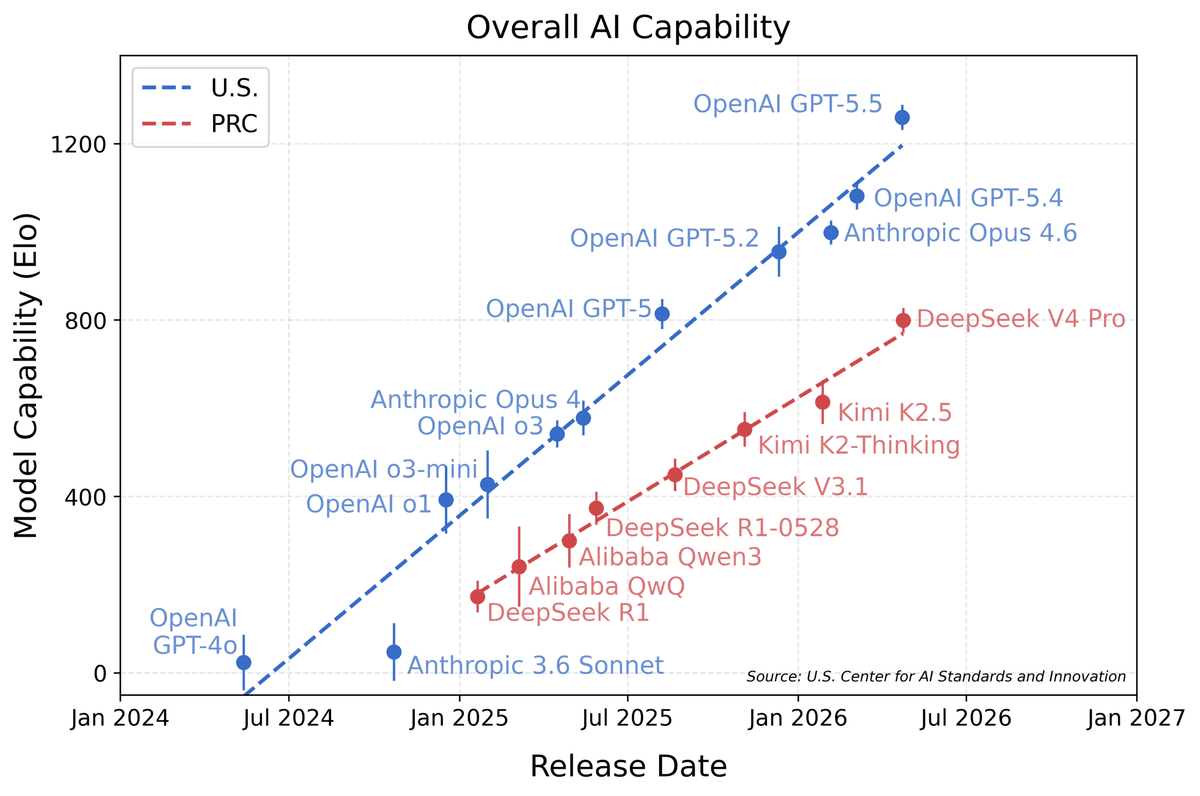
This Mixture-of-Experts approach — MoE for short — is the engine behind the pricing. When your model only fires 3% of its total parameters on any given query, you burn a fraction of the compute that a dense model of equivalent quality would need. DeepSeek has been pushing this design philosophy since V3, but V4-Pro is the most extreme expression yet. It supports a million-token context window, putting it in the same long-context league as Google's Gemini 2.5 Pro and Anthropic's Claude Opus 4. And on benchmarks, DeepSeek claims V4-Pro matches GPT-5.4 on MMLU-Pro — a self-reported number the community is still stress-testing, but early third-party evaluations from independent researchers are landing in the same ballpark. Coding benchmarks show it trading punches with Claude Opus 4.5. Reasoning tasks are strong but not category-defining.
So you've got a model that's arguably frontier-class, built on an architecture that's inherently cheaper to run. Now add the pricing on top, and the math gets genuinely uncomfortable for the competition.
Here's what the landscape looks like right now:
| Model | Input (per 1M tokens) | Output (per 1M tokens) | Context window |
|---|---|---|---|
| DeepSeek V4-Pro (promo) | $0.036 | N/A (promo input only) | 1M |
| DeepSeek V4-Pro (standard) | $0.145 | $3.48 | 1M |
| DeepSeek V4-Flash | $0.14 | $0.28 | 1M |
| GPT-5.5 (OpenAI) | $5.00 | $30.00 | 200K |
| Claude Opus 4.7 (Anthropic) | $5.00 | $25.00 | 200K |
| Gemini 2.5 Pro (Google) | $1.25 | $10.00 | 1M |
Look at that table one more time. The promotional rate on V4-Pro input is 139 times cheaper than GPT-5.5. Not 139 percent cheaper — 139 times. Even at its standard, non-promotional pricing, it's 34 times cheaper. And there's another wrinkle that production engineers will immediately zero in on: DeepSeek has introduced a permanent cache-hit discount — 10x off standard rates — which means repeat queries on the same context are essentially free. If you're running a RAG pipeline, an agent loop, or a code review workflow where cache-hit rates of 60-80% are normal, V4-Pro's effective cost per token drops into territory that's genuinely hard to believe.
Then there's V4-Flash, the speed-optimized variant for latency-sensitive applications. At $0.14 input and $0.28 output, with the full million-token context window, it's positioned as a Haiku/Flash-tier model at prices that make even those economy options look expensive. DeepSeek isn't just competing at the frontier — it's undercutting the budget tier too.
The natural question is: how? How can a company in Hangzhou offer pricing that makes the most well-funded AI labs in the world look like they're running a luxury boutique? The answer is a combination of architecture, hardware, competitive dynamics, and — if you're being honest about it — geopolitics.
Start with the architecture. We've already talked about MoE. But the efficiency gains compound when you layer on speculative decoding, KV-cache optimization, and aggressive quantization. Each of these techniques shaves compute costs independently, and together they multiply. DeepSeek's engineering team has been maniacally focused on inference efficiency in a way that Western labs, which tend to optimize more for training capability, simply haven't matched.
Then there's the hardware story — and this is where things get geopolitically interesting. V4-Pro runs on Huawei Ascend chips, not just NVIDIA H100s. That's not a technical footnote. It's a statement. The US government spent years crafting export controls designed to keep China's AI labs from accessing cutting-edge NVIDIA silicon. The theory was straightforward: without H100s and Blackwell GPUs, Chinese labs couldn't train or serve frontier models. The reality has played out like a plot twist in a movie nobody expected.
DeepSeek trained V4-Pro on a mix of older NVIDIA hardware — A100-equivalent chips that predated the export restrictions — and Huawei's domestically produced Ascend 910C chips. And here's the irony that should keep policymakers up at night: the export controls didn't stop the model. They shaped it. When you can't get the most powerful chips, you're forced to build architectures that extract maximum performance from limited silicon. MoE is that architecture. Quantization is that technique. And the model that emerged from those constraints isn't just competitive — it's cheaper to run than the models built on unrestricted hardware.
Jack Clark, co-founder of Anthropic, has been tracking this dynamic with the precision you'd expect from someone who helped build one of DeepSeek's main competitors. His latest analysis pegs the decline in inference costs since GPT-4's launch in March 2023 at roughly 830x. That's not a typo. What cost a dollar in early 2023 costs about $0.0012 today.
The inference cost curve since GPT-4: an 830x decline in three years. V4-Pro's promo pricing accelerates the trend.
"The inference cost curve is a one-way elevator going down," Clark wrote in his analysis. He's right, but what he didn't say — and what V4-Pro makes blindingly obvious — is that the elevator is moving faster on the Chinese side of the building. The drivers stack on top of each other: MoE architectures, speculative decoding, KV-cache optimization, quantization advances, custom silicon from both NVIDIA's Blackwell line and Huawei's Ascend 910C, and sheer competitive pressure from China's model makers who treat margin as a Western luxury.
That competitive pressure deserves its own thread, because V4-Pro didn't happen in isolation. It's the latest salvo in a price war that has been escalating across China's AI industry for over a year, and the dynamics of that war explain why Liang Wenfeng can price this aggressively without anyone in his orbit blinking.
Alibaba's Qwen team cut its API prices three times in 2025 before settling on rates that already undercut Western models by 5 to 10x. Tencent's Hunyuan followed. ByteDance's Doubao kept pace. But DeepSeek has consistently set the floor — and then dropped through it. Each time, the others scramble to match, and each time, DeepSeek moves the goalposts again. It's a pattern that looks less like normal competition and more like a deliberate strategy to establish dominance on the model layer while letting everyone else fight over infrastructure and distribution.
And that's exactly what's happening. Both Alibaba Cloud and Tencent Cloud have started integrating DeepSeek models directly into their cloud platforms. When your competitors start reselling your model, that's not competition anymore — that's capitulation on the model layer. Alibaba and Tencent are effectively saying: we'll compete on infrastructure and distribution, but we'll let DeepSeek win on quality-per-dollar. It mirrors how AWS commoditized compute and let the best services win on top, except here it's happening at the model layer, and it's happening fast. For a deeper look at how Alibaba and Tencent are integrating DeepSeek, see our coverage of the China cloud AI platform shift.
Now, if you're Sam Altman reading this from OpenAI's San Francisco headquarters, the math is deeply uncomfortable. GPT-5.5 launched at $5/$30 pricing — premium rates justified by premium performance. But if V4-Pro genuinely matches GPT-5.4 on key benchmarks at one-139th the price, the value proposition for GPT-5.5 needs to rest entirely on the delta between 5.4 and 5.5 performance. That delta exists. But it's narrow. And it's getting narrower with every DeepSeek release cycle.
Altman has signaled that OpenAI will respond with its own price cuts, but the company's cost structure makes it structurally harder to race to the bottom. San Francisco headcount doesn't come cheap. Massive compute contracts with Microsoft don't come cheap. Safety teams — which OpenAI genuinely invests in — don't come cheap. OpenAI's response will likely come through product bundling, through ChatGPT Pro subscriptions and enterprise tiers, rather than raw API price matching. But that's a different game than the one DeepSeek is playing, and developers making API-level decisions don't care about your subscription tiers.
Dario Amodei faces a different version of the same problem over at Anthropic. Claude Opus 4.7 sits at $5/$25 and is positioned as the quality leader for complex reasoning and long-document work. It's a defensible position — Anthropic's safety-first brand resonates in regulated industries where compliance officers have veto power over which APIs touch sensitive data. But there's a catch: Claude's 200K context window is a fifth the size of V4-Pro's million-token context. For the long tail of developers building chatbots, content tools, and automation workflows — people who don't need HIPAA compliance, who just need a good model at a good price — Amodei's safety premium starts to look like a luxury tax.
And then there's Jensen Huang. NVIDIA's position is more nuanced than it first appears. On one hand, cheaper inference means more inference volume, and more volume means more GPU demand. That's good for Jensen's empire. On the other hand, V4-Pro's compatibility with Huawei's Ascend silicon is a direct shot at NVIDIA's moat. For years, NVIDIA has been able to charge a premium not just for its chips but for its entire ecosystem — CUDA, TensorRT, NGC — because there was no credible alternative for serving frontier models. If DeepSeek just proved that a frontier model can run competitively on non-NVIDIA hardware, that premium starts to erode. Jensen won't lose sleep tonight, but his long-term strategy team certainly will.
The inference market is splitting into price tiers that increasingly favor Chinese model providers on cost.
Google, interestingly, is the most insulated player in this drama. Gemini 2.5 Pro's pricing at $1.25/$10 was already positioned as the value play among Western models, and Google's vertical integration — custom TPUs, owned data centers, Search distribution — gives it cost advantages that pure-play model companies simply can't replicate. But even Google's pricing looks expensive next to V4-Pro's promotional rate. The gap between $1.25 and $0.036 is still a factor of 35x. In any other industry, that kind of price differential would trigger an immediate response. In AI, where the product is arguably equivalent, it's existential.
The ripple effects extend well beyond model providers. Think about companies like Avoca, which just raised at a $1 billion valuation to power AI voice agents for service contractors. Voice AI is inference-heavy by nature — every conversation is a stream of tokens, and cost per token directly hits unit economics. A 75% cut in input costs could meaningfully shift their gross margins from "venture-subsidy math" to "actual business math." The same logic applies to coding assistants, RAG-powered enterprise search, and any application where the AI runs in a loop processing the same types of documents over and over. Our analysis of the 830x inference cost drop traced these compounding effects, and V4-Pro is the latest — and largest — data point on a curve that shows no sign of flattening.
But let's pump the brakes for a moment, because not everyone is popping champagne over these numbers. There's a legitimate skeptic's case, and it deserves a fair hearing.
Emily Zhang, a research scientist at Stanford's Institute for Human-Centered AI, has pointed out that DeepSeek's self-reported MMLU-Pro scores don't come with full evaluation methodology disclosure. "We've seen benchmark gaming before — training on test sets, cherry-picking prompt formats," she told VentureBeat. "Until independent evals on held-out benchmarks confirm these numbers, treat them as marketing." She's not wrong. The history of AI benchmarks is littered with models that looked world-class on the leaderboard and underwhelming in production. V4-Pro's claims need to survive contact with real-world workloads before the industry should treat them as gospel.
Dylan Patel at SemiAnalysis has raised an even sharper question about sustainability. "There's no scenario where $0.036 per million input tokens is profitable at scale, even with MoE efficiency gains," he wrote. "This is a land-grab subsidy, not a sustainable price. The question is how long Liang Wenfeng's backers — which include connections to the Chinese government through High-Flyer's quant fund origins — will keep subsidizing it." It's a fair point. Loss-leader pricing is a classic market-capture strategy, and the fact that DeepSeek can sustain it says as much about its funding sources as it does about its engineering.
And then there's the elephant in the room that no price cut can address: data governance. For enterprises in regulated industries — healthcare, finance, defense — running workloads through a Chinese-headquartered API provider raises compliance issues that make the pricing irrelevant. GDPR doesn't have a "but it's really cheap" exception. HIPAA doesn't care about your cost-per-token savings. ITAR restrictions don't bend for impressive benchmarks. For a meaningful segment of the enterprise market, V4-Pro's price tag might as well be infinity, because the model can't be used regardless of cost.
These caveats are real. But they don't change the fundamental dynamic that V4-Pro has introduced into the market. Even if the model is 10% worse than claimed on benchmarks, it's still price-competitive at a level that restructures the math. Even if the promotional pricing is a loss leader, it forces competitors to respond as if it's permanent, because developers who migrate during the promo window won't migrate back when rates go up by 4x to the standard price — they'll just keep using DeepSeek at $0.145, which is still 34x cheaper than GPT-5.5.
This is the paradox that Jack Clark and others have been flagging for months: restrictions on inputs — chips — can accelerate innovation on architectures — MoE, quantization, distillation — which produces outputs — models — that are cheaper to run. The competitive dynamics reverse polarity. The US tried to slow China's AI progress by restricting access to cutting-edge silicon. Instead, those restrictions pushed Chinese labs toward architectural efficiency, and now that efficiency is a competitive weapon being aimed right back at American companies' revenue models.
It's worth pausing to consider what this means beyond the AI industry itself. We're watching the emergence of a bifurcated AI market — one where price-sensitive, regulation-light use cases gravitate toward Chinese models and where compliance-heavy, premium-quality use cases stay with Western providers. That bifurcation has implications for everything from startup formation (where will the next wave of AI-native companies be built?) to national competitiveness (whose AI ecosystem will developers default to?) to the future of open-source AI (DeepSeek's model weights remain publicly available, which means anyone can run V4-Pro on their own hardware if they have enough of it).
The winners from this shakeup are clear enough. Developers and enterprises running inference-heavy workloads just got a massive cost reduction, whether they use V4-Pro directly or benefit from the competitive pressure it puts on every other provider. China's AI ecosystem gets a world-class model at domestic prices on domestic hardware — a strategic win that goes well beyond commercial considerations. Huawei gets a flagship model validated on its Ascend silicon, which is the best marketing the Ascend line could possibly receive. And open-source advocates get another data point proving that open weights can coexist with — and even outperform — closed commercial offerings.
The losers are equally clear. OpenAI's and Anthropic's pricing power on commodity inference tasks just took a body blow. Any startup whose pitch deck says "proprietary model" as a differentiator needs to explain why that model is 139x better than V4-Pro — and if it can't, investors will start asking uncomfortable questions. NVIDIA's monopoly narrative takes a hit now that Ascend is a credible alternative for serving frontier models, even if GPU demand remains strong in aggregate.
And then there's the watching category — the players who could go either way. Google has the cost structure to compete but hasn't matched this pricing yet, and the question of whether it will reveals a lot about how seriously Mountain View takes the Chinese model threat. Microsoft, whose OpenAI partnership economics depend on premium model pricing, has to watch its investment thesis get stress-tested in real time. And the US Commerce Department, which designed the export controls that inadvertently produced this outcome, has some explaining to do.
So what should you actually do about all of this? If you're running AI workloads in production, the answer is surprisingly simple: test it. Open the DeepSeek API dashboard. Create a test project with your most common workload — whether that's document summarization, code generation, or agent orchestration. Run it against your current provider at current pricing. Compare quality and cost side by side. The promotional pricing ends May 5. That gives you one week to collect data, not opinions.
If you're already on DeepSeek V3, the migration to V4-Pro is a model ID swap in your API call — about thirty seconds of work. If you're on OpenAI or Anthropic, budget two to three hours to adapt your prompt templates. The instruction-following style differs between providers, and you'll want to tune your system prompts for DeepSeek's particular strengths and quirks. It's not a drop-in replacement, but it's not a rewrite either.
If you're a startup founder, this is the moment to re-run your unit economics spreadsheet. Applications that were margin-negative at $5 per million tokens are profitable at $0.036. Business models that didn't pencil out six months ago might pencil out now. The inference cost floor just dropped again, and every company whose value proposition depends on model access premiums is losing ground to companies whose moats are built on data, distribution, or vertical integration.
And if you're an investor, reprice accordingly. The AI inference market is being commoditized faster than almost anyone predicted. The companies that will capture value aren't the ones selling tokens — it's the ones using tokens to build products that customers can't live without. The pick-and-shovel play was NVIDIA; the next pick-and-shovel play might be whoever builds the best tools on top of $0.036-per-million-token inference.
Liang Wenfeng probably isn't thinking about any of this in those terms. He's a quant. He sees a market where the equilibrium price of inference is dramatically lower than what anyone is currently charging, and he's simply moving to that equilibrium faster than his competitors can follow. Whether that's visionary or reckless depends on how the next twelve months play out. But one thing is certain: after this week, every AI company's margin structure is collateral damage, and the price of intelligence — artificial or otherwise — will never be the same.
References