Korea Started Laying "Our AI, Our Hands" Infrastructure
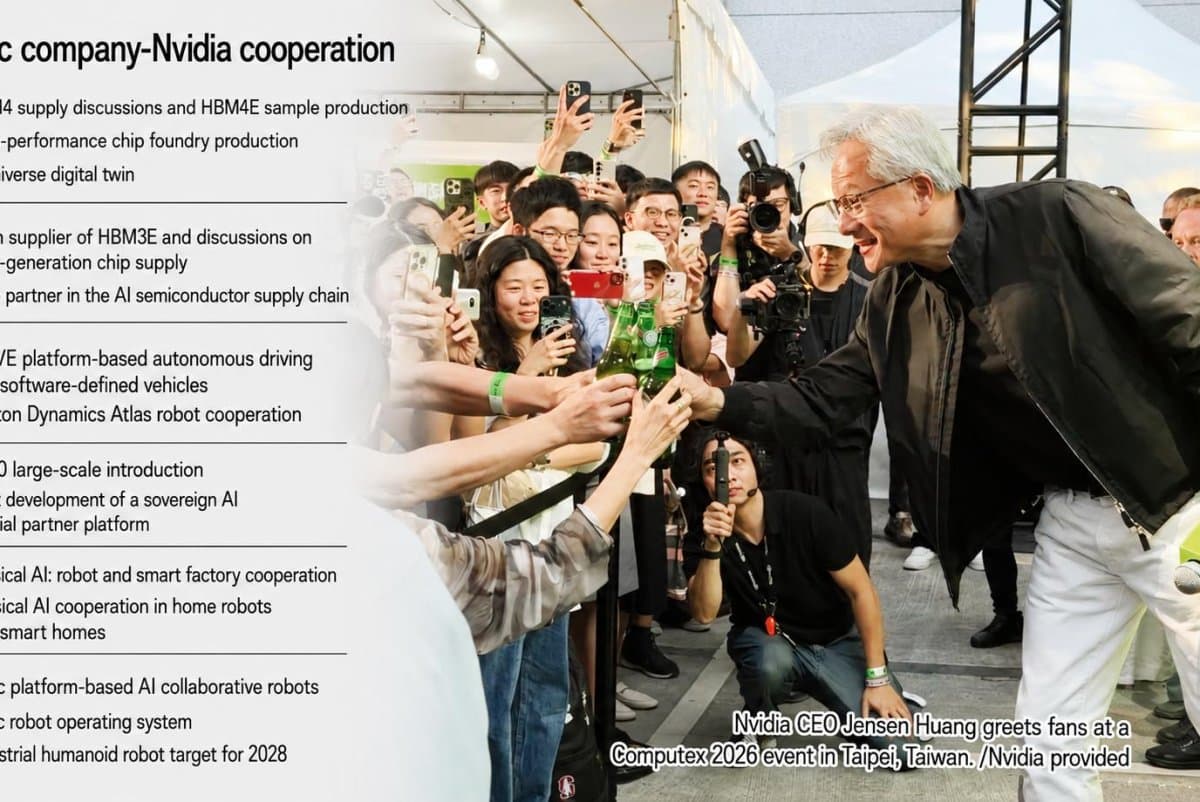
Here's the deal: on June 7, 2026, NAVER and NVIDIA agreed to build an "AI factory" scalable to gigawatt (GW) scale. An AI factory isn't just a data center — it's a massive compute plant specialized for training and running AI models. Built on NVIDIA's DSX platform, it starts at 55 megawatts (MW) and is designed to grow to gigawatt class over time.
The key phrase is "sovereign AI." Sovereign AI means a nation building and running AI suited to its own data, language, and values — within its own borders, not dependent on foreign infrastructure. Korean firms could build models but leaned heavily on foreign clouds for the big compute to run them. This deal is a Korean declaration toward "AI infrastructure independence."
Specifically, the factory starts at NAVER's Sejong data center, "GAK." NAVER will fine-tune a next-gen HyperCLOVA X with NVIDIA's Nemotron 3 Ultra, and becomes the first Korean company to join NVIDIA's "Nemotron coalition." In the second half, NAVER plans to unveil a Korean AI Agent platform built on this infrastructure.
The Cast — NAVER, NVIDIA, and HyperCLOVA X
First, NAVER — Korea's largest internet company and the face of domestic AI, owner of its own LLM, HyperCLOVA X. Its strength is vast Korean-language data and services across search, commerce, and content. The challenge has been backing its "Korea-specialized AI" with infrastructure amid global big-tech pressure — and this deal is part of the answer.
Second, NVIDIA, the DSX platform, and Nemotron. NVIDIA is the king of AI compute; DSX is its integrated platform for building large AI factories; Nemotron is a model/tech family others can use to upgrade their own models. NAVER joining the Nemotron coalition first in Korea makes it a key partner in growing Korean-language AI inside NVIDIA's ecosystem.
Third, HyperCLOVA X and "GAK." HyperCLOVA X is NAVER's flagship Korean LLM, now upgraded via Nemotron 3 Ultra tuning. The Sejong "GAK" data center is where it all physically runs. Scaling from 55MW to gigawatt isn't just adding servers — it's symbolically growing "the compute heart of Korean AI."
What Gets Built, and How
| Item | Detail |
|---|---|
| Announced | June 7, 2026 |
| Parties | NAVER + NVIDIA |
| Platform | NVIDIA DSX |
| Scale | 55MW → gigawatt (GW), scalable |
| Location | Sejong "GAK" data center |
| Model upgrade | HyperCLOVA X × Nemotron 3 Ultra tuning |
| Ecosystem | NAVER, first Korean member of Nemotron coalition |
| Next | Korean AI Agent platform in H2 |
The key point: vertical integration from infrastructure to model to service. Not just buying more GPUs, but stitching the whole chain inside Korea — AI factory (infra) → HyperCLOVA X upgrade (model) → AI Agent platform (service). Since sovereign AI is about "in-country integration," that vertical structure is the deal's real meaning.
The "gigawatt class" scale is worth noting. From 55MW to gigawatt is 20x-plus expansion. It's a "scalable, staged" plan, not all at once — grown as demand warrants. Still, laying out a blueprint this big signals NAVER treats AI infrastructure as a long-term core asset.
Who Gains What
For NAVER, "AI infrastructure self-reliance" is the biggest win. It built models domestically but relied somewhat on foreign compute; an in-country gigawatt-class AI factory reduces that. It can train and serve a Korea-specialized HyperCLOVA X freely on its own infrastructure. And Nemotron coalition membership grants fast access to NVIDIA's latest tech, boosting model competitiveness.
For NVIDIA, this cements the huge "sovereign AI" market in Korea. Governments and firms chanting "our AI on our infrastructure" are a new source of GPU/platform demand. Locking a Korean flagship like NAVER into DSX/Nemotron creates a beachhead to spread NVIDIA standards across Korea. Sovereign AI is paradoxically a bigger opportunity for core suppliers like NVIDIA.
For Korea as a whole, the gain is "strategic standing in the AI supply chain." National strength in the AI era hinges not just on having smart models but on securing the compute to run them at home. A memory/semiconductor powerhouse growing AI factories domestically holds more of the chip-infra-model-service chain inside its borders. This deal is a symbolic step that way.
Past Parallels — Sovereign AI and National Infrastructure
A success trend is the global "sovereign AI" push. NVIDIA has already helped multiple nations and firms build domestic AI infrastructure, some delivering results in local-language and industrial AI. Running AI fit to your data and language at home brings clear gains in data sovereignty, security, and industrial competitiveness. NAVER's move is the Korean version of that wave.
But limits and risks are clear. First, cost: a gigawatt-class AI factory needs enormous power, capital, and cooling — can it be sustained? Second, the dependency paradox: it preaches sovereign AI, yet core GPUs and platform still come from NVIDIA. Critics could call it "localization atop the NVIDIA ecosystem" rather than true independence. The announcement is grand, but actual buildout and operation need long time and verification.
The lesson: "announcement," "buildout," and "results" are different stages. The gigawatt blueprint is ambitious, but starting at 55MW and scaling in stages means how much, how fast depends on demand and capital. And the infrastructure must deliver real results via HyperCLOVA X and AI Agent to truly matter. Right now, see it as the start of a long journey.
Competitor Counterplay — Global Big Tech and Domestic Rivals
The biggest pressure is global big tech's models and clouds. With OpenAI, Google, and Anthropic penetrating Korea with powerful models and global infrastructure, NAVER's "sovereign AI" counters with "Korean language, Korean data, domestic operation." Big tech counters with "stronger general models, cheaper"; NAVER's line of defense is the trust and fit of "Korea-specialized, domestically controlled AI."
There's domestic competition too. Telcos and conglomerates are investing in their own AI infrastructure and models, and the government is pursuing national-scale AI compute. NAVER teaming with NVIDIA to set out a gigawatt blueprint first is a move to lead via "infrastructure preemption." Others may differentiate with custom chips (NPUs), different global partnerships, or industry-specific focus.
The intriguing wildcard is the "NVIDIA ecosystem vs. de-NVIDIA" tension. NAVER chose to lean deep into NVIDIA's Nemotron, while some firms and nations seek to reduce NVIDIA dependence with custom chips or alternative ecosystems. Which is wiser depends on cost, performance, and supply stability. NAVER bet on "fast access to the latest tech while accepting NVIDIA dependence" — whether that pays off long-term remains to be seen.
So What Changes — By Reader
For AI/IT professionals, read it as an opportunity signal that big AI infrastructure is landing domestically. A realized gigawatt-class AI factory grows work and opportunity across compute, Korean-model development, and the AI Agent ecosystem. The H2 Korean AI Agent platform especially could be a new foundation for local developers and service firms. Just mind the gap between "announcement" and "actual operation."
For business and policy, note that "sovereign AI" has moved from slogan to infrastructure investment. Running AI fit to your data and language at home ties directly to data security and industrial competitiveness. A good moment to check where your AI strategy sits between global big-tech dependence and domestic infrastructure use.
For everyone else, the big picture: AI competition is expanding from models to infrastructure. Securing the compute to run smart models at home is now as central to national/corporate competitiveness as building the models. NAVER and NVIDIA's deal signals Korea entering that race in earnest. But turning a grand blueprint into real results needs time and verification — so watch the progress over the long haul.
🥄 Three Things You're Probably Wondering
— So what does this mean for me? No direct impact. But if you use NAVER services, AI features more tuned for Korean and run on domestic infrastructure may gradually improve. If you're a developer, the Korean AI Agent platform due in H2 could be a new opportunity.
— If it's "sovereign AI," why depend on NVIDIA? Fair point. Sovereign AI is about controlling data and operations at home, but the core GPUs and platform are still NVIDIA's. So it's closer to "localization atop the NVIDIA ecosystem" than full independence. True self-reliance would require domestic chips and tech — a far longer task.
— Gigawatt class — will it really get that big? Too early to say. It's built as a "scalable" structure starting at 55MW, so reaching gigawatt depends on demand and capital. The blueprint is ambitious, but mind the long gap and variables between announcement and actual completion/operation.
References
- NAVER and NVIDIA Expand Sovereign AI Infrastructure — NVIDIA Newsroom
- Naver, Nvidia Seal 1GW AI Factory Plan: DSX Platform Powers Korea Sovereign Cloud — TechTimes
- Naver, Nvidia launch gigawatt-scale AI factory plan — UPI
Numbers and criteria are as of announcement and may change.