Korean Stocks Jumped Before Jensen Huang Even Got Off the Plane
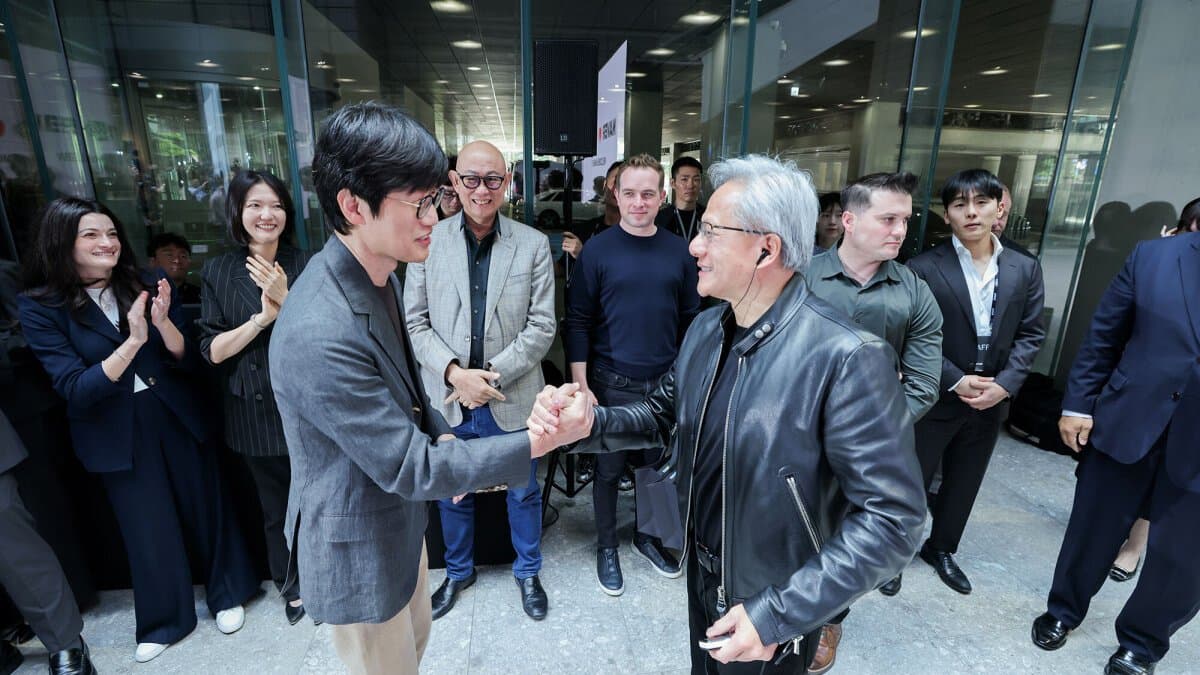
Here's the deal: on the afternoon of June 5, Jensen Huang landed at Gimpo International Airport. This wasn't just some foreign executive on a business trip. This was the man who single-handedly steers the global AI chip market, the guy who built the most valuable company on the planet by market cap, setting foot on Korean soil. And that very evening, he sat down for dinner with four chairmen who collectively represent the spine of Korea's economy: Chey Tae-won, Euisun Chung, Kwang-mo Koo, and Lee Hae-jin. The weight of those names alone tells you something is up.
But here's the genuinely wild part. Korean markets reacted before Huang even stepped off the plane. The mere news that he was coming sent LG Electronics to its daily upper limit — up 29.86 percent — on June 1. The ceiling. Not a single contract had been signed, and the market was already losing its mind. Someone even built a website to track Huang's itinerary around Korea, and tens of thousands of people piled in. "Where is Jensen Huang right now?" became a live obsession for Korean investors.
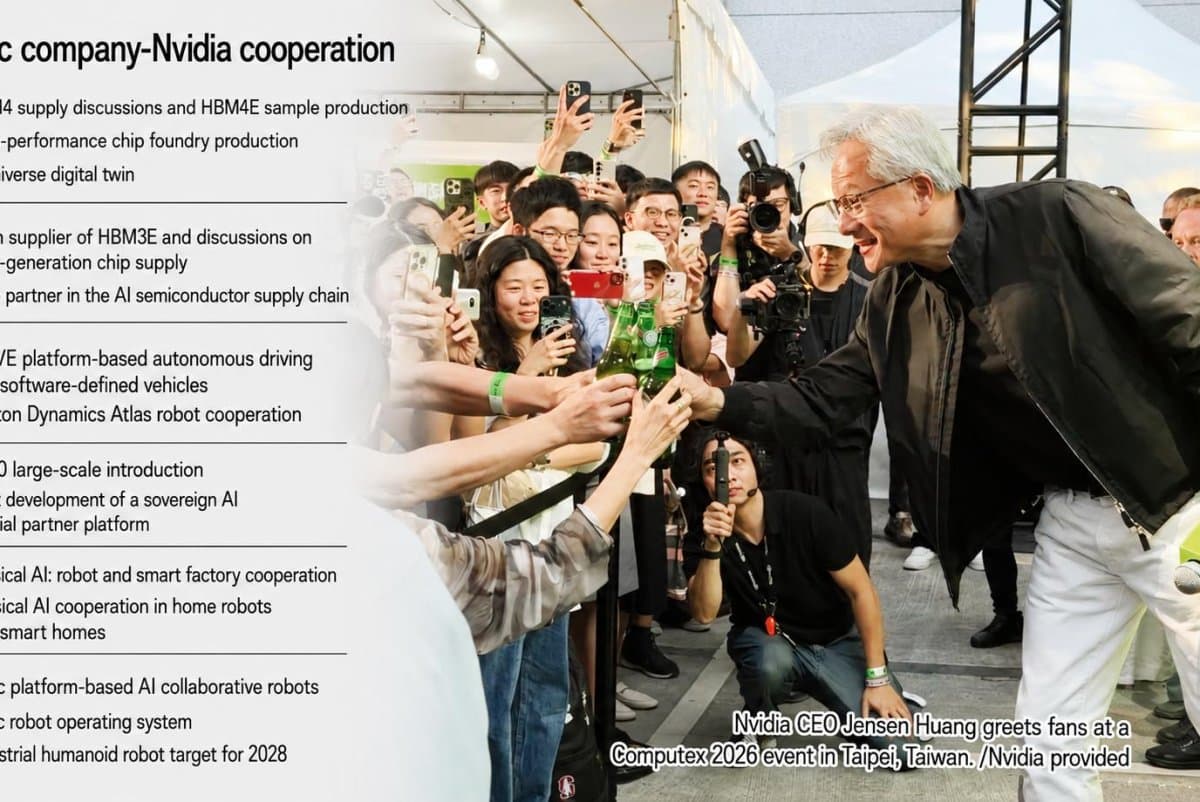
Why does any of this matter? Because the visit isn't a ceremonial handshake. It's the opening move of a "physical AI" alliance that knits together HBM and robotics. Nvidia is trying to break out of the data center — out of AI that lives behind glass — and into AI that moves in the real world: robots, autonomous vehicles, AI baked into telecom networks. And there is almost no partner more essential to building that than Korea. Huang flew over in person to make exactly that point. Which is why one dinner became this big a story.
The Players — Jensen Huang, Four Chairmen, and "Physical AI"
Start with Huang himself. He founded Nvidia back in 1993, and for years it was just a company making graphics cards for gamers. Then it turned out GPUs were absurdly well-suited to training AI, and almost overnight he became the guy selling the picks and shovels of the AI gold rush. Nearly every chip going into the world's AI data centers today is Nvidia silicon. So when he shows up in Korea, it's the core supplier of the entire boom walking into the mine to see it for himself.
Now the four chairmen he met. Chey Tae-won, chairman of SK Group, controls SK hynix — the company people call the king of HBM. Euisun Chung, executive chairman of Hyundai Motor Group, owns robotics (Boston Dynamics), autonomous driving, and the future of mobility. Kwang-mo Koo, chairman of LG Group, sits on top of home appliances, displays, batteries, and robots — a heavyweight in real-world hardware. And Lee Hae-jin, chairman of Naver, runs Korea's largest AI, cloud, and search platform. Is this lineup a coincidence? Not a chance. These are precisely the puzzle pieces Huang's picture needs.
So what exactly is "physical AI"? Until now, AI mostly lived on a screen. You ask a chatbot a question, have it draw a picture, get it to write some code. Physical AI is when that intelligence gets a body. Robots working a factory floor, autonomous cars on the road, humanoids helping people — that's physical AI. And to build it you need three things: memory fast enough to run the AI (HBM), hardware that can move in the real world (robotics), and a network to tie it together (telecom). Guess which country has all three? Right. Korea.
That's why Korea isn't just a "customer" to Nvidia — it's a partner Nvidia can't do without. SK hynix and Samsung essentially split the global HBM market between them. Hyundai is world-class in robotics and mobility. Korea's telecom infrastructure is among the best on the planet. From Huang's chair, how many countries on Earth let you hit all three notes in a single visit? That's why he flew straight here the moment his Taiwan schedule wrapped.
Here's a telling detail: these four chairmen don't usually share a table. Some of them compete, some have overlapping turf. Yet one foreign CEO managed to gather all of them in one room. That alone tells you what kind of gravity Nvidia exerts on Korean industry right now.
The Core — Itinerary, the Dinner, What Got Discussed, and the Market Frenzy
Let's walk it in order. From June 1 to 5, Huang was in Taiwan, working through GTC Taipei and Computex. Computex is Asia's biggest IT trade show, basically a home game for a company like Nvidia. He laid out new products and roadmaps there, and on the final day, June 5, hopped straight over to Korea in the afternoon. That route — Taiwan, then immediately Korea — is itself a message. "Korea is next."
That first evening in Seoul, the dinner happened. SK's Chey Tae-won, Hyundai's Euisun Chung, LG's Kwang-mo Koo, and Naver's Lee Hae-jin sat down with Huang. The disclosed agenda had two parts: expanding HBM supply, and collaborating on physical AI spanning robotics and telecom. In plain terms, "let's move more memory between us, and let's build real-world AI together."
Now the important caveat. Exactly what contracts were discussed, what dollar figures came up, who promised what — none of that was disclosed. All we got was "they met to discuss these topics." So nobody should be running around claiming "SK hynix landed a multi-trillion-won HBM deal." No such announcement exists. The dinner was about aligning direction, not inking a contract.
And yet the market went absolutely nuts. As mentioned, LG Electronics hit its daily ceiling — up 29.86 percent — on June 1, purely on anticipation that Huang might meet LG-related figures. A website tracking his Korea itinerary in real time pulled in tens of thousands of visitors. This wasn't celebrity airport-fashion paparazzi stuff; these were tens of thousands of investors following a semiconductor CEO's movements by the minute. It was a vivid demonstration of just how twitchy the Korean market is to a single word from Nvidia.
Here's a table to capture the visit at a glance.
| Item | Details |
|---|---|
| Arrival | Afternoon of June 5, 2026 (Gimpo International Airport) |
| Prior schedule | Taiwan: GTC Taipei and Computex (June 1–5) |
| First-evening event | Dinner with four conglomerate chairs |
| Attendees | Chey Tae-won (SK), Euisun Chung (Hyundai), Kwang-mo Koo (LG), Lee Hae-jin (Naver) |
| Disclosed agenda | Expanded HBM supply + physical-AI collaboration across robotics and telecom |
| Market reaction | LG Electronics hit upper limit (+29.86%) on June 1; tracking site drew tens of thousands |
| Not disclosed | Specific contracts, figures, commitments |
See the shape of it? The big picture is clear, but the details are still in the fog. Which is exactly what makes it interesting.
What Each Side Gains — Nvidia, the Korean Conglomerates, Korea Inc.
Start with Nvidia. Know what its biggest headache is? You can make the best GPU in the world, but if you can't get the HBM to pair with it, you can't ship. An AI accelerator isn't just a GPU die — it only shines when stacked high-bandwidth memory sits right beside it. And only a handful of companies on Earth make HBM properly: two in Korea, plus Micron. So for Huang, staying on excellent terms with Korea's memory makers is a matter of corporate survival. That's why he flies over and shakes the chairmen's hands himself.
Nvidia is also pushing into physical AI to reach markets beyond the data center. Robots and autonomous vehicles are a fresh frontier where it can sell GPUs by the truckload all over again. But Nvidia only makes chips — it doesn't build the actual robots or cars. So teaming with a hardware powerhouse like Hyundai secures the "bodies" its chips go into. Same logic for LG's appliances and robots, and for Naver's cloud and AI platform. Korea offers Nvidia a whole set of channels to plug its silicon into more places.
So what do the Korean conglomerates get? For one, SK hynix can lock in its HBM demand even more firmly. When Nvidia says "we'll buy more of yours," that's years of revenue getting penciled in. Hyundai, by tying into Nvidia's robotics and autonomous-driving platforms, can get a step ahead in mobility AI. LG can put Nvidia brains into its appliances and robots and push "AI home appliances" faster. Naver carves out a seat for itself right in the middle of the global AI ecosystem.
Zoom out and there's something in it for "Korea Inc." — Korean industry as a whole. The country has long been pegged as "great at memory, but behind the US on actual AI." But on the new board called physical AI, Korea's manufacturing and hardware muscle becomes a weapon again. The moment AI steps off the screen and into the real world, somebody has to actually build the robots, the chips, the networks. The big idea this visit floats is that Korea could sit at the center of that manufacturing.
Of course it's not all roses. If the structure ends up with Nvidia as the powerful buyer and Korean firms as the suppliers, Korea risks becoming a glorified parts depot. The deeper the collaboration, the greater the chance of getting locked into Nvidia's ecosystem. So this dinner also marks the start of a delicate balancing act: is Korea Nvidia's partner, or its subcontractor? Which way it tips depends entirely on the specific deal terms still to come.
Past Parallels — Some Wins, Some Flops
This "CEO visits Korea, stocks pop" pattern is hardly new. The Korean market has a long history of reacting unusually hard to visits from global heavyweights. A foreign Big Tech CEO showing up and saying "we'll cooperate" has been enough to send related stocks swinging more than once. The catch is that some of those pops turned into real earnings, and some fizzled into nothing but froth.
On the win side, the relationship between Nvidia and Korea's memory makers is itself a proven model. Since the AI boom kicked off, SK hynix's earnings have exploded on the back of HBM shipments to Nvidia. "Nvidia will buy it" wasn't empty talk — it turned into actual money. Viewed in that light, this visit isn't a photo-op stunt but a chance to take an already-running collaboration up another notch.
But there are clear counterexamples too. Over the years, plenty of global CEOs have flown into Korea, announced "massive investment" or "we'll build a plant," and then watched it quietly evaporate. Grand announcements, followed by capital and jobs that fell far short of the hype. So a market hitting its ceiling on visit news alone is, frankly, a risky bet. When a stock climbs on anticipation before any contract exists, it can fall just as hard if the details disappoint.
The key difference this time is that Nvidia needs Korea. Where some past cases were a foreign firm graciously dropping by to crack the Korean market, here Nvidia genuinely requires Korean HBM and hardware to run its own business. That structural necessity makes it relatively less likely this collaboration ends as pure froth. Still — until concrete numbers land, nobody should be calling it a done deal.
The Competitive Map — Taiwan, Japan and China Want Physical AI Too
Don't forget where Huang was right before Korea: Taiwan. Taiwan has TSMC, the world's strongest foundry — the factory that actually fabricates Nvidia's chips sits there. That makes Taiwan an absolutely essential partner on "chip manufacturing." Just look at how long Huang stretched his Taiwan schedule and how he staged everything at Computex, and you can see Taiwan's standing. Korea and Taiwan play different roles inside Nvidia's ecosystem while quietly competing — Taiwan does the "baking," Korea does the "memory and the bodies."
Japan can't be dismissed either. Japan is a traditional powerhouse in robotics, holding a staggering share of the industrial-robot market. On top of that, players like SoftBank are betting aggressively on AI and semiconductors. In the physical-AI era, who builds the best robots is the whole game, and Japan has decades of accumulated know-how there. Even as Korea charges ahead with Hyundai and LG robots, Japan stands as a formidable wall.
China is yet another variable. It's pouring government-scale money into humanoid robots and autonomous driving, brute-forcing it with volume and speed. The handicap: US chip export controls mean China can't freely buy Nvidia's latest silicon, so it has to develop its own physical-AI brains. That pushes China toward a go-it-alone path outside Nvidia's ecosystem — which, ironically, tightens the bonds among Nvidia's allies like Korea, Taiwan and Japan.
Here's where Korea sits in that map. Taiwan leads on chip fabrication, Japan goes deep on robotics know-how, China pushes on sheer volume. But the ability to deliver "HBM + robots + telecom + appliances" inside a single country is almost uniquely Korean. That Huang singled out Korea right after Taiwan means he recognized the value of that combined package. If Korea plays its all-rounder strengths well, it can claim a distinctive seat in the physical-AI era.
Holding that seat is another story, though. If Taiwan eyes memory, if Japan forges a deeper robotics alliance with Nvidia, or if China's go-it-alone ecosystem pulls off a surprise, Korea's position could wobble. So this dinner reads as more than a single meal — it's a positioning move to lock in an early edge in the regional race. Whoever grabs Huang first takes the high ground.
So What Actually Changes — Depending on Who You Are
If you invest in the Korean market, first take a breath. Hitting the ceiling on visit news alone is real short-term momentum, but turning that into earnings takes time. What actually matters is the concrete announcements still to come. How much did HBM supply volume grow? Did any real joint robotics or autonomous-driving projects launch? Those are the numbers that make it real. The stock pops right now are the sum of expectations, not a confirmed future. Jumping on the last train purely on anticipation can burn you.
If you watch robotics, this visit is genuinely exciting. Nvidia teaming with Korea's robot and mobility leaders signals that the physical-AI market is opening for real. The thing to watch is what products emerge once Nvidia brains sit inside Hyundai's robots and LG's appliances and robots. Within a few years you might actually see "Korean robots running Nvidia chips" rolling around. For people in this field, this is the decisive moment when the board gets set.
If you're a general AI watcher, the big current to read here is "AI is stepping off the screen." Everything we've used so far — chatbots, image generators — has lived behind glass. But Nvidia allying with Korea's manufacturing leaders shows the next stage for AI is the physical world: robots, cars, factories, homes. As that shift accelerates, the very way AI enters our daily lives is going to change.
And if you live in Korea, there's meaning here too. Whether Korea stands as a "player" rather than a "spectator" in the AI era hinges on exactly this. It's a chance to graduate from "the country that's good at memory" into a core manufacturing hub for physical AI. Botch it, and the risk is sliding into Nvidia subcontractor status. So how this alliance plays out is tied to the next decade of the Korean economy.
Bottom line: wherever you stand, this visit isn't news to wave off. It hands investors a reason for caution, tech watchers a reason for excitement, and Korean industry as a whole an important fork in the road. But, to say it again — no concrete deal has surfaced yet, so let's not get ahead of ourselves.
🥄 Three Things You're Probably Wondering
— When and where exactly did Jensen Huang arrive in Korea? He landed at Gimpo International Airport on the afternoon of June 5, 2026. Right before that he was in Taiwan working through GTC Taipei and Computex (June 1–5), then flew straight over.
— Who attended the dinner, and what was discussed? SK's Chey Tae-won, Hyundai's Euisun Chung, LG's Kwang-mo Koo, and Naver's Lee Hae-jin. The disclosed agenda had two parts: expanding HBM supply, and physical-AI collaboration spanning robotics and telecom. Specific contract terms or figures were not disclosed.
— So what deal got signed? None, yet. The dinner was about aligning on direction. Specific deal terms, figures, and commitments were not disclosed, so claims like "they landed a multi-trillion-won contract" can't be made.
— Why did stocks jump so hard? The visit news itself was a powerful jolt of anticipation. LG Electronics hit its upper limit (+29.86%) on June 1, and a site tracking Huang's itinerary drew tens of thousands of visitors. But this is anticipation-driven, so whether it converts into actual earnings remains to be seen.
References
- Nvidia CEO's Korea trip spotlights AI alliances — UPI
- Nvidia CEO Jensen Huang's Korea visit spotlights AI alliances — The Korea Herald
- Jensen Huang Arrives in Korea for Meetings With SK, LG and Naver Executives — The Elec
- Breaking: Nvidia's Jensen Huang to Arrive in Korea via Gimpo Airport — Seoul Economic Daily
- NVIDIA Official Newsroom
This article is based on public reporting. The specific contract terms, figures, and agreements discussed at the June 5 dinner were not disclosed, so don't take it as confirmation that any specific deal was signed — treat it as reference only. Investment decisions are your own responsibility.