May 11 — the single session where the memory cycle separated into "the AI memory cycle"
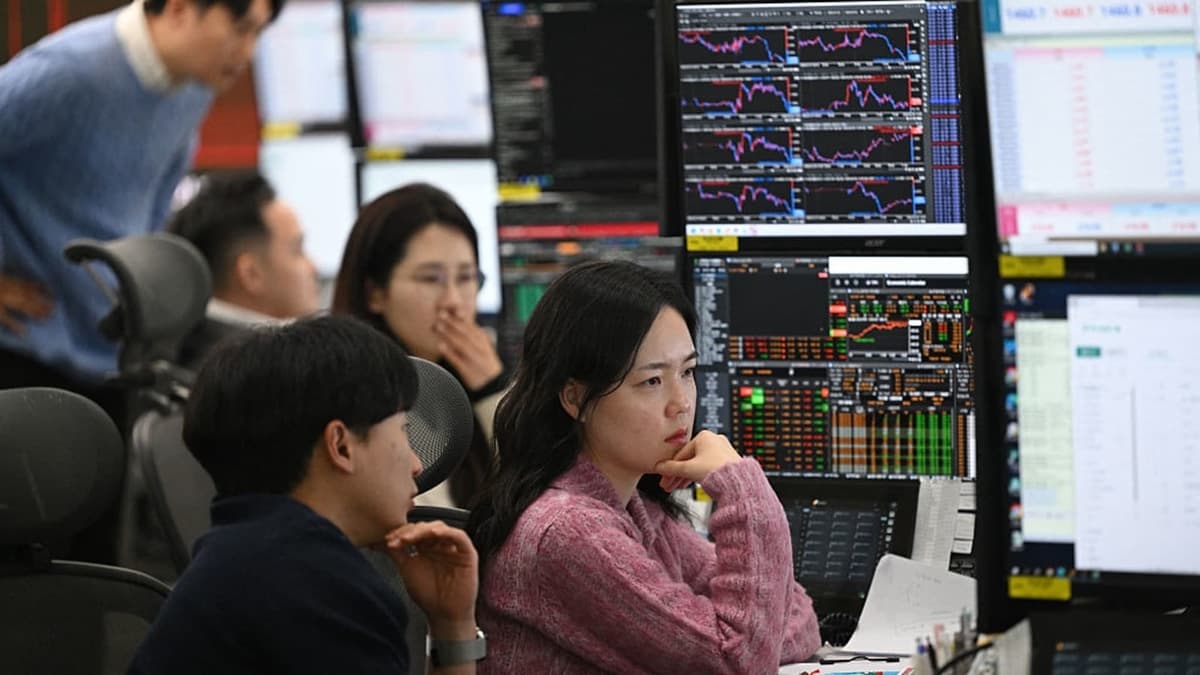
Here's the deal. SK Hynix touched 1,900,000 KRW intraday on May 11 — the first time ever. Close: 1,912,000 KRW, up 13.4% on the day. A near-14% single-session move briefly pushed market cap into the $900B range, putting a global semis top-5 spot in sight. The same day KOSPI broke 7,400 for the first time (after passing 7,000 last week), with foreign single-session net buying near a record.
The real signal isn't the price — it's the simultaneous analyst target raises. Kiwoom Securities lifted its SK Hynix target price from 1,300,000 to 1,900,000 KRW that morning, a 46% jump in one move. At the same time, Kiwoom cut its rating from Buy to Outperform. That combination is unusual. EPS upgrades and rating upgrades normally travel together; Kiwoom raised the model materially while flagging valuation discomfort. LS Securities went bolder — target 2,100,000 KRW. If LS is right, there's still ~+10% upside left from the May 11 close.
On the same day Fortune ran the opposite headline. The Philadelphia Stock Exchange Semiconductor Index has jumped 60% in six weeks; Micron surged 38% last week alone — its best weekly performance since 2008. Fortune cited a Harvard Business School economist who has tracked semiconductor cycles since the 1980s: "Anytime people show me these curves that just go to the sky with no end, that never continues forever." Both signals — Kiwoom and LS upgrading models, Fortune flagging the cycle — landed inside the same 24 hours. That's what makes May 11 distinctive.
Each player — SK Hynix, Samsung, Kiwoom and LS, Nvidia
SK Hynix. Since 2025, the entrenched "HBM king." Roughly 50% global HBM share and the first to ship HBM3E to Nvidia at scale. Q1 2026: ~28T KRW revenue, ~14T KRW operating profit — operating margin above 50%, a record band. The first cleanroom at the new M15X fab (Cheongju) finishes in May, then immediately enters HBM4 mass-production pilot. CEO Kwak Noh-Jung's GTC 2026 line — wafer shortages may last until 2030 — is the basis for the supplier-side pricing power.
Samsung Electronics. Up the same day. Samsung's absolute KOSPI weight is bigger, but in HBM it has temporarily ceded the momentum to SK Hynix following May 6's $1T market cap milestone. Differences: (1) Samsung was late to NVIDIA HBM3E 12-Hi qualification, (2) it trails SK Hynix by roughly a quarter in HBM4. But Samsung played a "next-next gen" card by unveiling HBM4E core die at GTC 2026.
Kiwoom Securities. One of Korea's top sell-side covers on SK Hynix. Park Yu-ak's note led the target raise. Kiwoom's revised model puts SK Hynix Q2 2026 OP at 70T KRW (~$50B) — about +80% YoY and well above the 55–60T consensus.
LS Securities. Same day, more aggressive 2,100,000 KRW target. Reasoning: (1) HBM3E pricing closed +20% in 2026 contracts, (2) HBM4 starts contributing revenue Q4 2026, (3) SOCAMM2 mass production for the Nvidia Rubin platform is ramping. The most bullish print on the Street.
Nvidia. All paths in memory pricing eventually point back at Nvidia. 2026 Nvidia data-center revenue is ~$250B; about $0.12–$0.15 per revenue dollar is HBM cost. So Nvidia spends roughly $35–40B on HBM annually — over half of which goes to SK Hynix. The next trigger for HBM4 demand is the Nvidia Rubin launch (expected H2 2026).
Substance — pricing, margins, market size
Pricing. Samsung and SK Hynix reportedly closed 2026 HBM3E contracts with NVIDIA and others at +20% blended ASP increases — high-bin SKUs went +30%+. Standard server DDR5 is up +35–40% over six months. Trendforce sees another +40–50% through H1 2026. The implication: only part of the price rise is in Q1 numbers. The bulk lands in Q2 and Q3.
Margins. SK Hynix Q1 2026 operating margin around 50% is the headline. Two years ago the same business was running single-digit margins. The 50% is built on (1) HBM ASPs 5–7x ordinary DRAM, (2) 12-Hi HBM3E yield stabilizing faster than internal forecasts, (3) pricing power fully on the supplier side.
| Item | 2026 Q1 actual / 2026 estimate |
|---|---|
| Revenue | ~28T KRW |
| Operating profit | ~14T KRW |
| Operating margin | ~50% |
| Kiwoom Q2 OP forecast | 70T KRW |
| Global memory market 2026 | $633B (vs. $216B prior, ~2.9x) |
| HBM share, SK + Samsung | 79% |
Memory market expansion. Trendforce and SemiAnalysis converge on a 2026 global memory market of ~$216B → $633B (~3x). HBM alone is over $250B of that. With SK Hynix and Samsung at 79% share, the two companies combined have a ~$200B HBM revenue opportunity. That's roughly the size of the entire memory market five years ago — out of one product category.
SOCAMM2 and HBM4 — the next two triggers. SK Hynix entered SOCAMM2 (Server Optimized CAMM 2nd gen) mass production right after GTC 2026. It's a Nvidia Rubin-specific module — overshadowed by HBM, but a separate revenue line that ramps with Rubin shipments. HBM4 (12-Hi 48GB at 11.7Gbps) was unveiled at CES 2026, with M15X fab mass production targeted for Q3 2026. Both are ASP-premium categories.
Who gets what
SK Hynix. Clear win. May 11 alone added ~$100B in market cap. More importantly, Kiwoom's downgrade (Buy → Outperform) came with a higher target — meaning "don't add aggressively" but not "sell." H2 2026 contract pricing has a clear path for another +10–15% increase, and IR is guiding accordingly.
Samsung. Co-beneficiary. Foreign buyers tend to pair the two. But after May 6's $1T market cap, Samsung is exposed to more short-term profit-taking than SK Hynix. Catching up by one HBM4 quarter is the H2 decision point.
Nvidia — both gain and pain. Gain: GPU demand is re-validated by data (combined Alphabet/Microsoft/Meta/Amazon AI capex outlook of $700B). Pain: HBM cost grows. HBM is currently 18–22% of GPU BOM and could push past 25%. Nvidia either passes the increase to customers (push-back risk) or absorbs (gross margin pressure on GPU growth).
Retail investor — gain and risk. Per Kiwoom data, Korean retail was in the top-5 buyers of SK Hynix on May 11. Six-month-old positions are sitting on +80–100% gains. New entrants face an awkward window — Kiwoom downgrade and Fortune's cycle warning land on the same day. Expect higher near-term volatility.
Korean government / KOSPI itself. KOSPI 7,400 increases Korea's global equity weight. MSCI Developed Markets re-classification pressure rises. On the political side, on May 11 the deputy PM held a panel emphasizing "no industries or workers left behind by AX (AI Transformation)" — explicit recognition that the memory boom is widening industrial inequality.
Past parallels — wins and losses
Win: 1995 DRAM supercycle. The year Samsung first took global DRAM #1. Single-quarter operating margin hit 50%, industry ASP rose +120% over two years. Difference: the trigger then was the PC cycle (Windows 95 + Pentium); this is the AI cycle. Common: a single application redefined the memory demand baseline.
Win: 2017–2018 memory cycle. Both Samsung and SK Hynix posted record operating profits — and then 2019 saw -50% price collapse and ~70% profit evaporation. What's different now: (1) demand concentrates on a single buyer (Nvidia accounts for 50%+ of HBM demand), (2) supply-side capex can't keep up with demand, creating structural shortage.
Loss: 2008 memory price collapse. Samsung's memory OP fell -90% in one move. Causes: (1) global financial crisis + (2) PC demand softness. Today's risk equivalent: an "AI capex freeze" — if hyperscalers paused spending, prices could fall -30% within 6–9 months.
Loss: H2 2022 supercycle end. Right before ChatGPT launched, memory ASPs declined for six straight quarters. SK Hynix posted loss quarters. The risk this cycle: "AI model efficiency" — if smaller models hit the same performance, the HBM demand curve bends. As of May, no such signal yet.
Competitor counter-plays
Samsung Electronics. Catching up by one HBM4 quarter is the priority. Goal is NVIDIA qualification on HBM4E core die in H1 2026. Texas Taylor fab HBM mass production may be pulled into H2 2027.
Micron. US-side alternative, ~15% HBM3E share. Less pricing power than SK Hynix and Samsung but locks in some hyperscaler demand on the back of CHIPS Act incentives + US-fab geopolitical premium. Last week's +38% one-week move is the signal.
China memory (CXMT, YMTC). US sanctions block direct HBM scale-up, but China is gaining share fast in standard LPDDR5X and DDR5. As SK Hynix and Samsung shift capex to HBM, China could grab +5–10pp on standard DRAM.
Nvidia. Trying to insource memory IP. Reports of memory design hires in 2025 suggest Nvidia could bring some packaging and HBM design in-house over the next 3–5 years. Manufacturing remains dependent on SK Hynix and Samsung.
Apple / Google / Microsoft. Custom AI silicon (M-series, TPU, Maia) R&D is shifting toward lower-HBM designs. But there's no real alternative within a 3-year horizon.
So what changes — by persona
Korean retail investor. Six-month-old positions are at +80–100%. New entrants need to reconcile (1) Kiwoom's downgrade and (2) Fortune's cycle warning at the same time. Volatility is up; staggered buys plus hedges beat full-size new entries.
Global fund manager. A moment to lift Korea EM exposure. But SK Hynix and Samsung together are ~40% of KOSPI, so passive index exposure is already a memory bet. Active diversification into Korean non-memory (batteries, shipbuilding, AI software) is the smarter move.
Tech BizDev / procurement. Plan for +30–40% server memory cost increases in H2 2026. Cloud instance pricing follows. Re-baseline AI workload ROI for the new memory cost share.
AI startup founder. Memory becomes a bigger share of infra cost. The build-vs-rent decision (own infra vs hyperscaler) is increasingly memory-cost driven. Hyperscalers are still cheaper near-term but lock-in cost rises.
Office worker. Real-life impact: PC, laptop, and smartphone storage prices up. Upgrading a 16GB laptop to 32GB now costs ~50% more than it did a year ago. Cloud storage pricing also faces H2 increases.
Korean job seeker. Hiring at SK Hynix and Samsung memory divisions is at record levels — both new graduate and experienced. Real-estate around Hwaseong, Pyeongtaek, and Cheongju is heating up alongside.
References
- Invezz: SK Hynix stock at record high — how much further can the AI darling run?
- Seoul Daily: LS Securities Raises SK hynix Target Price to 2.1 Million Won on HBM Strength
- Seoul Daily: Top Retail Traders Scoop Up Samsung Electronics, SK hynix Amid Rally
- Fortune: Chip stocks are soaring as AI investors rush in, but Harvard expert warns 'This too will pass'
- Nikkei Asia: Hynix shares jump 15%, driving KOSPI to record intraday high
- SK Hynix Newsroom: 2026 Market Outlook — HBM-Led Memory Supercycle