Two of the world's most-used AI models have been switched off for 10 days
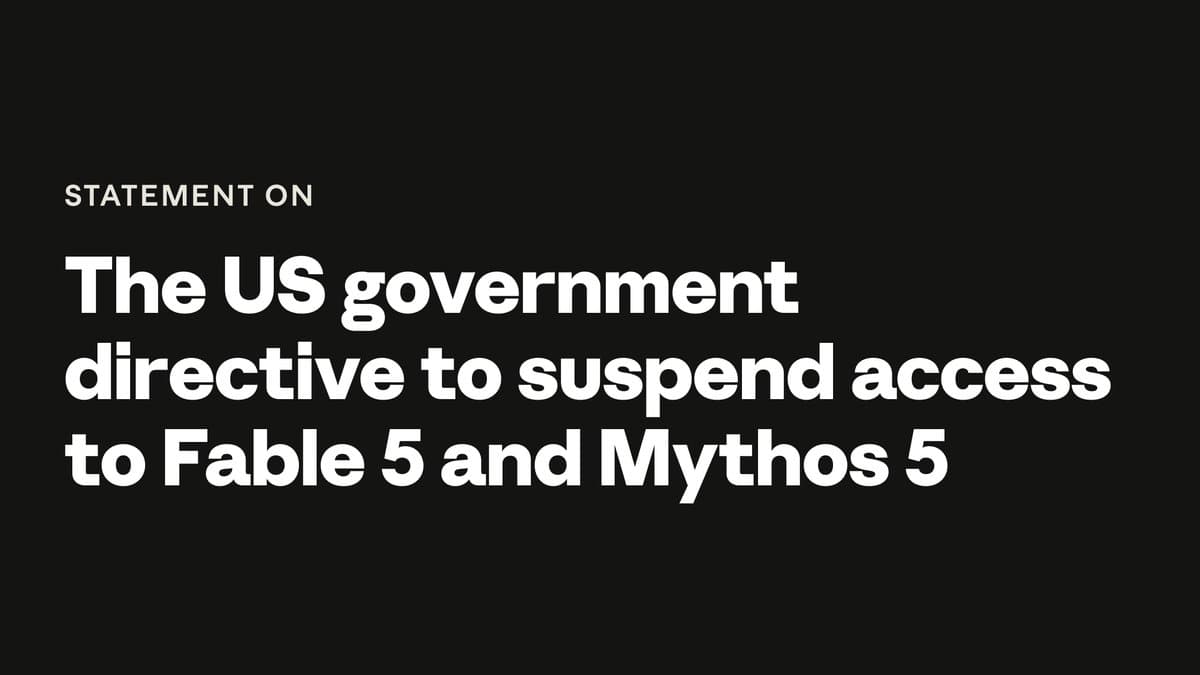
Right now, as you read this, Fable 5 and Mythos 5 are unreachable everywhere. Anthropic's two newest flagship models went dark the afternoon of June 12 on the strength of a single U.S. Commerce Department directive, and today marks exactly day 10. A commercial service used daily by hundreds of millions getting pulled globally overnight by a government order is something the AI industry has never seen before.
What makes it stranger: today is the second "deadline." Refund requests already closed on June 20, and the free-trial (make-good) window for Pro, Max, Team, and Enterprise subscribers shuts today, June 22. Nobody knows when the models come back — but the compensation clock keeps ticking down right on schedule. Here's the deal: what happened, why, and what it actually means for you.
Who's tangled up in this — the government, the company, and hundreds of millions of users
Start with the U.S. Department of Commerce. It holds the authority to control the export of advanced technology — chip-making equipment, supercomputers, and increasingly "AI models" themselves. This time, Commerce cited a "narrow potential jailbreak path" in Fable 5 and Mythos 5 as a national-security risk. In plain terms: a gap where someone could route around the model's safety guardrails and use it for dangerous purposes.
Next, Anthropic — yes, the Claude company. Fable 5 and Mythos 5 are its latest-generation models, with an enormous global user base. The moment the order landed, Anthropic complied immediately, cutting off all foreign-national access (even its own non-U.S. employees). At the same time, it publicly argued that a wholesale recall of commercial models used by hundreds of millions is excessive. Complying and pushing back at once — a tough tightrope.
Finally, the users. From individual subscribers to enterprises that wired Fable 5 and Mythos 5 deep into their pipelines. Startups shipping products on the API, teams that ran internal workflows on these models, individuals who just wrote and coded with them every day — all stuck for 10 days. Anthropic's international MD, Chris Ciauri, said at the June 17–18 Seoul office opening that he's "very confident that in the coming days, the models will become available again." But that "coming days" is now pushing a week.
What's happened so far — a 10-day timeline
This started by the minute. Commerce delivered the directive at 5:21 p.m. ET on June 12, and Anthropic cut global access almost immediately. Here's how it unfolded.
| Date | What happened |
|---|---|
| June 12 | Commerce export-control directive issued; global Fable 5 / Mythos 5 access suspended instantly |
| June 13 | Fortune and other major outlets report; "national-security threat" rationale made public |
| June 16 | Anthropic senior engineers begin in-person talks with Commerce officials |
| June 17–18 | Seoul office opening; Chris Ciauri's "within days" remark |
| June 20 | Refund-request window closes |
| June 22 | Free-trial (make-good) window ends ← today |
One thing jumps out of this table: the restoration date is blank, but the compensation and settlement dates are filled in neatly. For the company, that's a deliberate choice. When the models return depends on government talks Anthropic can't promise — but customer make-goods like refunds and trials are within its control, so it closes those first. Defer the uncertain, settle the certain. Textbook crisis sequencing.
It's also telling that the channel is "engineers vs. Commerce." These regulatory fights are usually led by legal and policy teams; senior engineers walking in suggests the dispute has narrowed from an abstract policy argument to a concrete engineering problem — how do you technically close that jailbreak path? If so, it likely resolves on a patch → verify → re-approve track.
Who gains and who loses
The government has firmly set a precedent: advanced AI models are fair game for export controls. It extended the control logic it applied to chips onto software — AI weights and access rights. On security, that's a powerful card. But it also shoulders the cost of potentially blunting its own AI champions' global competitiveness. While it ties down a home-grown leader, it has to wonder who fills the gap.
Anthropic is clearly losing in the short term — global revenue, enterprise trust, and brand momentum all take a hit. But there's an upside in being seen as "the responsible AI company that complies with government orders instantly." For a firm whose core identity is safety and alignment, not digging in against regulators can actually reassure enterprise and government buyers over the long run. The question is whether that reputation can cover the revenue and the churning customers it's losing right now.
Competitors reap a windfall just by standing still. As teams on Fable 5 and Mythos 5 scramble for alternatives, traffic flows to OpenAI and Google. But it's a double-edged sword. Anthropic took the hit today, but once "AI model export controls" are out of the holster, anyone could be next. The rivals can't laugh too hard.
Past parallels — successes and failures
We've seen versions of this before. The closest is semiconductor export controls. When the U.S. blocked advanced GPU and equipment exports to China, the controls worked short-term but, longer-term, pushed the targeted side to build its own supply chain. "Block it and someone fills the gap" is a lesson that could apply directly to AI. The longer Fable 5 stays dark, the more a migration to alternatives risks becoming permanent.
On the failure side are platforms that went down suddenly and were slow to restore. Users tolerate a multi-day outage, but once an opaque timeline drags past a week, the hunt for alternatives begins — and users who adapt to an alternative rarely come all the way back. What Anthropic should fear most isn't the government talks; it's this migration of habit.
There are success stories too. Companies that cleared a regulatory clash with a fast technical fix plus transparent communication often grew trust instead of losing it. Two things mattered: honestly owning the root cause and fixing it, and updating users frequently on exactly when and how service returns. Anthropic's refund and make-good handling shows some of the latter — but the missing "when" is the decisive weakness.
The competitor counter-play — this is the window
For OpenAI and Google, this is plainly a moment to win migrations. The most effective counter-play isn't loud marketing — it's driving the switching cost toward zero. Hand teams on the Anthropic API a compatibility layer, a migration guide, and free credits so they can move with a few lines of code. In situations like this, the contest isn't decided by "whose model is better" but by "whose model is easier to switch to."
A smart rival also won't gloat. "AI model export controls" hang over the whole industry, and openly mocking a competitor's misfortune today becomes a boomerang when it's your turn tomorrow. The rational move is a dual track: quiet on the surface, aggressive in practice, absorbing migrating customers.
If you're targeting enterprises, the message should be "multi-model strategy." Everyone just watched what happens when you bet everything on one company's model — the whole thing stops. Not "use only our model," but "don't put it all in one place; keep us as your backup." That's the pitch that lands right now.
So what changes
If you used Fable 5 or Mythos 5 daily, know that the free-trial and make-good windows close today — if you had something to claim, you needed to check before the cutoff. Restoration is only a "within days" promise, so short-term it's realistic to lean on older models or other services. If important work is blocked, set up a backup path now.
If you built a product on these models, this stings as a lesson: single-model dependence is a single point of failure, and that's now proven. Bolt on a fallback model immediately, and seriously consider redesigning toward an abstraction layer that lets you swap models in and out over the medium term.
If you're an enterprise adopter or policymaker, accept that regulatory risk is no longer abstract. Contract structures that pin core work to one specific model are dangerous, and vendor evaluations now need "regulatory and geopolitical risk" and "alternative on outage" as line items. This episode just handed you a free reason to update that checklist.
🥄 Three Things You're Probably Wondering
— So what does this mean for me? If you don't use Fable 5 or Mythos 5, there's no direct impact. But this episode shows an AI model can go dark globally on a single government order — so whatever AI service you use, keeping one backup around is the sensible takeaway.
— When do the models actually come back? Too early to call. The talks narrowing to "engineers vs. Commerce" is a positive sign that a technical patch could resolve it, but there's still no official restoration date. Anthropic's "within days" is closer to an expectation than a promise.
— Do competitors really benefit? Short-term, almost certainly — blocked users go find alternatives. But once "AI export controls" exist as a weapon, no one is safe, so the rivals aren't exactly celebrating either.
Sources
- Anthropic — Fable & Mythos access update
- Fortune — Anthropic disables Fable and Mythos AI models following U.S. government export ban
- explainx.ai — Is Fable 5 Back? Status & Alternatives (June 21, 2026)
- Anthropic on X (@AnthropicAI)
- U.S. Bureau of Industry and Security (BIS) — Export controls overview
Numbers and timing are as of announcement and may change. This one is moving fast!